- 408 pages
- English
- ePUB (mobile friendly)
- Available on iOS & Android
eBook - ePub
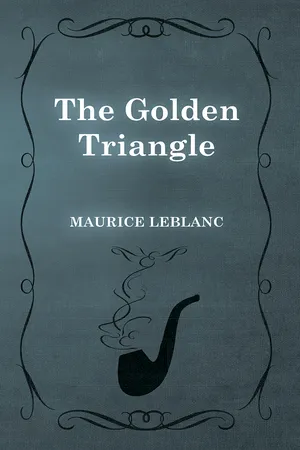
The Golden Triangle
About this book
"The Golden Triangle" as another fantastic mystery by Leblanc featuring gentleman thief arsène Lupin. It takes place during World War I and wounded warrior Patrice Belval is in love with his nurse. This early work by Maurice Leblanc was originally published in 1918 and we are now republishing it with a brand new introductory biography. Maurice Marie Émile Leblanc was born on 11th November 1864 in Rouen, Normandy, France. He was a novelist and writer of short stories, known primarily as the creator of the fictional gentleman thief and detective, Arsène Lupin. From the start, Leblanc wrote both short crime stories and longer novels - and his lengthier tomes, heavily influenced by writers such as Flaubert and Maupassant, were critically admired, but met with little commercial success. Leblanc was largely considered little more than a writer of short stories for various French periodicals when the first Arsène Lupin story appeared. It was published as a series of stories in the magazine 'Je Sais Trout', starting on 15th July, 1905. Clearly created at editorial request under the influence of, and in reaction to, the wildly successful Sherlock Holmes stories, the roguish and glamorous Lupin was a surprise success and Leblanc's fame and fortune beckoned. In total, Leblanc went on to write twenty-one Lupin novels or collections of short stories. On this success, he later moved to a beautiful country-side retreat in Étreat (in the Haute-Normandie region in north-western France), which today is a museum dedicated to the Arsène Lupin books. He died in Perpignan (the capital of the Pyrénées-Orientales department in southern France) on 6th November 1941, at the age of seventy-six.
Information
CHAPTER I.
CORALIE
CORALIE
It was close upon half-past six and the evening shadows were growing denser when two soldiers reached the little space, planted with trees, opposite the Musée Galliéra, where the Rue de Chaillot and the Rue Pierre-Charron meet. One wore an infantryman’s sky-blue great-coat; the other, a Senegalese, those clothes of undyed wool, with baggy breeches and a belted jacket, in which the Zouaves and the native African troops have been dressed since the war. One of them had lost his right leg, the other his left arm.
They walked round the open space, in the center of which stands a fine group of Silenus figures, and stopped. The infantryman threw away his cigarette. The Senegalese picked it up, took a few quick puffs at it, put it out by squeezing it between his fore-finger and thumb and stuffed it into his pocket. All this without a word.
Almost at the same time two more soldiers came out of the Rue Galliéra. It would have been impossible to say to what branch they belonged, for their military attire was composed of the most incongruous civilian garments. However, one of them sported a Zouave’s chechia, the other an artilleryman’s képi. The first walked on crutches, the other on two sticks. These two kept near the newspaper-kiosk which stands at the edge of the pavement.
Three others came singly by the Rue Pierre-Charron, the Rue Brignoles and the Rue de Chaillot: a one-armed rifleman, a limping sapper and a marine with a hip that looked as if it was twisted. Each of them made straight for a tree and leant against it.
Not a word was uttered among them. None of the seven crippled soldiers seemed to know his companions or to trouble about or even perceive their presence. They stood behind their trees or behind the kiosk or behind the group of Silenus figures without stirring. And the few wayfarers who, on that evening of the 3rd of April, 1915, crossed this unfrequented square, which received hardly any light from the shrouded street-lamps, did not slacken pace to observe the men’s motionless outlines.
A clock struck half-past six. At that moment the door of one of the houses overlooking the square opened. A man came out, closed the door behind him, crossed the Rue de Chaillot and walked round the open space in front of the museum. It was an officer in khaki. Under his red forage-cap, with its three lines of gold braid, his head was wrapped in a wide linen bandage, which hid his forehead and neck. He was tall and very slenderly built. His right leg ended in a wooden stump with a rubber foot to it. He leant on a stick.
Leaving the square, he stepped into the roadway of the Rue Pierre-Charron. Here he turned and gave a leisurely look to his surroundings on every side. This minute inspection brought him to one of the trees facing the museum. With the tip of his cane he gently tapped a protruding stomach. The stomach pulled itself in.
The officer moved off again. This time he went definitely down the Rue Pierre-Charron towards the center of Paris. He thus came to the Avenue des Champs-Élysées, which he went up, taking the left pavement.
Two hundred yards further on was a large house, which had been transformed, as a flag proclaimed, into a hospital. The officer took up his position at some distance, so as not to be seen by those leaving, and waited.
It struck a quarter to seven and seven o’clock. A few more minutes passed. Five persons came out of the house, followed by two more. At last a lady appeared in the hall, a nurse wearing a wide blue cloak marked with the Red Cross.
“Here she comes,” said the officer.
She took the road by which he had arrived and turned down the Rue Pierre-Charron, keeping to the right-hand pavement and thus making for the space where the street meets the Rue de Chaillot. Her walk was light, her step easy and well-balanced. The wind, buffeting against her as she moved quickly on her way, swelled out the long blue veil floating around her shoulders. Notwithstanding the width of the cloak, the rhythmical swing of her body and the youthfulness of her figure were revealed. The officer kept behind her and walked along with an absent-minded air, twirling his stick, like a man taking an aimless stroll.
At this moment there was nobody in sight, in that part of the street, except him and her. But, just after she had crossed the Avenue Marceau and some time before he reached it, a motor standing in the avenue started driving in the same direction as the nurse, at a fixed distance from her.
It was a taxi-cab. And the officer noticed two things: first, that there were two men inside it and, next, that one of them leant out of the window almost the whole time, talking to the driver. He was able to catch a momentary glimpse of this man’s face, cut in half by a heavy mustache and surmounted by a gray felt hat.
Meanwhile, the nurse walked on without turning round. The officer had crossed the street and now hurried his pace, the more so as it struck him that the cab was also increasing its speed as the girl drew near the space in front of the museum.
From where he was the officer could take in almost the whole of the little square at a glance; and, however sharply he looked, he discerned nothing in the darkness that revealed the presence of the seven crippled men. No one, moreover, was passing on foot or driving. In the distance only, in the dusk of the wide crossing avenues, two tram-cars, with lowered blinds, disturbed the silence.
Nor did the girl, presuming that she was paying attention to the sights of the street, appear to see anything to alarm her. She gave not the least sign of hesitation. And the behavior of the motor-cab following her did not seem to strike her either, for she did not look round once.
The cab, however, was gaining ground. When it neared the square, it was ten or fifteen yards, at most, from the nurse; and, by the time that she, still noticing nothing, had reached the first trees, it came closer yet and, leaving the middle of the road, began to hug the pavement, while, on the side opposite the pavement, the left-hand side, the man who kept leaning out had opened the door and was now standing on the step.
The officer crossed the street once more, briskly, without fear of being seen, so heedless did the two men now appear of anything but their immediate business. He raised a whistle to his lips. There was no doubt that the expected event was about to take place.
The cab, in fact, pulled up suddenly. The two men leapt from the doors on either side and rushed to the paveme...
Table of contents
- THE GOLDEN TRIANGLE
- Maurice Leblanc
- CHAPTER I. CORALIE
- CHAPTER II. RIGHT HAND AND LEFT LEG
- CHAPTER III. THE RUSTY KEY
- CHAPTER IV. BEFORE THE FLAMES
- CHAPTER V. HUSBAND AND WIFE
- CHAPTER VI. NINETEEN MINUTES PAST SEVEN
- CHAPTER VII. TWENTY-THREE MINUTES PAST TWELVE
- CHAPTER VIII. ESSARÈS BEY’S WORK
- CHAPTER IX. PATRICE AND CORALIE
- CHAPTER X. THE RED CORD
- CHAPTER XI. ON THE BRINK
- CHAPTER XII. IN THE ABYSS
- CHAPTER XIII. THE NAILS IN THE COFFIN
- CHAPTER XIV. A STRANGE CHARACTER
- CHAPTER XV. THE BELLE HÉLÈNE
- CHAPTER XVI. THE FOURTH ACT
- CHAPTER XVII. SIMÉON GIVES BATTLE
- CHAPTER XVIII. SIMEON’S LAST VICTIM
- CHAPTER XIX. FIAT LUX!
Trusted by 375,005 students
Access to over 1.5 million titles for a fair monthly price.
Study more efficiently using our study tools.
Frequently asked questions
Yes, you can cancel anytime from the Subscription tab in your account settings on the Perlego website. Your subscription will stay active until the end of your current billing period. Learn how to cancel your subscription
No, books cannot be downloaded as external files, such as PDFs, for use outside of Perlego. However, you can download books within the Perlego app for offline reading on mobile or tablet. Learn how to download books offline
Perlego offers two plans: Essential and Complete
- Essential is ideal for learners and professionals who enjoy exploring a wide range of subjects. Access the Essential Library with 800,000+ trusted titles and best-sellers across business, personal growth, and the humanities. Includes unlimited reading time and Standard Read Aloud voice.
- Complete: Perfect for advanced learners and researchers needing full, unrestricted access. Unlock 1.5M+ books across hundreds of subjects, including academic and specialized titles. The Complete Plan also includes advanced features like Premium Read Aloud and Research Assistant.
We are an online textbook subscription service, where you can get access to an entire online library for less than the price of a single book per month. With over 1.5 million books across 990+ topics, we’ve got you covered! Learn about our mission
Look out for the read-aloud symbol on your next book to see if you can listen to it. The read-aloud tool reads text aloud for you, highlighting the text as it is being read. You can pause it, speed it up and slow it down. Learn more about Read Aloud
Yes! You can use the Perlego app on both iOS and Android devices to read anytime, anywhere — even offline. Perfect for commutes or when you’re on the go.
Please note we cannot support devices running on iOS 13 and Android 7 or earlier. Learn more about using the app
Please note we cannot support devices running on iOS 13 and Android 7 or earlier. Learn more about using the app
Yes, you can access The Golden Triangle by Maurice Leblanc in PDF and/or ePUB format, as well as other popular books in Literature & Crime & Mystery Literature. We have over 1.5 million books available in our catalogue for you to explore.