eBook - ePub
Little Wars
About this book
This delightfully unusual book by H. G. Wells is a comprehensive guide to Little War, a game invented by Wells for "boys from twelve to one hundred and fifty years old and for that more intelligent sort of girls who like boys' games and books". A fascinating look at a bygone era, when boys were boys, and most girls (except the more intelligent ones) were girls. With a history of Little War, detailed instructions to playing it, a description of an exemplary game, extensions and amplifications to the game, and a final challenge by the author to his young readers. Many of the earliest books, particularly those dating back to the 1900s and before, are now extremely scarce and increasingly expensive. We are republishing these classic works in affordable, high quality, modern editions, using the original text and artwork.
Information
Print ISBN
9781445507743
SECTION II
THE BEGINNINGS OF
MODERN LITTLE WARFARE
THE BEGINNINGS OF
MODERN LITTLE WARFARE
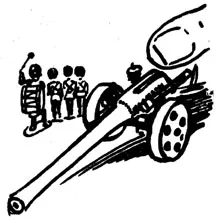
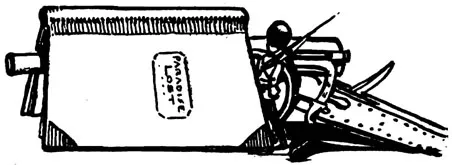
THE beginning of the game of Little War, as we know it, became possible with the invention of the spring breechloader gun. This priceless gift to boyhood appeared somewhen towards the end of the last century, a gun capable of hitting a toy soldier nine times out of ten at a distance of nine yards. It has completely superseded all the spiral-spring and other makes of gun hitherto used in playroom warfare. These spring breechloaders are made in various sizes and patterns, but the one used in our game is that known in England as the four-point-seven gun. It fires a wooden cylinder about an inch long, and has a screw adjustment for elevation and depression. It is an altogether elegant weapon.
It was with one of these guns that the beginning of our war game was made. It was at Sandgate—in England.
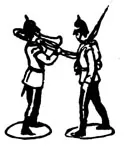
The present writer had been lunching with a friend—let me veil his identity under the initials J. K. J.—in a room littered with the irrepressible debris of a small boy’s pleasures. On a table near our own stood four or five soldiers and one of these guns. Mr J. K. J., his more urgent needs satisfied and the coffee imminent, drew a chair to this little table, sat down, examined the gun discreetly, loaded it warily, aimed, and hit his man. Thereupon he boasted of the deed, and issued challenges that were accepted with avidity. . . .
He fired that day a shot that still echoes round the world. An affair—let us parallel the Cannonade of Valmy and call it the Cannonade of Sandgate—occurred, a shooting between opposed ranks of soldiers, a shooting not very different in spirit—but how different in results!—from the prehistoric warfare of catapult and garter. “But suppose,” said his antagonists; “suppose somehow one could move the men!” and therewith opened a new world of belligerence.
The matter went no further with Mr J. K. J. The seed lay for a time gathering strength, and then began to germinate with another friend, Mr W. To Mr W. was broached the idea: “I believe that if one set up a few obstacles on the floor, volumes of the British Encyclopœdia and so forth, to make a Country, and moved these soldiers and guns about, one could have rather a good game, a kind of kriegspiel.” . . .
Primitive attempts to realise the dream were interrupted by a great rustle and chattering of lady visitors. They regarded the objects upon the floor with the empty disdain of their sex for all imaginative things.
But the writer had in those days a very dear friend, a man too ill for long excursions or vigorous sports he has been dead now these six years], of a very sweet companionable disposition, a hearty jester and full of the spirit of play. To him the idea was broached more fruitfully. We got two forces of toy soldiers, set out a lumpish Encyclopædic land upon the carpet, and began to play. We arranged to move in alternate moves: first one moved all his force and then the other; an infantry-man could move one foot at each move, a cavalryman two, a gun two, and it might fire six shots; and if a man was moved up to touch another man, then we tossed up and decided which man was dead. So we made a game, which was not a good game, but which was very amusing once or twice. The men were packed under the lee of fat volumes, while the guns, animated by a spirit of their own, banged away at any exposed head, or prowled about in search of a shot. Occasionally men came into contact, with remarkable results. Rash is the man who trusts his life to the spin of a coin. One impossible paladin slew in succession nine men and turned defeat to victory, to the extreme exasperation of the strategist who had led those victims to their doom. This inordinate factor of chance eliminated play; the individual freedom of guns turned battles into scandals of crouching concealment; there was too much cover afforded by the books and vast intervals of waiting while the players took aim. And yet there was something about it. . . . It was a game crying aloud for improvement.
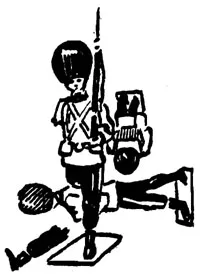
Improvement came almost simultaneously in several directions. First there was the development of the Country. The soldiers did not stand well on an ordinary carpet, the Encyclopaedia made clumsy cliff-like “cover,” and more particularly the room in which the game had its beginnings was subject to the invasion of callers, alien souls, trampling skirt-swishers, chatterers, creatures unfavourably impressed by the spectacle of two middle-aged men playing with “toy soldiers” on the floor, and very heated and excited about it. Overhead was the day nursery, with a wide extent of smooth cork carpet (the natural terrain of toy soldiers), a large box of bricks—such as I have described in Floor Games—and certain large inch-thick boards.
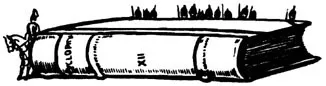
It was an easy task for the head of the household to evict his offspring, annex these advantages, and set about planning a more realistic country. (I forget what became of the children.) The thick boards were piled up one upon another to form hills; holes were bored in them, into which twigs of various shrubs were stuck to represent trees; houses and sheds (solid and compact piles of from three to six or seven inches high, and broad in proportion) and walls were made with the bricks; ponds and swamps and rivers, with fords and so forth indicated, were chalked out on the floor, garden stones were brought in to represent great rocks, and the “Country” at least of our perfected war game was in existence. We discovered it was easy to cut out and bend and gum together paper and cardboard walls, into which our toy bricks could be packed, and on which we could paint doors and windows, creepers and rainwater pipes, and so forth, to represent houses, castles, and churches in a more realistic manner, and, growing skilful, we made various bridges and so forth of card. Every boy who has ever put together model villages knows how to do these things, and the attentive reader will find them edifyingly represented in our photographic illustrations.
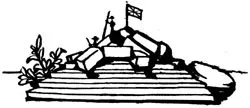
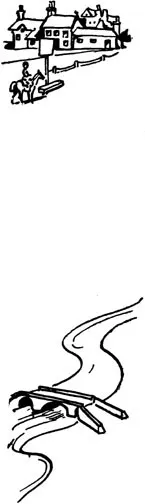
There has been little development since that time in the Country. Our illustrations show the methods of arrangement, and the reader will see how easily and readily the utmost variety of battlefields can be made. (It is merely to be remarked that a too crowded Country makes the guns ineffective and leads to a mere tree to tree and house to house scramble, and that large open spaces along the middle, or rivers without frequent fords and bridges, lead to ineffective cannonades, because of the danger of any advance. On the whole, too much cover is better than too little.) We decided that one player should plan and lay out the Country, and the other player choose from which side he would come. And to-day we play over such landscapes in a cork-carpeted schoolroom, from which the proper occupants are no longer evicted but remain to take an increasingly responsible and less and less audible and distressing share in the operations.

We found it necessary to make certain general rules. Houses and sheds must be made of solid lumps of bricks, and not hollow so that soldiers can be put inside them, because otherwise muddled situations arise. And it was clearly necessary to provide for the replacement of disturbed objects by chalking out the outlines of boards and houses upon the floor or boards upon which they stood.
And while we thus perfected the Country, we were also eliminating all sorts of tediums, disputable possibilities, and deadlocks from the game. We decided that every man should be as brave and skilful as every other man, and that when two men of opposite sides came into contact they would inevitably kill each other. This restored strategy to its predominance over chance.
We then began to humanise that wild and fearful fowl, the gun. We decided that a gun could not be fired if there were not six—afterwards we reduced the number to four—men within six inches of it. And we ruled that a gun could not both fire and move in the same general move: it could either be fired or moved (or left alone). If there were less than six men within six inches of a gun, then we tried letting it fire as many shots as there were men, and we permitted a single man to move a gun, and move with it as far as he could go by the rules—a foot, that is, if he was an infantry-man, and two feet if he was a cavalryman. We abolished altogether that magical freedom of an unassisted gun to move two feet. And on such rules as these we fought a number of battles. They were interesting, but not entirely satisfactory. We took no prisoners—a feature at once barbaric and unconvincing. The battles lingered on a long time, because we shot...
Table of contents
- Cover
- Title
- Contents
- Illustrations
- I Of the Legendary Past
- II The Beginnings of Modern Little Warfare
- III The Rules
- IV The Battle of Hook’s Farm
- V Extensions and Amplifications OF Little War
- VI Ending with a Sort of Challenge
Trusted by 375,005 students
Access to over 1.5 million titles for a fair monthly price.
Study more efficiently using our study tools.