- 200 pages
- English
- ePUB (mobile friendly)
- Available on iOS & Android
eBook - ePub
(Re)reading Ruth
About this book
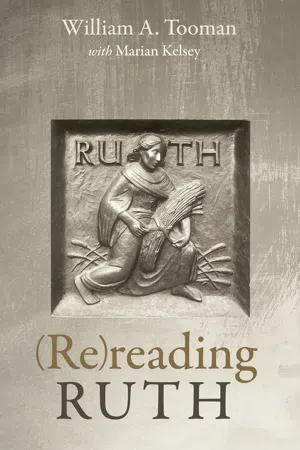
The book of Ruth seems simple. It is the tale of a poor Moabite widow who relocates to Bethlehem and finds security there when she marries Boaz, a wealthy Israelite man. Although the plot is simple, the book's message is elusive. Re(reading Ruth) demonstrates how careful attention to the book's structure, allusions, wordplay, and location in the canon can reveal the dynamic ways that it engages with other biblical stories and how that engagement shapes its message.
Information
Topic
Theology & ReligionSubtopic
Biblical Commentarychapter 1
Reading Ruth
Why would anyone need help reading Ruth? Compared with long, intricate narratives like Paradise Lost, War and Peace, or Ulysses, Ruth is very short and very easy to read. In fact, Ruth is sometimes characterized as the simplest of biblical stories. Armstrong Black thought it “unadorned and homely.”1 Ronald Hals found it difficult to praise Ruth’s “simple style” and settled on indistinct adjectives like “warm” and “straightforward.”2 Thomas Paine believed it to be so artless as to be stupid. Ruth is “an idle, bungling story, foolishly told, nobody knows by whom, about a strolling country-girl, creeping slyly to bed with her cousin Boaz.”3 But, is Paine’s caricature accurate? Is Black’s or Hals’?
What I will attempt to show in this chapter is that Ruth is quite simple in some ways and highly complex in others. It is simple enough that any reader can understand the basic contours of the story: the characters’ personalities, the problems they must overcome, and many of the twists and turns along the road from crisis to resolution. But this, I will argue, is a flat representation of the story, a mere sketch, reflecting only a rudimentary understanding of the story’s intricacies. Ruth, like all biblical narratives, operates by a different set of conventions (“rules” if you like) from modern narratives. If we want to arrive at a better understanding of its ideas and artistry, we will need to learn to appreciate these rules. Our first step, then, is to recognize how biblical storytelling differs from modern storytelling and to become aware of the ways that those conventions can extend and develop our comprehension and our pleasure.
Three Distinctives of Biblical Hebrew Narrative
Terseness & Density
One of the most obvious features of biblical narrative, when compared with modern literature, is its terseness. All the little details that give authenticity to a novel—descriptions of settings, weather, clothing, colors, meals, facial expressions—are rarely mentioned in the Bible. At best, we might be told that an encounter happed on a street or in the country, or we might be given a character’s name. Physical features of characters are almost never described. Whether indoors or outdoors, settings are seldom described. Bare events and one-to-one dialogue are the stuff of biblical storytelling. The biblical writers do not attempt to make their stories seem more realistic by filling them up with detail.4 There are small exceptions to this rule, to be sure. We know that Ehud was left-handed, that Abraham fed roast goat to three angels, and that Joseph was a beautiful man. In all these cases, though, no further details are offered that would add realism and authenticity to the story world. Even these sparse details are only provided because they introduce or reveal something essential about the characters and events in the story. This, in a nutshell, is what accounts for biblical terseness. Biblical writers only provide readers with essentials.5
This is also what makes biblical literature difficult to read and assimilate. It is dense. Events occur quickly, one after another in staccato. Dialogue is bereft of all the conversational cul-de-sacs and start-and-stop elements that we experience every day in nearly every conversation. In the Bible, almost every sentence is a topic-sentence. But biblical stories are not just dense in their contents and quick in their pacing. Poetic elements also occur more densely in biblical literature than in modern prose. “Poetics” is the literary term for the forms, conventions, and aesthetics of literature. It refers to features like cadence, figures of speech, imagery, characterization, repetition, plot structure, and wordplay. In short, it refers to all the thi...
Table of contents
- Title Page
- Acknowledgements
- Abbreviations and Symbols
- Introduction
- Chapter 1: Reading Ruth
- Chapter 2: Act 1 ~ Ruth 1:1–22
- Chapter 3: Act 2 ~ Ruth 2:1–23
- Chapter 4: Act 3 ~ Ruth 3:1–18
- Chapter 5: Act 4 ~ Ruth 4:1–22
- Concluding Postscript
- Appendix: Ruth in the Jewish and Christian Bibles
- Bibliography
Trusted by 375,005 students
Access to over 1.5 million titles for a fair monthly price.
Study more efficiently using our study tools.
Frequently asked questions
Yes, you can cancel anytime from the Subscription tab in your account settings on the Perlego website. Your subscription will stay active until the end of your current billing period. Learn how to cancel your subscription
No, books cannot be downloaded as external files, such as PDFs, for use outside of Perlego. However, you can download books within the Perlego app for offline reading on mobile or tablet. Learn how to download books offline
We are an online textbook subscription service, where you can get access to an entire online library for less than the price of a single book per month. With over 1.5 million books across 990+ topics, we’ve got you covered! Learn about our mission
Look out for the read-aloud symbol on your next book to see if you can listen to it. The read-aloud tool reads text aloud for you, highlighting the text as it is being read. You can pause it, speed it up and slow it down. Learn more about Read Aloud
Yes! You can use the Perlego app on both iOS and Android devices to read anytime, anywhere — even offline. Perfect for commutes or when you’re on the go.
Please note we cannot support devices running on iOS 13 and Android 7 or earlier. Learn more about using the app
Please note we cannot support devices running on iOS 13 and Android 7 or earlier. Learn more about using the app
Yes, you can access (Re)reading Ruth by William A. Tooman in PDF and/or ePUB format, as well as other popular books in Theology & Religion & Biblical Commentary. We have over 1.5 million books available in our catalogue for you to explore.