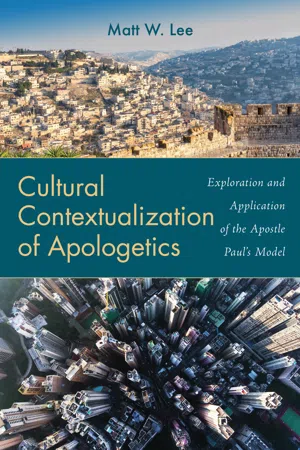
eBook - ePub
Cultural Contextualization of Apologetics
Exploration and Application of the Apostle Paul’s Model
- 202 pages
- English
- ePUB (mobile friendly)
- Available on iOS & Android
eBook - ePub
Cultural Contextualization of Apologetics
Exploration and Application of the Apostle Paul’s Model
About this book
In the post-Christian world, we find sincere efforts in traditional Christian apologetics repeatedly running into invisible walls. These blocks happen when cultural issues are neglected. With mere rational arguments presented as a defense of Christianity, logical answers alone are not attracting the nonbelievers nor resolving their skepticism. People today have different obstacles in coming to the Christian faith, particularly their own cultural presuppositions.
How do we present, defend, and commend Christianity to people whose culture gives them a frame of mind--the one that cares very little about how rational the arguments are? Cultural Contextualization of Apologetics explores the world of the New Testament and the ministry of the apostle Paul to excavate a fresh model for apologetics with cultural engagement to present an answer. Matt W. Lee analyzes the dynamics involved in Paul's cultural connection with his audience and how it relates to their receptivity, uncovering a scheme of apologetics engagement patterned in his apologetics speeches. From the background of Paul's world to the forefront of contemporary apologetics preaching, Cultural Contextualization of Apologetics offers a vision of apologetics communication that is both biblical and practical.
Information
Topic
Theologie & ReligionSubtopic
Biblische StudienChapter 1
Introduction
In 2016, the Oxford English Dictionary selected “post-truth” as its word of the year. The dictionary defines post-truth as “relating to or denoting circumstances in which objective facts are less influential in shaping public opinion than appeals to emotion and personal belief.”1 The selection of the word suggests how the shaping of public opinion now takes place less with facts and more with an emotional appeal or personal belief.2
Numbers of scholars articulate such a trend. In Moral, Believing Animals, Christian Smith argues that rational choice theory that sees human beings as actively using rational information to arrive at both personal and social formation does not adequately account for human culture and practices. Smith contends that human beings “build up their lives from pre-suppositional starting points in which place our trust and that are not derived from other (rational) justifying grounds.”3 This assessment explains why “a convincing narrative appealing to a pre-possessed set of beliefs and emotions holds more sway than any fact-laden argument that poses a threat to those sincerely held beliefs.”4
James K. A. Smith equally recognizes a need to re-assess the traditional understanding of the role rational justification plays in a belief formation. For this reason, he disputes the idea that education and worldview formation mainly involves ideas and information—a form of rationality.5 Instead, Smith contends that the ultimate factor critical to one’s beliefs and worldview formation is one’s desires.6 He further argues that human desires are shaped by “cultural practices as secular liturgies” along with habits of the physical body instead of mere rationality.7
If cultural practices function as liturgies that shape one’s desire and worldview, unprecedented cultural practices stemming from an “image-based digital world” reduces not only an appeal for rational justification but also an ability to process it.8 Andrew Root, leaning into Jean Baudrillard’s insights, warns that an image-saturated world “liquefy and thin out the ability to construct meaning that connects to experiences and relationships outside the image-based mediated machines themselves.”9 Root takes notice of the cultural change that disables one from making meaningful connections between language and symbols to reality, advocating that now this post-secular society requires a new perspective on faith formation.10
One must not overlook the implications of these cultural changes and renewed theoretical assessments of belief formation have on apologetics. Challenges arising from different cultures have generated a variety of apologetic responses throughout history; therefore, changes are needed in the way apologetics engages the audiences of today’s world.11 The world now requires a renewed approach that supplements apologetics that heavily depends on rational appeal.
Many voice the same need. James Sire, in Apologetics Beyond Reason: Why Seeing is Really Believing, argues that while apologetics that appeals to reason has been effective to the general audience in the past, “others in our postmodern world have come to distrust reason, and the arguments of the modern Christian rationalists now seem irrelevant, doubtful, and lifeless.”12 Furthermore, Sire detects a “growing failure of arguments to move students and others toward Christian faith and the rising possibility of doing apologetics with attention to why people today actually do become Christians.”13 In the book The End of Apologetics: Christian Witness in a Postmodern Context, Myron Bradley Penner stresses the need for “a shift from an epistemological focus on the rational justification of Christian beliefs to a hermeneutics concerned with explicating and understanding the life of faith.”14
In an apt summary, Alister McGrath too offers a critical assessment of the current state of apologetic communication while echoing the opinion of other apologists. He writes,
We must realize we are free to develop apologetic approaches that are faithful to the Christian gospel on the one hand and are adapted to our own cultural situation on the other. By doing this, we are repeating the method of “traditional apologetics” while responding to the changes in the cultural context toward which it is directed. We simply cannot use an apologetic approach developed to engage eighteenth-century rationalism to defend the faith to twenty-first-century people who regard rationalism as outdated and constricting! For example, postmodernity finds appeals to rational argument problematic. But it is deeply attracted to stories and images. Furthermore, postmodernity is more interested in a truth that proves itself capable of being lived out than being demonstrated by rational argument. This helps us understand why “incarnational apologetics,” which emphasizes the apologetic importance of faithful living, has become so influential in recent years . . . we can easily rise to this new challenge, usually not by inventing new approaches to apologetics, but by recovering older approaches that the rise of rationalism seemed to make obsolete.15
Bernand Van Den Toren in Christian Apologetics as Cross-Cultural Dialogue reaffirms the common sentiment amongst these apologists:
Apologists have, at the same time, become aware that they need to address a multiplicity of audiences. In our ‘global village,’ modernism and postmodernism are just two cultural options among many—often vibrant—alternatives such as Islam and Buddhism. In this...
Table of contents
- Title Page
- Preface
- List of Abbreviations
- Chapter 1: Introduction
- Chapter 2: Paul’s Cultural Connection
- Chapter 3: Paul’s Cultural Connection through Cultural Solidarity as the Wisdom Figure
- Chapter 4: Cultural Contextualization of Paul’s Apologetics Speeches
- Chapter 5: Cultural Contextualization of Second-Century Apologists
- Chapter 6: Cultural Contextualization of Apologetics Preaching
- Bibliography
Trusted by 375,005 students
Access to over 1.5 million titles for a fair monthly price.
Study more efficiently using our study tools.
Frequently asked questions
Yes, you can cancel anytime from the Subscription tab in your account settings on the Perlego website. Your subscription will stay active until the end of your current billing period. Learn how to cancel your subscription
No, books cannot be downloaded as external files, such as PDFs, for use outside of Perlego. However, you can download books within the Perlego app for offline reading on mobile or tablet. Learn how to download books offline
Perlego offers two plans: Essential and Complete
- Essential is ideal for learners and professionals who enjoy exploring a wide range of subjects. Access the Essential Library with 800,000+ trusted titles and best-sellers across business, personal growth, and the humanities. Includes unlimited reading time and Standard Read Aloud voice.
- Complete: Perfect for advanced learners and researchers needing full, unrestricted access. Unlock 1.5M+ books across hundreds of subjects, including academic and specialized titles. The Complete Plan also includes advanced features like Premium Read Aloud and Research Assistant.
We are an online textbook subscription service, where you can get access to an entire online library for less than the price of a single book per month. With over 1.5 million books across 990+ topics, we’ve got you covered! Learn about our mission
Look out for the read-aloud symbol on your next book to see if you can listen to it. The read-aloud tool reads text aloud for you, highlighting the text as it is being read. You can pause it, speed it up and slow it down. Learn more about Read Aloud
Yes! You can use the Perlego app on both iOS and Android devices to read anytime, anywhere — even offline. Perfect for commutes or when you’re on the go.
Please note we cannot support devices running on iOS 13 and Android 7 or earlier. Learn more about using the app
Please note we cannot support devices running on iOS 13 and Android 7 or earlier. Learn more about using the app
Yes, you can access Cultural Contextualization of Apologetics by Matt W. Lee in PDF and/or ePUB format, as well as other popular books in Theologie & Religion & Biblische Studien. We have over 1.5 million books available in our catalogue for you to explore.