eBook - ePub
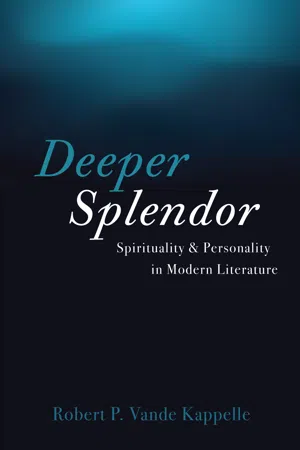
Deeper Splendor
Spirituality and Personality in Modern Literature
- 204 pages
- English
- ePUB (mobile friendly)
- Available on iOS & Android
eBook - ePub
About this book
Life's ultimate adventure--its grandest game and greatest challenge--is the spiritual transformation of the self. According to Swiss psychiatrist Carl Jung, personality and spirituality are interrelated, spirituality flowing out of individuality. Noting that people differ in fundamental ways, even though they possess the same instincts to drive them from within, Jung discovered that preference, rather than instinct, upbringing, environment, or genetic conditioning, is central to personality. The task of spirituality, then, is not to help us achieve correct doctrine or attain saintly status, but rather to help us best understand our humanity. This endeavor drives Deeper Splendor, a study of spirituality and personality in modern literature. We focus on modern literature, rather than on theology, philosophy, psychology, or sociology, because, as this volume makes clear, one of the best resources for studying transformative spirituality is great literature.
The great power of literature is that it speaks of human action and thought, not in the dry, matter-of-fact terms of history, ethics, psychology, or some other science, but in ways that are lively, uplifting, and productive. Engaging with great literature is like beginning a love affair. Such encounters may appear daunting at first, but when you fall in love, you want to know everything about the object of your love, and every encounter leaves you wanting more. When literature enhances spirituality--as is true in the dozen or more selections examined in Deeper Splendor--each literary moment renders us more fully alive.
Like its companion texts, Wading in Water and Deep Splendor, this volume is useful for individual or group study. Each chapter concludes with questions suitable for discussion or reflection.
Information
Topic
Theology & ReligionSubtopic
Personality in PsychologyChapter 1
Spirituality and Personality
Spirituality and personality are interrelated, and to examine one without the other is like viewing reality with one eye instead of two, or like hearing with just one ear; the result is partial, incomplete, and distorted. Like cyclists on a tandem, personality and spirituality travel together through the journey of life. Riding in tandem, they are deeply influenced by conditions both internal (goals, moods, desires) and external to the self. When one leans, the other leans; where one starts, the other starts; if one stops, the other stops. Though not identical, they strive to be in sync, balancing one another in profound and intimate ways. Personality takes the lead, and where personality goes, spirituality follows, though not blindly or passively. Spirituality has its own voice, and when its desires are addressed and heeded, personality thrives. When the two disagree, they must communicate, or the consequences can be disastrous. Cooperation always enhances the ride.
Ultimately, spirituality is about one’s relationship with God—not with an idea of God, but actually with God. While such a statement might seem mystical or unrealistic, it is both practical and realistic, if we understand God not as a concept or person, but as a stand-in for everything—Reality, truth, and the essence of our universe. What I have in mind, however, is not pantheism but panentheism, the view that God is in all things yet distinct and not a “thing” at all. What this means is that God is not simply another way of speaking of reality, for God is reality with a face—Reality with Personality—which is the only way most of us relate to others. For relationship to occur, there must be personality.
It is important that we understand God correctly, because our image of God influences, even determines, our self-image. There is an absolute connection between how we see God and how we see ourselves, between how we relate to ourselves, to others, and to the world around us and within us. This is why good theology, healthy psychology, and holistic spirituality can make a major difference in how we live with ourselves and with others.
Therapists, life coaches, and spiritual directors tell a common story, that most people’s operative image of God is initially a subtle combination of their parents and other early authority figures. Without a healthy and mature spiritual journey nurtured by prayer, contemplation, empathy, and a supportive community, much of religion is largely childhood conditioning, vital and valuable in itself but often limited and distorted. Skeptics and atheists rightly react against such religion because it is childish and fear-based, yet they argue against a caricature of faith, deriding views of God and forms of spirituality I too cannot endorse.
As we learn from philosophy and psychology and find illustrated in great literature, whatever we receive is received in the manner of the receiver. What this means theologically is that what we believe about God and how we view reality is greatly dependent upon our parents and other early authority figures. If our father was punitive, our God is usually punitive. If our mother was cold and withdrawn, we assume God is cold and withdrawn. If authority in our lives came primarily through males, we probably assume and even prefer a male image of God, even if our hearts desire otherwise.
In our conception of the nature of God lies the kernel of the spiritual life. Until we discover the God in which we believe, we will never fully accept and understand ourselves. Such lack of acceptance and understanding means that the polarities of our nature will keep us frustrated and fragmented, preventing the wholeness and integration we seek and need for health and happiness. As we develop physically, intellectually, and emotionally, we must also grow toward a mature spirituality that includes reason, faith, and inner experience we can trust. A mature God creates mature people: a big God creates big people; a small God creates small people; a loving God creates loving people; a punitive God creates punitive people. As our theology is mirrored in our spirituality, our self-image is mirrored in our political views as well: good theology makes for good politics and positive social relationships; bad theology makes for stingy politics, a reward/punishment mindset, xenophobia, and highly controlled relationships.
As views of God influence self-image, the reverse is equally true, for self-knowledge is the path to knowledge of God (the ultimate or the divine). While this correlation is affirmed by the world’s major religions, they disagree, however, on the nature of reality and the self, thereby differing on how self-knowledge is acquired. While Western religions assume an evolutionary cosmogony with a beginning and a goal, Eastern religions assume a static, self-contained, eternal cycle of events. Furthermore, the Western mindset finds meaning externally, in a purposeful universe, whereas the Eastern mind finds meaning and fulfillment internally, within the psyche. In his autobiography, Memories, Dreams, Reflections, Carl Jung finds himself agreeing with both perspectives, distinguishing between the Western mindset, which he describes as “predominantly extraverted,” and the Eastern mindset, found to be “predominantly introverted.” Meaning, he concludes,” is both without and within.”1
While Eastern religions attribute divine significance to the human self, this perspective is foundational to Western religions as well. Ancient Christians affirmed it, though mainstream medieval and Reformation Christians suppressed it by emphasizing externalized and objectified truth. Thankfully, this understanding continued in the mystical tradition and is affirmed by those who promote spiritual formation.
While there is plenty of evidence in the world to conclude that there is something fundamentally flawed with humanity, the biblical creation story declares that humans are created in the “image and likeness” of God and out of generative love. If this is true, this means that the human family of origin is divine. That original goodness is the place to which humans always seek to return. There are many detours along the way, and many “devils” planting the same doubt suggested to Jesus at his baptism, questioning his divine descent (see Matt 4:3, “If you are the Son of God” . . . ). Due to a lack of mysticism and a contemplative mind, many Christians still have no knowledge of the soul’s objective union with God (see 2 Pet 1:4). They delight in affirming that all humans are fallen and depraved. Such a negative starting point hardly results in loving, dignified, or responsive people.
The great illusion we must all overcome is not our unworthiness, but rather the illusion of separateness. It is almost the only task of religion—to communicate not worthiness but union, to reconnect people to their original identity “hidden with Christ in God” (Col 3:3). The Bible calls that state of separateness “sin,” and its total undoing is stated frequently as God’s clear job description: “Beloved, we are God’s children now; what we will be has not yet been revealed. What we do know is this: when he is revealed, we will be like him, for we will see him as he is” (1 John 3:2).
The true purpose of religion is to help us recognize and recover the divine image in ourselves and in everyone else. Whatever we call it, this “image of God” is absolute and unchanging. There is nothing we can do to increase or decrease it. It is not ours to decide who has it or does not have it. It is pure and total gift, given equally to all. Once we have this straight, nothing can stop us and no one can take it away from us.
There is a Jewish proverb, “Before every person there marches an angel proclaiming, ‘Behold, the image of God.’” Unselfish, sacrificial living is not about ignoring, denying, or destroying ourselves. It is about discovering our true self—the self that looks like God—and living life from that grounding. Many people are familiar with that part of Jesus’ summary of the law of Moses that tells us to love our neighbor as we love our self. What this means is that loving the self is essential. If we fail in that, we fail our neighbor as well. Proper self-love and proper self-understanding are also essential to spirituality. However, getting that starting point straight is not always easy. As Jung noted, “The most terrifying thing is to accept oneself completely.” Because most of us are unwilling or unable to accept negative aspects of our personality or of our experience, these repressed elements surface in unpredictable and unhealthy ways. As we will discover, this phenomenon is central to much of the literature discussed in this study.
Quick-Change Artistry
One of television’s most popular variety shows is America’s Got Talent, an amateur talent competition featuring acts ranging from singing and dancing to comedy, magic, stunts, and other genres. Each participant attempts to stay in the competition by impressing a panel of judges. The winner receives a large cash prize and a chance to headline a show in Las Vegas. One of the finalists during the 2021 season was a quick-change artist named Léa Kyle, a twenty-five-year-old French magician from Bordeaux. With blinding speed and in near-mystical fashion, Léa was able to swap outfits in a matter of seconds while strutting across the stage displaying handmade costumes.
Americans love costumes, and annually on October 31, the eve of the Christian All Saints’ Day, it is traditional for children to dress in Halloween costumes and go trick-or-treating around their neighborhood. Halloween costumes allow children to role-play by dressing up like a favorite movie or cartoon character. Children have active imaginations, and they love to dress up like scary creatures or exotic characters....
Table of contents
- Title Page
- Preface
- Chapter 1: Spirituality and Personality
- Chapter 2: Jungian Personality and Spirituality Theory
- Chapter 3: Hermann Hesse’s Four Ways of Functioning
- Chapter 4: Fyodor Dostoevsky’s The Brothers Karamazov
- Chapter 5: Jane Austen’s Sense and Sensibility and Charlotte Brontë’s Jane Eyre
- Chapter 6: Nathaniel Hawthorne’s The Scarlet Letter and Thomas Hardy’s Tess of the D’Urbervilles
- Chapter 7: Charles Dickens’s Bleak House and William Thackeray’s Vanity Fair
- Chapter 8: George Eliot’s Middlemarch and Virginia Woolf’s Orlando
- Chapter 9: E. M. Forster’s A Passage to India
- Chapter 10: Ralph Ellison’s Invisible Man and José Vasconcelos’s The Cosmic Race
- Appendix: Franz Kafka’s The Metamorphosis
- Bibliography
Trusted by 375,005 students
Access to over 1.5 million titles for a fair monthly price.
Study more efficiently using our study tools.
Frequently asked questions
Yes, you can cancel anytime from the Subscription tab in your account settings on the Perlego website. Your subscription will stay active until the end of your current billing period. Learn how to cancel your subscription
No, books cannot be downloaded as external files, such as PDFs, for use outside of Perlego. However, you can download books within the Perlego app for offline reading on mobile or tablet. Learn how to download books offline
Perlego offers two plans: Essential and Complete
- Essential is ideal for learners and professionals who enjoy exploring a wide range of subjects. Access the Essential Library with 800,000+ trusted titles and best-sellers across business, personal growth, and the humanities. Includes unlimited reading time and Standard Read Aloud voice.
- Complete: Perfect for advanced learners and researchers needing full, unrestricted access. Unlock 1.5M+ books across hundreds of subjects, including academic and specialized titles. The Complete Plan also includes advanced features like Premium Read Aloud and Research Assistant.
We are an online textbook subscription service, where you can get access to an entire online library for less than the price of a single book per month. With over 1.5 million books across 990+ topics, we’ve got you covered! Learn about our mission
Look out for the read-aloud symbol on your next book to see if you can listen to it. The read-aloud tool reads text aloud for you, highlighting the text as it is being read. You can pause it, speed it up and slow it down. Learn more about Read Aloud
Yes! You can use the Perlego app on both iOS and Android devices to read anytime, anywhere — even offline. Perfect for commutes or when you’re on the go.
Please note we cannot support devices running on iOS 13 and Android 7 or earlier. Learn more about using the app
Please note we cannot support devices running on iOS 13 and Android 7 or earlier. Learn more about using the app
Yes, you can access Deeper Splendor by Robert P. Vande Kappelle in PDF and/or ePUB format, as well as other popular books in Theology & Religion & Personality in Psychology. We have over 1.5 million books available in our catalogue for you to explore.