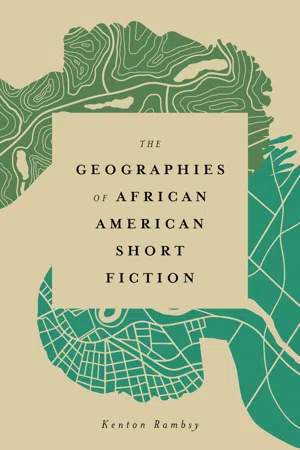
Perhaps the brevity of short fiction accounts for the relatively scant attention devoted to it by scholars, who have historically concentrated on longer prose narratives. The Geographies of African American Short Fiction seeks to fill this gap by analyzing the ways African American short story writers plotted a diverse range of characters across multiple locations—small towns, a famous metropolis, city sidewalks, a rural wooded area, apartment buildings, a pond, a general store, a prison, and more. In the process, these writers highlighted the extents to which places and spaces shaped or situated racial representations. Presenting African American short story writers as cultural cartographers, author Kenton Rambsy documents the variety of geographical references within their short stories to show how these authors make cultural spaces integral to their artwork and inscribe their stories with layered and resonant social histories.
The history of these short stories also documents the circulation of compositions across dozens of literary collections for nearly a century. Anthology editors solidified the significance of a core group of short story authors including James Baldwin, Toni Cade Bambara, Charles Chesnutt, Ralph Ellison, Zora Neale Hurston, and Richard Wright. Using quantitative information and an extensive literary dataset, The Geographies of African American Short Fiction explores how editorial practices shaped the canon of African American short fiction.
- 182 pages
- English
- ePUB (mobile friendly)
- Available on iOS & Android
eBook - ePub
The Geographies of African American Short Fiction
About this book
Information
Chapter 1
LOCATING THE BIG 7
One Hundred Anthologies and the Most Frequently Anthologized Black Short Stories
Anthologies constitute one of the most important ways to examine the histories of Black short fiction. These collections, which contain multiple modes of writing, shape as well as reinforce views of African American and American literature. Literary canons, as well-known anthologist M. H. Abrams describes it, consist of “authors who, by cumulative consensus of critics, scholars, and teachers, have come to be widely recognized as ‘major,’ and to have written works often hailed as literary classics.”1 He continues, “The literary works by canonical authors are the ones which, at a given time, are most kept in print, most frequently and fully discussed by literary critics and historians, and most likely to be included in anthologies and in the syllabi of college courses.” Anthology editors provide a platform for keeping writers and literary works in circulation. At the same time, editors necessarily filter and exclude works.
In the spring 1997 issue of Callaloo, Kenneth Kinnamon’s essay, “Anthologies of African-American Literature from 1845 to 1994,” offers an extensive historical account of the development of African American literature anthologies. Kinnamon examined collections that spanned more than eighty years and included comprehensive to genre-specific anthologies. He explained the structure of the collections in order to analyze the framing techniques of editors and document the multiple contexts through which Black writers circulated over several decades.2
Whereas Kinnamon focused solely on African American literature anthologies, a consideration of a variety of collections, including general primarily white anthologies and specialized books, reveals how stories appear in numerous kinds of collections. Editors of Harlem Renaissance collections highlight prominent and lesser-known works by writers of that particular era. Black women’s collections such as Black-Eyed Susans/Midnight Birds: Stories by and about Black Women (1990) and Revolutionary Tales: African American Women’s Short Stories, from the First Story to the Present (1995) include short story writers Ann Petry, Gayl Jones, Octavia E. Butler, Terry McMillan, and others who do not regularly appear in comprehensive Black or American collections. Ultimately, recognition of the multiple anthology types reveals the many contexts through which Black short fiction has circulated over several decades.
Editors of American literature anthologies accentuated the value of select Black writers by reprinting their stories more frequently than various other Black writers. African American collections presented a large group of Black writers, at least in comparison to American literature collections. African American Literature: An Anthology of Nonfiction, Fiction, Poetry, and Drama—Vol. 2 (1993) reprints twenty short stories by Black writers, while Harper American Literature, Vol. 2 (1993) includes six stories. An analysis of short fiction presented in anthologies over the decades reveals that editors collectively constructed, solidified, and altered historical periods, thereby creating cohorts of writers, sometimes arbitrarily, organized around key themes and social concepts.
Projects in the field of African American literary studies increasingly concentrate on truncated time periods. However, we can learn much about canonical history by observing the transmission of literary works over nearly a century. We additionally gain an understanding of framing practices by taking a closer look at the work of editors, an important but often overlooked group of contributors to the transmission of African American literature. Quantifying reprints clarifies how editors shaped canonical histories. While conventional bibliographies remain important, we can further advance African American literary studies by taking advantage of datasets, which greatly assist in exploring and quantifying multifaceted publishing histories.
This chapter offers a look at African American literary history by analyzing a dataset of one hundred anthologies published between 1925 and 2017. The first section addresses how editors established seven Black writers as the most consequential anthologized short story writers. The second section explains the importance of women’s anthologies for promoting short fiction by Black writers, especially during the 1990s. The third section explains how the tendency of editors to present Black writers along a chronological continuum contributed to the formation of distinct literary periods.
THE FORMATION OF THE BIG 7
There is no shortage of short fiction. In “The Black Short Story Dataset,” there are a total of 632 unique short stories by 297 Black writers. There are hundreds, if not thousands, more stories that were never selected for inclusion in collections. Individual stories rarely appear in three or more collections. In fact, only fourteen individual stories appear in ten or more anthologies. Chesnutt, Hurston, Wright, Ellison, Baldwin, Bambara, and Walker wrote twelve of those fourteen stories.3
These writers—the Big 7—are outliers for four main reasons. For one, their stories appear more frequently than 290 other short story writers whose works have been anthologized. Second, they are among a relatively small number of Black writers whose stories appear in different kinds of anthologies—general short story collections, comprehensive literature anthologies, and special topics collections. Third, each of the Big 7 has at least one signature story that has appeared in more than ten anthologies. Finally, since 1990, each of these writers has had their stories published in more than twenty-five anthologies. The only Black short story writers who meet those four criteria are Chesnutt, Hurston, Wright, Ellison, Baldwin, Bambara, and Walker.
Editors of African American and American comprehensive collections are especially important in the case of the Big 7. These anthologies make up forty-four of the collections in the current dataset. These types of collections, which are primarily used in survey courses, offer a historical survey of authors and a variety of literary work. Stories by all of the Big 7 writers appear together in The New Cavalcade: African American Writing from 1760 to the Present (1991), The Norton Anthology of American Literature, Vol. 2 (1998), The Heath Anthology of American Literature, Vol. 2 (2002), and the first, second, and third editions of The Norton Anthology of African American Literature (1997, 2003, 2014).
Editors ensured the visibility and widespread circulation of stories by Chesnutt, Hurston, Wright, Ellison, Baldwin, Bambara, and Walker by continually including their compositions. Repeated selections kept the stories in print. Moreover, American and African American literature anthologies circulated the stories in different contexts. On the one hand, American literature anthologies placed stories by Hurston, Wright, and Walker, for instance, in conversation with prominent white writers such as William Faulkner, Robert Frost, F. Scott Fitzgerald, John Steinbeck, Flannery O’Connor, and Sylvia Plath. African American literature anthologies, on the other hand, presented Hurston, Wright, and Walker in relation to Rudolph Fisher, Ann Petry, Ernest Gaines, and other Black writers.
The Heath anthology edited by Paul Lauter was one of the first major anthologies that set out to deliberately diversify the literary canon by including Black writers consistently in subsequent editions of the anthology during the late 1980s.4 By 2002, the Big 7 had all appeared together in three editions of the Heath. In addition, Paule Marshall and Gaines had stories reprinted in the 1998, 2000, 2002, and 2006 editions. Ann Petry’s stories also appeared in the 1998 and 2002 editions of the Heath. Although Gaines, Marshall, and Petry each have over twenty stories in the dataset, those stories are mostly reprinted in Black collections. Even though they are included in various editions of the Heath, their works do not appear in other general anthologies such as The American Tradition in Literature, Shorter 10th Ed. (2002) and The Bedford Anthology of American Literature, Volume Two (2014).
Editors have republished Chesnutt works in thirty-three comprehensive American and African American literature anthologies. His stories have been included in more comprehensive anthologies than any other Black writer. When editors sought short fiction from the late nineteenth century to include in anthologies, they often selected works by Chesnutt, whose successful career and prominence as a literary artist made his stories preferred choices. Chesnutt was not the only Black writer publishing short stories at the turn of the twentieth century. Various publications included stories by Frances E. W. Harper, Mary Weston Fordham, Booker T. Washington, and W. E. B. Du Bois. Chesnutt’s stories, however, published in The Conjure Woman (1899) and The Wife of His Youth and Other Stories of the Color-Line (1899), are the favorites of editors who seek to include Black writers. Chesnutt’s two collections of short stories depict Black southern characters living between approximately 1850 and the turn of the twentieth century.
Chesnutt’s stories appear more than any other writer in the dataset as editors have collectively republished eleven of his stories in forty-eight anthologies. In eighteen instances, editors included at least two of Chesnutt’s stories in the same anthology, which helped elevate the total number of reprints of his stories. His stories are included in comprehensive anthologies such as Black Writers of America: A Comprehensive Anthology (1972) and American Literature: A Prentice Hall Anthology, Vol. 2 (1991), general short story collections like The Oxford Book of American Short Stories (2013) and Great Short Stories by African-American Writers (2015), and special topic readers, including African-American Classics: Graphic Classics (2011) and Black Noir: Mystery, Crime, and Suspense Stories by African-American Writers (2009). Five stories—“The Goophered Grapevine,” “The Wife of His Youth,” “The Passing of Grandison,” “Po’ Sandy,” and “The Sheriff’s Children”—became the stories most often selected to represent Chesnutt. In the introduction to Cavalcade’s “Accommodation and Protest: 1865–1910” section, Davis and Redding explain that Chesnutt was “the first Negro novelist of imposing stature,” and the writer’s “special theme was the Negro of mixed blood, the ‘tragic mulatto’: he was the first black author to deal in depth with the problem of the ‘color line’ within the Negro race, and the first to make imaginative capital of racism’s consequences to the white man.”5 For Davis and Redding, Chesnutt’s racial firsts were important, and those achievements likely contributed to the basis for his inclusion.
Chesnutt’s plantation stories and use of Black southern vernacular gained popularity among majority white reading audiences during the late nineteenth and early twentieth centuries, similar to the popularity of the commercially successful poet Paul Laurence Dunbar and author of the Uncle Remus series Joel Chandler Harris.6 All of their compositions dramatized events in southern locales offering readers a glimpse into rural landscapes. According to Matthew R. Martin, “Chesnutt undertook the difficult task of conquering the literary marketplace by selling plantation tales which refused his readers the expected pleasures of paradisaical settings or happy slaves.”7 He continues, “At the same time, he used a literary form whose appeal lay almost wholly in its romanticization of slavery and the plantation South as a means of revising public perceptions about those institutions.” In these stories, Chesnutt is not so much interested in critiquing the cruelty of slavery, but instead focuses on contrasting the characterizations of his recurring protagonist Uncle Julius’s beliefs and those of his northern counterparts.
Even though Chesnutt is the most frequently anthologized writer, Baldwin has the single most republished story. Editors chose to reprint “Sonny’s Blues” in thirty-three anthologies, more than any other story in the dataset. The story has been republished in comprehensive African American collections such as Dark Symphony: Negro Literature in America (1968) and The New Cavalcade: African American Writing from 1760 to the Present (1991); the Black short story collections From the Roots: Short Stories by Black Americans (1970) and Children of the Night: The Best Short Stories by Black Writers, 1967 to the Present (1995); the general short story collections The Riverside Anthology of Literature (1996) and Fiction 100: An Anthology of Short Fiction (2012); and comprehensive American collections like The American Tradition in Literature, Shorter (1985) and Harper American Literature, Vol. 2 (1993). “Sonny’s Blues” has appeared in every comprehensive anthology in the dataset since 1972.
Baldwin’s story, however, was not always so prominent. Anthology editors included a variety of Baldwin’s stories such as “The Outing” and “This Morning, This Evening, So Soon.” Gradually however, “Sonny’s Blues,” along with select essays by Baldwin, became the preferred choice of editors. With Chesnutt, editors decided between “The Goophered Grapevine,” “The Wife of His Youth,” and, to a slightly lesser extent, “The Passing of Grandison.” With Hurston, editors made decisions between “The Gilded Six-Bits” and “Sweat.” For Baldwin, they almost always went with “Sonny’s Blues.” It has become his signature short story.
“Sonny’s Blues” first appeared in Partisan Review in 1957. The following year, Martha Foley and David Burnett selected Baldwin’s story for inclusion in the Best American Short Stories of 1958. Their selection of “Sonny’s Blues” for the collection represents the beginning of a long-standing choice made by editors. Since its initial appearance, the story has come to define much of Baldwin’s reputation as a short story writer. James Nagel noted in the biographical sketch on Baldwin for Anthology of the American Short Story (2008) that “Sonny’s Blues” is the writer’s most famous short story and the composition addresses “the complexity of racial identity and the ways in which it impinges upon artistic expression.”8
Critically acclaimed novelists are often represented by their short stories. Such was the case with Wright. The acclaim generated by Native Son as well as his autobiography, Black Boy, prompted editors to include the author, though they selected his short stories far more than excerpts from either of his most well-known books. In October 1938, Wright’s literary agent, Paul Reynolds Jr., capitalized on the national media attention of Uncle Tom’s Children and submitted a draft of Native Son to Ed Aswell, an editor at Harper and Brothers. In 1940, the Book-of-the-Month Club, which had five hundred thousand members, showcased Wright’s debut novel as a selection, thereby ensuring that Native Son would exceed sales of two hundred thousand copies within the first three weeks of publication and greatly expanding his reading audience.9 The reception of Native Son immediately secured Wright’s prominence and prompted editors to begin to include new and previous works by him in anthologies. In 1940, Harper and Brothers reissued his short story collection Uncle Tom’s Children with a new story “Bright and Morning Star” as well as Wright’s essay “The Ethics of Living Jim Crow” as the book’s introduction. Uncle Tom’s Children paved the way for Native Son; in turn, the success of that novel created reasons for anthology editors to select Wright’s short fiction.
Although Wright is widely known for his depictions of urban contexts in his work, his short stories reveal his facility in writing rural landscapes. Wright’s stories appear in general short story collections l...
Table of contents
- Cover Page
- Title Page
- Copyright
- Dedication
- Contents
- Introduction
- Chapter 1—Locating the Big 7: One Hundred Anthologies and the Most Frequently Anthologized Black Short Stories
- Chapter 2—Writing the South: Charles Chesnutt, Zora Neale Hurston, and Richard Wright
- Chapter 3—The Paradox of Homegrown Outsiders: Ralph Ellison, James Baldwin, and Alice Walker
- Chapter 4—New York Cityscapes: James Baldwin and Toni Cade Bambara
- Chapter 5—Up South: Geo-Tagging DC and Edward P. Jones’s Homegrown Characters
- Conclusion
- Acknowledgments
- Notes
- Selected Bibliography
- Index
- About the Author
Trusted by 375,005 students
Access to over 1.5 million titles for a fair monthly price.
Study more efficiently using our study tools.
Frequently asked questions
Yes, you can cancel anytime from the Subscription tab in your account settings on the Perlego website. Your subscription will stay active until the end of your current billing period. Learn how to cancel your subscription
No, books cannot be downloaded as external files, such as PDFs, for use outside of Perlego. However, you can download books within the Perlego app for offline reading on mobile or tablet. Learn how to download books offline
Perlego offers two plans: Essential and Complete
- Essential is ideal for learners and professionals who enjoy exploring a wide range of subjects. Access the Essential Library with 800,000+ trusted titles and best-sellers across business, personal growth, and the humanities. Includes unlimited reading time and Standard Read Aloud voice.
- Complete: Perfect for advanced learners and researchers needing full, unrestricted access. Unlock 1.5M+ books across hundreds of subjects, including academic and specialized titles. The Complete Plan also includes advanced features like Premium Read Aloud and Research Assistant.
We are an online textbook subscription service, where you can get access to an entire online library for less than the price of a single book per month. With over 1.5 million books across 990+ topics, we’ve got you covered! Learn about our mission
Look out for the read-aloud symbol on your next book to see if you can listen to it. The read-aloud tool reads text aloud for you, highlighting the text as it is being read. You can pause it, speed it up and slow it down. Learn more about Read Aloud
Yes! You can use the Perlego app on both iOS and Android devices to read anytime, anywhere — even offline. Perfect for commutes or when you’re on the go.
Please note we cannot support devices running on iOS 13 and Android 7 or earlier. Learn more about using the app
Please note we cannot support devices running on iOS 13 and Android 7 or earlier. Learn more about using the app
Yes, you can access The Geographies of African American Short Fiction by Kenton Rambsy in PDF and/or ePUB format, as well as other popular books in Literature & Literary Criticism. We have over 1.5 million books available in our catalogue for you to explore.