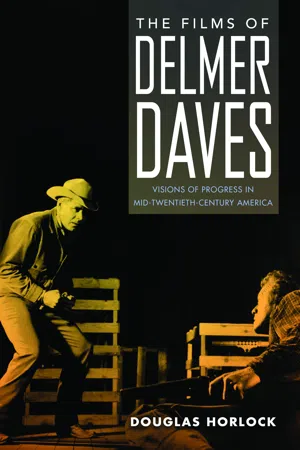
Delmer Daves (1904–1977) was an American screenwriter, director, and producer known for his dramas and Western adventures, most notably Broken Arrow and 3:10 to Yuma. Despite the popularity of his films, there has been little serious examination of Daves's work. Filmmaker Bertrand Tavernier has called Daves the most forgotten of American directors, and to date no scholarly monograph has focused on his work.
In The Films of Delmer Daves: Visions of Progress in Mid-Twentieth-Century America, author Douglas Horlock contends that the director's work warrants sustained scholarly attention. Examining all of Daves's films, as well as his screenplays, scripts that were not filmed, and personal papers, Horlock argues that Daves was a serious, distinctive, and enlightened filmmaker whose work confronts the general conservatism of Hollywood in the mid-twentieth century. Horlock considers Daves's films through the lenses of political and social values, race and civil rights, and gender and sexuality. Ultimately, Horlock suggests that Daves's work—through its examination of bigotry and irrational fear and depiction of institutional and personal morality and freedom—presents a consistent, innovative, and progressive vision of America.
eBook - ePub
The Films of Delmer Daves
Visions of Progress in Mid-Twentieth-Century America
- 248 pages
- English
- ePUB (mobile friendly)
- Available on iOS & Android
eBook - ePub
About this book
Information
Subtopic
Film & VideoCHAPTER ONE The Films of Delmer Daves
THE CAREER OF DELMER DAVES: CRITICAL RESPONSES TO HIS FILMS
THE MAJORITY OF DAVES’S FILMS WERE COMMERCIALLY SUCCESSFUL, WITH Destination Tokyo (1943), Hollywood Canteen (1944), Broken Arrow (1950), Demetrius and the Gladiators (1954), 3:10 to Yuma (1958), A Summer Place (1959), Parrish (1961), and Spencer’s Mountain (1963) among the top-grossing films of their respective years, and although critical reception was conflicting, incidental testimony suggests that his work merits greater attention. When contributors to the journal Cinema were encouraged not to be restricted by established taste and fashionability when nominating their “10-best films,” Roger Huss listed The Hanging Tree in his selection.1 Blake Lucas refers to Daves’s “masterly” direction of 3:10 to Yuma,2 and when Pride of the Marines was released, critic Howard Barnes commented that the war scenes may have been the finest to have appeared in a Hollywood production.3 However, this level of judgment was not always forthcoming, and Bertrand Tavernier submits that Daves continues to retain an unfairly low critical status.4
David Quinlan suggests that To the Victor (1948), Youngblood Hawke (1964), and The Battle of the Villa Fiorita (1965) should be considered the worst films of their respective years.5 Yet, one review of To the Victor concluded that “it would be impossible to praise too highly the script, the direction and the work of the entire cast.”6 Allen Eyles points out that Youngblood Hawke was heavily abridged for general release in Great Britain, noting that it was cut from 136 to 91 minutes,7 and his review of the complete film is more positive than Quinlan’s. Eyles concludes that it is well acted, stylish, and enjoyable, and he praises Daves’s direction if not his adaptation of the novel by Herman Wouk.8 The visual exteriors are memorable: while the sights of New York are very familiar to audiences, Daves captures the awe and enthusiasm of a first-time visitor, and the shots of Hawke alone by the river, set against the misty city skyline, intimate his loneliness and disillusion as his ambitions are collapsing. While some critics felt that the acting of James Franciscus was solid and plausible,9 his performance was regarded as a major weakness, particularly as Warren Beatty had been offered the title role. Franciscus fails to convince that his character has the ability to be an intelligent writer, and as Eyles observes, his performance is weak when he needs to act or react without speaking.10 There is less disagreement over the performance of Suzanne Pleshette as Hawke’s literary editor and eventual love interest. Just as in Rome Adventure, Daves was able to elicit a performance that conveys an understated but obvious passionate nature and sensuality together with sophisticated intelligence, integrity, and generosity of spirit.
Quinlan suggests that any reputation that Daves does enjoy as a director depends on a very small number of good films.11 He then goes on to make positive comments such as “memorable,” “compelling,” “commendable,” and “extraordinary” about eight of his films, while it is arguable that the critical reputation of Francis Ford Coppola rests largely on just three films.12 Certainly some of Daves’s work, while popular on release, is easy to dismiss. Described by Tavernier as a “hopeless failure,”13 Never Let Me Go (1953) is typical of the more simplistic of Hollywood’s Cold War films, which portrayed a perceived communist threat to American institutions. For another critic, A Kiss in the Dark (1949) was mediocre and silly.14 However, in his discussion of the auteur theory, Andrew Sarris concedes that “even the greatest directors have their ups and downs”15 and that it is inevitable that there may be disagreement about the relative quality of directors’ individual films. For William Meyer, Dark Passage is weak, illogical, and contrived.16 Yet for Dominique Rabourdin, it is one of the masterpieces of film noir.17 Similarly, Peter Bogdanovich believes that John Ford’s The Man Who Shot Liberty Valance (1961) is one of the best films ever made,18 but for Bruce Beresford, the film constitutes evidence of Ford’s creative decline.19 While critics have disagreed about individual films directed by Ford, there has been little dispute about his standing as a major figure in the history of cinema.
David Thomson writes that 3:10 to Yuma does not deserve a prestigious reputation, largely because of its contrived action scenario.20 However, predominately a tense psychological drama, it takes place in the confines of a farmer’s home and then in the claustrophobic space of a hotel room. Many scenes in Broken Arrow and Bird of Paradise (1951) have a static quality, with relatively small proportions of the films’ length taken up by action. Darryl F. Zanuck complained that some dialogue scenes in Broken Arrow were “hopelessly slow,” with characters “merely moving up to the camera and talking.”21 Nevertheless, he wrote that “the intimate scenes have been directed and staged magnificently,” including scenes with Tom Jeffords and Cochise in the wickiup that “are real masterpieces.”22 Unusually for Westerns, key issues emerge from characters talking and even debating fundamental matters of prejudice. In The Badlanders, the characters’ reactions highlight such issues.After being saved from ridicule and assault by a white man, a woman asks: “You knew I was Mexican when you fought for me. Why did you bother?” The man’s expressions and body language reveal his basic instincts for natural justice; a corrupt businessman, on the other hand, uses different body language and declares, “I don’t trust Mexes.”
For Thomson, another weakness of 3:10 to Yuma is the inability of its star, Glenn Ford, to be “nasty.”23 Yet in an earlier publication, he credits Daves for the film’s skillfully created tension and claims that the experiment of portraying Ford as an articulate villain works extremely well.24 Early in the film, he ruthlessly and without any apparent regret shoots one of his own gang members as well as killing a stagecoach driver. The scene is effective in the surprise it engenders and is a forerunner to the famous scene in Once Upon a Time in the West (1968), now regarded by some as one of the greatest of Westerns, in which the killer, played by Henry Fonda, normally the epitome of American integrity, shoots a defenseless young boy. Although the degree to which director Sergio Leone may have been influenced by Daves’s film is uncertain, it is noteworthy that rather than being taken to the local jail, Cheyenne is transported to a prison in Yuma. Additionally, the sequence in which Fonda’s gang seeks to ambush him evokes Daves’s scene in which the gunman is taken to the train station. The respective gangs stalk their targets amid the long, dark shadows that are cast across the empty streets. Leone’s rising crane shot, which shows the chaotic activity of a growing town accompanying the building of the railroad, is reminiscent of the opening shots of The Hanging Tree in which the protagonist views the rapidly developing mining community from high on a cliff. Daves’s slow, panning crane shot captures the hopes and desperation of “gold fever” and the chaos of hastily constructed buildings and tents as miners, their families, gamblers, and prostitutes journey from all directions. More specifically, the sequence in Leone’s film in which Cheyenne places his hand on a woman’s behind and suggests that she may allow others to do the same evokes a scene in Jubal in which the hero gives advice to his boss on appropriate attitudes to women: “She’s just fed up with being whacked on the rump.”
Tavernier feels that the decline in popularity and regard for the Western helps to explain the relatively low esteem in which Daves is held.25 However, this reasoning is not consistent with, for example, the increasing critical interest in the Westerns of Anthony Mann, nor with the continued admiration for those of Hawks and Ford. Additionally, Tavernier feels that the decline in quality of Daves’s later films, which Jean-Pierre Coursodon describes as “dangerously close to artistic suicide,”26 may also explain the lack of interest in his work. Spencer’s Mountain was a financial success, but for its star, Henry Fonda, the sentimental charm of this portrayal of a modern frontier family’s tribulations and joys “set the movie business back twenty years.”27 One review concurred, believing Daves’s “rose-tinted rural Americana” to be heavy handed and irrelevant to the 1960s.28 The issue of relevance will be considered, but for Eyles, the film had much that was genuinely poetic.29
Certainly, a number of the films Daves made after the commercial success of A Summer Place received some unfavorable reviews. He wrote and directed three further romantic melodramas, with a British review that dismissed Lovers Must Learn (released in the United States as Rome Adventure) as a “glossy tasteless fantasy” typifying the response.30 However, while Robin Bean’s review finds the plot to be trite, he concludes that the film is a very professional and polished production in which Daves demonstrates his talent for cinematic interpretation.31 Philip Strick’s review of Susan Slade (1961), while suggesting that Daves was wasting his talent with the material, nevertheless refers to “the Daves inspirational style.”32 This is perhaps Daves’s weakest film: it is set along the northern California coast, and while Strick comments on the beautiful photography, he concludes that the film is “superficial rhubarb all the same.” Daves admitted to Tavernier that the story had little quality and that he undertook the project only to help Jack Warner, who had purchased novels that were proving difficult to adapt for the screen.33 He acknowledged that he had made some films that he wouldn’t have normally selected, but had done so out of loyalty to Warner, who had given him the opportunities to be a screenwriter and later a director and producer.34 The limited acting range of Troy Donahue and Connie Stevens is a major weakness, while Daves’s screenplay wastes the talents of veteran actors Lloyd Nolan and Brian Aherne. Daves’s characters constantly use erudite, weighty, and profound phrases, but the effect is dialogue that is pretentious and mannered. For example, after Susan has nearly drowned, her father remarks to her doctor: “She’s learned a bitter lesson too young. In the midst of life we are in death,” and her mother’s advice is given in perfectly crafted but stilted prose: “There will come a day, a great and joyous day when you’ll know some man to whom you are heaven and earth.” Nevertheless, there are memorable moments that engage the viewer’s feelings. The shot of a pregnant young woman whose lover is avoiding contact, alone on a San Francisco street, sharply captures her desolation and desperation, and the wordless shots of Susan, later playing with her child, are poignant and moving. Particularly effective is the brief scene in which a father tries to keep his emotions in check as he announces the death of his only son: his understated grief is more heartfelt because of the intensity of his expression and the slight movements of his hand while he has difficulty holding the telephone.
Parrish was commercially successful but was not well received by critics. One review referred to a superficial and cumbersome plot, forgettable acting, and absurd dialogue.35 At 138 minutes the film is overlong, but in fact it benefits from some convincing acting, notably in the quiet integrity of Dean Jagger and the controlled ruthlessness of Karl Malden. Bean finds that the theme of the ethics of business methods and rivalries is interesting but believes that it is made too subservient to the love affairs of the title character and that the film succeeds or fails on this portrayal.36 By common critical consent, the stilted and expressionless acting of Troy Donahue seems totally inadequate, particularly when the original intention was to star Warren Beatty as Parrish with Jane Fonda as one of his romantic involvements. Therefore, Tavernier may be correct to suggest that Daves’s perseverance with Donahue has contributed to his lack of critical recognition.37 Lawrence Quirk notes Daves’s belief that Donahue possessed unexploited depth and sensitivity, and his determination to develop the actor’s potential beyond his physical appeal.38 Daves felt that the experience of working with actors such as Malden and Claudette Colbert would help in this regard, but in fact their acting only exposed Donahue’s weaknesses, and his career declined rapidly after Rome Adventure, his last film with Daves. In Parrish, Donahue fails to convey the initiative or ability to reach the level of success that the character achieves or to gain the loyalty of others. Similarly, the instant attraction of the three young women with whom he has relationships is not convincing because of his complete lack of charisma or charm.
Although these films received mixed reviews, the level of authority Daves exercised as writer, producer, and director should necessitate their inclusion in any consideration of the issue of authorship. Just as Douglas Sirk has gained a lasting critical reputation for melodramas that were poorly regarded when released, Daves’s later film...
Table of contents
- Cover Page
- Title Page
- Dedication
- Copyright
- Contents
- Acknowledgments
- Introduction
- Chapter One: The Films of Delmer Daves
- Chapter Two: Political and Social Values in the Films of Delmer Daves
- Chapter Three: Race and Civil Rights in the Films of Delmer Daves
- Chapter Four: Gender in the Films of Delmer Daves
- Conclusion
- Notes
- Filmography
- Bibliography
- Index
- About the Author
Trusted by 375,005 students
Access to over 1.5 million titles for a fair monthly price.
Study more efficiently using our study tools.
Frequently asked questions
Yes, you can cancel anytime from the Subscription tab in your account settings on the Perlego website. Your subscription will stay active until the end of your current billing period. Learn how to cancel your subscription
No, books cannot be downloaded as external files, such as PDFs, for use outside of Perlego. However, you can download books within the Perlego app for offline reading on mobile or tablet. Learn how to download books offline
Perlego offers two plans: Essential and Complete
- Essential is ideal for learners and professionals who enjoy exploring a wide range of subjects. Access the Essential Library with 800,000+ trusted titles and best-sellers across business, personal growth, and the humanities. Includes unlimited reading time and Standard Read Aloud voice.
- Complete: Perfect for advanced learners and researchers needing full, unrestricted access. Unlock 1.5M+ books across hundreds of subjects, including academic and specialized titles. The Complete Plan also includes advanced features like Premium Read Aloud and Research Assistant.
We are an online textbook subscription service, where you can get access to an entire online library for less than the price of a single book per month. With over 1.5 million books across 990+ topics, we’ve got you covered! Learn about our mission
Look out for the read-aloud symbol on your next book to see if you can listen to it. The read-aloud tool reads text aloud for you, highlighting the text as it is being read. You can pause it, speed it up and slow it down. Learn more about Read Aloud
Yes! You can use the Perlego app on both iOS and Android devices to read anytime, anywhere — even offline. Perfect for commutes or when you’re on the go.
Please note we cannot support devices running on iOS 13 and Android 7 or earlier. Learn more about using the app
Please note we cannot support devices running on iOS 13 and Android 7 or earlier. Learn more about using the app
Yes, you can access The Films of Delmer Daves by Douglas Horlock in PDF and/or ePUB format, as well as other popular books in Media & Performing Arts & Film & Video. We have over 1.5 million books available in our catalogue for you to explore.