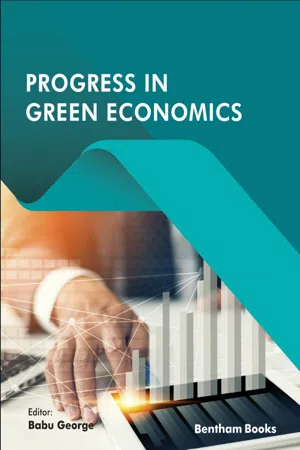
Green economics refers to the discipline in which economists and businesses pursue policies that are conducive to minimizing environmental and ecological damage and therefore sustainable development. Progress in Green Economics primarily focuses on developments in the transition of different industries and sectors to a sustainable, environment-friendly economic model. The book presents 7 chapters that cover different topics that reflect these developments in the field from a number of academic and practical angles. The topics covered in the book include a review of the Food Energy Water Waste (FEWW) paradigm in Asian countries, an analysis of green economic forces in the Arctic region, green economics for protected area tourism, a conceptual analysis of green economics strategy, sustainable development and green banking in South Africa, and six sigma methodology for implementing green economic policies in different industries. Each chapter is organized into reader-friendly sections and is supplemented with references for the benefit of more involved scholars. The multi-regional perspectives, along with the theoretical and practical information on the topic make this reference a timely and handy resource on green economics and sustainable development for academics, scholars, industrialists, policymakers and economics enthusiasts alike.
- English
- ePUB (mobile friendly)
- Available on iOS & Android
eBook - ePub
Progress in Green Economics
About this book
Information
Green Economic Transition Scenarios in the Arctic Region
Filip Lestan1, 2, *, Sajal Kabiraj3
1 International Institute of Energy Policy & Diplomacy, Moscow State Institute of International Relations of the Ministry of Foreign Affairs of the Russian Federation, RU-119454, Moscow, Russia
2 Business School, Nord University, NO-8026, Bodø, Norway
3 School of Entrepreneurship and Business, Häme University of Applied Sciences Ltd. (HAMK), FI-37630, Valkeakoski, Finland
Abstract
When the words “Energy” and “Arctic” occur together within the global context, in most of the cases, the ideology creates an image and ideas of large fossil fuel projects, oil and gas rigs, and ship tankers. Governments, institutions, businessmen, and other key stakeholders from the energy sector in the Arctic region face pressures that could be translated as green transition, low-carbon age, or data regarding the new oil. The green economy is a significant concept that refers to the the green transition of energy resources in the Arctic region. This particular chapter highlights numerous global trends, key driving forces and assumptions that have a direct impact on the future evolution of green transition in the Arctic region by the year 2030. The primary goal of this chapter was to create and draw potential future alternatives for the development of transition to green energy in the Arctic region by 2030. Hence, authors developed three green transition scenarios which do not aim to strictly project and forecast the future; instead, the aim is to identify possible alternatives of green transition evolution in the Arctic region by 2030. In addition to that, the authors developed a framework of key driving forces influencing green transition in the Arctic region, and introduced wild scenarios of green transition in the Arctic region.
Keywords: Energy, Green transition, Scenarios.
* Corresponding author Filip Lestan: International Institute of Energy Policy & Diplomacy, Moscow State Institute of International Relations of the Ministry of Foreign Affairs of the Russian Federation, RU-119454, Moscow, Russia and Business School, NORD University, NO-8026, Bodø, Norway; E-mail: [email protected]
INTRODUCTION
When the words “Energy” and “Arctic” occur together within the global context, in most of the cases, the ideology creates an image and ideas of large fossil fuel projects, oil and gas rigs, and ship tankers.
However, the evolution of the world energy system is currently in the phase of active and dynamic changes in the global processes, trends, practices, and policies. Governments, institutions, businessmen, and other key stakeholders from the energy sector in the Arctic region face challenges that could be translated as green transition, low-carbon age, or data regarding the new oil (DeGeorge, 2020).
Green transition can be interpreted in other words like a shift and transition towards cleaner and green energy alternatives. Hereby, to understand more clearly, the green transition aims to replace fossil fuels with renewable energy sources to conserve energy by efficient use of energy resources (Georgeson, Maslin, & Poessinouw, 2017).
Altogether, there are numerous global trends that have a direct impact on the future evolution of the green transition in the Arctic region, as well as they have an impact on the formulation of policies, integration of energy technologies, and most importantly, integration of renewable energy to the world’s energy system. For instance, to mention a few global trends, technological development as one of the key drivers of innovations can facilitate and enable renewable energy sources with the help of digitalization. Secondly, climate change as one of the key drivers of sustainability and responsible governance can easily shift towards a low-carbon and carbon-neutral world. Last but not least, globalization as one of the key drivers of economic growth can succour the chances to sustain renewable energy sources.
This particular chapter highlights numerous global trends, key driving forces and assumptions that have a direct impact on the future evolution of green transition in the Arctic region by the year 2030. The primary goal of this chapter was to create and draw potential future alternatives for the development of transition to green energy in the Arctic region by 2030. As a result, the authors of this chapter developed three green transition scenarios for the Arctic region.
All of the three green transition scenarios that were developed, each of them was assigned with a nickname; in fact, the nickname was connected to the basis on which the scenario was established. Here, green transition scenarios do not aim to strictly project and forecast the future; instead, the aim of the green transition scenarios is to identify alternatives of possible green transition evolution in the Arctic region by 2030. As a consequence of that, green transition scenarios aim to prepare for a full range of possible future events, including so-called “Black Swans”.
LITERATURE REVIEW
The scenario analysis method seems to be a promising and significant tool in the management processes across a variety of sectors to plan, foresight and prepare for uncertain future outcomes and events. With this in mind, the scenario analysis method from the management point of view is described among scholars and researchers as a process and valuable instrument in strategic planning. The strategic planning is a phase of the strategic management process which focuses on the long-term future; usually, on a time horizon scale, it is three and more years (David, David, & David, 2013). In the past, the concept of preparation towards future was to predict, i.e., to “forecast” rather than prepare, i.e., to “foresight” the future with possible evolution and developments that may occur over time (Mietzner & Reger, 2005, p. 235).
According to Mietzner and Reger (2005, p. 223), the main objective of the scenario analysis method is to “establish future planning which can minimise surprises and broaden the span of managers’ thinking about different possibilities”. In this context, to help us understand more clearly, the aim of the scenario analysis method is to prepare high-profile representatives in executive roles within governments, corporations and organizations for possible futures, whereas scenarios, in some cases, might be key aspects in the decision-making process.
Obviously, the scenario analysis method appears to be a driver for the improvement of the decision-making process; however, scenarios bring with them specific constraints and limitations, which eventually makes the scenario analysis method prosperous and disadvantageous in certain situations. To illustrate from the scientific perspective, there is still a lack of systematic approaches to generate, validate, and analyse scenario analysis (Hsia et al., 1994, p. 33).
The golden rule of the scenario analysis method is the quantity of built scenarios. In the article “Scenario building: a suitable method for strategic property planning?”, the author claims that an appropriate number of scenarios should not be equal to four, while being not less than two. The golden rule with this statement would be that three scenarios are appropriate and sufficient to foresight the future (Ratcliffe, 2000).
Advantages & Strengths of Scenario Analysis
Undoubtedly, the prime advantage of the scenario analysis method is the fact that this method takes into account and considers numerous futures rather than one particular foresight (Mietzner & Reger, 2005, p. 234). The world’s energy system is currently in the flux of changes caused by a variety of global processes and trends. Namely, the energy sector faces global trends that could be translated as low-carbon age, green transition or data regarding the new oil.
In such turbulent and uncertain times, the scenario analysis method can provide decision-makers with the advantage of the formulation of strategies, which ultimately could lead organizations to sustain and thrive their competitive advantage. As a result of that, organizations could greatly benefit from the integration of scenarios into their strategy practices (David et al., 2013).
In addition to the advantages of the scenario analysis method, this concept serves energy companies in the Arctic region with numerous strengths. To illustrate the major strengths of scenarios for energy companies, the authors of this chapter decided to portray seven strengths of scenario analysis in Table 1 with implications in the energy sector.
Table 1 Seven strengths of scenario analysis method with implications in the energy sector in the Arctic region [Authors’ own work (Mietzner & Reger, 2005, p. 235)]
| Scenario’s Strengths | Implications for Arctic Energy Sector | Source |
| 1. Quantity | The energy companies can foresight the future more effectively with numerous scenarios rather than one particular forecast. | (Mietzner & Reger, 2005, p. 235) |
| 2. Imagination | Managers of energy companies can use scenarios to enable radical imagination to formulate and monitor corporate and business strategies. | (Mietzner & Reger, 2005, p. 235) |
| 3. Recognition | Energy companies can easily recognize the weak spots within their organization, disruptive factors in the operational environment with the help of scenario analysis. | (Mietzner & Reger, 2005, p. 235) |
| 4. Communication | Scenarios can help energy companies and other key stakeholders to communicate strategic objectives and issues within the energy sector. | (Mietzner & Reger, 2005, p. 235) |
| 5. Coordination | Within the scenario bui... |
Table of contents
- Welcome
- Table of Content
- Title
- BENTHAM SCIENCE PUBLISHERS LTD.
- PREFACE
- List of Contributors
- The “FEWW” Nexus in Green Economics for Asian Countries
- Green Economic Transition Scenarios in the Arctic Region
- Green Economy in the Services: The Context of Protected Area Tourism
- Strategic Policies for Green Economy: A Conceptual Analysis
- Green Economy For Sustainable Development
- Case Studies In Green Banking
- Lean Six Sigma as a Methodology to Implement Green Economics Initiatives
Trusted by 375,005 students
Access to over 1.5 million titles for a fair monthly price.
Study more efficiently using our study tools.
Frequently asked questions
Yes, you can cancel anytime from the Subscription tab in your account settings on the Perlego website. Your subscription will stay active until the end of your current billing period. Learn how to cancel your subscription
No, books cannot be downloaded as external files, such as PDFs, for use outside of Perlego. However, you can download books within the Perlego app for offline reading on mobile or tablet. Learn how to download books offline
Perlego offers two plans: Essential and Complete
- Essential is ideal for learners and professionals who enjoy exploring a wide range of subjects. Access the Essential Library with 800,000+ trusted titles and best-sellers across business, personal growth, and the humanities. Includes unlimited reading time and Standard Read Aloud voice.
- Complete: Perfect for advanced learners and researchers needing full, unrestricted access. Unlock 1.5M+ books across hundreds of subjects, including academic and specialized titles. The Complete Plan also includes advanced features like Premium Read Aloud and Research Assistant.
We are an online textbook subscription service, where you can get access to an entire online library for less than the price of a single book per month. With over 1.5 million books across 990+ topics, we’ve got you covered! Learn about our mission
Look out for the read-aloud symbol on your next book to see if you can listen to it. The read-aloud tool reads text aloud for you, highlighting the text as it is being read. You can pause it, speed it up and slow it down. Learn more about Read Aloud
Yes! You can use the Perlego app on both iOS and Android devices to read anytime, anywhere — even offline. Perfect for commutes or when you’re on the go.
Please note we cannot support devices running on iOS 13 and Android 7 or earlier. Learn more about using the app
Please note we cannot support devices running on iOS 13 and Android 7 or earlier. Learn more about using the app
Yes, you can access Progress in Green Economics by Babu George in PDF and/or ePUB format, as well as other popular books in Economics & Sustainable Development. We have over 1.5 million books available in our catalogue for you to explore.