The Science of Wind Power
eBook - ePub

The Science of Wind Power

  1. 400 pages
  2. English
  3. ePUB (mobile friendly)
  4. Available on iOS & Android
eBook - ePub

The Science of Wind Power

About this book

Concern for the environment and for the impacts of environmental pollution has brought about the need to shift from the reliance on hydrocarbons to energy sources that are nearly pollution neutral and renewable. The Science of Wind Power is designed to provide a fundamental understanding for wind technicians and students alike, essentially examining how to harness the wind to produce energy for transmission and use, while keeping environmental impacts in mind. Wind power is one of the fastest-growing energy sources, as it offers many advantages such as being sustainable and a renewable energy source that has a much smaller impact on the global environment compared to fossil fuels. It is important to point out, however, that like wind itself, wind power has a good and bad side, advantages, and disadvantages (challenges), and these different aspects are discussed in detail herein.

Features:

  • Examines the mechanical, electrical, hydraulic, and electronic aspects of wind turbines
  • Provides the fundamentals of wind turbine aerodynamics, modeling, and testing
  • Includes design standards for wind turbines and electrical distribution systems
  • Delineates the differences between offshore and land-based wind power
  • Discusses special-purpose applications, such as energy distribution and storage

A must-have volume that includes the latest data, diagrams, and useful illustrations, The Science of Wind Energy offers a complete examination of one of the most promising sources of renewable energy and serves as a great introduction to the cross-disciplinary field for students and practicing engineers. The concepts and guidelines presented will equip readers with the scientific rationale required to make decisions that could directly affect the environment around them.

Frequently asked questions

Yes, you can cancel anytime from the Subscription tab in your account settings on the Perlego website. Your subscription will stay active until the end of your current billing period. Learn how to cancel your subscription.
No, books cannot be downloaded as external files, such as PDFs, for use outside of Perlego. However, you can download books within the Perlego app for offline reading on mobile or tablet. Learn more here.
Perlego offers two plans: Essential and Complete
  • Essential is ideal for learners and professionals who enjoy exploring a wide range of subjects. Access the Essential Library with 800,000+ trusted titles and best-sellers across business, personal growth, and the humanities. Includes unlimited reading time and Standard Read Aloud voice.
  • Complete: Perfect for advanced learners and researchers needing full, unrestricted access. Unlock 1.4M+ books across hundreds of subjects, including academic and specialized titles. The Complete Plan also includes advanced features like Premium Read Aloud and Research Assistant.
Both plans are available with monthly, semester, or annual billing cycles.
We are an online textbook subscription service, where you can get access to an entire online library for less than the price of a single book per month. With over 1 million books across 1000+ topics, we’ve got you covered! Learn more here.
Look out for the read-aloud symbol on your next book to see if you can listen to it. The read-aloud tool reads text aloud for you, highlighting the text as it is being read. You can pause it, speed it up and slow it down. Learn more here.
Yes! You can use the Perlego app on both iOS or Android devices to read anytime, anywhere — even offline. Perfect for commutes or when you’re on the go.
Please note we cannot support devices running on iOS 13 and Android 7 or earlier. Learn more about using the app.
Yes, you can access The Science of Wind Power by Frank R. Spellman in PDF and/or ePUB format, as well as other popular books in Technology & Engineering & Renewable Power Resources. We have over one million books available in our catalogue for you to explore.

Part I
Physical Aspects of Wind Turbines (aka The Horse)

H P = W t = F d t = 180 l b f × 2.4 × 2 π × 12 f t 1 min = 33 , 573 f t ⋅ l b f / min

1 Introduction

DOI: 10.1201/9781003288947-2
Wind is the fate we are facing
Wind is the life we are touching every second
Wind is the love we don’t understand but feel
Wind is the bridge we cannot see but feel
Wind is wind is wind is wind
—Nyein Way, Dance with Wind
In the end, the wind takes everything, doesn’t it?
And why not?
Why other?
—Stephen King, The Wind through the Keyhole

By Any Other Name

The epigraphs above give us two different views about wind. Way’s view is emotional and heartfelt, and King’s view veers or turns or twists or is bent more to the other side of emotion garnished with alarm, anxiety, fear, and reality. Whether we call it a breeze, air current, current of air, gale, hurricane, draft, zephyr, sea breeze, or the all-inclusive general term “wind” or by any other name, one thing is certain: the earth’s wind has a good and bad side. In this regard and for the truth be known, wind can be said to have a Dr. Jekyll and Mr. Hyde personality or characteristic or aspect; that is, again, like the two well-known literary personalities, one side is good, and the other side is bad. The bad or negative characteristics of wind are tornadoes, hurricanes, movement of pollen and mold (allergens), and the causation of waves in lakes and oceans that can cause destructive flooding. Wind erosion is another bad aspect and is a main geomorphological influence, especially in arid and semi-arid regions. It is also a major source of land desertification, degradation, harmful airborne dust, and crop damage—especially when being magnified far above natural rates by anthropogenic activities such as agriculture, deforestation, and urbanization. This is the “Mr. Hyde” or bad side of the wind. The “Dr. Jekyll” or good side of wind affects world circulation of weather patterns, pollinates plants, reduces air pollution via air circulation, moves warm breezes that comfort us, and provides energy to produce wind power. It is this providing of energy to produce wind power, one of the “good sides” of wind, which is the focus of this book. The bottom line: it is important to keep in mind that the good and/or bad aspects of wind are essential to the earth’s natural processes, all of which are generated with and by the urges or whims of Mother Nature.
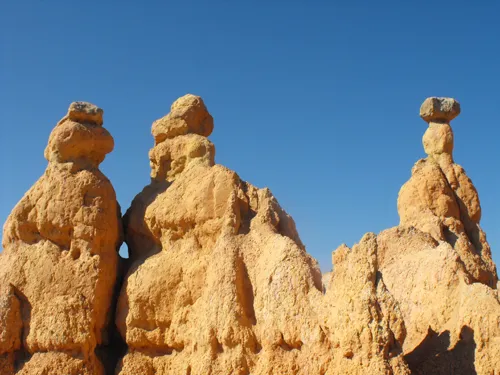
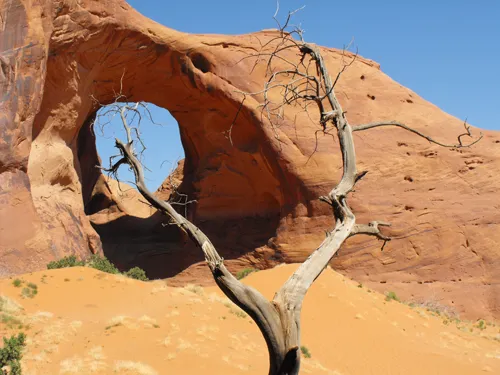
Note: Another Hyde characteristic is that wind is one of Mother Nature’s most often used tools, a sculpting/grinding/drilling tool without peer, wind erosion, contained within her grand toolbox and continuously used to reshape the earth’s surface features. Figures 1.1–1.3 illustrate a few examples of results of Mother Nature’s wind tool (water, freeze, and thaw also contribute). Keep in mind that not all people judge these wind carvings as bad but, instead, are amazed by Mother Nature’s handiwork.
A cave without back wall. The edges of the cave appear smooth.
FIGURE 1.1 Wind sculpting in Monument Valley, Utah. Photo by F.R. Spellman.
A cave without back wall. A large hole on the back of the cave appears in oval shape. The edges of the cave appear smooth.
FIGURE 1.2 Wind sculpting in Monument Valley, Utah. Photo by F.R. Spellman.
Rocks appearing as three pillars with smooth surface. The structure of the pillars appears to be built by stacked stones. The bottom of the pillar appears wider than the top.
FIGURE 1.3 Wind sculpting of Hoodoos in Bryce Canyon, Utah. Photo by F.R. Spellman.

Wind Power

Wind power or wind energy—these terms are used interchangeably throughout the text—is the use of wind to provide mechanical power through prime movers—wind turbines—to rotate or turn electric generators for electrical power. Wind power is one of the fastest-growing energy sources on the globe. This is the case because the use of wind power offers many advantages such as being sustainable and a renewable energy source that has a much smaller impact on the global environment compared to the usage of fossil fuels. It is important to point out, however, that like wind, wind power has a good and bad side—specifically wind power has advantages and disadvantages (challenges)—and is covered in detail in this book.

Wind Power Terminology and Development*

* From F. Spellman 2016. The Science of Renewable Energy. Boca Raton, FL: CRC Press.
To provide comprehensive coverage of wind power and to better prepare the reader for the material contained in this book, wind turbine and wind turbine plan of development terms are defined here in a comprehensible manner. Simply, it is important early on to identify and define key terms used in the book. Although it is common practice to provide a glossary of terms and their definitions at the end of most technical books, in the Science of series, the terms and their definitions are provided right up front so that the reader can become familiar with the terminology used throughout the text and thus increase understanding of the subject matter when it is presented. Terms and definitions not provided herein are provided when presented in the book.
Note: These terms and their definitions apply to modern wind power plant construction in the United States.

Terms and Definitions

Access Road: Provides primary access to large blocks of land and connects with, or is an extension of, the public road system. The Access Roads will bring the large turbine components and construction and operations personnel from the public road system to the initial point of entry and inspection on the project site.
Acreage: An area, measured in acres, which is subject to ownership or control by those holding total or fractional shares of working interests. Acreage is considered developed when development has been completed. A distinction may be made between “gross” acreage and “net” acreage:
  • Gross—All acreage covered by any working interest, regardless of the percentage of ownership in the interest
  • Net—Gross acreage adjusted to reflect the percentage of ownership in the working interest in the acreage
Active power: The component of electric power that performs work, typically measured in kilowatts (kW) or megawatts (MW). Also known as “real power.” The terms “active” or “real” are used to modify the base term “power” to differentiate it from Reactive Power.
Accumulator: Fluid-power component used to maintain a fixed volume of fluid at system pressure.
Active braking: Wind turbine yaw brake system that uses electrical or hydraulic actuators to maintain nacelle position when the yaw drive is not activated.
Actuator: Device used to convert electrical, pneumatic, or hydraulic power to useful work.
Aerodynamic force: Force on an object created by fluid flow around the object.
Aerodynamic pressure: Force applied to the surface area of an object created by its interaction with a fluid. Units include pounds per square inch (psi) and megapascal (MPa—a measure of internal pressure).
Note: A fluid is a substance that has no fixed shapes and yields easily to external pressure; a gas or (principally) a liquid.
Adaptation: Adjustment to environmental conditions.
Adaptive management: Focuses on learning and adapting, through partnerships of managers, scientists, and other stakeholders who learn together how to create and maintain sustainable ecosystems. Adaptive management helps science managers maintain flexibility in their decisions (knowing that uncertainties exist) and provides managers with the latitude to change direction and improve understanding of ecological systems to achieve management objectives and is about taking action to improve progress toward desired outcomes.
Adverse weather conditions: Reduced streamflow, lack of rain in the drainage basin, or lower water supply behind a pondage or reservoir dam, resulting in a reduced gross head that limits the production of hydroelectric power or forces restrictions to be placed on multipurpose reservoirs or other water uses.
Alternating current (AC): An electric current that reverses its direction at regularly recurring intervals, usually 50 or 60 times per second.
Alternative fuel: Alternative fuels, for transportation applications, include the following:
  • Methanol
  • Denatured ethanol and other alcohols
  • Fuel mixtures containing 85% or more by volume of methanol, denatured ethanol, and other alcohols with gasoline or other fuels
  • Natural gas
  • Liquefied petroleum gas (propane)
  • Hydrogen
  • Coal-derived liquid fuels
  • Fuels (other than alcohol) derived from biological materials (biofuels such as soy diesel fuel)
  • Electricity (including electricity from solar energy)
    The term “alternative fuel” does not include alcohol or other blended portions of primarily petroleum-based fuels used as oxygenates or extenders, i.e., MTBE, ETBE, other ethers, and the 10% ethanol portion of gasohol.
Alternator: A device that turns the rotation of a shaft into alternating current (AC).
Ambient: Natural condition of the environment at any given time.
Ampere (Amp): A unit of electrical current; can be thought of like the rate of water flowing through a pipe (liters per minute).
Ampere-Hour: Amperes times hour, used to measure energy production over time and battery capacity.
Amplitude: Measure the value of signal strength a...

Table of contents

  1. Cover
  2. Half-Title
  3. Title
  4. Copyright
  5. Contents
  6. Preface
  7. Author
  8. PART I Physical Aspects of Wind Turbines (aka The Horse)
  9. PART II The Nuts and Bolts of Wind Power
  10. Index