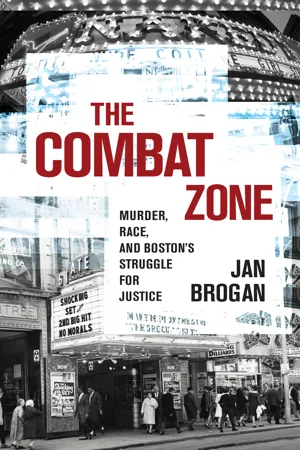
Shortlisted for the 2021 Agatha Award for Best Non-Fiction and the 2022 Anthony Award for Best Critical or Nonfiction Work
At the end of the 1976 football season, more than forty Harvard athletes went to Boston's Combat Zone to celebrate. In the city's adult entertainment district, drugs and prostitution ran rampant, violent crime was commonplace, and corrupt police turned the other way. At the end of the night, Italian American star athlete Andy Puopolo, raised in the city's North End, was murdered in a stabbing. Three African American men were accused of the crime. His murder made national news and led to the eventual demise of the city's red-light district.
Starting with this brutal murder, The Combat Zone tells the story of the Puopolo family's struggle with both a devastating loss and a criminal justice system that produced two trials with opposing verdicts, all within the context of a racially divided Boston. Brogan traces the contentious relationship between Boston's segregated neighborhoods during the busing crisis; shines a light on a court system that allowed lawyers to strike potential jurors based purely on their racial or ethnic identity; and lays bare the deep-seated corruption within the police department and throughout the Combat Zone. What emerges is a fascinating snapshot of the city at a transitional moment in its recent past.
ONACOLD night in November 1976, at the end of an up-and-down season, the varsity football team gathered at the Harvard Club in accordance with tradition. Under crystal chandeliers, the students dined on roast beef and green beans as they listened to speeches about brotherhood and accepted awards for their accomplishments.
Princeton Heisman Trophy winner Dick Kazmaier gave the principal address, and Robert F. Kennedy’s widow, Ethel, made a special trip to present an award in honor of her husband. But the more powerful speeches came from inside the team, from the coaches and the captain, who talked about the special bonds formed over double sessions, bus travel, and games that did not go as planned.
Everything about Harvard football was steeped in tradition, from the century-old rivalry with Yale to the little red flag waved each time the Crimson scored. It reminded the boys of the storied history of Ivy League football and the privilege of playing for Harvard.
Andy Puopolo, one of the seniors who had hung up his shoulder pads for the last time, ate the roast beef and sipped a Coke. He’d been pulled from Saturday’s game against Yale with a mild concussion and had to be careful about how much alcohol he drank. It didn’t matter. According to his friends and family, he was not much of a drinker.
He had dark hair that fell below his ears in the overgrown style of the seventies and green eyes often described as intense. Although relatively short for a football player at five feet ten, he was muscular from long hours spent in the gym. Originally scoffed at by the Harvard interviewer when he said he wanted to play football, he’d worked hard to bulk up and had fought through injuries to win a starting position. But now, his playing days were over and he was looking to the future. After the game loss on Saturday, he had surprised his parents by announcing he received his first acceptance to medical school.
Andy had had his share of glory—two interceptions in the game against UPenn and a mention in the New York Times—but it had been a disappointing season for the team. Picked as the favorite to win the Ivy League championship, Harvard had ended up not just behind the two cochampions, Yale and Brown, but tied with Dartmouth for second place.1
After dinner, the students went downstairs to the vaulted ceiling and dark Tudor wainscoting of the lounge. They milled around, drinking draft beer and bantering as they watched the highlight reels. By the end of the official Harvard banquet, they were ready to shake off defeat.2
Just under fifty of the football players left the hallowed halls of the Harvard Club and descended on Boston’s Combat Zone. They went to the Naked i, a strip club best known for its “All College Girl Review” and its logo, an eye that winked over a backside view of upside-down and bare female legs. One of the teammates was related to the manager and had arranged to reserve the private room in back for their own show. By all accounts, the teammates, who arrived dressed up in their three-piece suits and loafers, had a great time. After two of them climbed on stage to dance with the stripper shortly before last call, the bouncers announced it was time for the boys to go home.
A night in “the Zone” was an end-of-season tradition for Harvard’s football team, as well as a common end-of-year practice by other Boston college football teams, but the timing this year was extremely questionable. The Combat Zone, which had made headlines for police corruption and escalating crime only the week before, was at the peak of its lawlessness.
Restricted by law to a four-block area between the Downtown Crossing and Chinatown, the red-light district was crammed with strip clubs, X-rated movie houses, adult bookstores, and a gay bathhouse. Years before the advent of the videocassette recorder (VCR) and a decade before the internet, men formed long lines outside the peep shows where a quarter kept the porn reel going. Prostitutes swarmed the streets and created a gridlock on weekends as they stopped cars and fondled men through open car windows.3
FIGURE 1. The Naked i in Boston’s Combat Zone, August 1977. Photograph by Spencer Grant.
Dealers sold pot and heroin curbside. Mobsters and cops drank together at the bars as the muggers rolled drunks on the alleys outside. But the recklessness of the Zone, the unpredictability, was part of its allure. The neon marquees cast both a glow and a shadow over littered sidewalks that pulsed with excitement, crime, and danger.
As the Harvard students spilled out into the street, they broke into smaller groups, heading for taxis and cars. One of these groups, six Harvard students, accompanied by the Harvard equipment manager, passed by the Carnival Lounge on the way back to the Harvard van. Although they were dressed like lawyers, these men were young and loud and, at least one, drunkenly off-kilter.
Two of the young women standing outside the Carnival Lounge had prior arrests for both prostitution and theft. Cassandra McIntyre, still a girl at sixteen, was barely five feet tall and had a keloid scar running the length of her right cheek. Naomi Axell, the veteran at twenty-two, was long and lean, wearing a wig and a long, rust-colored leather coat. They approached the eight men passing by.4
The two prostitutes were Black, and the three Harvard football players at the front of the line were also Black. They regarded the women stonily. In the second year of court-ordered busing, racial tension in this segregated city was at its peak. As one of these three men would recall years later, they wanted no trouble with the cops or with anyone else on a Boston city street. They told the prostitutes to get lost and encouraged their teammates to do the same.
But Naomi and Cassandra were already weaving between the other young men, reaching for their crotches. Recent publicity in both the city’s two largest newspapers about the Zone’s pickpockets who lifted wallets while they fondled genitals made a couple of the other boys wary. But not all of them.
As a few of the students would later testify, a conversation began. Rates were discussed. The two women followed the boys back to the Harvard equipment van.5
Neither Andy Puopolo nor Tommy Lincoln were a part of this group. Both premed students, they were facing exams later that week and were halfway down the street, almost a block away, anxious to get home. Offered a ride by a fellow teammate, they made it back to his Chevy Nova. Andy would even get inside, taking a seat in back.6
But within fifteen minutes, as hell broke loose on Boylston Street over a stolen wallet, these two football players were stabbed—Andy, critically. Three Black men were arrested at the scene and charged with assault with intent to murder.
The news of this violent end to the Harvard football season went around the country, horrifying parents of college-aged children.
The early headlines would focus on the outrage over crime and violence in the out-of-control Combat Zone. But this was the year when Boston established its reputation as the most racist city in the nation; when angry parents rioted in the streets and pelted buses full of schoolchildren with rocks; when a Black student stabbed a white one in the high school library; and when student demonstrators attacked a Black businessman with an American flag. Race was a part of every story, every argument.
The stabbings would lead to the cleanup of Boston’s controversial red-light district and be an important factor in its eventual demise. The trials would change the way juries were chosen in Massachusetts and influence a federal Supreme Court decision on jury selection years later.
The Andrew Puopolo murder was the most highly publicized murder story in Boston in the 1970s. Wildly varying verdicts only two and a half years apart would reflect changes in the city and prove that criminal trials aren’t always about the victim, the accused, or even the crime when the forces in play are trying to right a completely different wrong.
FIGURE 2. Andy Puopolo in 1976, taken his senior year at Harvard, to submit with his medical school application. Courtesy of Danny Puopolo.
Chapter Two
Combat Medicine
INTHEEARLY morning, as doctors worked on Andy Puopolo, the emergency room lounge at Tufts New England Medical Center began to fill with football players, who had followed the police cruiser from the Combat Zone, and with cops, who lingered in the hallway as a hospital administrator tried to impose order on the growing crowd.
Decades later, Danny Puopolo, who had just turned nineteen, would recall being awakened from a deep sleep when the phone rang. His mother’s cry jolted him awake. He heard footsteps in his parents’ bedroom and his father’s voice on the phone. Within seconds his father was at his doorway, telling Danny to get up: Andy was in the hospital. He’d been stabbed in a fight, and it was bad.
Only twenty-two months apart, the two brothers were extremely close. They had shared a bedroom since infancy in the family’s tiny North End apartment and through adolescence, when they had moved to the three-bedroom, multilevel house in Jamaica Plain. Even when their older sister, Fran, married and moved out, leaving an extra bedroom, the boys opted to stay together.
Andy, who came home from Harvard nearly every weekend, had slept in the matching single bed just two nights before as he recovered from a concussion he’d suffered during the Harvard-Yale game. Now, groggy from sleep and spinning into shock, Danny refused to believe the news.
His first act was to throw on sweat pants and grab the keys to the 1975 Cutlass he and Andy shared. He wanted to get to the hospital to convince himself that his brother’s injuries weren’t that bad. But at the front door, his mother’s cries made him stop and turn. Helen Puopolo, already dressed, stood at the top of the half flight of stairs, her eyes fearful. She didn’t want her youngest, barely awake and in shock, careening through the city streets at this hour. She begged Danny to wait for them so they could drive together.
His father appeared behind her and asked Danny to call his sister and her husband and tell them to meet at the hospital.
The knife wounds were deep. The emergency room doctor had to cut open Andy’s chest and massage his heart to revive him. The hospital’s top cardiac and thoracic surgeons had been summoned from their homes, and when the family arrived at the hospital, Andy was about to be moved upstairs for more permanent repairs to his lung and heart.
Andrew Sr., a quiet man who carried himself with the bearing of a former Marine, asked if he could just see his son. He recalled that a nurse escorted him into the trauma room and allowed him a fleeting glance. Unconscious on the stretcher, Andy’s packed chest was covered by a bloodstained hospital gown; tubes came out of his throat, groin, and neck.
Andrew Sr. steadied himself and returned to the waiting room. He told Helen and Danny what the doctors had told him: They were lucky. Police had gotten Andy to the hospital just in the nick of time.
The lounge in the emergency room grew loud as teammates and friends continued to swarm in. A hospital administrator pulled Danny and his parents aside and guided them through the emergency room to a lounge in the Pratt/Farnsworth Building, near the intensive care unit where Andy would be moved after surgery. Built into the corner of the building, the semihexagonal room was called the Solarium. Large windows dominated three angled walls and looked out onto the dark and silent street.
For the next several hours, the family waited in the oddly shaped room that was furnished with two small couches and a dozen hard-backed chairs. Helen Puopolo sat stiffly next to her husband. Normally a stylish woman, well coiffed, she was a young-looking forty-seven, but tonight, her eyes, the same green Andy had inherited, were aged with fear. A deeply religious woman, she’d had no time to grab her rosary beads, which later would become a fixture. She prayed silently, her empty hands white knuckled, while her husband tried to keep her calm by assuring her that their son would make it through.
Andrew Sr. had been an athlete in his youth—a boxer in the Marines. He was still fit at fifty-two and sat at attention in the uncomfortable chair, sipping weak coffee from the vending machine. Fran and her husband, Paul, d...
Table of contents
Cover
Title Page
Copyright Page
Dedication
Contents
A Note on Language
Chapter One
Chapter Two
Chapter Three
Chapter Four
Chapter Five
Chapter Six
Chapter Seven
Chapter Eight
Chapter Nine
Chapter Ten
Chapter Eleven
Chapter Twelve
Chapter Thirteen
Chapter Fourteen
Chapter Fifteen
Chapter Sixteen
Chapter Seventeen
Chapter Eighteen
Chapter Nineteen
Chapter Twenty
Afterword
Acknowledgments
Author’s Note
Notes
Index
Trusted by 375,005 students
Access to over 1.5 million titles for a fair monthly price.
Study more efficiently using our study tools.
Frequently asked questions
Yes, you can cancel anytime from the Subscription tab in your account settings on the Perlego website. Your subscription will stay active until the end of your current billing period. Learn how to cancel your subscription
No, books cannot be downloaded as external files, such as PDFs, for use outside of Perlego. However, you can download books within the Perlego app for offline reading on mobile or tablet. Learn how to download books offline
Perlego offers two plans: Essential and Complete
Essential is ideal for learners and professionals who enjoy exploring a wide range of subjects. Access the Essential Library with 800,000+ trusted titles and best-sellers across business, personal growth, and the humanities. Includes unlimited reading time and Standard Read Aloud voice.
Complete: Perfect for advanced learners and researchers needing full, unrestricted access. Unlock 1.5M+ books across hundreds of subjects, including academic and specialized titles. The Complete Plan also includes advanced features like Premium Read Aloud and Research Assistant.
Both plans are available with monthly, semester, or annual billing cycles.
We are an online textbook subscription service, where you can get access to an entire online library for less than the price of a single book per month. With over 1.5 million books across 990+ topics, we’ve got you covered! Learn about our mission
Look out for the read-aloud symbol on your next book to see if you can listen to it. The read-aloud tool reads text aloud for you, highlighting the text as it is being read. You can pause it, speed it up and slow it down. Learn more about Read Aloud
Yes! You can use the Perlego app on both iOS and Android devices to read anytime, anywhere — even offline. Perfect for commutes or when you’re on the go. Please note we cannot support devices running on iOS 13 and Android 7 or earlier. Learn more about using the app
Yes, you can access The Combat Zone by Jan Brogan in PDF and/or ePUB format, as well as other popular books in History & North American History. We have over 1.5 million books available in our catalogue for you to explore.