Maria Baldwin (1856–1922) held a special place in the racially divided society of her time, as a highly respected educator at a largely white New England school and an activist who carried on the radical spirit of the Boston area's internationally renowned abolitionists from a generation earlier.
African American sociologist Adelaide Cromwell called Baldwin "the lone symbol of Negro progress in education in the greater Boston area" during her lifetime. Baldwin used her respectable position to fight alongside more radical activists like William Monroe Trotter for full citizenship for fellow members of the black community. And, in her professional and personal life, she negotiated and challenged dominant white ideas about black womanhood. In Maria Baldwin's Worlds, Kathleen Weiler reveals both Baldwin's victories and what fellow activist W. E. B. Du Bois called her "quiet courage" in everyday life, in the context of the wider black freedom struggle in New England.
eBook - ePub
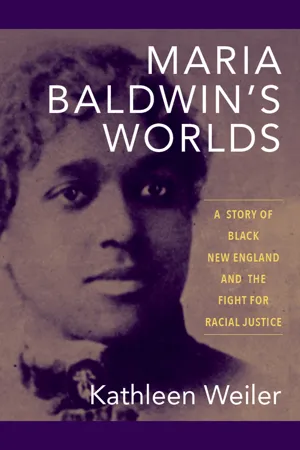
Maria Baldwin's Worlds
A Story of Black New England and the Fight for Racial Justice
- English
- ePUB (mobile friendly)
- Available on iOS & Android
eBook - ePub
About this book
Information
Publisher
University of Massachusetts PressYear
2020Print ISBN
9781625344786
9781625344779
eBook ISBN
9781613767214
Chapter One
A New England Girlhood
Many nineteenth-century African American public figures offered stories of their family’s origins, but very little is known of Maria Baldwin’s family history. Accounts of Baldwin’s life make no reference to either of her parents’ pasts. Except for her brother, Louis, and her sister, Alice, there is no mention of any other family members—no grandparents, aunts, uncles, cousins—and no account of how or why her parents arrived in Cambridge, Massachusetts, in the mid-1850s. Maria Baldwin was born on September 13, 1856, the first child of Peter and Mary Baldwin.1 Their documentation as Maria’s parents on the 1856 birth record seems to be the first mention of either of them in any historical source. On Maria’s birth record her mother, Mary’s, birthplace is given as Baltimore, a detail confirmed in Mary’s death notice, which gives Baltimore as her birthplace and also the birthplace of her parents, James and Catherine Blake. As a border state with a large commercial center, Maryland had a much higher percentage of free people of color than did the states of the deep South. By 1860, 75 percent of African Americans in northern Maryland, which included the city of Baltimore, were free. While Maryland may have had the largest percentage of free black people in the South, this did not mean African Americans were free of discriminatory laws and hostile treatment by whites. Nonetheless, freedom did mean the opportunity to earn money and, for some, the possibility of seeking a better life farther north.2 How Mary Blake came to leave Maryland and, in 1856, at the age of nineteen, be found living in Cambridge, Massachusetts, the wife of Peter Baldwin and mother to a newborn daughter, is unknown. Perhaps Mary Blake and Peter Baldwin met and married in Baltimore, or perhaps Mary came north to Boston to find work and met Peter Baldwin there. There is evidence that Mary Baldwin maintained connections with Maryland. In the 1860 US census, Peter and Mary Baldwin are listed as living at 25 Washington Street in Cambridge in a household with two other women, Mary L. Weeks, twenty, and Harriet Weeks, eighteen, both born in Maryland and most likely kin or close friends of Mary Baldwin—herself then only in her early twenties.
Even less is known of Peter Baldwin. On Maria’s 1856 birth record his occupation is given as mariner and his birthplace as Stonington, Connecticut. But while the 1860 Cambridge city directory also lists his occupation as mariner, and the 1860 US census identifies him as a seaman, his birthplace in the 1860 census is listed as the West Indies. In the 1870 census, his birthplace is once again listed as Connecticut. On his death certificate, both his birthplace and his parents are “unknown.” If Peter Baldwin was an immigrant seaman from the West Indies, he most probably came alone. If he was born in Stonington, Connecticut, there should have been some reference to family. Perhaps he met young Mary Blake in the port city of Baltimore and the two of them then moved to Boston. But why Boston? And what did it mean to be a black seaman?
Although in the nineteenth century seafaring was seen as difficult and low-status work for white men, African American seamen had a much higher status in the black community. In the early years of the nineteenth century, African American seamen participated in an international maritime culture that offered much greater equality and respect than did life in the United States, South or North. For African American men, work as a seaman offered more pay, greater mobility, and more social equality than almost any of the jobs available to them on land. Before 1850, about 20 percent of American seamen nationwide were black. Of the occupations listed for 575 black workers in Boston in 1850, the largest number, 142, were identified as seamen. The next-largest group were 115 laborers.3 In his study of African American seamen, Jeffrey Bolster claims that in the first half of the nineteenth century, seafaring was “crucial to blacks’ economic survival, liberation strategies, and collective identity-formation.”4
While black seamen may have had high status in the African American community, they did not escape racism, on the part of both white captains and crew and authorities in southern ports. By the middle of the nineteenth century, when Peter Baldwin went to sea, conditions for black seamen were worsening. Most southern states had passed Negro Seamen Acts, calling for the arrest of any free black seaman who debarked in a southern port. The jailed seamen faced brutal conditions and had to pay the costs of their own imprisonment. Ships themselves became more strictly segregated, and in general, work as a seaman became less steady and more dangerous in the years leading up to the Civil War.5 The percentage of black workers identifying themselves as sailors fell from 29 percent in 1850 to 19 percent in 1860.6 Nonetheless, Bolster argues, “by tapping an international maritime culture that allowed them to ‘feel as men’ in the presence of co-workers and to ‘presume upon their equality,’ several generations of black men partially circumvented the racist norms of American society.”7 Peter Baldwin’s experiences as a young seaman may have offered him opportunities to expand his talents and build a confidence in himself that he carried with him the rest of his life. And it probably offered him economic advantages as well. Work as a seaman was arduous, but there were no expenses while at sea, and the pay was equal to that of skilled laborers, who held jobs that were largely closed to black men.8 The1860 census lists Peter Baldwin as the owner of the house at 25 Washington Street, Cambridgeport, valued at $2,000. His personal property was worth $500. Somehow, by 1857 Peter Baldwin had amassed enough capital to buy a house, a rare accomplishment for an African American in nineteenth-century Boston or Cambridge.9
The Black Community
Whatever their path, there were good reasons why a young African American couple might have settled in Massachusetts. In Boston and Cambridge, the Baldwins found what has been called the most welcoming place for African Americans in the antebellum United States. In the mid-1850s, when Peter and Mary Baldwin were starting their life together, millions of people of African descent were still held in slavery in the American South, while in the free North, racist practices and beliefs were rampant. But in the thirty years before the Civil War, Boston became one of the major centers of abolitionist activity among both whites and African Americans. Massachusetts as a whole had a very small black population, less than 1percent of the total population of the state. Boston’s black population remained somewhat higher but was still less than 2 percent of the total between 1820 and 1880.10 Although the Boston African American community was small, it was a center of abolitionist organizing and activism. In 1829 the Boston African American activist David Walker published his “Appeal to the Colored Citizens of the World, but in Particular, and Very Expressly, to those of the United States of America,” calling for the abolition of slavery and demanding full social and political equality. Two years later, in 1831, the white abolitionist William Lloyd Garrison founded the newspaper The Liberator and the Massachusetts Anti-Slavery Society, which later merged with the Massachusetts General Colored Association.11 The Liberator became an important source of information and support for the black community with African Americans the majority of its subscribers.12 As Elizabeth Pleck has written, “In the expansion of legal rights, the atmosphere of interracial association, and the militancy of the community leadership, black Boston was almost without equal.”13
Although Boston offered advantages compared to other US cities, that did not mean it was not deeply marked by racism. There was no legal protection from racial discrimination in housing, employment, hotels, restaurants, or professional organizations. The primacy of conceptions of race—of white superiority and black inferiority—solidified and strengthened from the 1820s through the 1860s, in the North as well as the South. While the Boston black community was militant in its advocacy of civil rights and full citizenship, it was not always unified in terms of political strategy. In Black Boston, George Levesque argues that there was an underlying tension within the antebellum Boston African American community between the desire for complete social and legal equality on the one hand and pride in separate institutions that celebrated black identity on the other. In Levesque’s view, demands for both integration and separatism were shaped by the entrenched racism in the North as well as the ominous shadow of the slave system of the South. The struggle against racism meant “opposition to everything that smacked of exclusion.” Yet at the same time, writes Levesque, “the community—as an asylum and as a testimonial of achievement—was a psychic necessity and a source of pride.” Both stances—the demand for complete integration on the one hand and pride in black institutions on the other—were “simply different means to a common end.”14
In Boston, the black community was particularly split around schools and the church. In the antebellum period, African American integrationists argued that the very existence of separate black churches encouraged whites to practice segregation in other settings such as schools, transportation, restaurants, theaters, and shops. Frederick Douglass, for example, urged African Americans to leave black churches and join predominantly white congregations as a sign of social equality. In response, supporters of black churches argued that not only was it highly dubious that African Americans would be welcomed in white churches, but also black churches provided a refuge from racist white society and were central to fostering a sense of common black identity and encouraging collective resistance to racism. The majority of African Americans in both Boston and Cambridge belonged to black congregations.
Schooling in Boston was also a contentious issue. Although the public schools of most cities and towns throughout Massachusetts were integrated—no doubt in part because there were so few black children—Boston had a long tradition of segregation. In the early nineteenth century, in response to racist incidents in the public schools, the black community itself supported the establishment of a separate school for black children. This became the Abiel Smith School on Beacon Hill. By the 1840s, though, African American activists saw the school as an expression not of separatism but of segregation. They began a campaign to integrate the Boston public schools. The campaign culminated in a legal case, Roberts v. City of Boston, in which it was argued that five-year-old Sarah Roberts had the right to attend her local school rather than walk many blocks to the all-black Smith School. In 1850 the Massachusetts Supreme Court ruled against Roberts and affirmed that segregation was legal, a decision immediately condemned by African Americans and their allies. This was the same year that the US Congress passed the Fugitive Slave Act, which allowed slave owners to send slave hunters after escaped slaves even in the free states of the North. The Fugitive Slave Act outraged white as well as black northerners. It was a sign of whites’ growing acceptance of black civil rights in the North as well as the increasing strength of the abolitionist movement that five years later, in 1855, the Massachusetts General Court banned segregated schools throughout the state. Boston schools were then integrated, seemingly without incident.
The integration of public schools in Boston was a victory, but both black and white abolitionists were shaken by the US Supreme Court’s 1857 Dred Scott decision, which asserted that people of African descent could never be citizens of the United States. The decision intensified the sense of emergency caused by the Fugitive Slave Act among both the African American community and their white allies. Dred Scott seemed to justify the need for violent resistance advocated by radical abolitionists like John Brown, but it also encouraged the growth of the antislavery but more moderate Republican Party. Even though the extent of its commitment to full citizenship for all was questioned by many African Americans, the Republican Party seemed to offer the best hope for change within the existing political landscape.
Peter and Mary Baldwin must have been aware of the currents of opinion and struggles within the Boston African American community, and there is strong evidence that Peter Baldwin was a supporter of the Republican Party. The couple settled not in Boston but across the Charles River in the city of Cambridge. Their daughter Maria was born in 1856; in 1857 Peter bought the house at 25 Washington Street in the Cambridge neighborhood of Cambridgeport where their second daughter, Alice Gertrude, was born in 1859. Cambridge was a small city. In 1860, Boston, with a population of 177,000, was the fifth-largest city in the United States. Cambridge had a population of 26,000 and had been formally incorporated as a city only in 1846. By 1860 the city was gradually growing together from three original villages: Old Cambridge, centered on Harvard College; East Cambridge on the Charles River, home to a growing number of factories and small businesses; and Cambridgeport, halfway between the other two. Several bridges across the Charles connected Cambridge to the much larger city of Boston. When Peter and Mary Baldwin settled in Cambridgeport, it was a sprawling neighborhood of crowded streets providing housing to a mixed population of native-born whites, immigrants, and a small number of African Americans, who made up about 1 percent of the city’s total. Although the black population of Cambridge was small—rising from 141 in 1850 to 354 in 1860—it included a number of politically active abolitionists. We have no evidence of the political involvement of Peter or Mary Baldwin in these years, but they must have been aware of the Cambridge abolitionists as well as those in the larger Boston black community. In the mid-1850s there was no black church in Cambridge, although more liberal churches associated with the abolitionists could include black parishioners.15 In contrast, by 1848 there were four black churches in Boston for a black population of around two thousand. That year the black Twelfth Baptist Church, which quickly became a center of abolitionist organizing, was established. Peter and Mary Baldwin may have found a religious and political home in one of these black Boston churches.
The outbreak of the Civil War in April 1861 would have been a momentous event for the Baldwin family, as for others in the Boston and Cambridge black community. The goal of abolition, once seen as the obsession of a few radicals, was now within reach. Peter Baldwin’s activities during the war are not known. Like most other black New Englanders he supported the Republican Party, even though Lincoln and the Republicans had vacillated on the question of slavery. It was only on January 1, 1863, almost two years after the outbreak of war, that Lincoln issued the Emancipation Proclamation. Despite the hesitancy of Lincoln and the Republicans, the proclamation solidified black support for the party. Black Bostonians showed their support of the Union in a variety of ways, perhaps most dramatically in the participation of African American soldiers in the army’s black regiments and in the navy. In Boston, the formation of the black Fifty-fourth and Fifty-fifth Regiments was a powerful symbol of citizenship and achievement. There is no record of Peter Baldwin’s service in any of the black regiments, and although over 1,300 men enlisted in the navy at Charlestown Navy Yard, Baldwin’s name is not among them. He may well have continued to work as a seaman during the war, while Mary Baldwin would have been occupied with raising her two daughters and maintaining the household. Just as the war was ending, in 1865, when Maria was nine and her sister Alice was seven, their brother Louis was born.
Maria Baldwin, known as Mollie, a nickname that intimate friends continued to use throughout her life, must have entered Cambridge’s public schools in the early years of the war.16 In her only description of these years, “A Night Watch,” published in a section titled “Reminiscences” in the African American women’s journal The Woman’s Era, she describes an incident she experienced as a child in a city she calls Bainbridge, a thinly disguised Cambridge. It...
Table of contents
- Cover
- Title Page
- Copyright Page
- Contents
- Preface
- Introduction
- Chapter One
- Chapter Two
- Chapter Three
- Chapter Four
- Chapter Five
- Afterword
- Notes
- Index
Trusted by 375,005 students
Access to over 1.5 million titles for a fair monthly price.
Study more efficiently using our study tools.
Frequently asked questions
Yes, you can cancel anytime from the Subscription tab in your account settings on the Perlego website. Your subscription will stay active until the end of your current billing period. Learn how to cancel your subscription
No, books cannot be downloaded as external files, such as PDFs, for use outside of Perlego. However, you can download books within the Perlego app for offline reading on mobile or tablet. Learn how to download books offline
Perlego offers two plans: Essential and Complete
- Essential is ideal for learners and professionals who enjoy exploring a wide range of subjects. Access the Essential Library with 800,000+ trusted titles and best-sellers across business, personal growth, and the humanities. Includes unlimited reading time and Standard Read Aloud voice.
- Complete: Perfect for advanced learners and researchers needing full, unrestricted access. Unlock 1.5M+ books across hundreds of subjects, including academic and specialized titles. The Complete Plan also includes advanced features like Premium Read Aloud and Research Assistant.
We are an online textbook subscription service, where you can get access to an entire online library for less than the price of a single book per month. With over 1.5 million books across 990+ topics, we’ve got you covered! Learn about our mission
Look out for the read-aloud symbol on your next book to see if you can listen to it. The read-aloud tool reads text aloud for you, highlighting the text as it is being read. You can pause it, speed it up and slow it down. Learn more about Read Aloud
Yes! You can use the Perlego app on both iOS and Android devices to read anytime, anywhere — even offline. Perfect for commutes or when you’re on the go.
Please note we cannot support devices running on iOS 13 and Android 7 or earlier. Learn more about using the app
Please note we cannot support devices running on iOS 13 and Android 7 or earlier. Learn more about using the app
Yes, you can access Maria Baldwin's Worlds by Kathleen Weiler in PDF and/or ePUB format, as well as other popular books in History & History of Education. We have over 1.5 million books available in our catalogue for you to explore.