The life of William Apess (1798–1839), a Pequot Indian, Methodist preacher, and widely celebrated writer, provides a lens through which to comprehend the complex dynamics of indigenous survival and resistance in the era of America's early nationhood. Apess's life intersects with multiple aspects of indigenous identity and existence in this period, including indentured servitude, slavery, service in the armed forces, syncretic engagements with Christian spirituality, and Native struggles for political and cultural autonomy. Even more, Apess offers a powerful and provocative voice for the persistence of Native presence in a time and place that was long supposed to have settled its "Indian question" in favor of extinction.
Through meticulous archival research, close readings of Apess's key works, and informed and imaginative speculation about his largely enigmatic life, Drew Lopenzina provides a vivid portrait of this singular Native American figure. This new biography will sit alongside Apess's own writing as vital reading for those interested in early America and indigeneity.
eBook - ePub
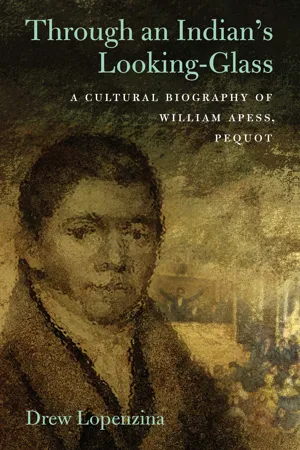
Through an Indian's Looking-Glass
A Cultural Biography of William Apess, Pequot
- English
- ePUB (mobile friendly)
- Available on iOS & Android
eBook - ePub
About this book
Information
Publisher
University of Massachusetts PressYear
2018Print ISBN
9781625342591
9781625342584
eBook ISBN
9781613764961
Chapter One
The Baskets Copy Our Stories
Some think the idea for weaving baskets came from the earth, which is the holder of our cornfields. Which is the holder of our lives. Yes, the baskets just copy the land.
But others think the idea for weaving baskets came from the sky. An upside-down holder of the rain. So it falls back to us.
But I say, the idea for baskets came from our stories. The baskets hold fish and corn and beans. Just like our stories hold meaning. Yes, I say the baskets copy our stories.
—Diane Glancy, Pushing the Bear
On a chill spring evening in 1802 walks the old woman, her unsold wares lashed to her back, bumping lightly together with the rhythm of her footsteps, straw brooms, pails, and baskets, some softer vessels of wild hemp and corn leaf she herself has woven and bound, stamped and imprinted with dye made from the juice of bloodroot and berries, the whole assemblage melded to her frame so that she resembles, in the dimming light, some mythic beast just wandered out from the wood. Her dress, thrown over her taut frame, is of brown homespun, embroidered with porcupine quills in roseate patterns that loop and wind, feet shoed with deerskin, hair pulled back with hemp. She walks, hunched over, not so much from weight or even age, but from other burdens she has carried. She has come many miles and her breath carries the heavy scent of rum that escapes with the curses she utters to none but the darkening sky as she presses homeward.
Upon reaching the threshold of the cabin, she unburdens herself of baskets and brooms, hangs them by a nail embedded on a rude post propping up the extended eave that shelters the doorstep. She enters the cramped quarters, her eyes moving back and forth, parsing the countenances of the five young children within whose shapes are limned by the hearthfire before which they huddle. There is a wooden table and a few handmade chairs for furniture, a small bundle of wood piled by the hearth and a pail filled with water nearby, bits of ash swirling within. Tools hang amidst grasses and dried herbs on the walls, the floor is strewn with wood shavings and straw.
The children do not appear to be engaged in anything other than staring at the flames. The youngest is not yet two years old and a doll made of corn cob and leaves lies limp in the folds of her dress. They have not eaten. There is no telling why the woman’s gaze lingers on the one whose dark hair hangs slightly over his eyes, skinny, sitting on his haunches, clothed in rags, his uncertain lips proffering the slightest intimation of a smile. The others look to her as well, but she is troubled by him alone, a certain searching in his countenance that levels some unspoken claim she feels welling up inside her, mixing with the rum.
She takes a step and stumbles, nearly falling to the floor. Until this point the very rhythm of her walking, endlessly, along the dirt path had steadied her like a drumbeat, kept her moving upright and in a straight line, but now that she has paused, forfeited her momentum, her knees buckle and she lurches forward. The child does not flinch or move his eyes from hers.
“Why do you stare at me like that?” she demands of him. She is only half aware at first that she has even spoken this aloud, or how it stands apart from her other random mutterings, but as the realization sinks in she repeats it with even greater force.
“Why do you stare at me? Do you hate me?”
This child has experienced many things in his short life. He has felt love, loss, hunger, pain, and sorrow enough to cripple many a soul. He has collected these emotions, stirred them about, wrestled down some of the sharper edged fragments that cut from the inside and are not forgotten.
Yet however rich and complex his world of feeling, however deep the intelligence by which he measures his small dram of heartache and injury, he does not count hate among his reserve. He has unconsciously flirted with it, but is too young to reduce his allotment of experiences into that cold hardened lump animating so much of human endeavor. Though he is cognizant of it. Has seen it in the world already and felt its proximity. It is a force that hovers about him, creeps close upon the quarters where he and his siblings huddle on the cold floor, involves itself in his circumstances in ways that he has no ability to articulate at this young age and perhaps never will. Hate is both a presence and an absence.
When he looks around the room, sees his young sister’s wasted frame close by the fire, waxen and listless, he knows hate is nearby. When he looks for the faces of his mother and father whose purposeful talk and movements once kept this space astir, he knows hate has worked to somehow cast them from his presence. And there is hate in the air both inside and out, although he wouldn’t know how to name it thus or from whence it entered. He only knows it as an indeterminate force that presses down on him and he feels it hovering around the frame of his grandmother who has been gone since before the sun arose and who is somehow visibly wrested by this force and speaking its name as the smell of it comes streaming in a current of her breath.
“Do you hate me?” she demands once more.
“Yes,” he answers.
“The Intensity of Our Sufferings I Cannot Tell”
William Apess was roughly thirty years old when he recorded the above events for his 1829 autobiography A Son of the Forest. Already he had journeyed far from his obscure and pathetic origins, seen a large swath of the world, served in war, experienced combat at its most heated and brutal pitch, and labored at many different occupations: cobbler, farmhand, baker, river boat navigator. More significantly, he had educated himself in the ways of the dominant white culture, becoming adept enough at their spiritual practices to be considered for ordination in the Methodist Episcopal Church (a position that would ultimately be denied him) and, in fact, to attempt what few, if any, other Native people had essayed up to this point in time—that is, to write a book-length story of his life. He had climbed about as high as a Native man could expect to aspire in a world built to enable and protect the economic and cultural propriety of whites, which is to say, he was eking out a living by itinerant preaching and selling his books.
He had also put some manner of distance between himself and the traumas of his youth. He had steadied himself against all odds, was married, sober, and supporting a young family. Settling down to write his story, he was able somehow to summon a controlled and dispassionate voice as he recalled how his grandmother took up a club on that long ago evening and proceeded to beat him “unmercifully,” repeating the question “Do you hate me?,” which, as he recalls, “I very innocently answered in the affirmative as I did not then know what the word meant and thought all the while I was answering aright; and so she continued asking me the same question, and I as often answered in the same way, whereupon she continued beating me,” until “my poor little body was mangled and my little arm broken into three pieces.”1
Undoubtedly Apess had learned enough in his travels to appreciate the risks of ripping open such old wounds, of trotting them out for a public viewing and exposing his immediate family, and, by extension, the larger indigenous community implicated in such acts, to censure and even ridicule by white readers. And there were personal risks for Apess as well. Such memories must still have carried with them a psychic residue, painful to recall and even more painful to orchestrate in prose. One of the paradoxical symptoms of being a victim of such violence is that it is not uncommon to entertain on some level the notion that it was somehow deserved. An affect and privilege of power is that it protects itself by channeling blame back toward the victim, and when such violence can be positioned within a discourse of race, the dynamic complicates exponentially, reaffirming deep-rooted stereotypes that operate both within and without the abused subject. Simpler by far, then, would have been to bypass the shameful history of his treatment at the hands of his own family altogether, burying such uncomfortable confessions in the darkest recesses of his consciousness or anecdotally attributing them to someone else entirely. Certainly, he could invoke sympathy for Native peoples without making them complicit in their own injury, without reaffirming the worst stereotypes maintained by the white evangelical communities most likely to read his books. He might easily be forgiven for not exposing such intimate acts of domestic cruelty to light. And yet Apess begins the narrative arc of his life journey at precisely this point. It is the very thing he must address.
Apess had arrived at an acute awareness that, whatever the risk involved, traumas left in the dark can never be healed, their wrongs never corrected. Rather than view himself as the individual object of an injustice at the hands of his grandparents, Apess apprehended larger machinations at work. He determined to boldly bear witness not only to his own mistreatment, but to the complex social forces that engendered it and to which he, his parents, his grandparents, and his entire extended community of “brethren” (as he often referred to his fellow Natives) remained entirely vulnerable. A powerful tide of history had brought both the young Apess and his grandmother to wreck upon the shores of this concentrated outbreak of violence. As he noted, “This cruel and unusual conduct was the effect of some cause.” And if he could not entirely exonerate his grandmother for her behavior, he understood that “the whites were justly chargeable with at least some portion of my sufferings.”2 This chapter seeks to explicate some of the cultural and historical forces that help to account for William Apess’s traumatic childhood experience.
At the time of his writing the autobiographical A Son of the Forest, it may have been difficult for Apess to fully unravel this long and complicated history. He may as yet have lacked the rhetorical skill, and he certainly lacked the formal education, the time, and the resources to explicate what many recognized but so few would openly acknowledge—that is, that indigenous peoples of the Northeast stood at the very epicenter of over two hundred years of the most aggressive and vindictive colonial encroachments. In fact, the deliberate annihilation of Native lifeways in New England, and in particular that of the Pequots, had proceeded to such a point that, where it had once been in the interests of the colonial power structure to violently “Root their very Name out of this Country,” it had now become almost fashionable to pity the “poor child of the forest” and view the “dying race” of Natives as dependent “wards of the state” in need of charity and government oversight.3 Such a state of cultural crisis and condescension served only to complicate the range of effective responses that could be mustered by any Native individual dedicated to improving the condition of his people.
Apess understood that there was little to gain by invoking sympathy for his troubled childhood. Sympathy, even well-intentioned sympathy, would only position him squarely back within the dominant paradigm that continued to politically disenfranchise Native people. He makes a point of noting, “I merely relate these circumstances, without any embellishment or exaggeration, to show the reader how we [he and his siblings] were treated. The intensity of our sufferings I cannot tell.”4 Apess understood that, rather than become an object of pity, he somehow needed to reverse the current of anguish, to reflect back upon the settler culture how their own actions lay at the root of the perceived injustices and were colored by the very characteristics of “savagery” with which they had attempted to tar Native peoples. Apess understood that hate didn’t always come exclusively at the end of a gun or a sword, but that it continued to exert itself through other means as an ambivalent presence, a studied indifference to the social conditions achieved through violence that could be generationally perpetuated, expanded upon, and coolly rationalized through processes of racial categorization. These categories, left unchallenged, would continue to wreak devastation on Native lives, uproot entire communities, and aggressively beat down every claim to Native sovereignty and land title across the North American continent.
In 1829, Apess had just recently battled his way into the structure of the Methodist Church. If he had attained a rare status for a Native man of the early nineteenth century, he stood yet on precarious ground. As we will see, he had to overcome a great deal of institutional resistance to get to where he was and needed to frame his words of protest with the greatest care. As such, he attributed his grandmother’s actions “in a great measure to the whites, inasmuch as they introduced among my countrymen that bane of comfort and happiness, ardent spirits—seduced them into a love of it and, when under its unhappy influence, wronged them out of their lawful possessions—that land where reposed the ashes of their sires.”5
For Apess to blame his grandmother’s actions on “the influence of spirituous liquor” was at best a partial indictment of colonial violence toward Native peoples, but it was an indictment that played well within the structure of the Methodist Church, where temperance sermons were the coin of the realm, and it allowed him to at least gesture toward that larger history of misuse and deceit that informed his pivotal childhood memories. Before the introduction of the “debaucheries of the whites,” Apess tells us, Native people were as “unoffending and happy as they roamed over their goodly possessions as any people on whom the sun of heaven ever shone.” But in the wake of colonial infiltration, “the consequence was that they [Native peoples] were scattered abroad. Now many of them were seen reeling about intoxicated with liquor, neglecting to provide for themselves and families, who were before assiduously engaged in supplying the necessities of those depending upon them for support. I do not make this statement in order to justify those who had treated me so unkindly, but simply to show that . . . I was thus treated only when they [his grandparents] were under the influence of spirituous liquor.”6
It may be difficult for contemporary readers to grasp the limited outlets for protest confronted by someone in Apess’s situation—his time, his place, and his racial profile. It may, in fact, be difficult for many contemporary readers to fathom that such an Indian as Apess even existed, given that he fails to conform to the most ubiquitous stereotypes of Native identity in circulation both then and now. Americans have long had a tendency to view Native people through a highly romanticized lens as a bundle of contradictions, typified by the Comanche and Sioux warrior type of Hollywood productions, patrolling the western plains or dense forests, bare-torsoed, in feathered headdress, pursuing buffalo or wagon trains and looking to kidnap unsuspecting white women and children—or, conversely, as hyperspiritualized stewards of the environment, in communion with animal spirits and shedding a tear, perhaps, for our current despoiled environment before dissolving into the landscape. Rarely is this figure imagined as belonging to vital community structures, in a family setting, with concerns both domestic and political. He is rather an emblem of savage passions and agendas, driven by bloodlust and revenge, melancholic, isolated by historical forces that are in the very process of rooting him from the earth. And even when we are, perhaps, conscious of the reductive nature of these stereotypes, we find ourselves armed with little to combat or replace them. In short, Indians, as the mainstream culture has come to know them, are supposed to look nothing like the evangelizing, book-writing, temperance-lecturing promoter of the Christian creed William Apess.
In the most general terms, however, Apess’s circumstances were, in fact, typical of nineteenth-century Native lives in the Northeast. By 1829, the local tribes of New England, including the Wampanoags, Narragansetts, Nipmucks, Pocumtucks, Abenakis, Passamaquoddies, Montauks, Schagticokes, Mohegans, and the Pequots among them, had withstood over two centuries of sustained colonial aggression. A number of these tribes had managed, against seemingly insurmountable odds, to maintain a land base, and they had done so through elaborate processes of diplomacy, resistance, and assimilation. By Apess’s time, however, Native peoples had, in the most outward manifestation of their appearance, accepted English manners and customs, like one who puts on a borrowed coat after their own has been strippe...
Table of contents
- Cover
- Title Page
- Copyright Page
- Dedication
- Contents
- Acknowledgments
- Introduction. Negative Work
- 1. The Baskets Copy Our Stories
- 2. Birthright, Bondage, and Beyond
- 3. The Broad Theater of the World
- 4. “And They Held All Things in Common”
- 5. Becoming a Son of the Forest
- 6. Indian Preacher
- 7. The Bizarre Theater of Empire
- Conclusion. “He Possessed the Real Traits of the Indian Character”
- Appendix: Memorial of the Marshpee Indians, January 1834
- Notes
- Index
Trusted by 375,005 students
Access to over 1.5 million titles for a fair monthly price.
Study more efficiently using our study tools.
Frequently asked questions
Yes, you can cancel anytime from the Subscription tab in your account settings on the Perlego website. Your subscription will stay active until the end of your current billing period. Learn how to cancel your subscription
No, books cannot be downloaded as external files, such as PDFs, for use outside of Perlego. However, you can download books within the Perlego app for offline reading on mobile or tablet. Learn how to download books offline
Perlego offers two plans: Essential and Complete
- Essential is ideal for learners and professionals who enjoy exploring a wide range of subjects. Access the Essential Library with 800,000+ trusted titles and best-sellers across business, personal growth, and the humanities. Includes unlimited reading time and Standard Read Aloud voice.
- Complete: Perfect for advanced learners and researchers needing full, unrestricted access. Unlock 1.5M+ books across hundreds of subjects, including academic and specialized titles. The Complete Plan also includes advanced features like Premium Read Aloud and Research Assistant.
We are an online textbook subscription service, where you can get access to an entire online library for less than the price of a single book per month. With over 1.5 million books across 990+ topics, we’ve got you covered! Learn about our mission
Look out for the read-aloud symbol on your next book to see if you can listen to it. The read-aloud tool reads text aloud for you, highlighting the text as it is being read. You can pause it, speed it up and slow it down. Learn more about Read Aloud
Yes! You can use the Perlego app on both iOS and Android devices to read anytime, anywhere — even offline. Perfect for commutes or when you’re on the go.
Please note we cannot support devices running on iOS 13 and Android 7 or earlier. Learn more about using the app
Please note we cannot support devices running on iOS 13 and Android 7 or earlier. Learn more about using the app
Yes, you can access Through an Indian's Looking-Glass by Drew Lopenzina in PDF and/or ePUB format, as well as other popular books in History & North American History. We have over 1.5 million books available in our catalogue for you to explore.