The rich slice of Americana found in minor league baseball presents a contradictory culture. On the one hand, the minors are filled with wholesome, family-friendly entertainment-fluffy mascots, kitschy promotions, and earnest young men signing autographs for wide-eyed Little Leaguers. On the other, they comprise a world of cutthroat competition in which a teammate's failure or injury can be the cause of quiet celebration and 90 percent of all players never play a single inning in the major leagues.
In Knocking on Heaven's Door, award-winning sportswriter Marty Dobrow examines this double-edged culture by chronicling the lives of six minor leaguers—Brad Baker, Doug Clark, Manny Delcarmen, Randy Ruiz, Matt Torra, and Charlie Zink—all struggling to make their way to "The Show." What links them together, aside from their common goal, is that they are all represented by the same team of agents—Jim and Lisa Masteralexis and their partner Steve McKelvey—whose own aspirations parallel those of the players they represent.
The story begins during spring training in 2005 and ends in the fall of 2008, followed by a brief epilogue that updates each player's fortunes through the 2009 season. Along the way Dobrow offers a revealing, intimate look at life in minor league baseball: the relentless tedium of its itinerant routines and daily rituals; the lure of performance-enhancing drugs as a means of gaining a competitive edge; the role of agents in negotiating each player's failures as well as his successes; and the influence of wives, girlfriends, and family members who have invested in the dream.
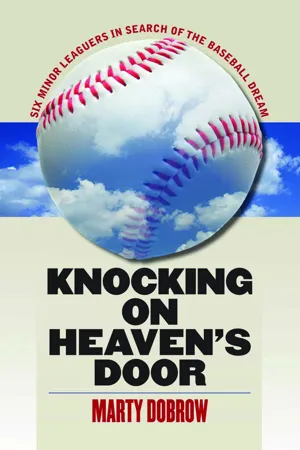
eBook - ePub
Knocking on Heaven’s Door
Six Minor Leaguers in Search of the Baseball Dream
- English
- ePUB (mobile friendly)
- Available on iOS & Android
eBook - ePub
About this book
Information
Print ISBN
9781558498433
9781558498426
Subtopic
Journalism1 | Spring Training 2005 |
1 | Crash Davis Territory Scottsdale, Arizona |
A few weeks in the Southwest have awakened Doug Clark’s freckles from hibernation. They have blossomed on his powerful forearms. They have started to create sheet music on his slightly lined forehead. And they have cropped up on the temples flanking his hazel eyes—alert, penetrating eyes that are now focused on a television screen in his room at the Days Inn.
As the cameras settle in on Sammy Sosa and Mark McGwire, Doug cannot help flashing back to 1998. That was the year when these two larger-than-life stars carried the sport on their broad shoulders. Together the ebullient Sosa, hop-stepping after each moon shot over the ivy, and the Bunyanesque McGwire, blasting baseballs deep into the St. Louis night, had taken aim at one of the gold standards of sport: Roger Maris’s single-season home run record of sixty-one. Maris, of course, had eclipsed Babe Ruth’s thirty-four-year-old record of sixty back in 1961. Thirty-seven baseball seasons had come and gone, with grand sluggers named Mays and Aaron, Killebrew and Banks, Robinson and Jackson, Schmidt and Griffey all falling well short of the mark. But in 1998 Sosa somehow hit sixty-six—a truly remarkable feat, and still four shy of the seventy smashed by Big Mac. That season was a national love fest, with SportsCenter paeans on a daily basis, charts in every newspaper, fans flocking to the ballpark, ready to invest their money and their faith. Many credited Sosa and McGwire with nothing less than saving the sport from the taint of 1994, when owners and players, unwilling to divide vast riches, had canceled the World Series.
That summer of the great long-ball duel coincided with Doug Clark’s first year of pro ball. He hit three home runs that year playing for the Single-A Salem-Keizer Volcanoes in Oregon. He lived in the basement of his host family’s house and took long bus trips to play teams like the Yakima Bears and the Tri-City Dust Devils. There were times when he almost couldn’t believe his good fortune. He was a professional athlete, getting paid to play the game. Yes, it was only $850 a month (not even in the same galaxy as Sosa’s 1998 salary of $8,325,000 or McGwire’s $8,928,354), but still, it felt like some childhood fantasy come to life. In a family of seven kids, he had grown up sharing a basement room with two older brothers, three thousand miles away in Springfield, Massachusetts. Now here he was, on a big green field between the Cascades and the vast sweep of the Pacific. Sometimes when he left the ballpark at night, he would just look up at the sky. He couldn’t believe how many stars there were.
Breathing in the stale air-conditioned air, Doug watches the usually effervescent Sosa speak haltingly, suddenly unable to answer in English after years of charming fluency in postgame interviews. Slammin’ Sammy’s prepared words are meek, their meaning carefully parsed: “To be clear, I have never taken illegal performance-enhancing drugs. I have never injected myself, or had anyone inject me with anything. I’ve not broken the laws of the United States or the laws of the Dominican Republic. I’ve been tested as recently as 2004 and I am clean.”
Doug stares at the mighty McGwire, looking like a man sitting on a tack, stammering and sputtering his way through one non-answer after another, repeating the limp mantra “I’m not here to talk about the past.”
He takes in the sight of the dapper Rafael Palmeiro, wagging his finger defiantly at the cameras and stating, “Let me start by telling you this: I have never taken steroids—period. I don’t know how to say it any more clearly than that. Never.”
There they are, three of only twenty men in the grand history of Major League Baseball to hit five hundred career home runs.1
And of course there is Jose Canseco, author of “only” 462 homers, and author also of Juiced, a 304-page book released a month earlier that swaggered its way through confession and accusation. Canseco alternately extolled the virtues of steroids, for extending the human potential and expanding the range of the possible, and cautioned about their risks—making the soul (and certain organs) contract. Canseco is resplendent in his navy blue suit, all but wearing the scarlet “S” as an accessory while accusing others of doing the same.
For Doug, though, the most riveting testimony does not come from the stars. It comes from the parents of Rob Garibaldi and Taylor Hooton, two young ballplayers who had taken steroids in the quest for baseball greatness.
Garibaldi had grown up in Petaluma, California, just north of the Bay Area. At age seven he had told his mother, Denise, a clinical psychologist, that he wanted to be a baseball player. For years he was single-minded in pursuit of that goal. He used to videotape McGwire’s at bats. At Casa Grande High School he was a scrawny star who began ingesting an array of supplements, which gave way to “Andro” (androstenedione, the steroid precursor that was legal in Major League Baseball when McGwire admitted using it in 1998). After graduating, Garibaldi drove to Tijuana with a friend and purchased steroids. He got bigger and better and bigger still, starring for a community college, and then earning a full scholarship to the University of Southern California, a perennial baseball power. After one great season, though, he began to tumble out of control: chasms of depression, stretches of unpredictable behavior, fits of rage. One day, sitting in a car around the corner from his home, he pointed a stolen .357 Magnum at his temple and fired.
“There is no doubt in our minds,” Denise Garibaldi told Congress, “that steroids killed our son.”
Taylor Hooton grew up in Plano, Texas. The cousin of former big league pitcher Burt Hooton, Taylor aspired to stardom on the mound. Told by a coach during his junior year of high school that he would need to be bigger to become a dominant pitcher, he embarked on an aggressive course of steroid use. Taylor built himself up, broke himself down. He was seventeen years old when his mother found him hanging from the door of his childhood bedroom. He left a vial of steroids in his room, wrapped in an American flag.
“It’s a real challenge for parents to overpower the strong message that’s being sent to our children by your behavior,” Taylor’s father, Donald Hooton, said to the assembled stars. “Players that are guilty of taking steroids are not only cheaters—you are cowards.”
Just a few weeks before, Doug Clark had been surrounded by kids who were not all that different from Taylor Hooton. The students he taught as a substitute at Springfield Central High School were a restless lot. There were two thousand of them, roughly a third black, a third white, a third Hispanic. Beneath all of their posturing Doug sensed the familiar hunger, the yearning to stand out. He understood. He had come out of the same inner-city high school some years before. In each of the last seven off-seasons he had come back to teach.
With a biology degree from the University of Massachusetts, he was comfortable manning a science class and overseeing most levels of math. He could fake his way through history and pinch-hit easily in PE. During downtime he liked to regale the trim and elegant Mena DeCarvalho (his former Spanish teacher and onetime coach of the cheerleaders) with tales from his winter league experiences in Mexico and the Dominican Republic. Mostly he was drawn by the kids, by the battles of innocence and angst, by the lights that had not yet gone out. Corny or not, he believed in being a role model.
After school he would sometimes talk about the students with his mother, Peggy, a former teacher herself. Often he’d persuade his cousin and close friend R. J. Joyal, a local high school principal, to go out for a beer; or he’d catch a college basketball game with his younger brother Connell, a middle school math teacher. Teaching was the family path.
At night he would crash at the family homestead, going down to the basement room he once shared with older brothers Will and Andrew, now both married and fathers of young children. On the wall, still, was a reminder of Doug’s other line of work: a poster made of baseball cards from the 1998 Salem-Keizer Volcanoes, thirty-three fresh-faced kids starting out their pro careers, all determined to make it to the big leagues. Almost all of them had long since abandoned ship or, more commonly, been pushed off the plank.
Doug has been good enough to stay on board. Through seven seasons he has managed a career batting average of .291. He spent the last five in the so-called “high minors” of Double-A (primarily) and Triple-A, close to the Promised Land. A year ago, in 2004, he hit .292 with ten home runs, seventy-one RBI, and thirty-three stolen bases for the Norwich Navigators, Double-A affiliate of the San Francisco Giants. He has played all three outfield positions and played them well. Talk to his minor league managers and you will hear a familiar refrain: Doug is a hard worker, a good guy, a true professional.
But he has never spent a single day in the major leagues.
One thing Doug has not demonstrated is a lot of pop. He has never hit more than eleven home runs in a season. At six foot two and a stony 207 pounds, Doug does have what some call gap power (twenty-three doubles and a league-leading thirteen triples a year ago), but he is playing in an era when there is a lust for the long ball.
It has been seven long years. Seven years of doing things on the cheap. Never before has Doug made more than $2,400 a month, paid only from the first day of the season in early April until the final game on Labor Day, meaning $12,000 for the year. True, 2005 will be different. Having completed seven full seasons, Doug had been eligible for the first time for minor league free agency. He and his agent, Jim Masteralexis, had gotten some interest from several teams but decided ultimately to re-sign with the Giants for a sizable raise. The $6,500 a month will give him a living wage from baseball for the first time, more than $30,000 for the year.
Still, that is a far cry from major league money. Playing just three weeks in the bigs at the prorated minimum salary of almost $2,000 per game would easily eclipse his yearly salary at the minor league level. In the minors, of course, he would continue to get a per diem on the road, meal money of $20. But in the majors that figure would be $80.50. Pizza versus prime rib.
Doug knows that the threshold of talent separating top-level minor leaguers from entry-level major leaguers is razor thin. The disparity in income, though, is enormous. Baseball is unlike most career fields that way; after all, near-great doctors are still quite affluent.
He has lived a big chunk of his life in the contradictory culture of the minors, at once charming and ruthless. For all the family-friendly entertainment the players provide, they live in a world that militates against forming any sort of friendship, one in which the temptation to cut corners—to cheat—is enormous. Many of them have little else to fall back on after baseball. Their identity and all their eggs are tucked into this one basket. There is a yearning to become just a little bit better. A little more bat speed, an extra two miles per hour on the fastball, and maybe, just maybe, you will get the call.
Doug’s perspective on baseball’s darkening cloud of steroids and performance-enhancing drugs doesn’t just come from his status as a minor leaguer trying to make it big, or a teacher trying to keep it real. It goes beyond his academic background in biology. There is also the little matter of his professional affiliation. He has spent his whole career as an outfielder—primarily a left fielder—with the San Francisco Giants’ organization, where he has worked in the most formidable shadow in the world of sports.
Doug is fascinated by Barry Bonds. How could he not be? In this intensely competitive arena, here is a guy who seems to stand above the game. Sometimes at the Giants’ spring training facility, around the edges of his own workouts, Doug can’t help staring at the batting cage when Bonds takes his hacks. It is always an event: the short and beautiful swing, the enormous blasts into the desert sky. This is the hardest thing to do in sports, it is often said—hit a round ball with a round bat, and hit it square. Nobody does it better. “He has so much power up there,” says Doug, “that you can’t even fathom it.”
Back in 2000 Doug had gone to major league spring training for the first time as a non-roster invitee. He got to stay at the major league hotel, the Marriott, and basked in the luxury of it all. In the clubhouse, his locker was just two away from Bonds’s. He went about his business, tried to act as if he belonged, put on his sanitary hose without yielding to peripheral vision. One day, though, he was introduced to the slugger by Bonds’s father, Bobby Bonds, himself a former Giants outfielder who now worked with minor leaguers. “This guy,” Bobby told his son, “can hit.”
A few days later, when Doug was, not surprisingly, sent down to minor league camp, Bonds gave him a bat. Doug thanked him, perhaps too profusely, and carefully placed the lumber in his bag. Later that day the bat was stolen, almost certainly by one of Doug’s minor league teammates.
In 2001 Doug was back at big league camp for a few weeks. He made a home video for his eldest brother, Will, who was getting married back in Springfield on Saint Patrick’s Day. Approaching veterans such as Eric Davis, Shawon Dunston, J. T. Snow, and Marvin Bernard, Doug asked for their thoughts about marriage and got replies from “Have tons of kids” to “Don’t do it!” Part of the video shows Bonds asleep in the training room. Of course he awakened to hit a record seventy-three home runs that season, while Doug, toiling in Shreveport, Louisiana, managed six.
He continued the grind, the bus trips to Wichita, to Mobile, to Trenton, living out of a suitcase for months at a time. He ate hundreds of meals at Denny’s. In stints with the Fresno Grizzlies at Triple-A in 2002 and 2003, he touched the highest rung of the minor league ladder. One of the supposed perks there was flying to road games. Often what that meant in practice was coming home to the two-bedroom condo he shared with three other players after a Thursday night game, sleeping for an hour or two, then waking for a 3:30 a.m. shuttle bus to the airport. There he would catch a flight to Tucson or New Orleans for a Friday night game. By not flying right after the game, the team saved on hotel bills.
In the off-season Doug took to spending two months as an “import” for winter league teams in the Dominican Republic and Mexico. The money was decent and the opportunity was clear: a chance to get better. Still, he struggled, far from home, dealing with Montezuma’s revenge, sputtering his way through the Spanish he remembered from Mena DeCarvalho, breathing in the smoke wafting to the back of the bus during twisting rides through the mountains. Sometimes when his Navojoa team played in Mexicali, he would wait in a long line to cross the border into Calexico, California, where he’d stock up on Pop-Tarts at Wal-Mart and revel in the cell phone reception, calling home to his dad. It was a hard life, a lonely one, but the quest demanded it. He yearned to find that edge, “to be that person they want.”
After his third year of winter ball, he came back to Springfield in January 2005, spent time with his family, and worked as a sub at Central High. In February he flew out once again to Arizona for his eighth year as a pro.
He was amazed at the world he encountered. The usual tranquillity of spring training had been replaced by a wild buzzing of activity. Reporters swarmed everywhere. The congressional hearings were looming. Barry Bonds would not be appearing because of an ongoing grand jury investigation regarding his testimony in the BALCO case from the fall of 2003, but he had become ever more the elephant in baseball’s living room.
Bonds arrived at spring training with 703 home runs, within range of the most hallowed record in sports—twelve more to pass the Babe, fifty-three to eclipse Hammerin’ Hank. He also arrived in the immediate aftermath of the leaking of his grand jury testimony, published by the San Francisco Chronicle in December 2004. The weeks ahead would be filled with discussion about “the cream” and “the clear” and Bonds’s mysterious knee injury.
When Doug showed up at the ballpark in Scottsdale, he was greeted by television trucks and a bevy of reporters with notepads and tape recorders. There was a gag order on the team in terms of talking about Bonds, but still the cameras were following his every move. “It was almost,” Doug said, “like he was above life.”
On March 4 Bonds broke his silence, speaking to two reporters. The greatest hitter of his generation was not the usual defiant Giant that day, but instead spoke in terms that were almost philosophical and as close to confessional as he would ever summon. “So we all make mistakes,” he said. “We all do things. We need to turn the page. We need to forget about the past and let us play the game. We’re entertainers. Let us entertain.” He turned around a question about whether people taking performance-enhancing drugs were cheating. “What is cheating?” he asked. “You can’t see, things look fuzzy, so what do you do? You go get glasses. Is that cheating? You get glasses so you can see, so you can do your job. What’s the difference?”
The next day the San Francisco Chronicle’s Henry Schulman began his story with these words: “Barry Bonds’ testicles have not shrunk and his hat size has not grown. So said the man himself as he ratcheted up his attack on critics.”
This was the state of baseball, our national pastime, on March 5, 2005, Doug Clark’s twenty-ninth birthday.
Twenty-nine is still young for a man in most parts of early-twenty-first-century America, but for a minor leaguer it is getting to be baseball old. Deep in his heart Doug knew he was approaching Crash Davis territory. Time was running out.
Three days later, having gone 3-for-9 (.333) in major league spring training games, Doug was sent down again to the Triple-A Fresno Grizzlies. He packed up his gear, slung a duffel bag over his shoulder, and moved out of the Marriott.
Twelve days af...
Table of contents
- Cover
- Title Page
- Copyright
- Dedication
- Contents
- Prologue. “If They Make It, We Make It” (Agents)
- Part 1. Spring Training 2005
- Part 2. Opening Day to the All-Star Break
- Part 3. The Second Half
- Interlude. The Off-Season
- Part 4. Opening Day 2006 to August 12, 2008
- Epilogue. The Strangest Luck
- Acknowledgments
- Notes
- Index
- Back Cover
Trusted by 375,005 students
Access to over 1.5 million titles for a fair monthly price.
Study more efficiently using our study tools.
Frequently asked questions
Yes, you can cancel anytime from the Subscription tab in your account settings on the Perlego website. Your subscription will stay active until the end of your current billing period. Learn how to cancel your subscription
No, books cannot be downloaded as external files, such as PDFs, for use outside of Perlego. However, you can download books within the Perlego app for offline reading on mobile or tablet. Learn how to download books offline
Perlego offers two plans: Essential and Complete
- Essential is ideal for learners and professionals who enjoy exploring a wide range of subjects. Access the Essential Library with 800,000+ trusted titles and best-sellers across business, personal growth, and the humanities. Includes unlimited reading time and Standard Read Aloud voice.
- Complete: Perfect for advanced learners and researchers needing full, unrestricted access. Unlock 1.5M+ books across hundreds of subjects, including academic and specialized titles. The Complete Plan also includes advanced features like Premium Read Aloud and Research Assistant.
We are an online textbook subscription service, where you can get access to an entire online library for less than the price of a single book per month. With over 1.5 million books across 990+ topics, we’ve got you covered! Learn about our mission
Look out for the read-aloud symbol on your next book to see if you can listen to it. The read-aloud tool reads text aloud for you, highlighting the text as it is being read. You can pause it, speed it up and slow it down. Learn more about Read Aloud
Yes! You can use the Perlego app on both iOS and Android devices to read anytime, anywhere — even offline. Perfect for commutes or when you’re on the go.
Please note we cannot support devices running on iOS 13 and Android 7 or earlier. Learn more about using the app
Please note we cannot support devices running on iOS 13 and Android 7 or earlier. Learn more about using the app
Yes, you can access Knocking on Heaven’s Door by Marty Dobrow in PDF and/or ePUB format. We have over 1.5 million books available in our catalogue for you to explore.