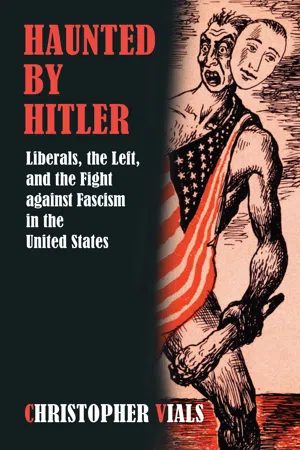
Although fascism is typically associated with Europe, the threat of fascism in the United States haunted the imaginations of activists, writers, and artists, spurring them to create a rich, elaborate body of cultural and political work. Traversing the Popular Front of the 1930s, the struggle against McCarthyism in the 1950s, the Black Power movement of the 1960s, and the AIDS activism of the 1980s, Haunted by Hitler highlights the value of "antifascist" cultural politics, showing how it helped to frame the national discourse.
Christopher Vials examines the ways in which anxieties about fascism in the United States have been expressed in the public sphere, through American television shows, Off-Broadway theater, party newspapers, bestselling works of history, journalism, popular sociology, political theory, and other media. He argues that twentieth-century liberals and leftists were more deeply unsettled by the problem of fascism than those at the center or the right and that they tirelessly and often successfully worked to counter America's fascist equivalents.
eBook - ePub
Haunted by Hitler
Liberals, the Left, and the Fight against Fascism in the United States
- English
- ePUB (mobile friendly)
- Available on iOS & Android
eBook - ePub
Haunted by Hitler
Liberals, the Left, and the Fight against Fascism in the United States
About this book
Information
Publisher
University of Massachusetts PressYear
2017Print ISBN
9781625341303
9781625341297
eBook ISBN
9781613763889
CHAPTER 1
European Precedents, American Echoes
Fascism in History and Memory
While fascism’s potential for creating a regime may be safely regarded as extinguished with the defeat of the Axis powers in the Second World War, as a political ideology capable of spawning new movements it should be treated as a permanent feature of modern political culture.
ROGER GRIFFIN, The Nature of Fascism (1991)
In 1969 Ernest Mandel wrote, “The history of fascism is at the same time the history of the theoretical analysis of fascism.”1 How its opponents understood fascism, in other words, has played a material role in its history. Mandel, a Jewish Marxist imprisoned at Dora concentration camp for his work in the Belgian underground during the Nazi occupation, learned this insight the hard way. He saw the inadequate theories of fascism pushed by the main organizations of the European left as more than just sloppy analysis: in misrecognizing the enemy, they diverted vital political energy necessary to stop Hitler’s rise, indirectly contributing to countless tragedies. Many of his fellow survivors on the left accessed the antifascist resistance more positively, and one must be careful not to overvalue the transformative powers of theory. Yet Mandel’s observation underscores the significance of antifascism, a terrain where recognition—and misrecognition—hold the potential to shape a history of intense political violence.
To evaluate the actors covered in this book, I must consider the extent to which they properly identified their foe, mainly by revisiting the now-venerable question, what is fascism? From there, one can address other matters specific to their location, namely, how applicable is fascism to the United States, particularly after 1945? and when does calling its name needlessly divert political energy? To this end, I want to first review pertinent elements of historical fascism in Europe: its demographic basis, its nationalism and ideology, the nature of its violence, its relationship to elites, and its reliance on a broader range of Western hierarchies. Since postwar antifascism typically wages its battles in reference to vanquished regimes, one must also theorize the efficacy of rooting one’s struggles in relation to a past formation. While cautioning prudence, I conclude the chapter by asserting that those concerned about an American fascism have had a rational basis for their fears. The contradictions of Enlightenment liberalism, which continue to generate far right movements, unfortunately guarantee that in certain situations “calling fascism” has been warranted in the United States before and after 1945. In the process, I will illuminate why those who have called it most intensely have tended to the political left.
Historians have come to no consensus on the definition of fascism. What’s more, fascist historiography is a highly contentious field, one in which the major definitions do not even begin to converge. As Roger Griffin has noted, the diversity of fascist movements across so many national contexts has led some historians to question even if the term should be applied outside of Italy.2 Though I draw on this historiography to fashion a working definition of fascism, the intent of my book is not to intervene in this debate. Rather, I will refer to major historians in the field to outline some of the features of fascism that are germane to this study and to consider aspects of its nationalism that are crucial to the questions posed above. The working definition of historical fascism I use is as follows: Fascism was a set of far right political movements, finding their fullest expression in Italy and Germany from the 1920s to the 1940s, that destroyed democratic space and violently hardened social hierarchies through a militarist, anti-Marxist, racist, symbol-laden cultural project of national rebirth. Though enabled and sustained by the support of the upper class, it differs from conservative authoritarianism in that its primary agents were not traditional elites but middle-class upstarts animated more by visions of national renewal than by economic logics. Leon Trotsky distinguished between fascism and so-called classic elite dictatorship, using the term Bonapartism to indicate the latter, and he was not the only prewar Marxist to differentiate along these lines.3
Historians have univocally disproven the vulgar Marxist notion that Hitler and Mussolini were simply front men for more powerful business interests that manipulated them from behind the scenes. Rather, fascism was disproportionately middle class, and its leaders were largely petit bourgeois upstarts with their own agenda of national renewal. This agenda involved the militarization of the entire society, the staging of symbolic rituals of national unity, and a complete cultural purge of cosmopolitanism, intellectualism, and leftist internationalism. In Germany its purge of the national body involved the physical extermination of Jews, Roma, homosexuals, the disabled, and other perceived undesirables. Unlike the elite right, composed of free-market liberals and traditional conservatives, both of whom aimed to politically demobilize the population, the fascist right of the National Socialist German Workers’ Party (NSDAP) and the Partito Nazionale Fascista (PNF) actively mobilized the public in a kind of cultural revolution. Elsewhere in Europe, for example, in Romania, Hungary, and Austria, conservative dictatorships emerged under the firm control of established ruling classes which jailed or killed their opponents and dismantled parliamentary authority without resorting to fascist mass mobilization and its particular transformation of civil society.4
While historians dismiss the idea that the upper classes were puppet masters pulling the strings of fascist leaders, there is consensus among them that the seizure of power by Hitler and Mussolini was directly enabled by the weight of established elites, including industrialists, financiers, large landowners, the civil service, and the military officer class. Politically, many of these elites were conservatives, but liberals, in the European sense of those who desire a society of open markets free of clerical control, were also complicit. Although there was not an identity of interests between fascists and representatives of elite interests, they formed an active partnership in Germany and Italy that remained in force until the tide of war turned definitively against the Axis.5 What initially caused the influential sections of the establishment to rally behind fascism was a desire to maintain their political power, which was threatened by the strength of the political left. Germany and Italy had been home to some of the largest, most radical movements of workers in Europe. The Red Years of 1919–20 were still fresh in the memory of Italian landowners and industrialists when Mussolini took power in his famous March on Rome in 1922. In the German elections of November 1932, shortly before the aristocrat Paul von Hindenburg rescued Hitler by naming him chancellor, the Communists had picked up seats in the Reichstag while the Nazis lost votes, political momentum, and even financial viability.6
Owing to the strong presence of the left, the hegemony of ruling groups in Germany and Italy was weakened; they needed the help of the fascist newcomers much more than their peers in Japan, Romania, and Hungary. What the Nazis and the Blackshirts offered their coalition partners on the right were not only the votes to form parliamentary majorities: in the wake of the First World War and the economic calamities that followed, they also offered fresh young faces to a public weary of a venerable establishment. Fascism appealed especially to people in the middle classes, including farmers, shop owners, and white-collar employees, who were disillusioned with established authorities yet rejected left-wing alternatives and clung to the idea of the nation. Before taking power it even co-opted pieces of the left’s platform. The first meeting of Italian fascists called for the introduction of the eight-hour workday and progressive taxation, while in Germany the spelled-out title of the Nazi Party—the National Socialist German Workers’ Party—reflected some of the party’s plebeian origins.7 Once installed in power, however, fascists broke almost every socialist-sounding promise of reform; contrary to their earlier rhetoric, fascist states restored the shop floor hierarchies compromised by labor and the left, though not under circumstances fully controlled or always preferred by business leaders.8 Fascism thus functioned to restore profits to some of the most influential sectors, even if capitalists, as a class, were not directing policy.
But fascism was much more than a class coalition or a mere restoration of profits. It was a socially transformative form of reaction leveled against the very existence of workers’ movements. Geoff Eley, a historian of the European left, writes that, in comparison with workers’ organizations in eastern Europe,
labor movements in Italy and north-central Europe were incomparably stronger. They were larger, better organized, and deeply integrated into the social life and public cultures of their countries. Uprooting the Left from this historic embeddedness in complex civil societies required a comprehensive assault on the status quo. . . . [Fascism] “sought to disenfranchise, in the fullest sense, the working classes, and to destroy political and labor market gains that had been generations in the making.” This required a different kind of regime, one that systematically attacked the given bases of political life.9
In Germany and Italy attacking the “given bases of political life” involved the use of the most modern forms of mass communication to rally the chosen people away from cosmopolitanism and class-consciousness toward a new national identity that explicitly fused race and nation. As Hitler wrote in Mein Kampf, “The folkish state . . . must set race in the center of all life.”10
Mussolini uses the words race and nation interchangeably throughout his autobiography My Rise (1928), and he did so in order to posit a notion of citizenship based on Italian blood.11 But the language of race was much more pronounced and sharpened in Nazism. Nazi ideology strove to wean its subjects away from the international, class identity of Marxism toward a national and individual identity that was essentially racial. As Hitler wrote, “The Jewish doctrine of Marxism rejects the aristocratic principle of Nature and replaces the eternal privilege of power and strength by the mass of numbers. . . . Thus it denies the value of personality in man, contests the significance of nationality and race, and thereby withdraws from humanity the premise of its existence and its culture.”12 This passage contains two central tropes of Nazi nationalism: first, the belief in fixed hierarchies rooted in nature and, second, the willful conjoining of Jews and Marxists into one enemy that threatens the cohesion of the nation. Cohesion was to be achieved not only through the elimination of Jews and Marxists but also through the collective, affirmative recognition of the Aryan as the paragon of races. Nazi policy reconfigured citizenship so that being German was not a function of one’s place of birth but an explicit function of one’s racial status as a physically healthy, genetically sound Aryan.
Fascism’s second attack on the “given bases of political life” was its militarization of the national culture. Walter Benjamin saw the cult of the warrior as essential to fascism because it elevated violence and war as the highest of virtues while aestheticizing blood, martyrdom, and sacrifice.13 Like many of their most ardent followers, both Hitler and Mussolini were profoundly shaped by their experiences in the First World War. They “found themselves” in the fraternal bonding of the battlefield, and their political awakening came when they realized that their uniformed brotherhood had been “stabbed in the back” by socialists, parliamentarians, and other traitors at home.14 When fascism was officially born at a meeting in Milan in March 1919, the young movement called itself the Fasci di Combattimento, or, approximately, “fraternities of combat.” The most honored of its members were war veterans called the arditi, Italian commandos who symbolized action, decisiveness, bravery, and the spirit of national sacrifice; the black shirt of their uniforms became the signature of Italian fascist style.15
To Hitler, the army was a school of virtue, and the nation was to be remolded in its image. In Mein Kampf he wrote,
What the German people owes to the army can be briefly summed up in a single word, to wit: everything. The army trained men for unconditional responsibility at a time when this quality had grown rare and evasion of it was becoming more and more the order of the day, starting with the model prototype of all irresponsibility, the parliament. . . . it was the school that still taught the individual German not to seek the salvation of the nation in lying phrases about an international brotherhood between Negroes, Germans, Chinese, French, etc., but in the force and solidarity of our own nation. The army trained men in resolution while elsewhere in life indecision and doubt were beginning to determine the actions of men.16
In effect, the militarization of civil society meant that the agent of fascism was male. As Klaus Theweleit argued, the feminine was the antithesis of virtue in the fascist lexicon—it was pacifistic, unclear, disruptive to male unity—and had to be purged through overt misogyny. Meanwhile, the class identity of the left, predicated on “lying phrases” of international and interracial solidarity, was to be made obsolete through the violent reality of war, which naturally elevates the virtues of race and nation; in Nazism, war is the natural means of expression for the Aryan, who constantly strives to expand his living space through conquest of lesser races.17 War, in other words, is the most effective vehicle for forging a national identity because it works to efface alternative forms of affiliation, melding a class-divided nation into a singular race. Not uncoincidentally, the fasces, the original symbol of fascism, was an axe surrounded by a bundle of rods, an ancient Roman icon signifying the unity of the people around the violent authority of the state. Yet the military model allowed this race to remain internally differentiated and unequal, its chain of command—commander, officers, noncommissioned officers, enlisted men—preserving a transparent hierarchy in which each member knows his place. This warrior cult was institutionalized through the staging of martial virtue in mass rituals, a punitive campaign against homosexual men, an educational system that emphasized physical activity over intellect, and universal male conscription during the war itself.
Whether imperial Japan was a fascist state has been heavily contested. Most European and American historians reject the label as an apt descriptor of this regime, while many of their Japanese colleagues have insisted on its applicability. Arguments against its application to Japan tend to hinge on the claim that its authoritarian system was elite driven and hence does not possess a close family resemblance to the regimes of Italy and Germany. Other scholars, while not denying imperial Japan’s elite leadership, point to ideological similarities between its government and those of the other Axis powers that are close enough to justify labeling it fascist; implicitly, these scholars call for a new definition of fascism that de-centers European models.18 While I am persuaded by the latter argument, in this book I focus on Europe, not Asia, when discussing fascism outside the United States because, to Americans, imperial Japan was only sporadically legible as a fascist state. Asian left-wing partisans who fought the Japanese occupation of their countries, including Luis Taruc, Ho Chi Minh, and Mao Zedong, regularly used the term to describe their enemy, and the designation of the occupiers as fascist passed into the official language of the Chinese state after the revolution. In the United States, the American League for Peace and Democracy (ALPD) in the late 1930s viewed China as one of the world’s most important battlegrounds, second only to Spain. Yet even members of the league disagreed on whether the Japanese state was fascist or whether it should be regarded as a related form of militarism. The confusion persisted into the war years and beyond, the phrase “Japanese militarism” becoming a common resolution.19
Far from trying to present an exhaustive or complete account of historical fascism, I wanted to give a sense of the political characteristics that are critical to understanding both its presence in the United States and its survival after the Second World War. For the purposes of this book, it is also necessary to briefly consider how major historians have dealt with the possibilities of its reincarnation after 1945 inside and outside Europe. In short, the idea that fascism survived the Second World War is no longer a controversial idea among historians; however, as might be expected, there is no consensus as to which national arena, if any, presents the ripest conditions for its full rebirth. In the early 1960s the German historian Ernst Nolte asserted that fascism was effectively buried in 1945, and other eminent scholars followed suit. But by the 1990s this assessment of the European scene changed in light of ethnic cleansing in the Balkans, the decline of social democracy, and the mainstreaming of radical right parties.20
In considering the continuity of fascism after the Second World War, one must distinguish between two things: the existence of fascist or fascist-like movements within ostensibly nonfascist states and the nightmarish reconstitution of a fully fascist government. As to the first, no one any longer denies that neofascist groups as well as mai...
Table of contents
- Cover
- Title Page
- Copyright
- Dedication
- Contents
- Acknowledgments
- Abbreviations
- Introduction: Antifascism and the United States
- 1. European Precedents, American Echoes: Fascism in History and Memory
- 2. From Margin to Mainstream: American Antifascism to 1945
- 3. Beyond Economics, Without Guarantees: Faschismustheorie in the United States
- 4. Resuming the People’s War: HUAC, Joe McCarthy, and the Antifascist Challenge of the 1950s
- 5. Brownshirts in the Twilight Zone: Antifascism in the Liberal Moment of the Early 1960s
- 6. United Front against Genocide: African American Antifascism, the Black Panthers, and the Multiracial Coalitions of the Late 1960s
- 7. Queer Antifascism: Pink Triangle Politics and the Christian Right
- Epilogue: Antifascism in Strip Mall America
- Notes
- Index
Trusted by 375,005 students
Access to over 1.5 million titles for a fair monthly price.
Study more efficiently using our study tools.
Frequently asked questions
Yes, you can cancel anytime from the Subscription tab in your account settings on the Perlego website. Your subscription will stay active until the end of your current billing period. Learn how to cancel your subscription
No, books cannot be downloaded as external files, such as PDFs, for use outside of Perlego. However, you can download books within the Perlego app for offline reading on mobile or tablet. Learn how to download books offline
Perlego offers two plans: Essential and Complete
- Essential is ideal for learners and professionals who enjoy exploring a wide range of subjects. Access the Essential Library with 800,000+ trusted titles and best-sellers across business, personal growth, and the humanities. Includes unlimited reading time and Standard Read Aloud voice.
- Complete: Perfect for advanced learners and researchers needing full, unrestricted access. Unlock 1.5M+ books across hundreds of subjects, including academic and specialized titles. The Complete Plan also includes advanced features like Premium Read Aloud and Research Assistant.
We are an online textbook subscription service, where you can get access to an entire online library for less than the price of a single book per month. With over 1.5 million books across 990+ topics, we’ve got you covered! Learn about our mission
Look out for the read-aloud symbol on your next book to see if you can listen to it. The read-aloud tool reads text aloud for you, highlighting the text as it is being read. You can pause it, speed it up and slow it down. Learn more about Read Aloud
Yes! You can use the Perlego app on both iOS and Android devices to read anytime, anywhere — even offline. Perfect for commutes or when you’re on the go.
Please note we cannot support devices running on iOS 13 and Android 7 or earlier. Learn more about using the app
Please note we cannot support devices running on iOS 13 and Android 7 or earlier. Learn more about using the app
Yes, you can access Haunted by Hitler by Christopher Vials in PDF and/or ePUB format, as well as other popular books in Politics & International Relations & North American History. We have over 1.5 million books available in our catalogue for you to explore.