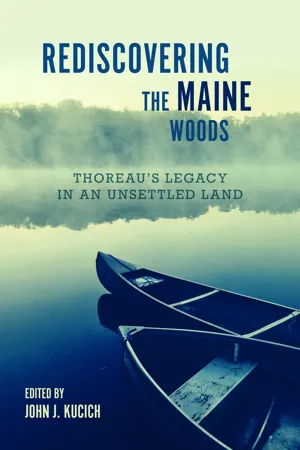
The Maine Woods, vast and largely unsettled, are often described as unchanged since Henry David Thoreau's journeys across the backcountry, in spite of the realities of Indian dispossession and the visible signs of logging, settlement, tourism, and real estate development. In the summer of 2014 scholars, activists, members of the Penobscot Nation, and other individuals retraced Thoreau's route.
Inspired partly by this expedition, the accessible and engaging essays here offer valuable new perspectives on conservation, the cultural ties that connect Native communities to the land, and the profound influence the geography of the Maine Woods had on Thoreau and writers and activists who followed in his wake. Together, these essays offer a rich and multifaceted look at this special place and the ways in which Thoreau's Maine experiences continue to shape understandings of the environment a century and a half later.
Contributors include the volume editor, Kathryn Dolan, James S. Finley, James Francis, Richard W. Judd, Dale Potts, Melissa Sexton, Chris Sockalexis, Stan Tag, Robert M. Thorson, and Laura Dassow Walls.
As I stepped out of the little diner before dawn, the pouring rain offered no signs of letting up, and I knew this day would be one to remember for a long time. Kevin Slater, one of our guides, walked by and said “It’s coming down in sheets” and let out a little laugh. I looked across the street to the boat launch where our canoes and gear were scattered about, and I thought, This is what organized chaos really looks like. An overwhelming sense of excitement ran through me, and I could feel the nervous anticipation in the air as we collected our gear and readied our canoes. Our adventurous group of travelers consisted of Maine guides, Thoreau scholars and historians, outdoor enthusiasts, photo journalists, and members of the Penobscot Nation. We all knew that not only was a long day lay ahead of us, but a journey of a lifetime was in store as we loaded and launched each boat into the cold, dark water of Moosehead Lake. Once all the canoes were finally in the water, we were ready to embark on this epic journey.
The fog on the lake set a mood that felt somewhat nostalgic yet provided me with an excited sense of surrealism as I sat in our canoe waiting for the others to load and paddle away from the docks. I then realized that this was really happening and I was about to have an experience I have never had before. The rain felt almost nonexistent to me as our group paddled off into the fog away from the sleeping town of Greenville. The steady sound of paddles dipping into the water and gently grazing the gunwales of the canoes was calming as rain and strong winds picked up throughout the morning. As we entered into more open water, the dark lake changed dramatically as the storm-driven waves grew larger. Paddling this massive lake was intense and exhilarating, with the storm only enhancing this experience. My nerves were running high as we continued to paddle in those early-morning hours through large rolling waves that made the other canoes ahead of us disappear as each wave passed us by.
Later in the morning we took a break from the weather and landed our canoes to adjust our gear and enjoy a snack. Our guide, Kevin, made the decision to lash the boats together for safety. We formed two catamaran-style double-hulled canoes and one trimaran with three canoes lashed together. I believe this decision made everyone feel a bit more at ease as we continued our paddle across the vast lower portion of Moosehead Lake. The intense weather continued, yet you could hear laughter and conversation within each of the small catamaran groups at the times when we paddled close together.
Out in the open water my thoughts were of how awesome it was to be paddling Moosehead Lake. I had been visiting this lake for many years, but I had managed only to take the short ferry shuttle over to Mount Kineo from Rockwood. Today I was checking off a bucket-list paddle that I had wanted to do for a long time. As we continued on with our trek across the lake in the rain, I felt a sense of awe thinking of how my ancestors had made this trip for thousands of years. I looked out across the water and spotted my fellow Penobscot paddlers, Jason Pardilla and Chris Francis, in their canoes and thought today was our turn to add to that legacy. I imagined how my ancestors felt paddling in these same elements as they made their way to the sacred mountain in the middle of the lake named Kineo. Here they would gather to hunt and fish, or to perform ceremonies, but most of all to collect the materials needed to make the stone tools that were of utmost importance to their daily survival. Mount Kineo is a significant source of rhyolite, which can be found in numerous archaeological sites in Maine as well as across the larger region of New England and eastern Canada. My ancestors were highly skilled in crafting this specific stone into spearheads, projectile points, knives, and other tool forms. Within our oral tradition, Mount Kineo was created when our cultural hero Gluskabe killed the giant cow moose. Her slain body became the mountain that has been the source of this special tool-making stone since time immemorial.
As we grew closer, I knew the mountain was there, though it was not yet visible through the dense fog. There were moments I caught glimpses of the silhouette in the distance, but then it would disappear again. Later in the day, Mount Kineo became more and more visible as we drew closer. It was immense as it stood alone along the horizon of the lake. We paddled within the fog and seemed to be in the middle of nowhere with just the mountain by our side, as the far mainland shoreline of Rockwood on the southern edge of the lake could no longer be seen. When we were closing in on Mount Kineo, our direction changed so that we were running along with the rolling, wind-driven waves. Our small catamaran-style canoe group caught some of the larger waves, and we found ourselves at times surfing along. It was fun to not paddle for a bit and let the water take us along at its own pace. Mount Kineo loomed high above us as we hugged the rocky shoreline and rounded the west side of the peninsula. As we paddled to our first day’s campsite at Hardscrabble Point, the storm subsided. We were greeted with a beautiful sunset among the retreating storm clouds as we unloaded our gear and prepped our campsite.
After a long, wet day paddling through the storm, it was a treat to put on warm, dry clothes and sit by the fire. Coffee was promptly made and was welcomed wholeheartedly by everyone. I brought along some materials to conduct a flint-knapping demonstration for our group before dinner. As I started my demonstration, I thought of how many times my ancestors sat in this same exact place at the base of Mount Kineo producing stone tools. I grabbed a large cobble of Kineo rhyolite and began striking it with a hammerstone to break off stone flakes to show the reduction technique of flint knapping. The sharp snaps of breaking stone echoed in my head, and again my mind wandered off, thinking of my ancestors sitting here doing the exact same thing I was doing while dinner cooked. Even though I have visited Mount Kineo numerous times throughout my life, I have never felt a total sense of belonging as I did that evening. It was as though I was supposed to be at that place at that particular time. The damp, earthy smell of pine and fir trees wafted in the breeze, and the sounds of the lake were very relaxing. Loons called off in the distance, and the lapping of waves on the rocks and beach made the late-evening sunset surreal. The smells of our dinner cooking over the open fire filled the campsite. Our group of travelers were scattered about the encampment, with some cooking dinner, some chopping wood, some setting up tents, some hanging out clothes to dry and off reflecting on the day in their own ways. The call for dinner brought us all together around the warmth of the camp fire. It could have been the hungered exhaustion from a long day’s paddle, but I am still convinced that those were the best pork chops I have ever tasted. Conversations and laughter could be heard across the campsite as the evening progressed. We were all sharing stories, thoughts, and feelings of the day’s paddle as the first leg of our sixteen-day journey ended.
May 18, 2014: Mount Kineo to Seboomook
The next morning’s sunrise was a welcoming sight after the stormy first day’s paddle. The water appeared like glass as the morning fog lifted. The early day of paddling was more relaxed, with calm water. Conversations could be heard among the group as we glided up the northern portion of Moosehead Lake. Along the way our small catamaran group came upon a large yellow-spotted salamander floating in the middle of the lake. We scooped up the castaway and placed it on the open map that lay spread across our dry bags. The warmth of the sun gradually revived our guest as we continued our paddle north. We ended up leaving our special passenger back on solid ground when we landed our canoes to take a break from paddling to get some food.
Midway through the day, the weather took a turn. Far off in the distance we could see the next storm front moving in our direction. We reached our campsite at Seboomook Point late in the afternoon and prepared camp. We all had plenty of time to collect our thoughts and reflect on the long two days of paddling Moosehead Lake. Dinner consisted of moose and elk burgers, and the evening conversations were light and filled once again with laughter and stories. I settled into bed early because I knew another long day of paddling with a major portage lay ahead of us.
May 19, 2014: Seboomook to the West Branch of the Penobscot River
The third morning of our journey was yet another rainy one. We ate breakfast and broke camp, loading our canoes for the short paddle that would end our travels on Maine’s largest lake. We landed at the Northeast Carry, and I could see Mount Kineo along the lake’s southern horizon. I knew we did not have much time to waste, but I stood and took a moment to reflect on the last two days. I was elated that I had just paddled the complete length of Moosehead Lake. It was now time to prepare for the long portage ahead.
The Northeast Carry is about a two-mile portage that takes you from Moosehead Lake to the West Branch of the Penobscot River. The rich history of the Northeast Carry has deep roots within the legacy of Maine’s logging era. The road today is long and takes one straight toward the West Branch. Our group loaded up and started out on the first run of this long portage. I was thankful the rain had stopped as I made my first of two trips carrying gear, which consisted of multiple dry bags, a cooler, and a wannigan that contained our cooking supplies. On my second trip of the portage with the wannigan, I began to feel saddened as I knew when I reached the West Branch, I would be done with this epic canoe journey, for the time being, until I could rejoin the paddle in a week’s time.
I sat with our group as long as I could as we took a break from the portage before loading canoes for the journey down the West Branch of the Penobscot River. It was hard to leave, but I had to return home to work on an important project. I knew I would be rejoining the journey along the East Branch of the Penobscot River. The six-hour drive home from the Northeast Carry provided me plenty of time to reflect on the last couple of days and the people I got to know more along the way. As I was driving, I often thought of my new group of friends and the paddle they still had before the next campsite, and I wished I was still out there with them. It was disheartening to leave the journey, but I had a smile on my face the whole way home.
FIGURE 4. Hardscrabble Point.
Morning at Hardscrabble Point on Moosehead Lake. Thoreau-Wabanaki Anniversary Tour, May 2014. Photograph by Chris Sockalexis.
Chapter 2
Undercurrents
Stan Tag
I don’t know if it’s the truth. I can only tell you what I know.
—Job Bearskin, Cree hunter
Joe Polis, a Penobscot who lived on Indian Island, was at work in his yard dressing a deerskin when Bangor lumberman George Thatcher and his cousin Henry Thoreau approached him. Polis and Thatcher had known each other since they were boys. Thoreau was looking for a guide to take him and his companion Edward Hoar on a journey into the Maine Woods “to the Allegash Lakes, by way of Moosehead, and return by the East Branch of the Penobscot,” perhaps even climbing Katahdin. Did Polis know of any good Penobscot who was interested in being their guide? Polis told Thoreau and Thatcher that he wanted to go himself, in particular, “to get some moose.”1 This was July 1857. The canoe journey that Thoreau and Hoar took with Polis became best known to the rest of us in the narrative Thoreau wrote about it, “The Allegash and East Branch,” the third section of his book The Maine Woods, which was published in 1864, two years after Thoreau died.
One hundred and fifty years after the publication of The Maine Woods, a group of hearty souls, the Maine Woods Discovery team, imagined a grand retracing of the 1857 trip—a sixteen-day, 325-mile canoe journey in May 2014, led by experienced Maine guides and including people who work in the Maine Woods, members of the Penobscot Nation, and a few Maine Woods historians and Thoreau scholars. The idea was to engage in a deep and lively dialogue—while canoeing, camping, and traveling through the landscape—about the Maine Woods themselves and, in particular, the Penobscot River watershed, considering its historical value, its use as recreation and resource, and how both Penobscot and others who live and work in the watershed view this place, its past, its present, and the possibilities for its future. We joined not only to canoe the waterways that circled Katahdin but also to talk about what the journey stirred up in us, to reflect on it all, photograph it, write about it, taste and smell it, listen to its sounds, and explore in any way we could the geologic, ecological, archaeological, natural, spiritual, and cultural histories that inform and intersect in this place.
This chapter is one attempt to put into words my own experiences and observations during this expedition and since then, for I have continued to look back on it and feel the tug of its undercurrents moving me in directions that both challenge and surprise me. I am grateful to Thoreau scholar James Finley mentioning to Mike Wilson, senior program director for the Northern Forest Center and organizer of this expedition, that he should give me a call. A minute into my conversation with Mike, I knew I wanted to take the entire journey, even though in May 2014...
Table of contents
Cover
Title Page
Copyright Page
Dedication
Contents
Acknowledgments
Introduction
Part one: Tracing a Landscape
Part two: Maine’s Thoreau
Part three: Between Wilderness and Working Forest
Contributors
Index
Trusted by 375,005 students
Access to over 1.5 million titles for a fair monthly price.
Study more efficiently using our study tools.
Frequently asked questions
Yes, you can cancel anytime from the Subscription tab in your account settings on the Perlego website. Your subscription will stay active until the end of your current billing period. Learn how to cancel your subscription
No, books cannot be downloaded as external files, such as PDFs, for use outside of Perlego. However, you can download books within the Perlego app for offline reading on mobile or tablet. Learn how to download books offline
Perlego offers two plans: Essential and Complete
Essential is ideal for learners and professionals who enjoy exploring a wide range of subjects. Access the Essential Library with 800,000+ trusted titles and best-sellers across business, personal growth, and the humanities. Includes unlimited reading time and Standard Read Aloud voice.
Complete: Perfect for advanced learners and researchers needing full, unrestricted access. Unlock 1.5M+ books across hundreds of subjects, including academic and specialized titles. The Complete Plan also includes advanced features like Premium Read Aloud and Research Assistant.
Both plans are available with monthly, semester, or annual billing cycles.
We are an online textbook subscription service, where you can get access to an entire online library for less than the price of a single book per month. With over 1.5 million books across 990+ topics, we’ve got you covered! Learn about our mission
Look out for the read-aloud symbol on your next book to see if you can listen to it. The read-aloud tool reads text aloud for you, highlighting the text as it is being read. You can pause it, speed it up and slow it down. Learn more about Read Aloud
Yes! You can use the Perlego app on both iOS and Android devices to read anytime, anywhere — even offline. Perfect for commutes or when you’re on the go. Please note we cannot support devices running on iOS 13 and Android 7 or earlier. Learn more about using the app
Yes, you can access Rediscovering the Maine Woods by John J. Kucich in PDF and/or ePUB format, as well as other popular books in Literature & North American History. We have over 1.5 million books available in our catalogue for you to explore.