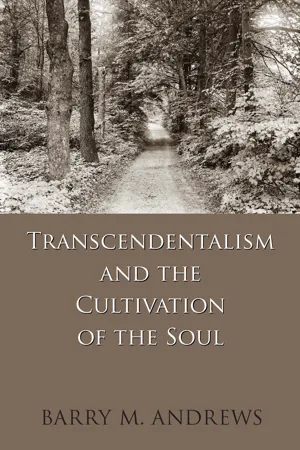
American Transcendentalism is often seen as a literary movement—a flowering of works written by New England intellectuals who retreated from society and lived in nature. In Transcendentalism and the Cultivation of the Soul, Barry M. Andrews focuses on a neglected aspect of this well-known group, showing how American Transcendentalists developed rich spiritual practices to nurture their souls and discover the divine. The practices are common and simple—among them, keeping journals, contemplation, walking, reading, simple living, and conversation. In approachable and accessible prose, Andrews demonstrates how Transcendentalism's main thinkers, Emerson, Thoreau, Fuller, and others, pursued rich and rewarding spiritual lives that inspired them to fight for abolition, women's rights, and education reform. In detailing these everyday acts, Andrews uncovers a wealth of spiritual practices that could be particularly valuable today, to spiritual seekers and religious liberals.
- English
- ePUB (mobile friendly)
- Available on iOS & Android
eBook - ePub
Transcendentalism and the Cultivation of the Soul
About this book
Information
Publisher
University of Massachusetts PressYear
2018Print ISBN
9781625342935
9781625342928
eBook ISBN
9781613765333
“The Soul of the Age”
On Christmas Day 1832 young Ralph Waldo Emerson set sail for Europe. He was seeking respite from grief and also clarity about his career. His wife of barely seventeen months had died the previous year, and he had recently resigned as pastor of Boston’s Second Church. He toured Italy, France, and Great Britain. He was looking forward to visiting three authors in particular, William Wordsworth, Samuel Taylor Coleridge, and Thomas Carlyle. The poetry of Wordsworth and Coleridge was well known to American audiences. Less familiar was the younger Carlyle, whose essays Emerson had only recently begun to read.
It was perhaps impossible for Wordsworth and Coleridge to measure up to their reputations. By the time Emerson met them they were old men who had become conservative in their views. His meeting with Coleridge “was rather a spectacle than a conversation,” he concluded, “of no use beyond the satisfaction of my curiosity.” Visiting Wordsworth in England at his home in the Lake District, Emerson came away with the impression that the poet “paid for his rare elevation by general tameness and conformity.” His experience with Carlyle, much more his contemporary, was quite different. He hired a private carriage from Dumfries in Scotland to take him sixteen miles to Carlyle’s house out in the middle of nowhere. He spent a memorable night with the writer and his wife, Jane. “We went out to walk over long hills,” Emerson wrote. “There we sat down and talked of the immortality of the soul.”1
Despite his unfavorable impressions of Coleridge and Wordsworth in person, Emerson read their works with increasing interest and appreciation following his return to America the next autumn. Carlyle, too, continued to influence Emerson and his circle of friends and fellow intellectuals, a number of whom sought out the Scottish author on their own travels to Britain later on. What was it that drew them to these writers? They were literary lions whose writings had heralded new views of nature, society, and the life of the spirit. In a broader sense, they were representative of the Romantic movement as a whole—in continental Europe, Britain, and America, if we include the Transcendentalists.
Romanticism was much more than a passing phase in literature, music, and the fine arts; it was revolutionary—“a crack in nature,” as Emerson put it.2 It was a reaction against many aspects of life prevalent at that time, and to some extent, even today: political tyranny, Enlightenment rationalism, materialism, the Industrial Revolution, skepticism, conventionality, religious formalism, and the despoiling of nature. It took different forms in different countries, but young poets, artists, musicians, philosophers, theologians, critics, and naturalists of the late eighteenth and early nineteenth centuries were everywhere caught up in the spirit of it. Though he found it difficult to define, Isaiah Berlin, a noted historian of ideas, was of no doubt about its significance: “The importance of romanticism is that it is the largest recent movement to transform the lives and the thought of the Western world. It seems to me to be the greatest single shift in the consciousness of the West that has occurred, and all the other shifts which have occurred in the course of the nineteenth and twentieth centuries appear to me in comparison less important, and at any rate deeply influenced by it.”3
Boston, Cambridge, and Concord, Massachusetts, were at the center of Romantic intellectual activity in America. Looking back some years later, Frederic Henry Hedge, one of the leaders of the budding Transcendentalist movement, recalled that he and others were conferring on the unsatisfactory state of current opinion in theology and philosophy. The writings of Coleridge and Carlyle had, as he put it, “created a ferment in the minds of some of the young clergy of that day.” There was, he said, “a promise in the air of a new era of intellectual life.”4 (Hedge’s own article on Coleridge and German philosophy in an 1833 issue of the Christian Examiner had done a lot to stimulate this interest.) In Edward Everett Hale’s account of the period, their literature formed the countercultural curriculum at the Harvard Divinity School in the 1820s and 1830s, giving rise to “a certain enthusiastic expectation” that “quickened the lives of all young people in New England who had been trained in the freer schools of religion.”5
Hedge, Emerson, James Freeman Clarke, Theodore Parker, and a number of others were the nucleus of a group of young Unitarian ministers and intellectuals who began meeting in 1836 to discuss the “new views” of religion, culture, and society that were coming out of Europe. These new ideas had huge implications for the kind of theology the Unitarians had been trained in and which these radicals now found terribly wanting. The Transcendentalists, as they came to be called, were spiritual seekers looking for new sources of inspiration and insight in a milieu that was becoming, in their view, increasingly materialistic, dehumanizing, and alienating, and in which more traditional and normative approaches to theology and religious life seemed outmoded and insufficient. Emerson characterized the situation—in language familiar to anyone who came of age in the 1960s and ’70s—as a schism between “the party of the Past and the party of the Future; the Establishment and the Movement,” materialism and spirituality, old ways of thinking and new.6
As early as 1827 Emerson listed in his journal several “peculiarities” of the Romantic period. One was that “it is said to be the age of the first person singular.” Another he termed “the reform of the Reformation.” A third he referred to as “Transcendentalism. Metaphysics and ethics look inwards.”7 What did he mean? The first characteristic was an emphasis on subjectivity, which had widespread implications both for literature and theology. In an essay on “Modern Literature” in the Dial magazine, Emerson observed, “The poetry and speculation of the age are marked by a certain philosophic turn which discriminates them from the works of earlier times. . . . And this is called subjectiveness, as the eye is withdrawn from the object and fixed on the subject or mind.” Furthermore, “another element of the modern poetry akin to this subjective tendency, is the Feeling of the Infinite” that “has deeply colored the poetry of the period.”8
In his 1839 lecture series on “The Present Age,” Emerson elaborated on his phrase “the first person singular,” making the connection between subjectiveness and the “Feeling of the Infinite” somewhat clearer. “In the eye of the philosopher,” he announced, “the individual has ceased to be regarded as a part and come to be regarded as a whole. He is the world. The individual learns his deep access to the Universal Mind, is inspired by the sentiment of a deep and total union with Nature.”9 What he had in mind were sentiments such as those Wordsworth described in “Tintern Abbey”:
. . . a sense sublime
Of something far more deeply interfused,
Whose dwelling is the light of setting suns,
And the round ocean, and the living air,
And in the blue sky, and in the mind of man,
A motion and a spirit, that impels
All thinking things, all objects of all thought,
And rolls through all things.10
The emphasis on subjectivity is not the same as exalting the ego or individual personality, however. For Emerson and the Transcendentalists, as for Wordsworth, the turning of consciousness inward reflects a progressive awareness of a Universal Self “deeply interfused” throughout all of nature, including human nature. The individual self is a manifestation of the Universal Mind or Soul, and it is through this unique but limited self that we have access to the Universal Soul in experiences characterized by a “Feeling of the Infinite.” Far from implying egotism, the emphasis on subjectiveness attests to the need to transcend individuality in order to achieve a “deep and total union with Nature.”
What Emerson meant by the second peculiarity, “a reform of the Reformation,” is the progressive secularization of religion, a process well under way during the Romantic period. For the Romantics and particularly the Transcendentalists, philosophical skepticism, historical criticism of the Bible, and comparative studies of religion had undermined the traditional grounds of religious belief in the scriptures and the teachings of the Christian church. Each of these developments called into question the exclusive and supernatural claims of Christianity. The Romantics, including the Transcendentalists, were on the whole deeply spiritual, even if they were not conventionally religious. The Transcendentalists in particular were abandoning faith in historical Christianity.
In what amounted to a radical shift in the religious consciousness of the West two things happened simultaneously. In spite of the name “Transcendentalism,” God came to be viewed as a force or power immanent in nature, including human nature, and not as a supernatural being entirely separate from it. At the same time nature took the place of the Bible as the source of revelation. The Transcendentalists believed that all of creation was a manifestation of the divine. In his book-length essay Nature, an early manifesto of the Transcendentalist movement, Emerson asserted that “the noblest ministry of nature is to stand as an apparition of God. It is the organ through which the universal spirit speaks to the individual, and strives to lead back the individual to it.”11
This idea can be traced to Carlyle’s coinage of the phrase “natural supernaturalism” in Sartor Resartus, a book avidly read by Emerson and his Transcendentalist friends. “The Mythus of the Christian Religion looks not in the eighteenth century as it did in the eighth,” Carlyle insisted. Those who wish to salvage it must seek “to embody the divine spirit of that religion in a new Mythus, in a new vehicle and vesture, that our Souls, otherwise too like perishing, may live.”12 The phrase was indicative of “the general tendency,” according to M. H. Abrams, “to naturalize the supernatural and humanize the divine.”13 For the Romantics and Transcendentalists such as Emerson, who were moving away from traditional Christianity, the term expressed the revelations of nature in familiar religious language and symbolism, including biblical imagery.
For example, in the “Prospectus” for The Recluse—a favorite poem among Emerson and his friends—Wordsworth wrote:
Paradise and groves
Elysian, Fortunate Fields—like those of old
Sought in the Atlantic Main, why should they be
A history only of departed things,
Or a mere fiction of what never was?
For the discerning intellect of Man,
When wedded to this goodly universe
In love and holy passion, shall find these
A simple produce of the common day.14
Here Wordsworth employs tropes from classical mythology and the Bible to suggest that an earthly paradise might be ours here and now, in the “simple produce of the common day,” through a union with nature. Emerson uses similar imagery in Nature. “The reason why the world lacks unity, and lies broken in heaps,” he wrote, “is because man is disunited with himself.” The unification of the world proceeds from the unification of the self, but in actuality “the marriage is not celebrated.” If united within ourselves and in union with nature, we would find that “the invariable mark of wisdom is to see the miraculous in the common.”15 Thus the term “natural supernaturalism” implies a this-worldly as opposed to an other-worldly form of spirituality. The mundane world of the common and everyday is celebrated over the supernatural realm of God and heaven; and the notion of an eternal now, in the present moment, is substituted for that of eternity at some future point in time.
What did Emerson mean by the third of his peculiarities of the modern age, “Transcendentalism. Metaphysics and ethics look inwards”? Romanticism was a reaction, in large part, to the “sensual” philosophy of John Locke and the skepticism of David Hume, to which it led. Locke argued that knowledge comes to us solely by way of the senses, and Hume went so far as to suggest that empirical knowledge offers no convincing basis for religious belief. Rejecting Locke’s epistemology, Coleridge asserted instead that there are two ways of knowing, which he termed the “Understanding” and the “Reason.” Understanding, or empirical knowledge, is analytical in nature—weighing, measuring, and quantifying experience. Reason, on the other hand, is a way of knowing that is holistic and intuitive. It is a revelation of the Universal Mind. The emphasis on intuition is what Emerson meant by “metaphysics and ethics look inward.”
It would be difficult to exaggerate the significance of Coleridge’s contribution to the Transcendentalists. According to historian Perry Miller, the American publication in 1829 of Coleridge’s Aids to Reflection “was of the greatest single importance in the formation of their minds.”16 In her journal, Margaret Fuller, an editor of the Dial magazine, expressed a “conviction that the benefits conferred by [him] on this and future generations are as yet incalculable,” and added that “to the unprepared he is nothing, to the prepared, everything.”17 In his Autobiography, Clarke recalled, “I became a great reader of Coleridge, and was quite ready to accept his distinction between the reason and the understanding judging by sense. . . . It enabled me to distingui...
Table of contents
- Cover
- Title Page
- Copyright Page
- Dedication
- Contents
- Introduction
- 1. “The Soul of the Age”
- 2. The Transcendentalist Crisis of Faith
- 3. Transcendentalist Spirituality
- 4. The Art of Life
- 5. Three Prerequisites of the Spiritual Life
- 6. Solitude, Contemplation, Sauntering, and Simple Living
- 7. Reading, Conversation, and Journal Writing
- 8. Religious Cosmopolitanism
- 9. Self-Culture and Social Change
- 10. Abolition and Women’s Rights
- 11. Education, Environmentalism, and Sustainability
- 12. Church Reform and the Free Religious Association
- 13. The Legacy of Transcendentalism
- Notes
- Further Reading
- Index
Trusted by 375,005 students
Access to over 1.5 million titles for a fair monthly price.
Study more efficiently using our study tools.
Frequently asked questions
Yes, you can cancel anytime from the Subscription tab in your account settings on the Perlego website. Your subscription will stay active until the end of your current billing period. Learn how to cancel your subscription
No, books cannot be downloaded as external files, such as PDFs, for use outside of Perlego. However, you can download books within the Perlego app for offline reading on mobile or tablet. Learn how to download books offline
Perlego offers two plans: Essential and Complete
- Essential is ideal for learners and professionals who enjoy exploring a wide range of subjects. Access the Essential Library with 800,000+ trusted titles and best-sellers across business, personal growth, and the humanities. Includes unlimited reading time and Standard Read Aloud voice.
- Complete: Perfect for advanced learners and researchers needing full, unrestricted access. Unlock 1.5M+ books across hundreds of subjects, including academic and specialized titles. The Complete Plan also includes advanced features like Premium Read Aloud and Research Assistant.
We are an online textbook subscription service, where you can get access to an entire online library for less than the price of a single book per month. With over 1.5 million books across 990+ topics, we’ve got you covered! Learn about our mission
Look out for the read-aloud symbol on your next book to see if you can listen to it. The read-aloud tool reads text aloud for you, highlighting the text as it is being read. You can pause it, speed it up and slow it down. Learn more about Read Aloud
Yes! You can use the Perlego app on both iOS and Android devices to read anytime, anywhere — even offline. Perfect for commutes or when you’re on the go.
Please note we cannot support devices running on iOS 13 and Android 7 or earlier. Learn more about using the app
Please note we cannot support devices running on iOS 13 and Android 7 or earlier. Learn more about using the app
Yes, you can access Transcendentalism and the Cultivation of the Soul by Barry M. Andrews in PDF and/or ePUB format, as well as other popular books in Literature & Literary Criticism. We have over 1.5 million books available in our catalogue for you to explore.