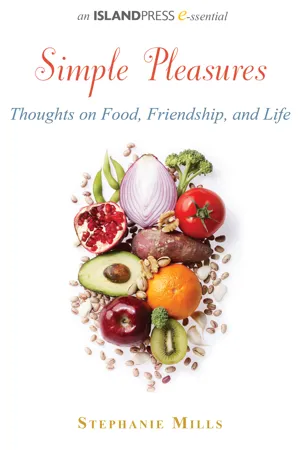
In Simple Pleasures: Thoughts on Food, Friendship, and Life we have highlighted two chapters from Stephanie Mill’s reflection the pleasures, as well as the virtues and difficulties, of a perhaps simpler than average North American life. It is a thoughtful paean to living, like Thoreau, a deliberate life. Mill’s writing is beautifully crafted, fluid, inspiring, and enlightening, and these chapters encourage you to take a moment to reflect on your own life. It celebrates the pleasures, beauty, and fulfillment of a simple life, a goal well worth striving for.
- English
- ePUB (mobile friendly)
- Available on iOS & Android
eBook - ePub
About this book
Information
Subtopic
Literary BiographiesIndex
Biological SciencesThoughts on Conviviality
by Stephanie Mills
Onions and butter; flour, celery, and salt: all the makings of the soup except for the well water came from the co-op. There were no ingredients that couldn’t have been grown here given the right farms, farmers, and markets. Even the dill and caraway seed that flavored it could have been the produce of somebody’s garden.
Even in America, even in an information age, food is not something to take for granted but a matter of life and death. It’s strange to live in a time that has alienated almost all of us from direct participation in providing our food. It takes good land and a lot of work and skill to produce food well and in salable quantity. For most of us, even the more-successful gardeners, the farmer is the woman or man who keeps us fed. I know some of the organic farmers in these parts. They combine entrepreneurial acumen, soil nurturing, plant and animal husbandry, mechanical skill, and fortitude to encourage the land to sustain the people. These are the folks who should be getting the genius grants. My farmer friends, I notice, live in their bodies, articulating their intelligence and creativity physically. They seem less deluded by the culture’s departmentalization of physical and mental than anyone else I know.
Hunger, too, unifies and focuses the being. To be able to reply to its demands through the pleasure of cooking has become one of those ancient everyday activities for which few people have the time. There are even prefabricated peanut-butter sandwiches for busy schoolchildren. Puttering in the kitchen to make myself a meal, using simple foods, tools, and skills, could be regarded as a luxury in a world where fast food, junk food, or insufficient food are the commoner portion.
Celery is such a polysensory foodstuff, with its unassertive but lingering flavor, with all those strings and all that crunch. After dicing the celery, I chop the onion as quickly as I can and still keep my fingertips, blinking back the tears. Working with onions must be nearly as old as cooking itself. An onion’s bulb is a potent fact and useful metaphor—the powerful, pearly layers upon layers, grown in the dark of the soil, swaddling a good cry. Diaphanous tissue of cells taut with rain, transmuted into aromatic, stinging juice, which, in a heated encounter with butter, yield the most alluring of the kitchen’s perfumes.
I have been a gourmet cook, but not anymore. These days, I don’t follow recipes. Usually the ingredients at hand determine the dish. The celery soup came to be because there had been an abundance of apples in the house the week before. I’d bought the celery to dice a few ribs into a Waldorf salad. Snacking my way through the rest of the celery didn’t appeal. Utilizing it all in one fell soup seemed the more practical and pleasurable thing to do. Respecting food, preparing it nicely, set me thinking about hospitality, covenants, and friendships. Although in this instance I was cooking for myself, there’s nothing I like better than cooking for friends.
It’s entirely apt that the title of one of the classic cookbooks speaks of the joy of cooking, all that sensuous, creative pleasure that precedes the joy of eating. Working hours are longer, life’s pace has increased brutally, and children are booked solid with sports and other extracurricular activities. To be robbed of time for the enjoyable, and ultimately convivial, work that can be done in the kitchen and shared at the table certainly bespeaks a social ill, a destitution in affluence.
Learning to cook is a lifetime sport. In times of bounty, the culinary possibilities are inspirational and call for feasting. In lean times, parsimony with the parsnips, hunger as a seasoning, and remembering to say grace may all make the meal. Life’s too short to forgo the gentle smiles that come of fondling eggplants and tomatoes, of being lost in a cloud of steam rising from a colander full of draining pasta, of drawing in the aroma of onions sautéing in butter. Of course, cooking is work. But it can be play at the same time and can reunite some of the scattered pieces of living. Like any endeavor, it’s a lot more gratifying if it’s undertaken freely and is not some thankless indenture. As with voluntary simplicity itself, volition makes all the difference.
My mother was a good and enthusiastic cook who just plain loved food. What I learned from her was not how to cook but that cooking can be an absorbing activity. Mama rarely accepted help in the kitchen, but she didn’t mind a little company. She and her family had lived through the Great Depression in a small town in southern Mississippi. Her mother was a good cook, and her father was a doctor whose patients sometimes paid their bills in chickens or watermelons. There were other wonderful makings to be had: fish from the Gulf of Mexico, vegetables grown in household gardens and on nearby farms. Hunger was not a part of my mother’s youth, even in the lean times. She ate at a big table where her mother fed ten or twelve at dinner: father, brother, sister-in-law, sisters, brothers-in-law, and their children.
My visits to Grandmother Garrison at her home in Mississippi were so long ago—she was so old and I was so young—that I can’t recollect any of the meals. However, I keep in my wallet a scrap of ruled paper, one of my octogenarian aunt Madge’s menus. Madge, Mama’s older sister, cooked the following for a family dinner on the occasion of one of my visits to her home in Mobile, Alabama: butter beans, fresh fried corn, field peas, corn bread, dressing, roast, gravy, rice, Waldorf salad, and creamed potatoes for my second-cousin Josh, who got his special preferences. All of it was delicious, if not heart-smart. Perhaps it harked back to Grandmother’s style of cooking.
Mama headed for New Orleans, the nearest big city, when she graduated from college. There, I imagine, she experienced a standard of cuisine that was pretty good even if the eatery happened to be the po’boy shop downstairs from the French Quarter apartment she shared with her sister Weesie, or the tea room at the Maison Blanche department store.
Mama read Gourmet magazine and clipped recipes from the Phoenix Gazette. When I was still a baby, she learned to make Mexican food from Mrs. Musa, our Mexican landlady. She swapped recipes with the bonne vivant Weesie and occasionally made dishes, such as coconut cake, fried chicken, or “Depression spaghetti,” that her mother, Mattie, used to make. My mother, the perfectionist, boldly tried new things. She liked nothing better than the challenge of preparing some new dessert or canapé. With Dad, she would mount the occasional grand project, such as a huge batch of dark fruitcake for the holidays. This required toasting a washtub full of flour, beating a sweet, caloric wealth of butter, eggs, and sugar, and then folding a king’s ransom of jewel-like glacéed fruit into the batter.
Mom and Dad enjoyed entertaining. My mother adopted an Emily Post etiquette and a style of table-setting established at a time when middle-class households had servants. Having no servants, Mama had to perform as cook, butler, and chatelaine for her dinner parties, with good help from her husband and help that was either grudging or substandard from her daughter.
My parents’ entertaining was business-related. My father worked as a sales engineer for a foundry that made specialized castings for the hard-rock mining in...
Table of contents
- About the Island Press E-ssentials Program
- Thoughts on Conviviality
- Thoughts on Our Common Fate
- About the Author
- Learn More | Further Reading
- Island Press | Board of Directors
- About Island Press
- Follow Island Press
Trusted by 375,005 students
Access to over 1.5 million titles for a fair monthly price.
Study more efficiently using our study tools.
Frequently asked questions
Yes, you can cancel anytime from the Subscription tab in your account settings on the Perlego website. Your subscription will stay active until the end of your current billing period. Learn how to cancel your subscription
No, books cannot be downloaded as external files, such as PDFs, for use outside of Perlego. However, you can download books within the Perlego app for offline reading on mobile or tablet. Learn how to download books offline
Perlego offers two plans: Essential and Complete
- Essential is ideal for learners and professionals who enjoy exploring a wide range of subjects. Access the Essential Library with 800,000+ trusted titles and best-sellers across business, personal growth, and the humanities. Includes unlimited reading time and Standard Read Aloud voice.
- Complete: Perfect for advanced learners and researchers needing full, unrestricted access. Unlock 1.5M+ books across hundreds of subjects, including academic and specialized titles. The Complete Plan also includes advanced features like Premium Read Aloud and Research Assistant.
We are an online textbook subscription service, where you can get access to an entire online library for less than the price of a single book per month. With over 1.5 million books across 990+ topics, we’ve got you covered! Learn about our mission
Look out for the read-aloud symbol on your next book to see if you can listen to it. The read-aloud tool reads text aloud for you, highlighting the text as it is being read. You can pause it, speed it up and slow it down. Learn more about Read Aloud
Yes! You can use the Perlego app on both iOS and Android devices to read anytime, anywhere — even offline. Perfect for commutes or when you’re on the go.
Please note we cannot support devices running on iOS 13 and Android 7 or earlier. Learn more about using the app
Please note we cannot support devices running on iOS 13 and Android 7 or earlier. Learn more about using the app
Yes, you can access Simple Pleasures by Stephanie Mills in PDF and/or ePUB format, as well as other popular books in Biological Sciences & Literary Biographies. We have over 1.5 million books available in our catalogue for you to explore.