"Engaging hybrid - part lyrical travelogue, part investigative journalism and part jeremiad, all shot through with droll humor." --The Atlanta Journal Constitution
In 1867, John Muir set out on foot to explore the botanical wonders of the South, keeping a detailed journal of his adventures as he traipsed from Kentucky southward to Florida. One hundred and fifty years later, on a similar whim, veteran Atlanta reporter Dan Chapman, distressed by sprawl-driven environmental ills in a region he loves, recreated Muir’s journey to see for himself how nature has fared since Muir’s time. Channeling Muir, he uses humor, keen observation, and a deep love of place to celebrate the South’s natural riches. But he laments that a treasured way of life for generations of Southerners is endangered as long-simmering struggles intensify over misused and dwindling resources. Chapman seeks to discover how Southerners might balance surging population growth with protecting the natural beauty Muir found so special.
Each chapter touches upon a local ecological problem—at-risk species in Mammoth Cave, coal ash in Kingston, Tennessee, climate change in the Nantahala National Forest, water wars in Georgia, aquifer depletion in Florida—that resonates across the South. Chapman delves into the region’s natural history, moving between John Muir’s vivid descriptions of a lush botanical paradise and the myriad environmental problems facing the South today. Along the way he talks to locals with deep ties to the land—scientists, hunters, politicians, and even a Muir impersonator—who describe the changes they’ve witnessed and what it will take to accommodate a fast-growing population without destroying the natural beauty and a cherished connection to nature.
A Road Running Southward is part travelogue, part environmental cri de coeur, and paints a picture of a South under siege. It is a passionate appeal, a call to action to save one of the loveliest and most biodiverse regions of the world by understanding what we have to lose if we do nothing.
eBook - ePub
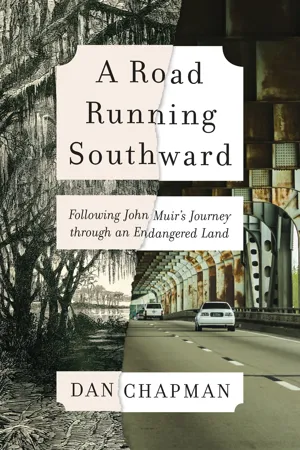
A Road Running Southward
Following John Muir's Journey through an Endangered Land
- 246 pages
- English
- ePUB (mobile friendly)
- Available on iOS & Android
eBook - ePub
About this book
Information
CHAPTER 1
Who Is John Muir?
I used to climb to the top of one of the huge chinaberry trees, which guarded our front gate, and look out over the world. The most interesting thing that I saw was the horizon. It grew upon me that I ought to walk out to the horizon and see what the end of the world was like.
—Zora Neale Hurston, Dust Tracks on a Road
Atlanta, Georgia — Any deep dive into understanding John Muir’s rebellious life leads to one overriding conclusion: He was a hippie.
The shaggy, poetry-spouting, draft-dodging Bohemian thumbed his nose at conventional wisdom, religious orthodoxy, and societal mores. He defied his father, disavowed his early Christian upbringing, and made a lifetime habit of questioning authority. Muir shredded the nineteenth-century maxim that all progress is good progress. He didn’t trust The Man—or, in his words, “Lord Man”—and society’s money-first mentality. Confronted early on with good jobs and a bourgeois life, Muir recoiled. And then went hiking.
Nature was his bag. He was the proverbial “wild child” who never lost his love for adventure. An early advocate of Flower Power, Muir believed that all of God’s flora and fauna were worthy of preservation and were no less valuable than us bipeds. Universal peace and quiet was his thing. The dude even loved weed(s). Plus, he up and did some crazy stuff, like climbing a tall tree in a storm to experience life in all its cosmic glory.
Yet Muir remained a Bible-toting prude who blanched at relations with the opposite sex. His encounters with African and Native Americans were less than enlightened, even downright racist. As a boy, he was cruel to animals. Marriage was more of a convenience than an affair of the heart. His all-natural piety grated on less-devoted disciples of wildness.
Muir eventually embraced mainstream society, raised a loving family, got rich, and trod the corridors of power. He realized that his articles and books, leadership of the Sierra Club, and lobbying of the mighty served the budding conservation movement better than his musings on flowers and glaciers. Still, it was Muir’s status as an unassailable truth-sayer preaching the back-to-nature gospel to an increasingly jaded, yet eager, American audience that would prove to be his most enduring legacy.

John Muir was born April 21, 1838, in Dunbar, Scotland. He was the third of eight children and the first boy. His father, Daniel, had moved to the North Sea port town to recruit soldiers for the British army. He married a woman who inherited a prosperous grain and feed store. She died within a year. Daniel then married Ann Gilrye, whose father, a meat merchant, opposed their marriage. Ann loved nature, gathered flowers, wrote poetry, enjoyed music and painting. Daniel, a religious zealot, forbade idolatry of any kind and prohibited music, dancing, jokes, or pictures on the walls. Meals were spartan and taken in silence. Ann even felt compelled to drop her cross-stitching. Daniel, though, did allow one pleasure: an Eden-inspired backyard garden with high walls and locked gates. It also served to keep his children from wandering off into hedonic nature. Or so he thought.
“When I was in Scotland I was fond of everything that was wild, and all my life I’ve been growing fonder and fonder of wild places and wild creatures,” reads the beginning of Muir’s The Story of My Boyhood and Youth. “I loved to wander in the fields to hear the birds sing, and along the seashore to gaze and wonder at the shells and seaweeds, eels and crabs in the pools among the rocks when the tide was low; and best of all to watch the waves in awful storms.”
By many accounts, Muir was a typically rambunctious Scottish kid. The ruins of Dunbar Castle were a playground and a training ground for rock climbing. Boys challenged each other to fistfights and cross-country races. He relished walks with his grandfather into the countryside to eat apples and figs and marvel at birds, mice, and other creatures. Muir dreamed of voyages to France, India, Australia, and America. He also enjoyed dogfights and the slaughter of pigs. He threw stones at cats and, with a brother, tossed one feline from the top story of their house onto the ground below—“a cruel thing for even wild boys to do,” as Muir acknowledged decades later.
The Scots’ characteristic dourness, coupled with Daniel’s oppressive piety, relentless Bible study, and fondness for the switch, drained much of the joy from Muir’s early childhood. So when Daniel, dissatisfied with the Church of Scotland’s supposed religious leniency, told the family on February 18, 1849, that they were emigrating to America, young John was ecstatic.
The next morning, John, aged eleven, Sarah, thirteen, and David, nine, took the train with their father to Glasgow for the ship to America. Six weeks later, after joyful hours spent on deck with endless ocean vistas and shanty-singing sailors, the Muirs landed in New York City, ferried up the Hudson River to Albany, traveled the Erie Canal by packet boat to Buffalo, and steamed across Lake Michigan to Milwaukee. They paid a farmer thirty dollars to carry them a hundred miles by wagon into the hinterlands, where they soon settled on eighty acres of virgin land and open forest near the Wisconsin River. Their nearest neighbors were four miles away. Soon, though, the region would fill with fellow Britishers and afford Daniel a ready audience for his circuit preaching. The Muirs built a temporary shanty and set about carving a farm, and a new life, out of the Wisconsin wilderness. By fall, they had constructed a fine-looking, eight-bedroom home to welcome the rest of the Muir family.
The natural bounty surrounding Fountain Lake farm amazed Muir: whippoorwills, jack snipes, and sandhill cranes; love-struck frogs and snapping turtles; Winnebago Indians; ferocious thunderstorms; strawberries, dewberries, cranberries, and huckleberries.
“The sudden plash into pure wildness—baptism in Nature’s warm heart,” he wrote. “Here, without knowing it, we still were at school; every wild lesson a love lesson, not whipped but charmed into us.”
Work, though, proved grueling. Muir’s first job was to burn the brush that had been cleared for the planting of wheat, corn, and potatoes. A year later, he was put to the plow, a boy of twelve whose head barely cleared the handles. The brothers fetched water, chopped wood, and fed the animals before breakfast. Fall harvest required seventeen-hour days. Winters were spent shelling corn, fanning wheat, making ax handles, sorting potatoes. Daniel would allow only a few sticks of wood for the morning’s fire, guaranteeing that his family would shiver around the stove while putting feet with chilblains into wet socks (“causing greater pain than a toothache”) before hurrying to their chores.
John missed but one day of harvest that first decade, and only because he had pneumonia. “We were all made slaves through the vice of over-industry,” he wrote.
The soil was exhausted within five years. Daniel bought another farm three years later, named it Hickory Hill, and set John to work digging a well ninety feet deep. He nearly died of asphyxiation from the carbon dioxide vapors that filled the bottom of the hole.
Daniel prayed that his eldest son would follow in his pious footsteps. Daily Bible lessons resulted in John’s rote mastery of the New Testament, and three-fourths of the Old, by age eleven. Any misquote was met with a whipping. The burning of brush afforded John’s father countless opportunities to warn his sinful children of hellfire and eternal damnation. Daniel belittled virtually every nonreligious endeavor that John undertook. James B. Hunt, a Muir biographer, writes that father and son “were locked in mental and theological combat.”
Daniel left his children free to enjoy Sunday afternoons, the Fourth of July, and January first. They made the most of it. The fields, woods, and streams were cathedrals of learning and mystery that piqued John’s ceaseless sense of wonder. Ducks, loons, and millions of passenger pigeons filled the skies. A few stray pine boards were transformed into a boat to better catch pickerel, sunfish, and perch. The boys hunted musk-rats. They learned to swim by imitating frogs (and almost drowning).
Too busy on the farm, the kids didn’t go to school. Yet John, by age fifteen, grew hungry for knowledge. He sold squirrel and muskrat pelts to buy algebra, geometry, and grammar books. He borrowed the works of Walter Scott, William Shakespeare, and John Milton from neighbors despite his father’s admonition that the “Bible was the only thing required on earth.” Mungo Park, a Scottish explorer, enthralled Muir with tales of Africa. Alexander von Humboldt, the German naturalist, introduced him to Latin America. Muir would steal minutes at lunch or before bed to read. Daniel ordered John to bed promptly at eight, but said he could get up as early as he wanted. John woke at 1:00 a.m. to read or tinker. He became quite the inventor. With bits of leather, metal, and whittled wood, John made water wheels, locks, clocks, thermometers, barometers, and hygrometers. He built a self-starting sawmill and a bed that stood its occupant upright at an appointed hour via a clock, pulleys, and counterweights. Daniel considered the inventions nonsense, but word of the crazy contraptions spread across the countryside.
John, unsure of what to do with his life, stayed on the farms until he was twenty-two. A Scottish neighbor, wowed by the inventions and sympathetic to the boy’s harsh home life, told John about the upcoming Wisconsin state fair with its display of scientific inventions. On a September morning, in 1860, John left home. Daniel offered no money. John pocketed the gold sovereign his grandfather had given him upon leaving Scotland a decade earlier and headed to Madison.
The fair changed Muir’s life. His clocks, thermometers, and self-rising bed wowed the judges and earned him a ten-dollar prize and accolades in the local newspaper as “An Ingenious Whittler.” Two boys helped Muir demonstrate the bed’s mechanics. One was the son of Ezra and Jeanne Carr, who became mentors and confidantes and steered Muir’s intellectual journey over the next two decades.
Muir recalled that he was “desperately hungry and thirsty for knowledge and willing to endure anything to get it,” yet he couldn’t afford college. Once the fair ended, he traveled to Prairie du Chien with another exhibitor to help build steam-powered iceboats that could sail across the frozen Mississippi River. He lived in a boardinghouse whose occupants played parlor games where kisses were exchanged. Muir rebuked the players by quoting Scripture.
Bored by the foundry work, Muir returned to Madison after three months. He scratched up the money to attend the University of Wisconsin by selling some of his bedsteads, addressing circulars in an insurance office, and caring for horses.
Muir followed his own course of study, which precluded earning a degree in four years. He took classes in chemistry (from Ezra Carr), math, physics, Greek, Latin, botany, and geology. A fellow student introduced him to the wonders of flowers and trees, and Muir took every opportunity to explore the countryside in search of plants to collect and catalogue.
He survived on bread, mush, and the occasional potato. His family sometimes sent ten or twenty dollars. His funky bed would get him up in the morning for a day of classes, studies (Muir would climb a basswood tree overhanging the campus lake with book in hand), botanizing, and work. The farm boy with an unkempt beard “was already acquiring a reputation for amiably eccentric social behavior,” writes biographer Stephen Fox.
Muir was rootless and restless, uncertain who he was and what he wanted to be. The times, too, were unsettling. The Civil War had begun. Muir witnessed military training at Camp Randall, which also housed Confederate prisoners. The draft began in 1862. Immigrants who, like Muir, didn’t consider themselves American rioted against compulsory military service. (Muir didn’t become a US citizen until he was sixty-five.) War was also contrary to Muir’s religious faith. His violent upbringing, at the hands of his father, further cemented Muir’s pacifism.
He left the university in 1863 after the spring semester, planning to attend medical school at the University of Michigan in the fall. A botanical journey down the Wisconsin River valley into Iowa came first, though. “I was only leaving one University for another, the Wisconsin University for the University of the Wilderness,” Muir wrote.
A year later Muir crossed into Canada and disappeared into the woods and swamps around Lake Huron. One boggy day, with the sun setting and hunger rising, he stumbled across a rare botanical find—Calypso borealis. Muir, ecstatic, called the swamp orchid “the most spiritual of all the flower people I had ever met.” Forty-five years later he reminisced that only meeting Ralph Waldo Emerson, and a few other notables, was more memorable than discovering Calypso. Muir related his discovery to a former professor who sent it along to the Boston Recorder. It was Muir’s first published work.
The orchid infused Muir’s budding philosophy of nature. “Are not all plants beautiful?” he wrote. “Or in some way useful? Would not the world suffer by the banishment of a single weed? The curse must be within ourselves.”
Muir was questioning the anthropocentric ideal that anything not human or made for the benefit of man wasn’t important, useful, or worthy. Everything in the universe, Muir was beginning to believe, had a purpose. This signified a break from the Christian creed that nature must be subservient to man, a far-out discovery that would be reinforced during Muir’s Southern trek.
Muir continued his Canadian walkabout acting “like a fugitive,” according to biographer Fox. Later, embarrassed by his draft dodge, he glossed over his two-year stint in Canada, as did some of his biographers and disciples. Muir soon met up with younger brother Dan, who had already fled the country, and found work at a mill in Meaford, Ontario, that made handles for rakes and brooms. They lived in a boardinghouse run by Campbellites, members of the same strict religious order as their father. John slept little, worked long hours, and improved the factory’s productivity enough to be offered a partnership. He was, as usual, conflicted. Doctor? Inventor? Machinist? Professor? Scientist? Explorer?
He rekindled an epistolary relationship with Jeanne Carr. “How intensely I desire to be a Humboldt!” he wrote. Carr, a Vermont-born botanist in her own right, pushed the young wanderer to find God in nature. She told him what to read, encouraged him to write, and sent his work to East Coast publishers. She eventually introduced him to Emerson and other leading lights, as well as to his future wife, Louisa Strentzel. Nobody outside of family so influenced the young Muir’s life. He called Jeanne his “spiritual mother.” “She had opened his whole being to a physical and spiritual relationship with nature,” writes Donald Worster, another Muir biographer.
In March 1866, a winter storm sent fireplace embers onto the mill’s roof. Gone was the factory, a large inventory of wooden handles, and Muir’s dream of returning to college. The owners couldn’t pay the three hundred dollars they owed Muir. He returned to the States—the war was over—and settled in Indianapolis with a job at a manufacturer of wheels, spokes, and carriage parts. The factory-versus-forest struggle continued to gnaw at his soul. Soon, disaster would resolve matters.
Muir threw himself into the job at Osgood, Smith & Co. with characteristic intensity. He started as a sawyer at ten bucks a week, but quickly advanced to supervisor of all machinery at eighteen a week. He teased his inner Humboldt with Sunday-afternoon excursions into the surrounding oak and hickory forests with paper and pen in hand. Back at work, his boss encouraged him to improve the factory’s design and production, a task Muir relished. On March 6, 1867, the tinkerer was shortening a belt when a file slipped and ricocheted into his right eye. His cornea was pierced. He couldn’t see out of the eye. He staggered back to the boardinghouse, where his left eye went dark, too. He feared he would never again witness nature’s beauty.
“You have, of course, heard of my calamity,” Muir wrote to Jeanne Carr. “The sunshine and the winds are working in all the gardens of God, but I—I am lost. I am shut in darkness. My hard, toil-tempered muscles have disappeared, and I am feeble and tremulous as an ever-sick woman.”
William Frederic Badè, literary executor of Muir’s estate and an early president of the Sierra Club, said that the accident ended Muir’s indecisiveness over a career path. “He concluded that life was too brief and uncertain, and time too precious, to waste upon belts and saws, that while he was pottering in a wagon factory, God was making a world; and he determined that, if his eyesight was spared, he would devote the remainder of his life to a study of the process,” Badè wrote. “Thus the previous bent of his habits and studies, and the sobering thoughts induced by one of the bitterest experiences of his life, combined to send him on the long journey.”
Muir would walk the South. Within a month his eyesight had returned. He journeyed to Wisconsin to set his affairs in order—which family member would inherit what if he died in Georgia, Florida, or Brazil. The life of a wandering botanist did not appeal to his father, however. Daniel likened his son’s proposed journey to “walking in the paths of the Deevil.” He made John pay for his summer’s room and board. Incensed, John responded: “You may be sure it will be a long time before I come again.”
He didn’t return until twenty years later, as his father lay dying.
In 1864, President Lincoln signed legislation transferring forty thousand acres, including the Yosemite Valley, to the state of California to be set aside for public recreation. Towering waterfalls, granite cliffs, ancient sequoias, deep valleys, and flower-filled meadows were the already popular preserve’s calling cards. Many consider the alpine ref...
Table of contents
- Cover Page
- Subscribe
- Title Page
- Copyright Page
- Contents
- Introduction: Ghosts, Skeeters, and Rye
- Chapter 1: Who Is John Muir?
- Chapter 2: A New South Reckoning
- Chapter 3: The South’s Incredible Biodiversity Is Threatened and Endangered
- Chapter 4: A Celebration of Muir Turns Toxic
- Chapter 5: “The Mountains Are Calling”—and They’re Not Happy
- Chapter 6: More Rain, More Heat, and More Trouble
- Chapter 7: Water Wars
- Chapter 8: The Deeper the River, the Greater the Pain
- Chapter 9: A Coastal Playground Is Disappearing
- Chapter 10: Where Hogs Rule and Turtles Tremble
- Chapter 11: Take My Water, Please
- Chapter 12: The End of the Road
- Acknowledgments
- Further Readings
- About the Author
Trusted by 375,005 students
Access to over 1.5 million titles for a fair monthly price.
Study more efficiently using our study tools.
Frequently asked questions
Yes, you can cancel anytime from the Subscription tab in your account settings on the Perlego website. Your subscription will stay active until the end of your current billing period. Learn how to cancel your subscription
No, books cannot be downloaded as external files, such as PDFs, for use outside of Perlego. However, you can download books within the Perlego app for offline reading on mobile or tablet. Learn how to download books offline
Perlego offers two plans: Essential and Complete
- Essential is ideal for learners and professionals who enjoy exploring a wide range of subjects. Access the Essential Library with 800,000+ trusted titles and best-sellers across business, personal growth, and the humanities. Includes unlimited reading time and Standard Read Aloud voice.
- Complete: Perfect for advanced learners and researchers needing full, unrestricted access. Unlock 1.5M+ books across hundreds of subjects, including academic and specialized titles. The Complete Plan also includes advanced features like Premium Read Aloud and Research Assistant.
We are an online textbook subscription service, where you can get access to an entire online library for less than the price of a single book per month. With over 1.5 million books across 990+ topics, we’ve got you covered! Learn about our mission
Look out for the read-aloud symbol on your next book to see if you can listen to it. The read-aloud tool reads text aloud for you, highlighting the text as it is being read. You can pause it, speed it up and slow it down. Learn more about Read Aloud
Yes! You can use the Perlego app on both iOS and Android devices to read anytime, anywhere — even offline. Perfect for commutes or when you’re on the go.
Please note we cannot support devices running on iOS 13 and Android 7 or earlier. Learn more about using the app
Please note we cannot support devices running on iOS 13 and Android 7 or earlier. Learn more about using the app
Yes, you can access A Road Running Southward by Dan Chapman in PDF and/or ePUB format, as well as other popular books in Biological Sciences & Science & Technology Biographies. We have over 1.5 million books available in our catalogue for you to explore.