![]()
KILLING THE MARINE MAMMALS
![]()
5
STELLER’S LEGACY
In 1648, Semyon Dezhnev, a Siberian Cossack, set sail with seven boats, following the northern Siberian coast eastward from the Kolyma River. Four of the boats were lost before they rounded the Chukotsky Peninsula and one was wrecked there, but the two remaining boats made it as far south as the Anadyr River, which meant that they passed through what would later be known as the Bering Strait. When Dezhnev returned to Moscow in 1662, he filed reports of his journey for payment of accrued salary, so sixty years before Vitus Bering set out, there was evidence that the two continents were indeed separated. Either Peter the Great never saw or heard of Dezhnev’s reports or he chose to send Bering anyway, to provide better proof than the reports of an illiterate Cossack.
In 1725, following instructions that Peter the Great signed on his deathbed, Bering headed north from the Kamchatka Peninsula and found an island that he named St. Lawrence, for the saint’s day on which he found it. In the little St. Gabriel, Bering and his second in command, Alexei Chirikov, actually passed through the fifty-six-mile-wide Bering Strait, which separates Asia from America, but the weather was bad and the fog too heavy for them to confirm the separation of the continents—how could they tell they were not in an enormous bay? Fearing for the safety of the ship, Bering returned to Kamchatka. The government authorized a second expedition in 1740, and this time, with Bering commanding the St. Peter and Chirikov the St. Paul, they headed eastward, looking for the fabled (but nonexistent) Gamaland, and then continued toward America. The two ships were separated south of the Aleutian island of Amchitka in June 1741 and never reestablished contact. Chirikov made it to Alaska, sighting the Alexander Archipelago on July 15 and then traveling westward before returning to Kamchatka.
Bering’s ship, carrying his naturalist, Georg Wilhelm Steller, fared less well. Running low on food and water and with the men falling to scurvy, the St. Peter also reached the Alaskan mainland (at Mount St. Elias) and then headed back toward Kamchatka. Bering was now too sick to command the ship; under Sven Waxell, the crew of the eighty-foot-long St. Peter passed Kodiak Island without seeing it in the fog, finally reaching the Shumagin Islands and the western terminus of the Alaska Peninsula. As they cleared the islands, with no idea of where they were, a terrible storm arose and blew them westward. Finally, on November 4, 1741, with most of the crew soaked, freezing, and near death, they sighted land, which they believed to be Avacha Bay, their departure point on Kamchatka. It was not; it was the westernmost island in the Aleutian chain, an island home to seals, sea otters, and little blue foxes. Vitus Bering would die there and posthumously give the island his name. The crew anchored the battered ship in a bay, only to have the offshore winds drive the vessel onto shore two days later, burying her keel in the sand.
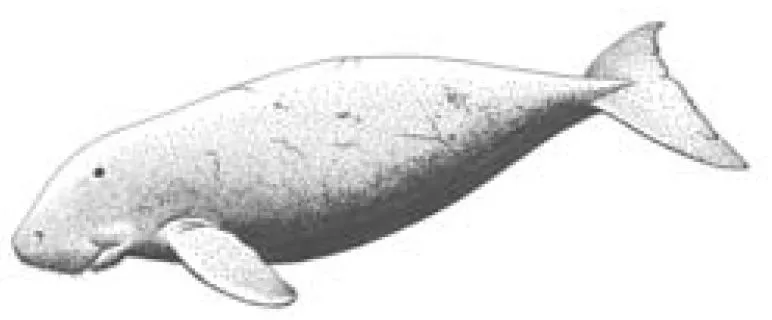
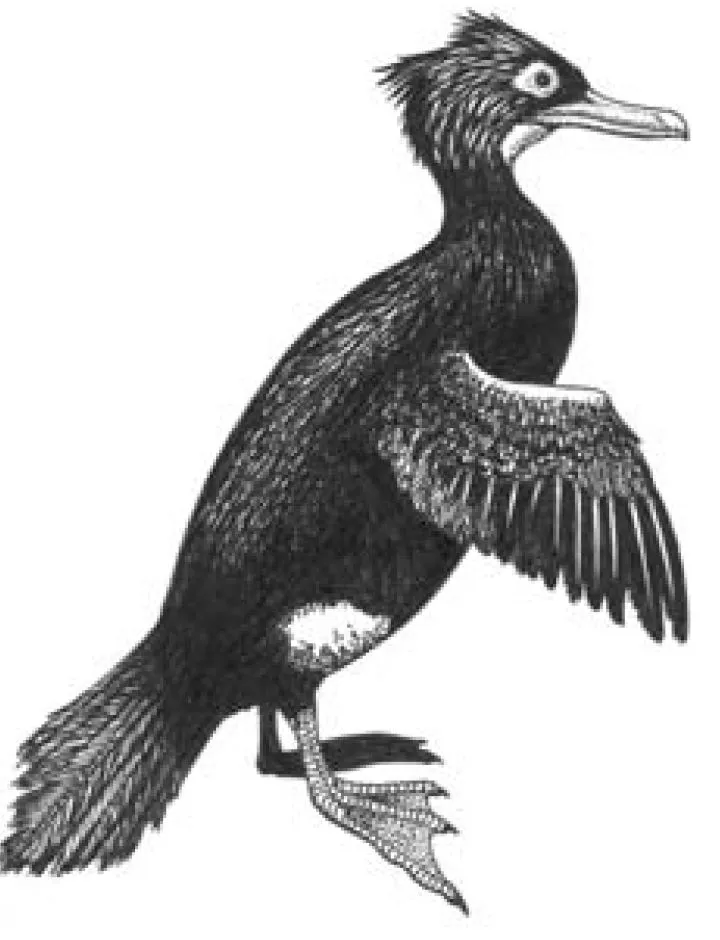
The arrival of white men on the Aleutians signaled big trouble for the region’s marine life. When Bering and Steller were shipwrecked on the barren Commander Islands in 1741, they and the other survivors had to subsist on what they could catch. They began with sea otters and fur seals and initiated what soon became the total elimination of the hapless sea cow. They also found a large, flightless bird ripe for the plucking. It was the spectacled cormorant (Phalacrocorax perspicillatus), an ungainly creature that, most unfortunately for its future, had wings too small for flight. Like the sea cow, it was ridiculously easy to kill and tasted good, a combination that almost guaranteed its demise. In his 1936 biography of Steller, Leonhard Stejneger described the bird:
The flightless spectacled cormorant is another of Steller’s sensational discoveries—sensational not only because its wings were too small to carry its gigantic body, but chiefly because—like the sea cow—it is known only from Bering Island and was exterminated by ruthless hunting. Steller, the only naturalist to see the bird alive, and his comrades were able to vary their fresh meat diet of sea-otter and seal with roasts of this stupid bird, which was as large as a goose, weighing 12 to 14 pounds, “so that one single bird was sufficient for three starving men.” Ordinarily cormorants are not considered particularly savory eating, but Steller avers that when properly prepared according to the method employed by the Kamtchadals, namely by burying it encased—feathers and all—in a big lump of clay and baking it in a heated pit, it was a palatable and juicy morsel.
SPECTACLED (FLIGHTLESS) CORMORANT
(Phalacrocorax perspicillatus)
Russian sealers killed off the sea cows within twenty-eight years of their discovery of the cormorants, but it took them more than a century to kill off the birds. There is no question that the sea cows and the cormorants are gone, but Steller observed another creature on this voyage that has not been seen again—not because it is necessarily extinct but because it may never have existed at all. Here is Steller’s description of an animal seen in the Bering Sea on the evening of August 10, 1741, included by Stejneger in his biography:
The length of the beast was about two arshins [5 feet], its head like that of a dog, the ears pointed and erect. On the lower and upper lips on the sides long hairs like a beard, eyes large: the shape [of the body] roundish [cylindrical] and oblong, thicker towards the head, but much slenderer towards the tail. Hair on the whole body thick, on the back gray, but on the belly of a chestnut white, but in the water the said beast appeared entirely like a chestnut cow. The tail [flipper] was divided in two parts, of which the upper was longer. In the meantime the author [Steller] was very much astonished that he could notice on it neither feet nor flippers as in other marine animals.... This marine animal, considering its resemblance to a marine ape, might in very truth be called by that name because of its characteristics as displayed by its astonishing manner, tricks and agility. It swam about their ship for more than two hours looking with an air of wonderment now at one person, now at another. At times it came so near to them that it would have been possible to touch it with a pole; at times it went far away, especially when it saw them stirring about. It raised one-third of its body out of the water, and stood upright like a man and did not change its position for several minutes. Having looked at them attentively for about half an hour it darted like an arrow under their ship and came out of the water on the other side, but soon dived again under the ship and reappeared where it was first seen; and this it repeated about thirty times.
The animal took a long piece of seaweed in its mouth and played with it. After watching the creature for two hours, Steller shot at it, “intending to get possession of it to make an accurate description,” but he missed. When the animal reappeared, he took another shot at it but missed again. “However,” he wrote, “it was seen at various times in different parts of the sea.”
Because no living animal conforms to Steller’s description, it has been more than a little difficult to determine what it was. In Searching for Hidden Animals: An Inquiry into Zoological Mysteries, Roy Mackal agrees in all particulars with the account reproduced by Stejneger but then disagrees as to how the description is to be interpreted. Mackal, a biologist and cryptozool-ogist, believes that “the simplest explanation is that the ‘sea monkey’ actually existed, and that Steller saw it for the first and last time before it became extinct, like the northern sea cow which he was the only naturalist ever to observe.... Rational observers are forced to conclude that Steller must have observed a real animal, one that is unidentified to this day.” Harold McCracken (1957) believes that Steller merely misidentified a known sea mammal: “Even the eminent naturalist Steller,” he wrote, “when he saw his first live sea-otter from the deck of the St. Peter, mistakenly called it a ‘sea-ape’ because of the peculiar antics it performed in the water.” Stejneger, on the other hand, thinks that Steller saw a bachelor fur seal, mistook the hind flippers for a two-part tail, and missed the forelegs because “when moving at high speed through the water the fur-seal keeps the fore flippers pressed very close to the body so that they are practically invisible.” Stejneger points out (in italics) that up to that moment, Steller had never seen a fur seal, but this point is meaningless because Steller had to have written up his observations after the sighting, so it doesn’t matter if he hadn’t seen one before August 10.
We will probably never know what it was Steller saw that evening, but a clue has surfaced that would seem to tilt the interpretation toward an unknown animal. In 1971, Charles Greer and Victor Scheffer published the text and accompanying illustration of what they believed to be one of the earliest pictures of a fur seal, as it appeared in the 1715 Comprehensive Pictorial Encyclopedia of Japan and China by an Osaka physician named Ryoan Terajima. The illustration shows a vaguely seal-like animal, with its whiskers sticking up and with what would appear to be either a three-part tail or small hind legs and a long tail. Terajima’s description reads as follows:
The color of its fur resembles that of a fox, and the shape of its tail is similar to a fish’s. Its legs resemble a dog’s, but it has no forelegs.... Large ones are two to three shaku (twenty-eight to forty-two inches) in length. The whole body is that of a fish, and it has a tail, but it is half fish and half beast. Its head resembles a cat’s, and its muzzle is sharp. It has eyes and a nose, but no external ears, only small holes.... The tail is forked like that of a goldfish and is black in color, but some have a five-forked tail.... It has no forelegs, but near the tail there are fins on both flanks, which are black in color, like small legs. These are fins, however, and not legs.
Despite the anomalies, such as no forelegs, no external ears, and a tail like that of a goldfish, Greer and Scheffer read this as a perfectly good description of a northern fur seal, which, they say, was “known to Asiatic peoples . . . long before Europeans came to the North Pacific.” The reddish color and forked tail, not to mention the missing forelegs, certainly conform more closely to Steller’s mysterious sea monkey than to any known pinniped or sea otter, but the earless nature of this creature differentiates it from Steller’s animal. Perhaps there were marine apes with ear flaps, à la Steller, and others with just ear holes, as described by Terajima.
Appending Steller’s as a prefix to the common name of an animal is tantamount to passing down a death sentence. Whatever it was, Steller’s enigmatic sea monkey is gone; his sea cow and cormorant are extinct; his sea lion is in decline (for reasons unknown); only his jay, eider, and sea eagle remain unthreatened. (The sea otter was not discovered or named by Steller; it was known from Kamchatka long before Steller’s adventures on the Commander Islands.) There is, however, another bird discovered by Steller that had the name of the great naturalist added to its own, and it too has barely managed to survive.
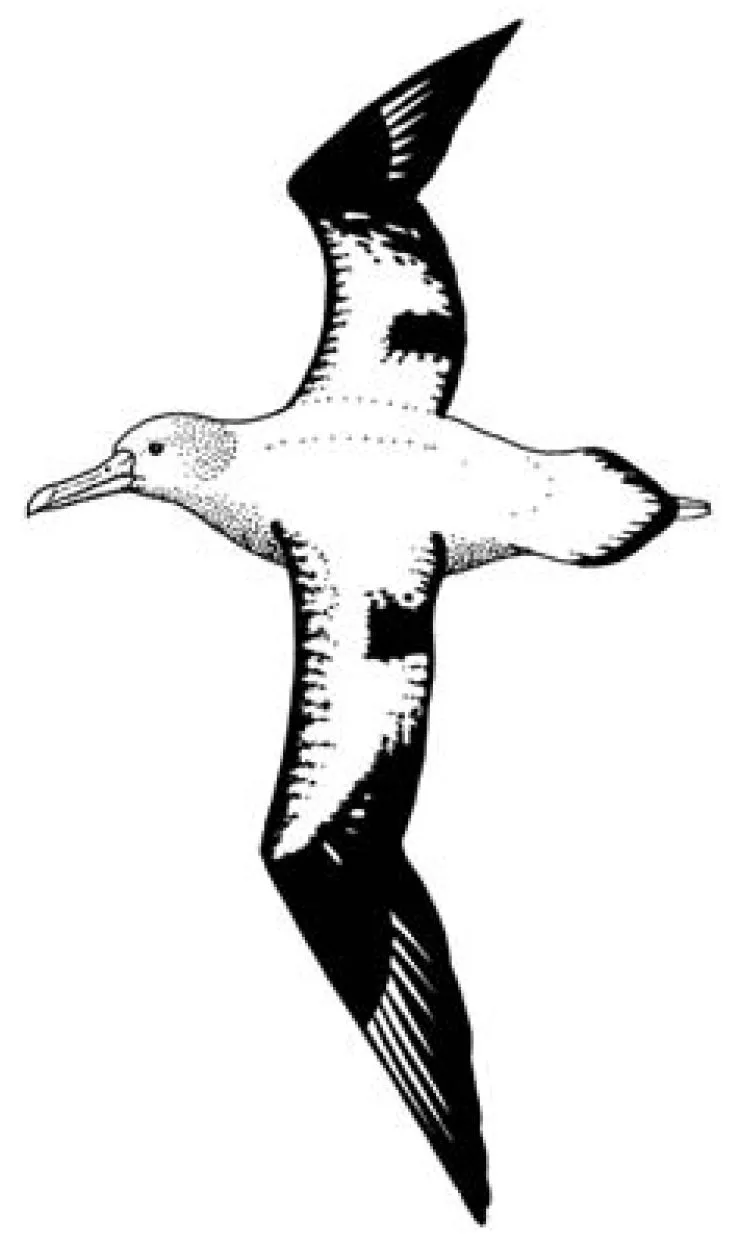
Of all birds, albatrosses are far and away the least terrestrial—they have been known to spend months or even years riding the winds above the ocean, slowing only to pluck food items from the sea. During Bering’s ill-starred 1741 voyage, a large flying bird was sighted, and although Steller thought it was some kind of large gull, it was actually a North Pacific albatross. (The albatrosses of the Southern Hemisphere had been known since navigators rounded the Cape of Good Hope on their way to India, and in 1697 William Dampier identified algatrosses as “very large long-winged fowl.”) During Steller’s time, these birds—now known as Steller’s (or the short-tailed) albatross, Diomedea albatrus—probably ranged along the northern Chinese coast, Taiwan, the Kamchatka Peninsula, the ice edge of the Bering Sea, and the Pacific coast of North America, perhaps going as far south as Baja California. They were said to follow whaling vessels in order to feed on scraps, but it was probably their North Pacific habitat that served to identify them, not their blue-tipped pink bill. (The only other North Pacific albatrosses are the black-footed and the Laysan, which are dark-backed, whereas the back of the short-tailed is white.) The name short-tailed is misleading, according to W. Lance Tickell (2000): “Laysan and black-footed albatrosses also have short tails, and the Galápagos albatross has the shortest tail of all albatrosses.”
SHORT-TAILED ALBATROSS
(Diomedea albatrus)
The short-tailed albatross is the largest of the North Pacific albatrosses and also the rarest. Indeed, it is one of the rarest birds in the world, with a total numbering somewhere around two hundred. Before its decline, D. albatrus was known or suspected to breed in the southern Izu Islands, the Ryukyus, the Pescadores, and the Daitos, but its main area of concentration was Torishima Island in the southern Izus, some 360 miles south of Tokyo. Today, Torishima is the bird’s only breeding ground.
In 1887, a Japanese firm called the South Seas Trading Company put ashore fifty laborers whose sole function was to kill these aho-dori, or “fool birds.” The white body feathers were used to stuff pillows and quilts; the wing and tail feathers made dandy quill pens; and some of the larger feathers, known as “eagle feathers,” appeared on women’s hats in Europe and North America. The fat was useful as food, and the meat was dried and used as fertilizer. Albatrosses are awkward and clumsy on land, and because they show no fear of predators while sitting on the nest, they were clubbed to death as they sat. Japanese ornithologist Yoshimaro Yamashina estimated that 5 million of these birds had been killed between 1887 and 1902, when a volcanic eruption killed all 129 humans on the island at the time. After five years, the island was resettled, and the new homesteaders picked up where their predecessors left off, killing 3,000 birds between December 1932 and January 1933. By April 1933, fewer than 100 birds were left on Torishima. The volcano erupted again in 1939 and then again in 1941, burying the breeding grounds of the short-tailed albatross under thirty feet of ash and lava.
During World War II, the Japanese built an aircraft observation post on Torishima, and the observers reported that a couple of aho-dori were breeding there again. In 1946, when Oliver Austin was head of wildlife at the Headquarters of Allied Powers occupying Japan, he tried to visit Torishima, but “available transportation never coincided with freedom from other duties during the breeding season,” and he never landed there. Three years later, he sailed around the Bonin Islands whaling grounds on a Japanese whale catcher and “saw no albatrosses whatever.” This led him to conclude that Steller’s albatross was extinct.
When W. Lance Tickell visited the island in 1973 aboard the British warship HMS Brighton, however, he discovered fifty-seven breeding pairs, and he estimated that there had been ten breeding pairs twenty years earlier. A rare bird nesting on a live volcano seems a recipe for disaster. But, as Tickell points out, “Steller’s albatross is an oceanic bird and its habitat is not Torishima so much as a wide expanse of ocean not influenced by one small island volcano. No albatrosses are on the island from June to September and throughout the rest of the year, [and] a substantial proportion of the population is always at sea, even at the height of breeding.... As long as the island was not blown apart completely, an eruption would merely change the topography; much of Tori...