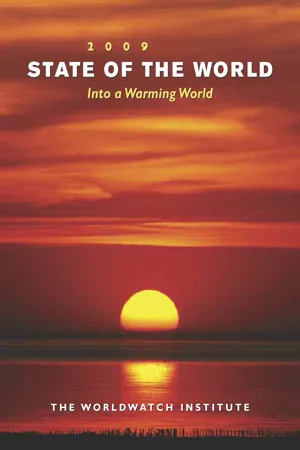
It's New Year's Day, 2101. Somehow, humanity survived the worst of global warming—the higher temperatures and sea levels and the more intense droughts and storms—and succeeded in stabilizing the Earth's climate. Greenhouse gas concentrations are peaking and are expected to drift downward in the 22nd century. The rise in global temperatures is slowing and the natural world is gradually healing. The social contract largely held. And humanity as a whole is better fed, healthier, and more prosperous today than it was a century ago. This scenario of an imagined future raises a key question: What must we do in the 21st century to make such a future possible, and to head off the kind of climate catastrophe that many scientists now see as likely? This question inspires the theme of the Worldwatch Institute's State of the World 2009 report: how climate change will play out over the coming century, and what steps we most urgently need to take now.
- 247 pages
- English
- ePUB (mobile friendly)
- Available on iOS & Android
eBook - ePub
About this book
Information
Subtopic
Environment & Energy PolicyCHAPTER 1
The Perfect Storm
Christopher Flavin and Robert Engelman
Something extraordinary happened at the top of our planet in the past three summers. For a few weeks each year—in the final days of the northern summer—a large stretch of open water appeared around the Arctic, making it briefly possible to pilot a ship from the Atlantic to the Pacific without going through the Panama Canal or around the Cape of Good Hope. Never before in recorded human history has it been possible to make that journey.1
As a barometer of global environmental change, the loss of the permanent ice cap at the North Pole is like a seismograph that suddenly jumps off the charts. For several decades now, Earth’s heat balance has been severely out of equilibrium. Earth is absorbing more heat than it is emitting, and across the planet ecological systems are responding. The changes so far have been almost imperceptible, and even now they appear from the human viewpoint gradual.
But don’t be fooled: the changes represented by melting glaciers, acidifying oceans, and migrating species are—on a planetary timescale—breaking all known speed limits. The planet that humans have known for 150,000 years (encompassing the Pleistocene and Holocene epochs, as geologists describe them) is changing irrevocably thanks to human actions. In 2000 the Nobel Prize-winning chemist Paul Crutzen and his colleague Eugene F. Stoermer concluded that these changes are so profound that the world has entered a new geological epoch—which they aptly named the Anthropocene.2
Changing Earth’s climate is like sailing a massive cargo ship. Tremendous energy is required to get such a ship moving—and its forward progress is at first almost imperceptible—but once it is traveling at full speed, it is very hard to stop. It is now virtually certain that children born today will find their lives preoccupied with a host of hardships created by an inexorably warming world. Food supplies will be diminished, and many of the world’s forests will be destroyed. Not just the coral reefs that nurture many fisheries but the chemistry of the oceans will face disruption. Indeed, the world’s oceans are already acidifying rapidly. Coastlines will be rearranged, and so will the world’s wetlands. Whether you are a farmer or an office worker, whether you live in the northern or southern hemisphere, whether you are rich or poor, you will be affected.3
Fiddling While the World Burns
Like a distant tsunami that is only a few meters high in the deep ocean but rises dramatically as it reaches shallow coastal waters, the great wave of climate change has snuck up on people—and is now beginning to break. Climate change was first identified as a potential danger by a Swedish chemist in the late nineteenth century, but it was not until the late 1980s that scientists had enough evidence to conclude that this transformation was under way and presented a clear threat to humanity.
An American scientist, James Hansen of the National Aeronautics and Space Administration, put climate change squarely on the agenda of policymakers on 23 June 1988. On that hot summer day, Hansen told a U.S. Senate Committee he was 99 percent certain that the year’s record temperatures were not the result of natural variation. Based on his research, Hansen had concluded that the rising heat was due to the growing concentration of carbon dioxide (CO2) and other atmospheric pollutants. “It’s time to stop waffling so much and say that the evidence is pretty strong that the greenhouse effect is here.”4
Hansen’s words, joined with those of other scientists, echoed around the world. Within months government officials were beginning to consider steps to reduce greenhouse gas emissions, with much of the focus on the kind of international agreement that would be needed to tackle this most global of problems. In 1992 the United Nations Framework Convention on Climate Change was adopted by heads of state in Rio de Janeiro, and in 1997 the Kyoto Protocol, with its legally binding emissions limits for industrial countries, was negotiated.5
As the 1990s came to an end the world appeared to be moving to tackle the largest and most complex problem humanity has ever faced. But fossil fuel interests mobilized a counterattack—pressuring governments and creating confusion about the science of climate change. Taking advantage of the inevitable uncertainties and caveats contained in leading climate assessments, a handful of climate skeptics—many of them PhDs with oil industry funding—managed to position climate change as a scientific debate rather than a grim reality.
The climate change skeptics had their greatest influence in the United States, putting it at loggerheads with the European Union, which since the early 1990s has been the strongest advocate of action on climate change. In November 2000, in the waning days of the Clinton administration, climate negotiators met in The Hague with the intention of finalizing details of the Kyoto Protocol—which in principle had been agreed to three years earlier. Two weeks of intense discussions concluded with an agonizing all-night session that ended in failure. Distrust and miscommunication between American and European negotiators were at the heart of this historic diplomatic failure—a failure that became more significant a short time later when the U.S. Supreme Court decided that Al Gore would not be the next President of the United States.6
In the months that followed, many remained optimistic: before his election, President George W. Bush had indicated his support for addressing the climate problem and working cooperatively with other countries. Two months later—under heavy pressure from Vice President Cheney and the oil industry—he executed an abrupt U-Turn, rejecting the Kyoto Protocol outright and throwing negotiations into a tailspin. Europe, Canada, Japan, and Russia were shocked into completing and ultimately ratifying the Kyoto Protocol in the following years, but time and political momentum had been lost. More significantly, the unilateral actions of the U.S. government deepened North-South fissures on climate change—a divide that has now become the largest obstacle to progress.7
Storm Clouds Gather
The tragedy of these two wasted decades is that during this period the world has moved from a situation in which roughly a billion people in industrial countries were driving the problem—the United States, for example, has 4.6 percent of the world’s population but accounts for 20 percent of fossil-fuel CO2 emissions—to today’s reality in which the far larger populations of developing countries are on the verge of driving an even bigger problem.8
Global emissions of carbon dioxide from fossil fuel combustion and cement production rose from 22.6 billion tons in 1990 to an estimated 31 billion tons in 2007—a staggering 37-percent increase. This is 85 million tons of carbon dioxide spilled into the atmosphere each day—or 13 kilograms on average per person. The annual increase in emissions shot from 1 percent a year in the 1990s to 3.5 percent a year from 2000 to 2007—with China accounting for most of that remarkable leap.9
Between 1990 and 2008 U.S. emissions of carbon dioxide from fossil fuel combustion grew by 27 percent—but emissions in China rose 150 percent, from 2.3 billion to 5.9 billion tons. More suddenly and dramatically than experts had expected, China and other developing countries are entering the energy-intensive stages of economic development, and their factories, buildings, power plants, and cars are consuming vast amounts of fossil fuels. As recently as 2004, the International Energy Agency projected that it would be 2030 before China passed the United States in emissions. It now appears that the lines crossed in 2006.10
Accelerating emissions are not the only factor driving increased concern. Tropical deforestation—estimated at 13 million hectares per year—is adding 6.5 billion tons of carbon dioxide to the atmosphere annually. The world’s largest tropical forest, the Amazon, is disappearing at a faster pace as high agricultural prices encourage land clearing. More alarmingly, Earth’s natural sinks—its oceans and biological systems—appear to be losing their ability to absorb a sizable fraction of those emissions. As a result, the increase in atmospheric CO2 concentrations has accelerated to the fastest rate ever recorded.11
Scientists are reticent by nature, and the overwhelming complexity and inevitable uncertainty of the climate problem have led them to produce equivocal and hard-to-interpret studies that have given considerable comfort to those who argue it is too early to act on climate change. In the past year, however, a few brave scientists have cast reticence aside. Speaking in Washington on the twentieth anniversary of his historic testimony, James Hansen had a sharp warning for policymakers: “If we don’t begin to reduce greenhouse gas emissions in the next several years, and get on a very different course, then we are in trouble.... This is the last chance.”12
Climate scientists have discovered a particularly inconvenient truth: by the time definitive predictions of climate change are adopted by scientific consensus, the climate system may have reached a tipping point at which climate change begins to feed on itself—and becomes essentially irreversible for centuries into the future. The loss of Arctic ice, for example, will allow more sunlight to heat the Arctic Ocean, accelerating the buildup of heat and putting the vast Greenland ice sheet at risk. And there are early indications that the rapid rise in Arctic temperatures is thawing the tundra and thereby releasing additional amounts of CO2 and methane.
The political will for change is building, thanks to the strong base in science and widening public awareness of climate change and its risks.
These dramatic changes will affect the entire planet, but the world’s poor will suffer first and suffer most. The latest climate models indicate particular vulnerability in the dry tropics, where the food supplies for hundreds of millions of people will be undermined by climate change. Hundreds of millions more who live in the vast Asian mega-deltas will be at risk from rising sea levels and increased storm intensity. Health threats from malaria, cholera, and other diseases that are likely to flourish in a warmer world will add to the burdens facing the world’s poor. The fact that many of the 1.4 billion people who now live in severe poverty already face serious ecological debts—in water, soil, and forests—will exacerbate the new problems presented by climate change.13
When they were released in 2007, the latest findings of the Intergovernmental Panel on Climate Change were taken as an urgent warning of the dangers ahead. But the torrent of scientific data to emerge since then has led some scientists to sharpen their advice. James Hansen and W. L. Hare of Germany’s Potsdam Institute are among those who have concluded that to prevent “dangerous climate change”—the goal that governments have already agreed to—global emissions must begin declining within the decade and then fall to no more than half the current level—and possibly even to zero—by the middle of this century. (See Chapter 2.)14
This is a tall order indeed. Some would call it impossible. But the resources, technologies, and human capacity for change are all in place. The missing ingredient is political will, and that is a renewable resource.
A New Political Climate
Over the past few years, political will to tackle the climate problem has grown in many countries around the world. The European Union has committed to reducing its emissions to 20 percent below the 1990 level in 2020—and to reaching 30 percent if other industrial countries join them in a strong international agreement. And the political will for change is building, thanks to the strong base in science and widening public awareness of climate change and its risks. In late 2007, Australians voted out a conservative government in part out of impatience with the Prime Minister’s unwillingness to support the Kyoto Protocol; the new Prime Minister promptly secured its ratification. His first trip outside Australia was to a climate negotiation in Bali, and his government has been working to build a national climate plan ever since.15
In the United States, climate policy is raging like a prairie fire at the state level. By late 2008, some 27 states had adopted climate plans, and groups of eastern and western states are developing their own regional emissions cap and trade systems. In April 2008, the governors of 18 states gathered at Yale University to proclaim: “Today, we recommit ourselves to the effort to stop global warming, and we call on congressional leaders and the presidential candidates to work with us—in partnership—to establish a comprehensive national climate policy.” And the U.S. business community is responding as well: 27 major corporations, including Alcoa, Dow Chemical, General Motors, and Xerox, have announced their support for caps on national greenhouse gas emissions.16
Developing countries are joining in too. In June 2008, the prime minister of India released the much-anticipated National Action Plan on Climate Change. It focuses on eight areas intended to deliver maximum benefits in terms of domestic climate change mitigation and adaptation: solar energy, energy efficiency, sustainable habitat, water, sustaining the Himalayan ecosystem, green India, sustainable agriculture, and sustainable knowledge for climate change. China announced a new climate plan in 2007, and during the course of 2008 continued to strengthen its energy efficiency programs, including a new incentive system that ties promotion of local officials to their success in saving energy.17
These advances are welcome. But the world needs to change course much faster. To concentrate the attention of policymakers, a mass global movement is needed in support of a new climate treaty that picks up where the Kyoto Protocol leaves off in 2012. It is...
Table of contents
- Cover
- Title Page
- Copyright
- Worldwatch Institute Board of Directors
- Acknowledgments
- Table of Contents
- Foreword
- State of the World: A Year in Review
- About This Book
- 1. The Perfect Storm
- 2. A Safe Landing for the Climate
- 3. Farming and Land Use to Cool the Planet
- Climate Connections
- 4. An Enduring Energy Future
- 5. Building Resilience
- 6. Sealing the Deal to Save the Climate
- Climate Change Reference Guide and Glossary
- Notes
- The acclaimed series from Worldwatch Institute
- You Can Make a Difference
Trusted by 375,005 students
Access to over 1.5 million titles for a fair monthly price.
Study more efficiently using our study tools.
Frequently asked questions
Yes, you can cancel anytime from the Subscription tab in your account settings on the Perlego website. Your subscription will stay active until the end of your current billing period. Learn how to cancel your subscription
No, books cannot be downloaded as external files, such as PDFs, for use outside of Perlego. However, you can download books within the Perlego app for offline reading on mobile or tablet. Learn how to download books offline
Perlego offers two plans: Essential and Complete
- Essential is ideal for learners and professionals who enjoy exploring a wide range of subjects. Access the Essential Library with 800,000+ trusted titles and best-sellers across business, personal growth, and the humanities. Includes unlimited reading time and Standard Read Aloud voice.
- Complete: Perfect for advanced learners and researchers needing full, unrestricted access. Unlock 1.5M+ books across hundreds of subjects, including academic and specialized titles. The Complete Plan also includes advanced features like Premium Read Aloud and Research Assistant.
We are an online textbook subscription service, where you can get access to an entire online library for less than the price of a single book per month. With over 1.5 million books across 990+ topics, we’ve got you covered! Learn about our mission
Look out for the read-aloud symbol on your next book to see if you can listen to it. The read-aloud tool reads text aloud for you, highlighting the text as it is being read. You can pause it, speed it up and slow it down. Learn more about Read Aloud
Yes! You can use the Perlego app on both iOS and Android devices to read anytime, anywhere — even offline. Perfect for commutes or when you’re on the go.
Please note we cannot support devices running on iOS 13 and Android 7 or earlier. Learn more about using the app
Please note we cannot support devices running on iOS 13 and Android 7 or earlier. Learn more about using the app
Yes, you can access State of the World 2009 by The Worldwatch Institute in PDF and/or ePUB format. We have over 1.5 million books available in our catalogue for you to explore.