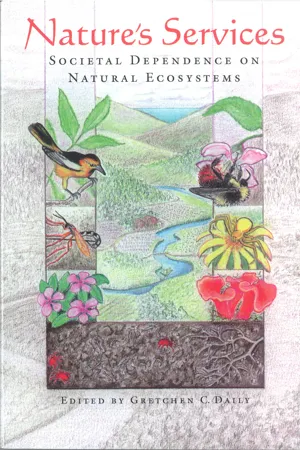
Life itself as well as the entire human economy depends on goods and services provided by earth's natural systems. The processes of cleansing, recycling, and renewal, along with goods such as seafood, forage, and timber, are worth many trillions of dollars annually, and nothing could live without them. Yet growing human impacts on the environment are profoundly disrupting the functioning of natural systems and imperiling the delivery of these services.
Nature's Services brings together world-renowned scientists from a variety of disciplines to examine the character and value of ecosystem services, the damage that has been done to them, and the consequent implications for human society. Contributors including Paul R. Ehrlich, Donald Kennedy, Pamela A. Matson, Robert Costanza, Gary Paul Nabhan, Jane Lubchenco, Sandra Postel, and Norman Myers present a detailed synthesis of our current understanding of a suite of ecosystem services and a preliminary assessment of their economic value. Chapters consider:
major services including climate regulation, soil fertility, pollination, and pest control
philosophical and economic issues of valuation
case studies of specific ecosystems and services
implication of recent findings and steps that must be taken to address the most pressing concerns
Nature's Services represents one of the first efforts by scientists to provide an overview of the many benefits and services that nature offers to people and the extent to which we are all vitally dependent on those services. The book enhances our understanding of the value of the natural systems that surround us and can play an essential role in encouraging greater efforts to protect the earth's basic life-support systems before it is too late.
- English
- ePUB (mobile friendly)
- Available on iOS & Android
eBook - ePub
About this book
Information
Part I
ECONOMIC ISSUES OF VALUATION
Chapter 3
VALUING ECOSYSTEM SERVICES: PHILOSOPHICAL BASES AND EMPIRICAL METHODS

Societies often must choose between alternative uses of the natural environment. Should a given wetland be preserved, or should the land be drained and converted to agricultural use? Should a particular timberland be maintained in its current state, or should it be opened to forestry or other development? Should a certain park be maintained, or converted to a parking lot? These are difficult questions. The way they are answered has critical importance for the viability of species in the habitats involved as well as the performance of the complex ecosystems of which they are a part.
To make rational choices among alternative uses of a given natural environment, it is important to know both what ecosystem services are provided by that environment and what those services are worth. The first item lies in the realm of fact; the second, the realm of value. Societies cannot escape the value issue: whenever societies choose among alternative uses of nature, they indicate (at least implicitly) which alternative is deemed to be worth more. In many instances, environmentally concerned individuals sense that the wrong decision has been made—that society has imputed insufficient value to nature in its current state and has thereby permitted conversion to take place for the sake of an inferior alternative. Indeed, one may sense that nature routinely is undervalued. No matter how strong suspicions are along these lines, one cannot make a convincing case that nature is undervalued without having a philosophical and empirical framework for assessing nature’s values.The philosophical element seeks to identify the ethical or philosophical basis of value, that is, articulate what constitutes the source of value. The empirical element aims to find techniques for the measurement of value, as defined according to a given philosophical notion.
This chapter considers both components in offering a framework for valuing ecosystem services. While most of the other chapters in this volume examine valuation issues as they apply to particular ecosystem services (soil conservation, pest control, pollination, etc.), this chapter is more philosophical and broader in its focus. Our attention to philosophical underpinnings helps clarify the ethical issues underlying different approaches to value. And our general approach to empirical valuation methods helps convey the range of empirical approaches available to researchers, as well as the strengths and limitations of these approaches.
The Philosophical Basis of Value
From what do nature’s values derive? When we claim that a given living thing or species or habitat is worth such and such, what is the basis of that claim?
Competing Approaches
A broad class of approaches to value is represented by anthropocentric viewpoints: elements of nature are valuable insofar as they serve human beings in one way or another. Within the anthropocentric group is utilitarianism, which maintains that natural things (indeed, all things) have value to the extent that they confer satisfactions to humans. Economists endorse the utilitarian viewpoint; as we will discuss later, this approach is inherent in benefit-cost analysis.
At first blush, it might seem that a utilitarian basis for value cannot be consistent with safeguarding the planet or protecting “lower” forms of life. But utilitarianism does not necessarily imply a ruthless exploitation of nature. On the contrary, it can be consistent with fervently protecting nonhuman things, both individually and as collectivities. After all, we may feel that the protection of certain forms of life is important to our satisfaction or well-being, and thus be led to place a high value on these forms. Utilitarianism doesn’t rule out making substantial sacrifices to protect and maintain other living things. But it asserts that we can assign value (and therefore help other forms of life) only insofar as we humans take satisfaction from doing so. The notion of satisfaction here should be interpreted broadly, to encompass not only mundane enjoyments (as with consuming plants or animals for food) but also more lofty pursuits (such as marveling at the beauty of an eagle).
The utilitarian approach allows value to arise in a number of ways. It embraces both direct use values (for example, the satisfaction from eating fish) and indirect use values (for example, the value that can be attached to plankton because it provides nutrients for other living things that in turn feed humans). This approach does not restrict value to forms of nature that are consumed: there are both consumptive and nonconsumptive use values. An example of the former are the values that might be attached to ducks insofar as they provide food. An example of the latter are the values we attribute to ducks that provide pleasure to bird watchers. This approach also includes non-use values: values that do not involve any actual direct or indirect physical involvement with the natural thing in question. The most important value of this type may be existence value (or passive use value)—the satisfaction one enjoys from the mere contemplation of the existence of some entity. For example, a New Jersey resident who has never seen the Grand Canyon and who never intends to visit it can derive satisfaction simply from knowing it exists.1 The array of services provided by ecosystems spans all of these categories of values. The pest-control and flood-control services they offer have direct use value to nearby agricultural producers.2 Their provision of habitats for migratory birds implies an indirect use value to people who enjoy watching or hunting these animals; depending on whether such birds are hunted or just observed, the indirect use value may be consumptive or nonconsumptive. Ecosystems also yield an existence value: wetlands, for example, provide such value to people who simply appreciate the fact that wetlands exist.
One can distinguish weak and strong forms of utilitarianism. The weak form asserts that the value of a given species or form of nature to an individual is entirely based on its ability to yield satisfaction to the person (directly or indirectly). The stronger form makes an assertion about the value of a species (or other natural thing) to society. It claims that the value to society of the natural thing is the sum of the values it confers to persons.
This stronger form of utilitarianism is inherent in benefit-cost analysis. An attraction of strong utilitarianism is that it provides a rather convenient way of ascertaining social values of alternative policies and thus offers a way to make difficult decisions. Benefit-cost analysis seeks to ascertain in monetary terms the gain or loss of satisfaction to different groups of human beings under each of various policy alternatives. Under each alternative, it adds up the gains and subtracts the losses, and then compares the net gains across policy options. Importantly, benefit-cost analysis doesn’t cast judgment on the differences between one person’s valuation of a given species and another’s. Each person’s valuation receives the same weight. It makes no attempt to correct for differences in awareness, education, or “enlightenment” among individuals. The preferences of people who have no concern for future generations, or who have no sense of the ecological implications of their actions, count the same as those of people who are more altruistic or who recognize more fully the fragility of ecosystems. Benefit-cost analysis is nondiscriminating, perhaps to a fault.3
Among ecologists’ criticisms of benefit-cost analysis, this is one of the most important. When philosophers argue with economists about the use of benefit-cost analysis, a critical underlying issue is whether some preferences are better than others and ought to count more.4 Note that it is perfectly consistent to uphold the weaker form of utilitarianism—to believe that human satisfaction is the source of all value—while rejecting the stronger form, that is, while maintaining that some persons’ valuations ought to take precedence over others’. In this case, it is the strong utilitarian assumption that social value is just the sum of the individual valuations that is objectionable.
Some would argue that the fate of other species becomes too precarious when it must depend on a link to human satisfactions. The utilitarian view contends that if a species doesn’t convey satisfaction—either directly or indirectly—to human beings, it should be given no value, and thus no sacrifice to protect this species is warranted.5 Many philosophers are uncomfortable with these implications; some have embraced, as an alternative, an intrinsic rights approach to dealing with other species. According to the intrinsic rights view, species and other natural things have intrinsic rights to exist and prosper, independent of whether human beings derive satisfactions from them. Many animal rights advocates appeal to certain intrinsic rights. In Animal Liberation (1975), ethicist Peter Singer argues that nonhuman animals have the basic right to be spared of suffering that is deliberately caused by humans. This argument is grounded in the notion that, like humans, other animals are sentient creatures, capable of experiencing pleasure and pain, and that there is something fundamentally wrong about causing pain to any creature.6
The intrinsic rights approach falls within the category of biocentric (as opposed to anthropocentric) approaches. It puts other living things on a moral plane comparable to that of human beings. Defenders of anthropocentrism point out that since human beings are the dominant species on the planet, they are obliged to define ethical principles in terms of human wants and needs (see Watson 1983). But biocentrists can counter by pointing out the following implication of anthropocentric logic: Suppose that representatives of another species should arrive from outer space, a species that is clearly superior to human beings in intelligence, perceptiveness, and technological know-how. To the extent that defenders of anthropocentrism have invoked the “dominant species” argument, consistency would seem to require them to yield the central moral status to this new, superior species. Consistency would require humans to abide by whatever decisions are made by this other species, since humans would no longer have any moral authority. 7 This may be troubling to many of us. This reductio ad absurdum argument can be invoked to support biocentric approaches that are more generous in the allocation of moral status.
A similar rights-based approach is given by the Kantian categorical imperative. The essence of Kantian justice is the notion that each human being should only act in ways that are able to be universalized in the sense that they would seem appropriate for any human being in the comparable situation. To determine the right action in a situation involving alternative choices, one should first remove from consideration one’s own stake in the outcome, and imagine what action one would be willing to uphold for any individual facing the same circumstances.8
Kant’s approach gives rise to certain rights and obligations, including certain duties to “lower” animals. This may seem to imply a biocentrism in Kantian justice. But in fact Kantian justice is anthropocentric in that it confers no moral status to nonhumans, as the following passage (Kant 1963, 239–241) suggests: “so far as animals are concerned we have no direct duties. Animals are not self-conscious and are there merely as a means to an end. That end is man. Our duties toward animals are merely indirect duties towards humanity.”
Ethical Bases and Social Decisions
It’s easy to get entranced by philosophical nuance, but our main concerns here are practical—recognizing values in order to make ethical collective decisions about the preservation of nature. What does this brief excursion into the bases of value imply about valuing ecosystems in practice?
First, it establishes the utilitarian—indeed, strong utilitarian—basis of benefit-cost analysis. As traditionally practiced, benefit-cost analysis not only regards human satisfaction as the source of the value of every natural thing, but also gives the same ethical status to every person’s valuation. Some ecologists might concede the economists’ claim that value is sourced in individual satisfactions yet insist that social value, or just decision making, should not be determined simply by adding up individual values. Some economists might counter by defending strong utilitarianism. But there is an intermediate position that we find attractive. In cases where various policy alternatives are related to the use of a given habitat, we would recognize that the results of a benefit-cost study are not sufficient to settle the question of which policy is best. There are some ethical dimensions that benefit-cost analysis cannot consider. Here is where the nondiscriminating element of benefit-cost analysis falls short. To the extent that ecologists can show that the general public was unaware of significant ecological issues in forming their own valuations, this seems relevant to decision making. Moreover, even if individual valuations were based on very good information, there is an ethical dimension to the decision—associated with how the benefits and costs are distributed across affected parties or generations—that is not addressed by the simple adding up of individual benefits and costs. At the same time, we would affirm that benefit-cost information—in particular, the aggregate net benefits from various alternatives—remains useful in weighing the various policy alternatives.
A second main insight is that the leading alternatives to utilitarianism (and benefit-cost analysis) usually do not deal with “values” at all! The exercise of imputing values ...
Table of contents
- About Island Press
- Title Page
- Copyright Page
- Dedication
- Table of Contents
- CONTRIBUTORS
- PREFACE
- PERSPECTIVES ON NATURE’S SERVICES
- Chapter 2 - ECOSYSTEM SERVICES: A FRAGMENTARY HISTORY
- Part I - ECONOMIC ISSUES OF VALUATION
- Part II - OVERARCHING SERVICES
- Part III - SERVICES SUPPLIED BY MAJOR BIOMES
- Part IV - CASE STUDIES
- Part V - CONCLUSION
- INDEX
- Island Press Board of Directors
Trusted by 375,005 students
Access to over 1.5 million titles for a fair monthly price.
Study more efficiently using our study tools.
Frequently asked questions
Yes, you can cancel anytime from the Subscription tab in your account settings on the Perlego website. Your subscription will stay active until the end of your current billing period. Learn how to cancel your subscription
No, books cannot be downloaded as external files, such as PDFs, for use outside of Perlego. However, you can download books within the Perlego app for offline reading on mobile or tablet. Learn how to download books offline
Perlego offers two plans: Essential and Complete
- Essential is ideal for learners and professionals who enjoy exploring a wide range of subjects. Access the Essential Library with 800,000+ trusted titles and best-sellers across business, personal growth, and the humanities. Includes unlimited reading time and Standard Read Aloud voice.
- Complete: Perfect for advanced learners and researchers needing full, unrestricted access. Unlock 1.5M+ books across hundreds of subjects, including academic and specialized titles. The Complete Plan also includes advanced features like Premium Read Aloud and Research Assistant.
We are an online textbook subscription service, where you can get access to an entire online library for less than the price of a single book per month. With over 1.5 million books across 990+ topics, we’ve got you covered! Learn about our mission
Look out for the read-aloud symbol on your next book to see if you can listen to it. The read-aloud tool reads text aloud for you, highlighting the text as it is being read. You can pause it, speed it up and slow it down. Learn more about Read Aloud
Yes! You can use the Perlego app on both iOS and Android devices to read anytime, anywhere — even offline. Perfect for commutes or when you’re on the go.
Please note we cannot support devices running on iOS 13 and Android 7 or earlier. Learn more about using the app
Please note we cannot support devices running on iOS 13 and Android 7 or earlier. Learn more about using the app
Yes, you can access Nature's Services by Gretchen Cara Daily in PDF and/or ePUB format, as well as other popular books in Biological Sciences & Ecology. We have over 1.5 million books available in our catalogue for you to explore.