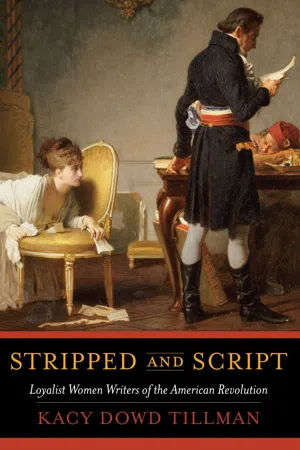
Female loyalists occupied a nearly impossible position during the American Revolution. Unlike their male counterparts, loyalist women were effectively silenced—unable to officially align themselves with either side or avoid being persecuted for their family ties. In this book, Kacy Dowd Tillman argues that women's letters and journals are the key to recovering these voices, as these private writings were used as vehicles for public engagement. Through a literary analysis of extensive correspondence by statesmen's wives, Quakers, merchants, and spies, Stripped and Script offers a new definition of loyalism that accounts for disaffection, pacifism, neutralism, and loyalism-by-association. Taking up the rhetoric of violation and rape, this archive repeatedly references the real threats rebels posed to female bodies, property, friendships, and families. Through writing, these women defended themselves against violation, in part, by writing about their personal experiences while knowing that the documents themselves may be confiscated, used against them, and circulated.
- English
- ePUB (mobile friendly)
- Available on iOS & Android
eBook - ePub
About this book
Information
Publisher
University of Massachusetts PressYear
2019Print ISBN
9781625344328
9781625344311
eBook ISBN
9781613766835
chapter one
scripting disaffection
Grace Growden Galloway
I travel over 1,000 miles to reach the mansion of loyalist Grace Growden Galloway in Bensalem Township, Pennsylvania. One research grant, two car rides, one airplane, one train, and multiple sleepless nights later, I stand at the front door of the Growden Mansion with my tour guide, Sally, a volunteer for the Bensalem Historical Society. There’s only one problem: the tenant who lives in the mansion will not let us in. She has, in fact, already slammed the door in our faces, reluctantly inching it back open only when Sally reminds her that allowing guests inside is part of her lease agreement. “Go away!” the occupant shouts. “This house is full of dead raccoons and it reeks. My husband is naked and refuses to put on pants. You can’t come in.” I begin to speak, but the tenant ignores me. She focuses on my guide, pointing a finger in her face. “The last time you were here, you brought those paranormal investigators. We can’t have that. They stir up ghosts!” She punctuates this last accusation by slamming the door a second time. I turn to Sally for an explanation, but she refuses to meet my eyes. “I may have evicted her last night,” she mumbles by way of explanation, which explains both the U-Haul and the tenant’s terrible mood. “Great timing,” I think, and I put both palms to the door. I lose any shred of dignity I may have once had and begin pleading for the woman to let me in. “Do you know about Grace Growden Galloway?” I shout through the wood. “She’s fascinating, and I have to tell her story.” Nothing happens for several beats. I turn to leave, but I pause when the door hinge creaks. The tenant stands there smiling, and this time she is looking at me. She crosses her arms, leans on the doorframe, and sizes me up. I surreptitiously wedge my foot between the door and the frame, aware that this might be the last opportunity I have to convince her to let me see the place where Galloway wrote her letters and journals. I can barely make out the hallway—which is long, dark, and raccoon-free. “Oh yeah, I know her,” the tenant says, putting her shoulders back to stand up taller. “I was Galloway in our school play.” And with that, she kicks my foot away and slams her door shut one final time. She does not open it again. I never get inside.
I TELL YOU THIS story not only because it is bizarre (and it is bizarre) but also because this tenant acted almost exactly as Grace Growden Galloway acted when the confiscation committee came to evict her over two hundred years ago.1 It is as if the house itself creates inexorable people. This tenant embodied Galloway’s resolve when asked to leave a place she believed to be rightfully hers. She exemplified her entitlement, her defiance of the state, and her resentment that anyone would breach her private space.
Galloway owned Trevose because it was gifted to her by her father, Lawrence Growden (fig. 2). Growden ran the Durham iron furnaces, owned ten thousand acres, and held a prominent position on the Pennsylvania Assembly. When Grace married Joseph Galloway, who was also a Pennsylvania assemblyman, Joseph inherited Grace’s share of the property, which her father bequeathed to his daughter following his death in 1770.2 The trouble for the Galloways began after Joseph argued that a centralized government, chosen from titled aristocracy, would prevent the colonies from fomenting rebellion born from contention.3 The vote narrowly missed passing, but Joseph Galloway still became the face of treachery, his vision of the colonies as an extension of the British political system providing a useful foil for his opponents.4 The Pennsylvania Assembly viewed him as an unwelcome dissenter, and in 1774, it removed him as speaker, replacing him with John Dickinson. The Galloways became the face of treason. Crowds descended on Trevose but could not find the occupants, who had fled ahead of the mob. Furious, they fired on the home, and the bullet holes remain to this day. Joseph joined Sir William Howe’s army in 1777 as an intelligence official. He fled with Howe to England, his daughter Betsy in tow, after he evacuated with the British troops. The Pennsylvania Assembly thereafter listed treasonous citizens whose property the state would seize if they failed to pledge allegiance to the rebels before April 20, 1778, including that of the Galloways. Grace was left in Bensalem Township to guard the family’s estate.5 She refused to flee with her family because she assumed if she lived in the house the commissioners wanted, the men would pity her as an abandoned wife and leave her alone. She was wrong. She barricaded herself inside her home when the men came to evict her and stood in the dark as they beat on her doors. She would not be moved. It was this image of Galloway standing stock-still, furious, immovable, that flashed before me when the tenant slammed the door in my face. I had to smile. Galloway would be proud, I thought, that this tenant would not go quietly from her house.

FIGURE 2. Trevose layout. Courtesy of Historical Society of Bensalem Township.
I read Grace Growden Galloway’s journal as an alternative political space where Galloway could script her loyalties for herself. Her journal could easily be interpreted as simply the story of a miserable, abandoned wife, but when read this way, we miss her ingenuity as she attempted to manipulate the legal system, and we run the risk of overlooking her adept writing ability. The space she created was disaffected. That is, she used the space in her journal to cut ties with both the British Empire and the Americans opting, in the end, to abandon her families’ loyalties. I also explore how a feme covert’s political, and sometimes literal, body became uncovered during the American Revolution. And, finally, I explore the metaphor that runs throughout loyalist letters and diaries from this period: the metaphor of forced entry of the home, body, and even the journal itself.
Studying the disaffected perspective during the American Revolution unlocks a series of rhetorical complexities about the way people saw themselves during the war. If pacifists eschewed war on moral grounds, and if neutralists wanted to opt out of making a decision altogether, the disaffected vehemently resented being placed in any political position in the first place. As a result, writing by the disaffected is often characterized by anger, hostility, and active rejection of both the loyalists and the rebels. Neutralists were unwittingly caught in the middle of a warzone, whereas the disaffected spoke out against both sides to decry the entire operation altogether. The former is passive; the latter is active.
The story of any war is often about the winners, occasionally about the losers, but rarely about those people in between. By saying this, I mean to emphasize an important fact: when we study the rhetoric of the disaffected—and Galloway’s letters and journal is an example of this kind of rhetoric—we are able to glimpse a much more nuanced vision of the gradients of loyalty that existed in the moment between the Boston Tea Party and the dawn of the early national period. I want to further emphasize that to study this group of people means to study how Americans came to think of themselves as citizens of a nation, rather than emblems of an empire. This is the story of the space Grace Growden Galloway created to script her disaffection. This is also the story of that moment of hesitation that all citizens had—or still have—whether fleeting or permanent, as they reflected on what it meant to be asked to pledge allegiance to a country born out of violence, chaos, and betrayal.
Stripped Properties in Galloway’s Journal
The fear and resentment that transformed Grace Growden Galloway’s life between 1777 and 1779 dominates her journal, which documents the confiscation of Galloway’s properties—her land and her body—and the evolution of Galloway’s own loyalties. Galloway eventually explored her political quandaries, but the journal seems to have begun as a daily account of her ordeal during this troubling period, kept for her own information and well-being. In these passages, she rarely addressed a reader beyond the journal or herself, and she did not gloss or contextualize any of the people or events that she recorded. Galloway shifted to address Betsy, her daughter, as a named reader, at which point she began to explain her legal situation in detail. And, finally, Betsy received the journal after Galloway died, which further complicates the ways in which we might categorize this text’s genre.6 Much of the latter part of the journal documents Galloway’s attempt to regain her daughter’s inheritance, so it seems safe to assume that the journal that records these efforts was shipped to Betsy at her mother’s request. We might then read this text as a posthumous letter-journal since it includes a salutation to Betsy, a valediction, and a series of messages in between that Galloway wanted dispatched to an intended recipient. We might just as easily, however, read it as a “contained” journal, as discussed in the introduction, insomuch as it was meant for a narrow/named reader, falling along the sliding scale of privacy and publicity somewhere beyond “for-the-author’s-eyes-only” but before “published at her directive for a broad readership’s amusement.” At times, the journal moves between all of these categories, sliding between genres as Galloway negotiated various subject positions. I suggest that recognizing the ways in which Galloway manipulated and defied these generic conventions is more important than stamping her text as one thing or another. It is also important to note that she engaged in such slippage while trying to make sense of the impossible legal situation of the “covered” wife of an exile as well as distancing herself both from the Americans who stripped her of all she cared about and from the Crown who abandoned her.
Given that Galloway was suffering for her husband’s loyalties, it is perhaps unsurprising that the majority of the journal is a discursive exercise attempting to achieve both ideological and literal separation from her husband. She strips herself of any ties to the man who caused her to suffer. She achieves this by remaining what I would describe as politically “still.” She stays where she is, in Trevose, and remains steadfast in her refusal to swear allegiance to either side. In her version of what happens after the rebel men come to inventory the estate, Galloway emphasizes that she resisted all efforts to be moved. Galloway’s journal opens by focusing on her treatment by the commissioners of forfeited estates—Robert Smith, Charles Willson Peale, William Will, Samuel Massey, and Jacob Schreiner—whom the Pennsylvania Assembly charged with arresting traitors and confiscating loyalist lands.7 Pennsylvania chief justice Thomas McKean ordered these men to confiscate all of the property that Galloway inherited from her father: Trevose (400 acres), Belmont (550 acres), Richlieu (439 acres), and King’s Place (312 acres).8 The considerable amount of property involved in this confiscation would help finance the war and would send a strong message to people in the nearby area that no loyalist, no matter how wealthy, would be spared repercussions. On July 21, 1778, Grace Growden Galloway writes that McKean sent the commissioners, who “took an inventory of everything, even to broken china and empty bottles,” because “they must advertise the house” as they intended to sell it. She writes that the committee would have to take her “by the force of a Bayonet” if they wanted her to leave.9 Galloway rhetorically distances herself from any blame for this confiscation; she reminds Joseph that he is the cause of her suffering. His politics, not hers, have stripped her of her home, companions, and social standing. “I expect every hour to be turn’d out of doors, and where to go I know not,” she writes. “No one will take me in, and all the men keep from me. . . . I am fled from as a pestilence,” she laments, adding, “I have No friends.”10 Many of the women in my archive talk about loyalism and patriotism as a disease, and Galloway is no exception.
The infection, as characterized by these disaffected women writers, begins in a man’s body—typically the body of an exiled or imprisoned husband, soldier, looter, or rioter—and spreads to the women and children who suffer by proxy. The writers framed their experiences in such a way that women’s bodies became metonymic for their relatives’ loyalties: they were exposed, violated, and humiliated so that the absent husbands were vicariously punished. These loyalties infected Galloway, eroding not only her body, which became sick with stress, but also her social standing. She was unaccustomed to asking for help, particularly since she was one of the wealthiest people in that region, so when she approached a “Mrs. [Polly] Wharton” to ask for transportation and boarding, she felt deeply ashamed. Her humiliation magnified when Wharton refused her request. Galloway reflects on the depth of her fall by saying, “My heart was ready to burst at the mean figure I must cut in begging to go to another persons house & be told I cou’d Not. . . . I was so Mortified & Troubled that I cou’d not sleep all Night about it.”11 Her greatest fears came true on August 3, 1778, when she received a letter from George Bryan, president of the Commonwealth of Pennsylvania, informing her that the state had officially confiscated her property, despite her husband not living there any longer and despite the only person occupying the home being supposedly apolitical as far as the law was concerned. The insomnia that Galloway mentions in relation to her endangered property is also present in the letters and diaries featured in the other chapters, particularly in those manuscripts written by passive loyalists. I return to this restlessness in chapter 2, when Sarah Logan Fisher connects her spiritual disquiet with the attacks on her home, and in chapter 4, when Anna Rawle refused to sleep until her house was safely secured, fearing the crowd outside would harm her family. As Galloway frames her legal battle for her family’s estate, Joseph’s loyalties spread to contaminate all aspects of her life, infecting her ability to rest, heal, and shed worry.
Perhaps unsurprisingly, 1778 also marked Galloway’s entry into a lengthy discussion about the construction of the eighteenth-century political female, most notably in the absence of a still-living husband. She writes that she asked George Bryan why she was being punished for Joseph’s vote. She then studied his reply to try to make sense of her situation, but, unfortunately, Bryan was just as confounded as she was. He writes,
When a lady marries, (unless by a special reserve of her lands in the hands of Trustees, made before the contract,) the use and profits of the real estate belonging to her rests in her husband for and during their joint lives, and if children be born then for his life. This estate, so acquired by wedlock, the gentleman can sell. It may be seized by creditors and applied to their relief; And it may be lost by attaint, and then it devolves to the publick as a forfeiture. But the moment the husband dies it returns to the widow, or if she be deceased to her children or other heirs. . . . In every case of attaint for treason, support for the wife and children shall be awarded by the Judges of the Supreme Court, out of the estate of the husband. What may be thought proper in your case I profess myself very ignorant, yet it is probable it will be most convenient for you and the publick too, that such allowance be made out of the paternal estate, lost by you, for the uncertain term of Mr. Galloways natural life.12
Bryan’s letter explains what Galloway already knew. The commissioners removed Grace Growden Galloway from her house because the name on the deed was Joseph’s. Since he had committed a crime against Pennsylvania, the courts could—and did—decide to take what was his. Trevose would belong to Grace if Joseph were dead, but while he lived, the assembly felt justified in taking it from him. While Bryan could explain the court’s logic, he admitted that her situation seemed odd. Joseph lived but was absent as an exile. Grace remained but was theoretically covered by a man who was not there to protect her. She would have to appeal for mercy as a wife with little authority of her own, emphasizing her status as a feme covert, casting herself as an unfortunate bystander in war.
Galloway did not take Bryan’s advice. This moment is crucial because if students of loyalist women writers are going to understand how women achieved agency by using their pens, they need to make note of how those women navigated the men who attempted to control their limited options. Galloway framed herself as both helpless and willful, unmoved and defeated, all of which aptly describes the female loyalist’s predicament. The commissioners’ forced entry was a physical violation; Galloway described it as she would her own rape. The violation of her home was a violation of her body. When Charles Peale and his men arrived to evict her, Galloway writes that they “try’d every door but coud get none open,” so “they went to the Kitchen door & with a scrubbing brush which they broke to peices they forced that open.” They met with “the Women”—Galloway and her servants—“standing in the Entry in the Dark.” These women were not running or hiding; rather, they had stayed to make their stand. While the committeemen were breaking down the door, Galloway went through the house and opened all of the windows she had previously barred, so when they finally entered the kitchen after much exertion, they saw that their first attempted point of entry was now completely unblocked. Galloway writes that this made them “very mad.”13
Galloway failed to successfully bar the door, so she implemented a legal argument, likely the one written by George Bryan, to get them to leave. That did not work either. “I spoke first,” she says, reminding her audience that she was doing all she could to control this situation, “& told them I was . . . ill.” (She does not say what has made her ill, but she implies she is trying to appeal to their empathy. She hopes that they will not evict a sick woman.) Galloway “show’d them the opinion of the Lawyers. Peel [Peale] read it but they all dispised it & just said he had studied the Law & knew they did right.” All of the legal opinions in the world could not save her. The men were not interested in her treatise on coverture and property ownership; they were there to throw her out and make a point to the community around her that no one was immune to these ne...
Table of contents
- Cover
- Title Page
- Copyright Page
- Dedication
- contents
- Preface
- introduction
- chapter one
- chapter two
- chapter three
- chapter four
- chapter five
- afterword
- Notes
- Index
Trusted by 375,005 students
Access to over 1.5 million titles for a fair monthly price.
Study more efficiently using our study tools.
Frequently asked questions
Yes, you can cancel anytime from the Subscription tab in your account settings on the Perlego website. Your subscription will stay active until the end of your current billing period. Learn how to cancel your subscription
No, books cannot be downloaded as external files, such as PDFs, for use outside of Perlego. However, you can download books within the Perlego app for offline reading on mobile or tablet. Learn how to download books offline
Perlego offers two plans: Essential and Complete
- Essential is ideal for learners and professionals who enjoy exploring a wide range of subjects. Access the Essential Library with 800,000+ trusted titles and best-sellers across business, personal growth, and the humanities. Includes unlimited reading time and Standard Read Aloud voice.
- Complete: Perfect for advanced learners and researchers needing full, unrestricted access. Unlock 1.5M+ books across hundreds of subjects, including academic and specialized titles. The Complete Plan also includes advanced features like Premium Read Aloud and Research Assistant.
We are an online textbook subscription service, where you can get access to an entire online library for less than the price of a single book per month. With over 1.5 million books across 990+ topics, we’ve got you covered! Learn about our mission
Look out for the read-aloud symbol on your next book to see if you can listen to it. The read-aloud tool reads text aloud for you, highlighting the text as it is being read. You can pause it, speed it up and slow it down. Learn more about Read Aloud
Yes! You can use the Perlego app on both iOS and Android devices to read anytime, anywhere — even offline. Perfect for commutes or when you’re on the go.
Please note we cannot support devices running on iOS 13 and Android 7 or earlier. Learn more about using the app
Please note we cannot support devices running on iOS 13 and Android 7 or earlier. Learn more about using the app
Yes, you can access Stripped and Script by Kacy Dowd Tillman in PDF and/or ePUB format, as well as other popular books in Social Sciences & North American History. We have over 1.5 million books available in our catalogue for you to explore.