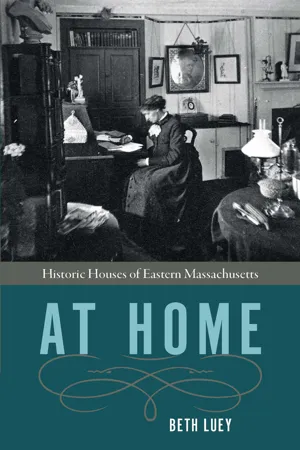
With its abundant history of prominent families, Massachusetts boasts some of the most historically rich residences in the country. In the eastern half of the Commonwealth, these include Presidents John and John Quincy Adams's home in Quincy, Bronson and Louisa May Alcott's Orchard House in Concord, the Charles Bulfinch—designed Harrison Gray Otis House in Boston, and Edward Gorey's Elephant House in Yarmouth Port.
In At Home: Historic Houses of Eastern Massachusetts, Beth Luey uses architectural and genealogical texts, wills, correspondences, and diaries to craft delightful narratives of these notable abodes and the people who variously built, acquired, or renovated them. Filled with vivid details and fresh perspectives that will surprise even the most knowledgeable aficionados, each chapter is short enough to serve as an introduction for a visit to its house. All the homes are open to the public.
Every summer since 1902, descendants of Jonathan Fairbanks have gathered for a reunion in Dedham, at the family homestead, America’s oldest surviving frame house. Jonathan and his family arrived in Boston in 1633 and began building the house four years later. Family members lived there continuously for nearly three centuries, but it has been a museum during the lifetimes of the living descendants. In some way, though, it is still their home—the site of collective memories that include prosperity, poverty, eccentricity, and murder.
The Progenitor
Jonathan Fairbanks was born in Sowerby, in the West Riding of Yorkshire, toward the end of the sixteenth century. By the time he came to America he was a man of means. He sailed with his wife, Grace Smith, whom he had married in 1617; their six children, born between 1618 and 1629; and probably some servants. Jonathan’s brother Richard and his wife, Elizabeth, settled in Boston in 1633. By 1637 Jonathan had been granted a twelve-acre lot in Dedham, southwest of Boston on the Charles River, and eight acres of swamp to clear. Over the next ten years, he acquired additional land and hired a professional builder to construct a two-story house that the family genealogist describes as large for its time and “of more than ordinary pretensions.” By modern standards, though, the house was modest: two rooms on each floor, an attic room, and a single central chimney.1
Jonathan was well respected and active in town affairs. However, church records show that he joined only in 1646, “not withstanding he had long stood off fro’ the church upon some scruples about publike profession of faith & the covenant.” His brother Richard had more serious disagreements with the church. Lorenzo Sayles Fairbanks, the family genealogist, wrote that in 1637 Richard was “disarmed, with many others, for holding and expressing ‘opinions’ with regard to the creeds and dogmas of the church.” His beliefs made him too dangerous to own, buy, or borrow guns, pistols, swords, powder, shot, or matches. He nevertheless prospered in Boston: he owned a large amount of land and later became Boston’s first postmaster.2
Jonathan Fairbanks cleared his swamplands and farmed, raising enough food to feed his family and to sell. The sheep and flax they raised enabled the family to spin wool and linen thread. Jonathan made spinning wheels and looms, and other members of the household may have engaged in woodworking, spinning, and weaving. Jonathan added to the house: cellars, a lean-to used as workspace and a dairy, and additional living space at the western end of the building. His oldest son, John, and his family lived in the western addition. By the time of his death in 1668, Jonathan had amassed a considerable estate. Following the English custom, he left the house and land to his oldest son, who was already living there. His wife, Grace, received the movable property and an annuity, while small bequests went to the other children. He had probably made his plans clear to his children before his death, because two of the younger sons had established themselves elsewhere: George in Medfield and Jonas in Lancaster. Jonathan, the youngest, lived in another house in Dedham.3
From Generation to Generation
Jonathan’s children married and had large families: he eventually had forty-seven grandchildren. John, who had married Sarah Fiske in 1641, continued to farm and add land to his inherited holdings. Jonathan’s children and grandchildren were farmers, active to varying degrees in their towns, and eager to ensure their children’s prosperity through land acquisition and education. Some became or married clergymen, teachers, and doctors. Many men in the subsequent generations fought in the Indian Wars and, later, the Revolutionary War. They also began to settle in other Massachusetts towns and in Connecticut, New York, New Hampshire, Vermont, and Canada. Because our focus is on the homestead, we will follow the careers of the descendants who remained at the house.4
John’s first and third sons, Joshua and Jonathan, died in 1661; his second son, John, had settled in Wrentham. He therefore left his Dedham properties to his two younger sons, Joseph and Benjamin, giving Joseph the first choice of houses. Joseph chose the main house. He and his wife, Dorcas, had a daughter (Dorcas, born in 1684) and a son (Joseph, born in 1687), and in 1734 the younger Joseph inherited the house. He and his wife, Abigail Deane, had six sons and two daughters. In 1752, Joseph conveyed the house and lands to his oldest son, also named Joseph. Three years later, the younger Joseph sold the property to three of his brothers—John, Israel, and Samuel—who in turn conveyed their interest to their brother Ebenezer in 1764. Ebenezer, then thirty-two years old, had married Prudence Farrington in 1756. Lorenzo Fairbanks described him as “a highly esteemed citizen . . . a man of fine presence and dignified bearing, and associated with the best people in town. He had considerable musical ability, and was for many years a member of the church choir. He sang with the choir at the memorial funeral services, held in Dedham, on the death of General Washington, the hymn and music, written with a pen, being among the relics now preserved in the old house.”5
Over the years, the family made alterations to the house. The original windows with diamond-shaped panes were replaced by casement windows with rectangular panes. A staircase replaced the ladder to the second floor, and the original large hearths were reconfigured for greater convenience and efficiency. Ebenezer had a large family: at various times, the household included Ebenezer and Prudence; their unmarried sons, William, Joshua, Abner, and Jason; Ebenezer’s sister Abigail, who died in 1798; and their son Ebenezer Jr. and his wife, Mary, who had eight children born between 1778 and 1796. They soon outgrew the house, so Ebenezer added an east wing of one and a half stories and a west wing, both existing buildings that were moved to the site. The additions made room for the three generations and changed the appearance of the house, with the pitched roof converted to a gambrel roof and windows and doors added and altered.6
For five generations, throughout the seventeenth and eighteenth centuries, life at the Fairbanks homestead had been comfortable and prosperous, neither unusual nor particularly eventful. At the turn of the nineteenth century, though, dramatic events brought the family into the public eye and changed their fortunes.
FIGURE 1. Fairbanks House, ca. 1890. Courtesy of the Fairbanks House.
An Unsolved Mystery
Ebenezer Sr.’s first son, Ebenezer Jr., was born in 1758, and Prudence and William were born soon after, in 1760 and 1762. Joshua was born six years later, and Abner six years after him. Their last son, Jason, was born in 1780. The younger Ebenezer recalled of his youngest brother that “never was a child so caressed, so beloved, or who appeared to have so many claims upon the attachment of his surrounding family: for as he grew in stature, his prepossessing form, his intelligent mind, and his affectionate temper, made him the hope, the delight, the boast of his connections. I have seldom known a disposition so inclined to good, nor a soul more free from evil, than appeared from all the conduct, and the whole character of his first boyhood.”7
Ebenezer recalled that when Jason was twelve years old, he was unsuccessfully vaccinated against smallpox, and “the natural appearance of the disease, in its most malignant state, left but little hopes of his preservation.” He was treated with mercury, and “his limbs and joints became sensibly affected, and his constitution so injured, that there appeared no expectation for this darling of his family, but to remain crippled and debilitated through his remaining existence. The strength and excellence of his native stamina, in a degree counteracted the destroyer. He was restored with the loss of several bones of his right arm, by which it partly withered, and became useless from the shoulder to the wrist.” Unable to do farm work, Jason was sent to school, but severe headaches, probably caused by mercury poisoning, made study impossible. He briefly held a job in the office of the register of deeds, but his health forced him to retire. In addition to headaches, he suffered from fevers and weakness. By the time he was twenty, he was often unable to dress himself.8
Despite his physical limitations, Jason made friends with other young people in Dedham, including Elizabeth Fales, who was always called Betsey. As he recalled, “I paid my addresses, and was received by her as a favored lover, for a whole year, living in perfect harmony with all her family, and treated with the greatest respect and affection by them.” Then Betsey’s family withdrew their affection. Jason believed that it was because of some slight jokes he had made at their expense, though it may have been because of his obvious inability to support their daughter. “Not long after this, Betsey and I agreed to part, in order to see if the tide of rage and madness would not abate; but we rather found its furious enmity to increase.” A year after their separation, they met by chance, and Betsey asked Jason “If I thought it any crime for her to acknowledge that she loved my person, andcould not be happy without enjoying my conversation?” Jason answered “that I did not conceive it any crime for two persons of different sexes to avow their affection for each other; and as to myself, I would answer, that words could not convey the ardent and passionate expression of love that filled and warmed my breast towards her.” Because of the Fales family’s opposition, the couple met outdoors, in one of the outbuildings on the Fales property, or at the homes of neighbors. When Jason became too ill to leave his house, Betsey met him there, frequently staying until the early hours of the morning and once spending the night. On that occasion, they talked of marriage and agreed to see each other again the next week. Jason was feeling well enough to suggest that they meet in a nearby meadow.9
There are two versions of what happened in the meadow on May 18, 1801, between two and three in the afternoon. According to Jason, the couple talked about the difficulties that made marriage unlikely. Betsey expressed the doubts her family had raised about his love, and Jason replied angrily that if she believed what her sisters said about him, “she might go to the devil with them, since she so well knew that I had already possessed her person, and received the pledge of her most tender attachment!” Betsey called him a monster, “and looking on me, as I sat whittling a small piece of wood with a pen-knife, she cried out ‘give me that knife, I will put an end to my existence, you false-hearted man!—for I had rather die than live!’ ” She took the knife “and began, as if in a state of distraction, to stab her breast and body—screaming out and walking violently from me . . . while I, struck with astonishment, remained without power.” After stabbing herself in the chest, Betsey cut her throat. Jason “immediately seized that cruel knife which had robbed me of all my fond heart held dear! and while it yet remained wet with her blood, stabbed myself in many and repeated places; only leaving off when I had finished cutting my own throat, and when I believed all was over with me.”10
The other version is that of the prosecuting attorney at Jason’s trial on August 5, 1801: that Jason Fairbanks, “not having the fear of God before his eyes, but being moved and seduced by the instigations of the devil . . . feloniously, willfully, and of his malice aforethought, did make an assault, and that he the said Jason Fairbanks, with a certain knife, of the value of ten cents, which he the said Jason Fairbanks, in his right hand, then and there had and held,” stabbed Betsey Fales and cut her throat.11
There is more agreement about what happened immediately after the disastrous meeting. Betsey’s uncle, Samuel Fales, testified that at about three that afternoon, he “saw Jason Fairbanks standing by my house, with his throat cut, and having a number of stabs in his body. He said, Betsey had killed herself . . . I went to him, took hold of his hand, and held him, till her father came to us. I told her father we had better go and look for Betsey.” Samuel asked his son to “hold” Jason while he and Nehemiah Fairbanks went to the meadow. They found Betsey bleeding and unable to speak. “She was lying on the ground, nearly on her face, with her arms extended over her head; her head lying between them . . . Her mother came just before she died,” twenty or twenty-five minutes later. Jason was put to bed in an upstairs room at the Fales house, with his brother Ebenezer attending him. A coroner’s inquisition was held the next day, and Betsey’s funeral the day after that. On May 21, Jason was carried to the Dedham jail in a litter.12
Jason’s wounds were grave. Dr. Charles Kitteridge, who examined him in prison, sewed up “a large wound on his throat” and treated three shallow wounds in his breast, three deeper wounds in his abdomen, and seven wounds on his arms and thigh. “His wounds were very dangerous. The one in the abdomen, began to mortify, and it was with great difficulty, the mortification was stopped. It brought on the lock-jaw, that lasted seven or eight days . . . I had but little prospect of his recovering.” By August, however, Jason had gained enough strength to stand trial. On August 4, a grand jury voted to indict him for murder, and on August 5 Jason pleaded not guilty. He was represented by two prominent, politically active Boston attorneys: Harrison Gray Otis and John Lowell Jr. The prosecutor was Massachusetts Attorney General James Sullivan. The case was heard on August 6 and 7 before four justices of the Supreme Judicial Court and a jury, meeting in the First Parish Meeting House. According to a local newspaper, the courthouse was too small to accommodate the “throng of anxious spectators.” The high-powered legal figures involved, as well as the romantic and dramatic possibilities of the story, generated interest far beyond Dedham. One historian claims that the case “evoked greater newspaper coverage than almost any previous homicide in the region, and local printers issued more than half a dozen separate publications on the case, some of which went into multiple editions.” The trial was reported in newspapers as far away as Pennsylvania and Ohio.13
The testimony focused on two issues: the relationship between Jason and Betsey, and the nature of Betsey’s wounds. Witnesses contradicted one another on both questions. Jason’s family and friends testified to the long-standing friendship between the two young people and their genuine affe...
Table of contents
Cover
Title Page
Contents
Preface and Acknowledgments
1. Over the River and through the Woods
2. First Families
3. Decline and Rise
4. Cousins
5. Home and Family
6. A Room of Her Own
7. Greater Than the Sum of Its Parts
8. A Book by Its Cover
Notes
Index
Trusted by 375,005 students
Access to over 1.5 million titles for a fair monthly price.
Study more efficiently using our study tools.
Frequently asked questions
Yes, you can cancel anytime from the Subscription tab in your account settings on the Perlego website. Your subscription will stay active until the end of your current billing period. Learn how to cancel your subscription
No, books cannot be downloaded as external files, such as PDFs, for use outside of Perlego. However, you can download books within the Perlego app for offline reading on mobile or tablet. Learn how to download books offline
Perlego offers two plans: Essential and Complete
Essential is ideal for learners and professionals who enjoy exploring a wide range of subjects. Access the Essential Library with 800,000+ trusted titles and best-sellers across business, personal growth, and the humanities. Includes unlimited reading time and Standard Read Aloud voice.
Complete: Perfect for advanced learners and researchers needing full, unrestricted access. Unlock 1.5M+ books across hundreds of subjects, including academic and specialized titles. The Complete Plan also includes advanced features like Premium Read Aloud and Research Assistant.
Both plans are available with monthly, semester, or annual billing cycles.
We are an online textbook subscription service, where you can get access to an entire online library for less than the price of a single book per month. With over 1.5 million books across 990+ topics, we’ve got you covered! Learn about our mission
Look out for the read-aloud symbol on your next book to see if you can listen to it. The read-aloud tool reads text aloud for you, highlighting the text as it is being read. You can pause it, speed it up and slow it down. Learn more about Read Aloud
Yes! You can use the Perlego app on both iOS and Android devices to read anytime, anywhere — even offline. Perfect for commutes or when you’re on the go. Please note we cannot support devices running on iOS 13 and Android 7 or earlier. Learn more about using the app
Yes, you can access At Home by Beth Luey in PDF and/or ePUB format, as well as other popular books in History & Architecture General. We have over 1.5 million books available in our catalogue for you to explore.