Winner of the 2016 Eliza Atkins Gleason Book Award and the 2016 Lillian Smith Book Award
Americans tend to imagine their public libraries as time-honored advocates of equitable access to information for all. Through much of the twentieth century, however, many black Americans were denied access to public libraries or allowed admittance only to separate and smaller buildings and collections. While scholars have examined and continue to uncover the history of school segregation, there has been much less research published on the segregation of public libraries in the Jim Crow South. In fact, much of the writing on public library history has failed to note these racial exclusions.
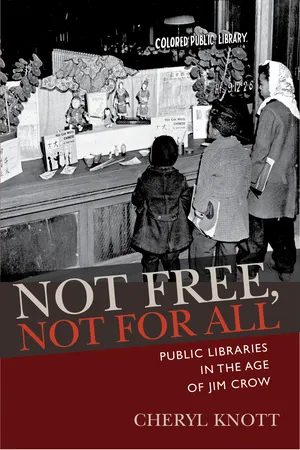
In Not Free, Not for All, Cheryl Knott traces the establishment, growth, and eventual demise of separate public libraries for African Americans in the South, disrupting the popular image of the American public library as historically welcoming readers from all walks of life. Using institutional records, contemporaneous newspaper and magazine articles, and other primary sources together with scholarly work in the fields of print culture and civil rights history, Knott reconstructs a complex story involving both animosity and cooperation among whites and blacks who valued what libraries had to offer. African American library advocates, staff, and users emerge as the creators of their own separate collections and services with both symbolic and material importance, even as they worked toward dismantling those very institutions during the era of desegregation.
- 304 pages
- English
- ePUB (mobile friendly)
- Available on iOS & Android
eBook - ePub
About this book
Information
Publisher
University of Massachusetts PressYear
2017Print ISBN
9781625341785
9781625341778
eBook ISBN
9781613764336
CHAPTER 1

The Culture of Print in a Context of Racism
The creation of racially segregated public libraries early in the twentieth century followed two key trends of the age: the amplification of print culture and the attenuation of black civil rights. The amplification of print culture was apparent in the heightened production, distribution, and consumption of all kinds of reading matter throughout the nineteenth and into the twentieth centuries. Evidence of the burgeoning print culture of the late nineteenth century can be found in paper manufacturing, book publishing, the newspaper and magazine trade, the library industry, and the literacy rate. Evidence of the attenuation of black civil rights after Reconstruction ended in the 1870s can be found in the legal system and in daily social practices.
The increase in paper manufacturing is documented in the 1900 Census of Manufactures. Data reveal that the 1890s had been a period of consolidation and growth in the paper industry, a response to “the extraordinary development of the newspaper press and … the great demand for reading matter which characterizes the American people.”1 The aggregated value of the products published and printed in 1900, including books, pamphlets, music, newspapers, and periodicals, totaled more than $347 million and accounted for more than half of all the goods produced in the printing and publishing category.2
Coinciding with the production of reading material was the rapid creation and construction of public libraries as agencies that selectively collected, organized, and distributed printed matter. Carl F. Kaestle and Janice A. Radway characterize the period between 1880 and 1940 as one of “print in motion,” a time when the publishing industry was consolidating as the reading public was expanding and diversifying. In their introduction to a collection of essays about the national book trade, the importance of newspapers and magazines, institutions of reading such as libraries, and related topics, Kaestle and Radway discuss the culture of print in the context of accelerating social change, the rise of the consumer economy, and the emergence of interest groups such as women, ethnic minorities, and African Americans: “We have found the term ‘culture of print’ a useful shorthand descriptor for this period’s social formation, in part because the tensions between social integration and disintegration, between order and disorder, and between incorporation and diversity were themselves played out with the indispensable assistance of proliferating print practices and reading formations.”3
Technological innovations and other factors made publishing a less-expensive enterprise than it had been before 1880, and the publishing trade became an integrated industry with national sweep and scope.4 At the same time, cheaper production gave previously marginalized groups access to print as producers and consumers. Evidence of increased access among African Americans includes a rise in the literacy rate: from about 5 percent at the start of the Civil War to almost 80 percent by 1920. Close to 700 black-owned periodicals were in existence at the end of the Civil War, compared to more than 3,000 twenty years later. Organizations such as the NAACP and the National Urban League began issuing their own publications, and by the end of World War I the NAACP’s Crisis had a circulation of nearly 100,000. Tuskegee Institute’s The Negro Yearbook, first published in 1912, became a staple reference work, featuring statistics on lynching, home ownership, literacy, and other phenomena and reporting on numerous developments related to African American lives and experiences. Religious organizations, including the National Baptist Convention and its publishing board and women’s auxiliary, issued millions of tracts, pamphlets, and books, not all on strictly religious topics. African Americans founded newspapers, including, in 1905, the influential Chicago Defender, whose nationwide circulation of about 280,000 helped fuel the Great Migration.5
In Philadelphia, newspaper columnist William Carl Bolivar drew on his extensive private library to publicize the history and accomplishments of the city’s black residents and make readers aware of other bibliophiles like himself.6 Black women’s clubs undertook a combination of charitable and educational activities in which print culture sometimes played a central role. For instance, the Woman’s Era Club in Boston published a newspaper that exhorted readers to expand their intellectual and critical faculties and represent their own interests in their own voices as they engaged with a broad swath of literature discussed in the club paper and at local club meetings.7 Numerous subscription libraries and reading rooms (as opposed to tax-supported public libraries) offered collections and space for African American readers, particularly those living in northern cities and towns, where a critical mass made such ventures viable.8 An 1876 U.S. Bureau of Education report counted 257 public libraries. By the mid-1930s, there were more than 6,000. Only 491 were in the south, and among them were 64 separate public library branches for African Americans.9
One might assume that the widespread production, distribution, and consumption of reading material would have fostered an era of enlightenment, but it did not, at least not as regards notions about race. Instead, the rights and status of black Americans diminished in the late nineteenth century, in a series of post-Reconstruction legal decisions that signaled what one historian has called a “nadir” in race relations.10 In 1883 the U.S. Supreme Court declared the Civil Rights Act of 1875 unconstitutional. Thirteen years and a number of state and local segregation ordinances later, the Court’s Plessy v. Ferguson decision found “separate but equal” facilities to be constitutional. The system of segregation had its greatest impact in urban areas, where it regulated relations among strangers as the south’s faltering agrarian economy and brutal sharecropping practices increased black migration to towns and cities.11
Until the civil rights era of the mid-twentieth century, racial segregation persisted as a result of laws as well as ingrained customs that made explicit laws unnecessary. Not surprisingly, some African Americans—those who had the advantage of education and the courage of conviction—turned to the communication circuitry of writing, publishing, disseminating information, collecting publications, creating bibliographies, and reading in an effort to lessen the impact of racist policies and practices. Some built and staffed libraries.
Underlying such efforts to participate in the production, distribution, and consumption of print culture was a long-standing reverence for education. African Americans’ interest in acquiring and using literacy as a means to a variety of ends had a history long before southern public libraries began opening branches for blacks. But that history intersected with whites’ “possessive investment in whiteness,” as George Lipsitz has termed it. He argues that European Americans seldom have sustained resistance to racism because they benefit materially from widespread discrimination against blacks and other minority groups. Among his examples are the bifurcation of black neighborhoods by freeways constructed during urban renewal, the undermining of fair housing laws by government officials and real estate brokers and agents, and the placement of landfills and hazardous waste dumps in minority communities. All of these actions have improved whites’ ability to own homes where property values increase steadily, leading to the accumulation of personal wealth that accompanies better education, better health, and greater life chances overall—at the expense of members of minority groups, who are consigned to substandard, inconvenient, scarce, and overpriced housing.12 Similarly, as print culture burgeoned in the United States, there were obvious efforts to limit its associated privileges and profits to whites. Such practices included offering industrial rather than liberal education to African Americans and refusing blacks admittance to printing trade unions. Countering those systems and practices were the group and individual efforts that African Americans employed to gain access to print.
Observers of life in the United States during its first fifty years as an independent nation applauded what they saw as “the general diffusion of knowledge” and a concomitant interest in books and other printed materials. Between 1780 and 1835, reading became “a necessity of life” in the rural northeast, an impetus that gradually spread to other parts of the developing republic.13 During the 1820s and 1830s African Americans in urban areas of the north began to act collectively on that necessity. In cities and towns in Pennsylvania, New York, Massachusetts, Connecticut, Rhode Island, New Jersey, Maryland, Ohio, Michigan, and the District of Columbia, black residents gathered to read aloud, participate in debates, share their writings, and borrow and return reading materials. They organized literary societies that offered access to the organizations’ collections of books as a privilege of paid membership.14 Their rationale would be echoed three-quarters of a century later with the founding of public libraries for African Americans in the South. They sought to enrich their intellectual and cultural life, to encourage reading of the “best” literature and the dissemination of information, and to provide wholesome alternatives to what they saw as destructive forms of entertainment, such as visits to taverns.
More significantly, literary societies gave African Americans an opportunity to position themselves as participants in rather than victims of a democratic experiment whose founding documents revered liberty but whose national economy increasingly depended on slavery. Free blacks who joined such societies gained confidence as both consumers and producers in an increasingly influential print culture and hoped their contribution to public life would help overcome racial prejudice. As Elizabeth McHenry has argued in her study of black literary societies, “it was immensely important that the public see black people engaged in the particular activities and discourse valorized by the white majority.”15
In contrast, the south’s participation in and interpretation of print culture was shaped by different economic and social conditions. Over the course of the nineteenth century, the northeast developed the railroads that distributed books, the industries that generated disposable income, the mechanics’ institutes and social libraries that promoted reading, the common schools that taught literacy skills, and the developing economy that created a middle class with leisure time.16 At least until the Civil War, the south had a less diversified, agrarian economy dependent on slave labor. The region consistently reported higher rates of illiteracy, not only because of its different pattern of economic development but also because of deliberate attempts to keep a significant proportion of its population—African Americans, slave and free—uneducated and ignorant.17
Despite their disparate skills and practices, however, both north and south, elite and non-elite, linked the idea of literacy with knowledge and knowledge with power. In the south, that underlying formulation drove efforts to prohibit the distribution and circulation of abolitionist pamphlets, newspapers, and books because they had the potential to foment rebellion against the peculiar institution. Such potential could not be averted simply by denying access to printed matter and to the skills needed to decipher it. Instead, a whole system comprising law, economics, politics, ideology, and brutality was at work to preserve slavery. Nevertheless, denying access to printed matter that opposed such a system of oppression was one of several powerful practices for maintaining the status quo.18
In the antebellum south, state statutes forbade the education of blacks in slavery, and a slave discovered to be literate faced punishment. Despite the risks, some sought education because they comprehended the advantages of literacy. Consequently, individual slaves did learn to read and write, either teaching themselves, studying with another member of the household, or, like Frederick Douglass, doing both. Occasionally, religious whites were moved to take action. For instance, in the 1840s, two white members of Nashville’s First Baptist Church taught several of their black counterparts and reported that their students were “greatly delighted with the privilege of reading the Bible.” In a few southern cities, schools were open to blacks, even to slaves who had their owners’ permission to attend. For the most part, however, slaves lived and learned in a largely oral culture.19
At emancipation, the illiteracy rate among black adults was approximately 93 percent. It was less than half that by the turn of the century, and in 1920 it had dropped to 23 percent.20 The rapid gain in literacy indicated the value that African Americans placed on schooling and their long-term dedication to securing education for themselves and their children, despite the discouraging conditions that worked against such efforts. Their sense of urgency was apparent in the Reconstruction south, where former slaves became the earliest advocates of universal state-funded public education. At the same time, influential white southerners who recognized the futility of mounting an all-out campaign against black education put their efforts into shaping a special kind of education for African Americans, one that would counter the broad-based education envisioned by the ex-slaves and prepare them instead for a life of subordination and service.21
After the Civil War and Reconstruction, racist ideology shaped and was shaped by the economic promise of an alliance between northern industrialists and southern businessmen, who were ready to build what they called the “New South.” The desire to improve the southern economy translated into a need to improve the southern educational system for both whites and blacks. In the 1880s, southern newspapermen such as Henry Grady of Atlanta, Richard Hathaway Edmonds of Baltimore, and Henry Watterson of Louisville publicized the New South creed. Grady promoted the cause of north-south reconciliation in an 1886 speech to the New England Society of New York, where he outlined the south’s efforts to make the Mason-Dixon line irrelevant, especially for northern commercial enterprises. Among his claims for southern progress he listed education: “We have planted the schoolhouse on the hilltop and made it free to white and black.”22 In truth, however, Grady’s speech was a promotional effort rather than a report of actual conditions.
In the 1890s, an alliance of northern industrialists and philanthropists and southern educators emerged. Members were intent on establishing universal education in the south, including industrial training for blacks. They proselytized throughout the region for education as a force for stability and efficiency in an industrializing economy. The alliance promoted black educational approaches such as the Hampton Normal and Agricultural Institute in Virginia (founded by white northerner Samuel Chapman Armstrong in 1868 and sponsored by the American Missionary Association) and its progeny, the Tuskegee Normal and Industrial Institute in Alabama (founded by Hampton alumnus Booker T. Washington in 1881). Among the northerners who financially backed the model known as the Hampton-Tuskegee Idea were Robert C. Ogden, manager of Wanamaker’s in New York and head of both Hampton’s and Tuskegee’s boards of trustees; George Foster Peabody, a Wall Street banker and Hampton trustee; and William H. Baldwin, Jr., general manager of the Southern Railway Company and a Tuskegee trustee. Southern supporters included James Dillard of Tulane University, Charles William Dabney of the University of Tennessee, and North Carolina school superintendent and later U.S. commissioner of education Philander Claxton. J. L. M. Curry and Walter Hines Page, both born in the sou...
Table of contents
- Cover
- Title Page
- Copyright
- Contents
- Preface
- Introduction: Questions of Access
- 1. The Culture of Print in a Context of Racism
- 2. Carnegie Public Libraries for African Americans
- 3. Solidifying Segregation
- 4. Faltering Systems
- 5. Change and Continuity
- 6. Erecting Libraries, Constructing Race
- 7. Books for Black Readers
- 8. Reading the Race-based Library
- 9. Opening Access
- Epilogue
- Notes
Trusted by 375,005 students
Access to over 1.5 million titles for a fair monthly price.
Study more efficiently using our study tools.
Frequently asked questions
Yes, you can cancel anytime from the Subscription tab in your account settings on the Perlego website. Your subscription will stay active until the end of your current billing period. Learn how to cancel your subscription
No, books cannot be downloaded as external files, such as PDFs, for use outside of Perlego. However, you can download books within the Perlego app for offline reading on mobile or tablet. Learn how to download books offline
Perlego offers two plans: Essential and Complete
- Essential is ideal for learners and professionals who enjoy exploring a wide range of subjects. Access the Essential Library with 800,000+ trusted titles and best-sellers across business, personal growth, and the humanities. Includes unlimited reading time and Standard Read Aloud voice.
- Complete: Perfect for advanced learners and researchers needing full, unrestricted access. Unlock 1.5M+ books across hundreds of subjects, including academic and specialized titles. The Complete Plan also includes advanced features like Premium Read Aloud and Research Assistant.
We are an online textbook subscription service, where you can get access to an entire online library for less than the price of a single book per month. With over 1.5 million books across 990+ topics, we’ve got you covered! Learn about our mission
Look out for the read-aloud symbol on your next book to see if you can listen to it. The read-aloud tool reads text aloud for you, highlighting the text as it is being read. You can pause it, speed it up and slow it down. Learn more about Read Aloud
Yes! You can use the Perlego app on both iOS and Android devices to read anytime, anywhere — even offline. Perfect for commutes or when you’re on the go.
Please note we cannot support devices running on iOS 13 and Android 7 or earlier. Learn more about using the app
Please note we cannot support devices running on iOS 13 and Android 7 or earlier. Learn more about using the app
Yes, you can access Not Free, Not for All by Cheryl Knott in PDF and/or ePUB format, as well as other popular books in Politics & International Relations & Social History. We have over 1.5 million books available in our catalogue for you to explore.