What would it mean to live in cities designed to foster feelings of connectedness to the ocean? As coastal cities begin planning for climate change and rising sea levels, author Timothy Beatley sees opportunities for rethinking the relationship between urban development and the ocean. Modern society is more dependent upon ocean resources than people are commonly aware of—from oil and gas extraction to wind energy, to the vast amounts of fish harvested globally, to medicinal compounds derived from sea creatures, and more. In Blue Urbanism, Beatley argues that, given all we’ve gained from the sea, city policies, plans, and daily urban life should acknowledge and support a healthy ocean environment.
The book explores issues ranging from urban design and land use, to resource extraction and renewable energy, to educating urbanites about the wonders of marine life. Beatley looks at how emerging practices like “community supported fisheries” and aquaponics can provide a sustainable alternative to industrial fishing practices. Other chapters delve into incentives for increasing use of wind and tidal energy as renewable options to oil and gas extraction that damages ocean life, and how the shipping industry is becoming more “green.” Additionally, urban citizens, he explains, have many opportunities to interact meaningfully with the ocean, from beach cleanups to helping scientists gather data.
While no one city “has it all figured out,” Beatley finds evidence of a changing ethic in cities around the world: a marine biodiversity census in Singapore, decreasing support for shark-finning in Hong Kong, “water plazas” in Rotterdam, a new protected area along the rocky shore of Wellington, New Zealand, “bluebelt” planning in Staten Island, and more. Ultimately he explains we must create a culture of “ocean literacy” using a variety of approaches, from building design and art installations that draw inspiration from marine forms, to encouraging citizen volunteerism related to oceans, to city-sponsored research, and support for new laws that protect marine health.
Equal parts inspiration and practical advice for urban planners, ocean activists, and policymakers, Blue Urbanism offers a comprehensive look at the challenges and great potential for urban areas to integrate ocean health into their policy and planning goals.
- 189 pages
- English
- ePUB (mobile friendly)
- Available on iOS & Android
eBook - ePub
About this book
Information
Topic
ArquitecturaSubtopic
Arquitectura generalChapter 1
The Urban-Ocean Connection
OUR URBAN FUTURE AND OCEAN WORLD are intimately intertwined in numerous ways. The ecological services provided by a healthy ocean are immense—from the weather patterns that have given rise to our modern civilization to the oxygen-producing effects of life in the sea to the benefits of carbon sequestration. All cities, no matter how close or distant from an ocean, receive benefits from marine resources. The world’s oceans are a major carbon sink, soaking up an estimated 2 billion metric tons of carbon dioxide per year, likely delaying the severity of weather-related climate change. Food from the sea—fish, mollusk, and plant—is a significant source of sustenance and protein for most of the world’s population. Much of the development of modern society draws on ocean resources, from goods moved along shipping channels to deposits of oil under the ocean floor.
As oceanographer and ocean explorer Sylvia Earle eloquently explains, oceans are key to everything: “The ocean drives climate and weather, regulates temperature, holds 97 percent of Earth’s water, and embraces 97 percent of the biosphere. Far and away the greatest abundance and diversity of life occurs in the ocean, occupying liquid space from the sunlit surface to the greatest depths.”1 Earle continues, arguing that we all have an essential stake in healthy oceans: “Even if you never have the chance to see or touch the ocean, the ocean touches you with every breath you take, every drop of water you drink, every bite you consume. Everyone, everywhere is inextricably connected to and utterly dependent upon the existence of the sea.”2
Urban consumption and production activities depend in many ways on resources provided by ocean environments, sometimes directly, other times more indirectly. The pressures are many and multifaceted, often bordering on abstract because the supply chains and international treaties that incent exploitative behavior are far beyond the day-to-day activities of most of us. But to create blue urban cities, we must examine the current policy relationship between our oceans and cities, and the nascent alternatives to harmful practices.
Urban Demands on Ocean Resources
Our oceans provide plentiful resources, from food to oil to wind power. And yet, evidence indicates that most of the standard practices for extracting these resources are significantly harming ocean health. I call the incursions of modern urban life into the marine realm a form of “ocean sprawl.” Busy shipping lanes, development of wind farms, drilling rigs and industrial fishing boats—all impact the integrity of ocean ecosystems as they provide goods and services to humans.
Arguably, oceans are the source of the natural resources that form the foundation of our modern lifestyles. There are increasingly intense direct pressures to extract resources from ocean beds, such as new proposals for oil and gas exploration in the Arctic. When we fill up the fuel tanks of our cars, we usually aren’t thinking about how dependence on oil-based transportation has real consequences for our oceans. For many of us watching television during the summer of 2010, the images of the Deepwater Horizon explosion and spill in the Gulf of Mexico were gut-wrenching. It was a visceral and painful reminder of how our oil-soaked and car-dependent lifestyles severely impact marine environments. And while there have been discussions about the adequacy of our regulatory system and the appropriate amount of offshore and deep-sea drilling as well as a recent settlement that charged $4.5 billion in damages to BP, little has actually changed.
This reliance on fossil fuels has created perhaps the greatest threat to our oceans: climate change. Marine scientist Jeremy Jackson paints a discouraging picture of the changing chemistry, biology, and biophysical functioning of oceans that are rapidly heating up, with a likely increase in sea surface temperatures of 3 to 4 degrees Celsius by the end of the century. Changes in global sea temperatures have already resulted in significant shifts in the distribution of marine species, and more will occur as species seek to adapt, if they can, to these temperature and habitat changes.3 Ocean stratification, and reduced ocean mixing, will further contribute to the declining complexity and productivity of ocean ecosystems. The mixing of ocean water layers serves essential ecological and biological functions. In many parts of the ocean, for instance, nutrient upwelling (or the movement to the surface of nutrients otherwise trapped in lower layers) provides important food sources for species that form the base of the ocean’s food chain.
The oceans have served as a “giant reservoir of carbon,” likely reducing and moderating the impacts of our profligate fossil fuel use.4 The cost to oceans and ocean life has been high, as acidification of ocean waters has been a continuing death knell for coral reefs and threatens to further disrupt essential marine food chains. Phytoplankton and other marine organisms form their shells from calcium carbonate, and as the pH of ocean waters decreases, this becomes more difficult because carbonate becomes less available.5
On a more optimistic note, the oceans may also represent our best hope for a more sustainable global future, as they hold great potential as a source of renewable production of energy that can ease our current fossil fuel dependence. Offshore wind production has many advantages over land-based turbines, and a number of offshore wind projects are now under way in US waters and around the world. The promise and potential of offshore wind are great indeed, and the US Department of Energy’s Wind Powering America initiative estimates the US potential at some 4,150 gigawatts, or about four times the nation’s current energy production.6 While many of these energy technologies and opportunities represent a positive trend toward more sustainable, lower-carbon models, they also create new pressures on offshore marine environments (impacts on fish movement and habitat, for example) and must be designed and sited carefully to ensure impacts are minimal.
The rise in global trade over the past half century has increased our use of the ocean as a critical transportation zone as well. Immense levels of cargo ship traffic providing global transportation of everything from car parts to T-shirts to cell phones have begun to seriously threaten whales, for example, which are maimed or killed when struck by huge transport vessels. Some progress has been made to reduce these whale fatalities by requiring modification of shipping lanes into and out of major port cities to minimize threats. Working together with the shipping industry, the National Oceanic and Atmospheric Administration (NOAA) has recently established new shipping lanes and procedures (including a “real-time whale monitoring network”) for traffic into and out of the San Francisco Bay.7 Nevertheless, the impacts of shipping traffic on whale species can be severe, with multiple fatalities of blue whales, a species that seems especially vulnerable, reported in recent years along the California coast.8
Finally, more people in the world get protein from fish than from any other source. We harvest vast amounts of fish and other seafood in ways that are profoundly unsustainable and that look increasingly like the industrial food production systems on land—shortsighted, environmentally destructive, and highly mechanized and subsidized. Most global fisheries are either at or beyond their productive capacity, yet over the past several decades, the reach of global fishing fleets has been extreme and unforgiving. As the World Wildlife Fund reports, the global fish catch has increased fivefold in the past forty years or so, a function of ever larger and more destructive trawling as well as other destructive fishing techniques, such as purse seining and long lines, that exploit ever more distant parts of the ocean and its depths.9 New estimates (still conservative) suggest that more than 70 million sharks are harvested annually for shark finning, which is wasteful and cruel, and likely holds significant ecological implications.
The Long Reach of Polluted Waters
Coastal cities have treated our oceans as garbage dumps and open sewers for centuries, believing they were too massive and expansive to be damaged or altered. Now, science tells us otherwise. The accumulation of plastics in the ocean is one of the more publicly recognized problems, and yet new studies indicate the effects are worse than we thought. Researchers at the University of California at Davis recently discovered that certain kinds of plastic, especially those made from polyethylene (plastic water bottles, plastic shopping bags), absorb large amounts of toxins from the water, compared with other plastics. Additionally, the study found that as the plastics degrade, they adsorb even more toxins.10 The research concludes that marine organisms thus face a “double threat” when they ingest plastics—if a turtle happens to survive eating a plastic bag it has mistaken for a jellyfish, for example, it may instead be slowly poisoned.
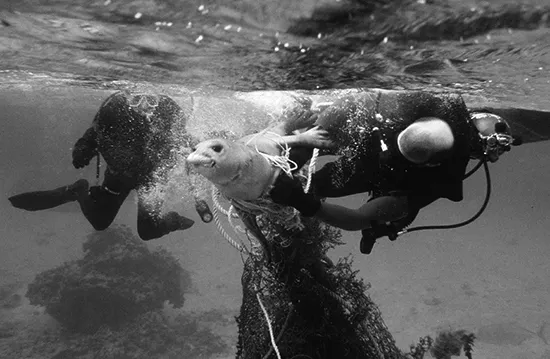
Figure 1-1: NOAA divers free an entangled Hawaiian monk seal at French Frigate Shoals, Northwestern Hawaiian Islands, during a marine debris survey and removal cruise. (Credit: Ray Boland, NOAA/NMFS/PIFD/ESOD)
How to stop the pollution and staunch the flow of plastics to the ocean is a serious challenge, but one that urban policy makers are beginning to address with plastic bag bans and fees. But cleaning up the existing trash is perhaps even more challenging. A research team in Australia recently concluded that if we were able to today completely stop the flow of plastics to ocean (a miraculous accomplishment), it would be five hundred years before the ocean garbage patches—gyres—stopped growing in size.
Closer to shore, the impacts are equal, if not more intense. Oceans have served as a major dumping ground and liquid landfill for the discarded waste and detritus of urban life. Where would we put all of this waste if it couldn’t go directly into the sea? From plastics to municipal solid waste of various kinds to untreated wastewater, we have designed our cities to take advantage of the vastness of the ocean, believing that we could deposit anything with impunity. But research shows that this kind of uncensored disposal is greatly impacting ocean ecosystems.
In addition to plastic waste, land-source air pollution from urban areas is a significant problem for oceans. Coal-burning power plants, built to satisfy profligate urban energy demands, send large amounts of mercury into oceans, for instance, and the threats to both ocean life and human health are on the rise. A recently released United Nations Environment Programme report documents a doubling of mercury levels in the top 100 meters (300 feet) of ocean water over the past one hundred years.11
Industrial agriculture, which can occur thousands of miles from the coast, has begun to impact ocean health as excess nitrogen and phosphorus are washed downriver and poison estuaries, where rivers meet the ocean. The chemicals catalyze algal blooms that monopolize all of the available oxygen in the water and create “dead zones,” wiping out nearly all ocean life within the bloom. The dead zone of the Gulf of Mexico is the best known, but there are more than four hundred dead zones worldwide, and this number is predicted to increase in the years to come.12 This has direct implications for human health, since exposure to toxins released from algal blooms can cause illness and even death.13
The Value of Healthy Oceans
The problem we find ourselves with is the long-standing “tragedy of the commons.” As with many things related to the natural environment, costs imposed on marine and ocean organisms and environments are external (externalized), are largely hidden, and result from the cumulative impacts of many decisions and behaviors. Therefore, it is quite difficult to change policies and behaviors that negatively impact our oceans because there isn’t one obvious cause-and-effect relationship but many direct and indirect influences. And yet, there should be a strong incentive to study, understand, and change behaviors and policies that degrade ocean health.
We know that the ecosystem functions provided by the ocean carry a huge economic value. The Global Partnership for Oceans has nicely summarized much of this knowledge, including some important statistics: 350 million jobs globally are dependent on oceans, and the annual trade in fish and seafood generates $108 billion. The economic value of ecotourism related to coral reefs alone totals some $9 billion.14 A key premise of blue urbanism is that large economic benefits result from maintaining healthy oceans; large social, environmental, and economic costs are associated with diminishing ocean health; and future urban decisions should reflect and be guided by an understanding of these costs and benefits.
Other industries, which you might not initially think of, see great benefits from examining and studying marine life. For example, many drugs have been developed from compounds found in marine creatures. Well-known corals, sponges, and tunicates already provide components used in anti-cancer, anti-malarial, and anti-viral drugs.15 In the engineering sciences, studying ocean organisms can offer tremendous insights for materials development, propulsion studies, and regenerative design. From building design inspired by nautilus shells, to automated cars that are packed together and move like schools of fish, to swimsuit fabric that mimics sharkskin, we have learned much from studying ocean creatures.16 At the Engineering School at the University of Virginia, researchers ...
Table of contents
- Cover
- Title Page
- Copyright Page
- Dedication
- Contents
- Preface: A New View of Cities on the Blue Planet
- Acknowledgments
- Chapter 1: The Urban-Ocean Connection
- Chapter 2: The Reach of Cities: Connecting Urban Lifestyles and Ocean Health
- Chapter 3: Satisfying Urban Fish Eaters Sustainably
- Chapter 4: Urban Design for a Blue Planet
- Chapter 5: Reimagining Land Use and Parks in the Blue City
- Chapter 6: Engaging Urban Dwellers in Marine Life around Them
- Chapter 7: New Ideas for Connecting Oceans and Cities
- Chapter 8: Forging a Blue Urban Future
- Notes
- Index
Trusted by 375,005 students
Access to over 1.5 million titles for a fair monthly price.
Study more efficiently using our study tools.
Frequently asked questions
Yes, you can cancel anytime from the Subscription tab in your account settings on the Perlego website. Your subscription will stay active until the end of your current billing period. Learn how to cancel your subscription
No, books cannot be downloaded as external files, such as PDFs, for use outside of Perlego. However, you can download books within the Perlego app for offline reading on mobile or tablet. Learn how to download books offline
Perlego offers two plans: Essential and Complete
- Essential is ideal for learners and professionals who enjoy exploring a wide range of subjects. Access the Essential Library with 800,000+ trusted titles and best-sellers across business, personal growth, and the humanities. Includes unlimited reading time and Standard Read Aloud voice.
- Complete: Perfect for advanced learners and researchers needing full, unrestricted access. Unlock 1.5M+ books across hundreds of subjects, including academic and specialized titles. The Complete Plan also includes advanced features like Premium Read Aloud and Research Assistant.
We are an online textbook subscription service, where you can get access to an entire online library for less than the price of a single book per month. With over 1.5 million books across 990+ topics, we’ve got you covered! Learn about our mission
Look out for the read-aloud symbol on your next book to see if you can listen to it. The read-aloud tool reads text aloud for you, highlighting the text as it is being read. You can pause it, speed it up and slow it down. Learn more about Read Aloud
Yes! You can use the Perlego app on both iOS and Android devices to read anytime, anywhere — even offline. Perfect for commutes or when you’re on the go.
Please note we cannot support devices running on iOS 13 and Android 7 or earlier. Learn more about using the app
Please note we cannot support devices running on iOS 13 and Android 7 or earlier. Learn more about using the app
Yes, you can access Blue Urbanism by Timothy Beatley in PDF and/or ePUB format, as well as other popular books in Arquitectura & Arquitectura general. We have over 1.5 million books available in our catalogue for you to explore.