2022 Christianity Today Award of Merit, Christian Living & Spiritual Formation
2022 Foreword INDIES Finalist, Religion
A new vision for loving one another as sisters and brothers in Jesus. Many Christian women and men carry heavy burdens. Much teaching on gender relations, roles, and rules binds the conscience beyond what Scripture actually teaches. Gender has become a battleground for power. But God created men and women not to compete for glory but to cooperate for his glory.
In Jesus and Gender, Elyse Fitzpatrick and Eric Schumacher paint a new vision for gender--Christ's gentle and lowly heart. The centrality of the gospel has been lost in gender debates. Our ultimate example is Jesus, our humble king, who used his power to serve others. So we must rethink our identities, roles, and relationships around him. Christ transformed enemies into family. Men and women are allies in God's mission.
Drawing from Scripture and experience, Fitzpatrick and Schumacher show how Jesus's example speaks to all areas of our lives as men and women, including vocation, marriage, parenting, friendships, and relating to each other as sisters and brothers in Christ. Real-life testimonies from a variety of Christians--including Christine Caine, Justin and Lindsey Holcomb, and Karen Swallow Prior--show a variety of men and women freed to pursue their gifts for God's glory.
Fitzpatrick and Schumacher's perspective untangles what God has said about gender from what he hasn't. By coming to Jesus, women and men can find rest.
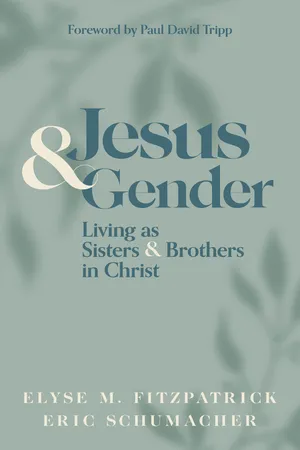
eBook - ePub
Jesus and Gender
Living as Sisters and Brothers in Christ
- 288 pages
- English
- ePUB (mobile friendly)
- Available on iOS & Android
eBook - ePub
About this book
Information
Print ISBN
9781683595878
Subtopic
Ministro del culto cristiano1
Sisters, Brothers, and the Gospel
“[The Father] gave [the Son] authority over all flesh, so that he may give eternal life.”—John 17:2 EHV
Let’s stop now to consider why it would be important to view ourselves and how we relate to one another through a distinctly gospel-focused lens. How many times have you heard squabbling little children scream, “You’re not the boss of me!” as they marched off in anger. Sometimes when I’ve heard that from little ones, I’ve chuckled and thought, Oh, I get that. And although I probably wouldn’t ever put it in exactly that way, I’m sure I’ve said it thousands of times, at least in my own heart. For instance, when I see a blinking sign that tells me I’m exceeding the speed limit, my heart’s response is all too often, You’re not the boss of me.
Which brings us to the importance of defining what it means to be male and female through an incarnationally informed lens. How do you react to the You’re not the boss of me impulse in your own heart? The most common response to resistance against authority is to give more rules and consequences. Maybe if we made the rules and consequences clearer, more reasonable, or more firm or applicable, people would respond better. But is that what we learn in the New Testament?
Is that a gospel-shaped perspective? We don’t think so.
The Bible teaches that only One can quench the desire to define ourselves, and our lives, the way we think is best, and he is the humble King who used his own power to serve others (not himself) and then died. It is only as we learn that his way really is the only way to true freedom and peace that we will find our thirst for independence and authority quieted by his love.
We’re building a different perspective on men and women because so much of what has been written about the topic, especially in modern American evangelicalism, isn’t all that different from the norms of the ancient world when the power of the state, and the men who ran it, was the only acceptable norm. Patriarchy informed every relationship, from the lowliest foot-washing slave to the legion commander. Women and men, children and slaves were all expected to live within strict social roles, and no one dared challenge them without risking the ire of those in authority, which is why Jesus and his message of self-sacrifice shocked and repelled them so much. His humility was not only foolish but also repulsive to them. And it was frightening: It threatened the very structures they relied on for prosperity and civil society. Jesus shattered all their rules of who’s the boss when he stooped down and became the King who washed feet.
But it isn’t only Jesus who shattered those paradigms. Paul’s statements about sexual equality between husbands and wives in 1 Corinthians 7 would have been inconceivable to his readers, who viewed wives as little more than chattel or broodmares, while also affirming the right of husbands to consort with female or male household slaves (of any age), or prostitutes. Paul’s shocking assertion that husbands and wives were equal, especially in this most intimate area of relationship, and that husbands were to lay down their lives for their wives and love them as Christ loved the church was utterly anathema to the Corinthians and the Ephesians, as it would have been to any ancient society.
We find it troubling that even though many Christians accept the gospel accounts of Jesus’s life and the letters of Paul as truth, they frequently disregard them when framing discussions about relationships between women and men. Rather than living in amazement at Jesus’ humility and serving, some revert back to old patriarchal models of the ancient Near East, striving to somehow blend Christ’s message of humility and service with Rome’s message of power and rule. On the contrary, the New Testament is meant to stand, at least in part, as a rebuke against the structures of that day, structures that prized and guarded power over the weak, the use of authority for self-aggrandizement and ambition, and the denigration and disregard of those considered less valuable.
This book is important because we will reshape our paradigms about relationships between men and women, parents, children, church leaders, and parishioners from the perspective of the gospel. We aren’t saying that others who have written about gender and particularly gender roles before us don’t love and believe the gospel. We assume that they do and that they are our brothers and sisters in the faith. What we do question, however, is whether their perspectives on this topic have been as deeply informed by and tied to the gospel and the incarnation as they should have been.
Again, why would it be important to develop a distinctly gospel-centered perspective on what it means to be men and women? And how would that perspective speak to our You’re not the boss of me dilemma?
Not surprisingly, the apostle Paul has something to say to us about it. In Romans 7 he confessed his struggle with God’s law: although he knew it was “holy and just and good” (7:12), he also sensed a sinful predisposition to react against it. For instance, when he heard the command, “Do not covet,” it didn’t stop him from coveting. In fact, it produced in him “coveting of every kind” (7:8). Even though he knew that God had the right to command him and even though he knew all God’s commands were righteous, he confessed that he was resistant to being told what to do. He understood that all his underlying You’re not the boss of me resistance could never be overcome by rules. That’s why, at the end of Romans 7, after confessing his powerlessness to respond rightly to the law, he cried, “What a wretched man I am! Who will rescue me from this body of death?” (7:24).
Hear Paul’s agonized frustration. This former ultra-righteous Pharisee had come face to face with his inability to obey the law he claimed to love. And it crushed him, doing exactly what the law was meant to do: it forced him to turn away from himself toward the only One who could rescue him, “Jesus Christ our Lord!” (7:25). Paul recognized that his inability to respond in humility and obedience to God’s law could never be overcome by more rules or even more effort. No, his and our only hope is found in the grace of the Son who obeyed the law in our place, forgave all our resistance to his law, and declared us to be righteous rule keepers. Paul realized he needed assurance of God’s unconditional love, not more rules. “Thanks be to God” (7:25) is right!
In concert with Paul, we’re convinced that any perspective about either who we are as men and women or how we are to relate to men and women that is not based on Jesus’ life, death, and resurrection is not only futile, but it will also result in more and more conflict and resistance. That’s because rules without the assurance of love and forgiveness are powerless to make us love God and others. Indeed, love is the only power that is strong enough to transform us into humble, loving, and kind people. Without the assurance of God’s love, the law brings nothing but God’s wrath and subsequent spiritual death (2 Cor 3:7; Rom 4:15; see also Rom 3:20; 1 Cor 15:56; 2 Cor 3:6–7; Gal 2:16; 3:23–25; Jas 2:10). That’s because no one obeys it (Rom 3:10–23). As Paul proclaimed, rules are ineffective at transforming our hearts: “If a law had been granted with the ability to give life, then righteousness would certainly be on the basis of the law” (Gal 3:21).
Rules about how to be biblical men and women won’t make us love each other. They can’t. They won’t make us willing to embrace our God-given identities or help us be willing to walk in humble obedience. They can’t because they don’t have the power to. No, what we need is Someone who will transform our hearts by his love and humility.
THE NEW AND BETTER WORD
We’re shaping our model on the incarnation because Jesus is the only one fully qualified to speak a word about who we are and what we are to be. That’s because he is both God and man. His new word of love remakes every other word about existence within social structures into a life-transforming gift. He demonstrated what godly authority was when, in the same breath he claimed his Father had given “authority over all people” to him, he also declared that he would not use this authority to rule over and crush his enemies, but rather to give them life (John 17:2). Jesus’ new and better word transformed authority into humble service, rulership into servanthood, pride into humility. Then he demonstrated what that looked like when he willingly “poured out his soul to death” (Isa 53:12 ESV), resisting the power and his right to call down legions of angels to rescue him (see Matt 26:53). Humanity and its endless hunger for power was shamed once and for all by his breathtaking love for the insignificant, weak, and broken. The desire to dominate, to be the boss, was forever swallowed up when, in agony, he said to the Father who had granted him all authority, “not as I will” (Matt 26:39). What does godly authority look like? It looks like using power to lay down your life. He said, “I lay [my life] down of my own accord. I have authority to lay it down, and I have authority to take it up again” (John 10:18 ESV).
THE INCARNATION: A NEW HUMANITY
There is so much about the Christmas season that I love. Sure, there are the cringe-worthy songs, like the one about mama kissing Santa Claus, and the frenetic shopping and stretched budgets we must persevere through, and the overeating we all regret, but still Christmastime remains magical to me. One of the aspects of the season that I find most enjoyable is being able to sing Christmas carols to myself as I wander through stores trying to find that oh so elusive, perfect gift. I particularly love it when “Hark, the Herald Angels Sing” fills the mall’s atmosphere and I get to muse on and hum this rich theology:
Veiled in flesh the Godhead see
Hail the incarnate Deity
Christmas means that God has been “veiled in flesh.” He can be seen. That the invisible God has become visible means that God could be seen for the very first time in all eternity. God was clothed with a human body like ours, becoming incarnate, embodied. The invisible, immortal, omnipotent, and omniscient God fully took on human form and became a visible, mortal, weak human. As a tiny embryo, he gestated in the womb of a young virgin and was born the way we all were: placenta and all. He needed to nurse and be kept from the cold by his mother’s body and love. And he needed to be taught how to speak the word “mama,” and what it meant to love his neighbors. And he was able to die. That’s pretty shocking, isn’t it? As the hymn continues, we learn that this newly incarnate Deity has a name: Jesus. And we’re told that this divine human has come to complete a particular task: to bow down and dwell with humanity. As one of us … joyfully!
Pleased as man with men to dwell
Jesus, Our Emmanuel
The problem we have is that we’re not shocked by this all-too-familiar story. But trust me, if you had been one of those shepherds, or the religious elite of the day, or even one who had actually been anticipating his birth, you would have been completely shocked. The Creator took the form of the created? No wonder they killed him: he proclaimed that something entirely new was happening; a novel sort of humanity had just begun. When the Second Person of the Trinity took on flesh, God broke through, into our time and space, into earthly history, and brought about something entirely unique. God became one of us. Never in the history of the world, in all the millions and millions of births that had gone before, had something like this happened. There was, in fact, something new under the sun. Hail the incarnate Deity!
Again, we’ve failed to achieve a joyful consensus about our identity and relationships because we have failed to grasp the significance of Jesus’ incarnation and life of self-emptying love. Sadly, because we’re not shocked by this story, we’ve failed to draw out the important implications it forces on us.
What does his taking on our embodied nature as his own mean about each of us as his brothers and sisters? And do those truths impact us practically, particularly as we consider what it means to be male or female? How would it transform the way that we live our lives now, post-Christmas?
Since Jesus Christ is the “radiance of God’s glory and the exact expression of his nature” (Heb 1:3), then at the very least we should draw our understanding of gender, and how we are to relate to one another, from the way that Jesus understood and related to both men and women. His story changes the way we view ourselves, each other, and, of course, the way we treat one another. How then could it be that this momentous event, God’s voluntary humiliation and condescension to become one of us, would fail to transform everything? Shouldn’t humility, condescension, and the desire to be in unity occupy the very heart of every relationship we have, no matter our gender?
Jesus’ voluntary relinquishing of rightful authority to become a slave, obedient to his Father’s will, his self-emptying love, magnificent act of selfless devotion for the sake of the other, should be the foremost paradigm that informs all of our relationships in whatever sphere they may be: in the home, in the church, and in society. As those who bear his name, the “Christ,” Christians should be known as people who refuse to grasp power, even when they think that power could be used for good. We are all tempted to believe that power is best used when it is grasped by us for our purposes. But God, the Son, who really did know how to use power for right purposes, has shown us a different way. He taught us to walk away from positions of power and embrace the life of a servant....
Table of contents
- Cover
- Title Page
- Copyright
- Dedication
- Contents
- Foreword
- Acknowledgments
- Introduction
- Chapter 1: Sisters, Brothers, and the Gospel
- Chapter 2: When We Forget
- Chapter 3: Brothers, Sisters, Brides, and Sons
- Chapter 4: One Family, One Calling
- Chapter 5: Sisters and Brothers in God’s Image
- Chapter 6: Siblings Serving Together
- Chapter 7: The Pursuit of Mutual Flourishing
- Chapter 8: Husbands, Wives, and the Gospel
- Chapter 9: Parenting Boys and Girls Who Resemble Jesus Christ
- Chapter 10: Siblings in the Household of God
- Chapter 11: Voices into the Culture
- Chapter 12: Jesus and His Christic Brothers and Sisters
- Study Guide
- Notes for Group Leaders
- Scripture Index
- Old Testament
Trusted by 375,005 students
Access to over 1.5 million titles for a fair monthly price.
Study more efficiently using our study tools.
Frequently asked questions
Yes, you can cancel anytime from the Subscription tab in your account settings on the Perlego website. Your subscription will stay active until the end of your current billing period. Learn how to cancel your subscription
No, books cannot be downloaded as external files, such as PDFs, for use outside of Perlego. However, you can download books within the Perlego app for offline reading on mobile or tablet. Learn how to download books offline
Perlego offers two plans: Essential and Complete
- Essential is ideal for learners and professionals who enjoy exploring a wide range of subjects. Access the Essential Library with 800,000+ trusted titles and best-sellers across business, personal growth, and the humanities. Includes unlimited reading time and Standard Read Aloud voice.
- Complete: Perfect for advanced learners and researchers needing full, unrestricted access. Unlock 1.5M+ books across hundreds of subjects, including academic and specialized titles. The Complete Plan also includes advanced features like Premium Read Aloud and Research Assistant.
We are an online textbook subscription service, where you can get access to an entire online library for less than the price of a single book per month. With over 1.5 million books across 990+ topics, we’ve got you covered! Learn about our mission
Look out for the read-aloud symbol on your next book to see if you can listen to it. The read-aloud tool reads text aloud for you, highlighting the text as it is being read. You can pause it, speed it up and slow it down. Learn more about Read Aloud
Yes! You can use the Perlego app on both iOS and Android devices to read anytime, anywhere — even offline. Perfect for commutes or when you’re on the go.
Please note we cannot support devices running on iOS 13 and Android 7 or earlier. Learn more about using the app
Please note we cannot support devices running on iOS 13 and Android 7 or earlier. Learn more about using the app
Yes, you can access Jesus and Gender by Elyse M. Fitzpatrick,Eric Schumacher in PDF and/or ePUB format. We have over 1.5 million books available in our catalogue for you to explore.