eBook - ePub
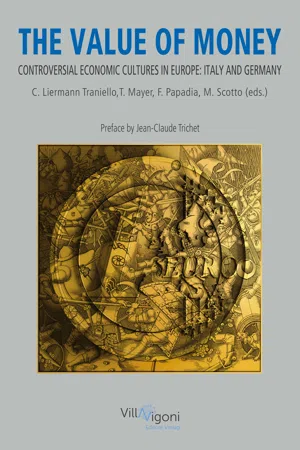
The Value of Money
Controversial Economic Cultures in Europe: Italy and Germany
- 248 pages
- English
- ePUB (mobile friendly)
- Available on iOS & Android
eBook - ePub
The Value of Money
Controversial Economic Cultures in Europe: Italy and Germany
About this book
Thanks to the collaboration with renowned economists and policymakers, the publication compares Italian and German macro-economic cultures and performances. When the Bretton Woods system crumbled and currencies lost their direct link to the dollar and their indirect link to gold, these two countries embarked upon strongly different monetary policies. This divergence was reflected in the evolution of the exchange rates: the value of one D-Mark increased from 170 Italian lira under Bretton Woods to 990 Italian lira at the start of European Monetary Union: an astounding devaluation of about 85 per cent for the lira! Firstly, the volume describes the German and the Italian economic and, specifically, monetary models, with major attention paid to institutions such as Deutsche Bundesbank and Banca d'Italia, analysing their development in a diachronic perspective. Secondly, these paradigms are contextualized within a broader European context, which is fundamental to reflect upon possible future scenarios.
Das Buch versammelt renommierte Ökonomen und Politiker, hauptsächlich (aber nicht nur) aus Italien und Deutschland. Die Autoren vergleichen die makroökonomischen Kulturen und die Leistungsfähigkeit der beiden Länder. Seit dem Zusammenbruch des Bretton-Woods-Systems verfolgen beide Länder sehr unterschiedliche Geldpolitiken. Die Divergenz spiegelte sich auch in der Entwicklung der Wechselkurse: Der Wert der D-Mark stieg von 170 italienischen Lire unter Bretton Woods-Bedingungen auf 990 italienische Lire zu Beginn der Europäischen Währungsunion – eine atemberaubende Abwertung der Lira um rund 85 Prozent! Der Sammelband beschreibt das deutsche und das italienische Wirtschafts- und insbesondere das Geldmodell. Institutionen wie die Bundesbank und die Banca d'Italia stehen im Zentrum. Der historische Hintergrund wird ebenfalls ausgeleuchtet. In einem zweiten Schritt werden diese Modelle in einem breiteren europäischen Kontext analysiert, auch um mögliche künftige Szenarien aufzuzeigen. Mit Beiträgen von: Pierluigi Ciocca, Lorenzo Codogno, Fabio Colasanti, Federico Fubini, Daniel Gros, Otmar Issing, Harold James, Hans-Helmut Kotz, Ivo Maes, Klaus Masuch, Thomas Mayer, Stefano Micossi, Pier Carlo Padoan, Francesco Papadia, Lucio Pench, Tobias Piller, André Sapir, Gunther Schnabl, Ludger Schuhknecht, Sabine Seeger, Giulio Tremonti, Gertrude Tumpel-Gugerell. Vorwort von Jean-Claude Trichet
Information
Table of contents
- The Value of Money
- Christiane Liermann Traneillo and Matteo Scotto - Foreword
- Table of Contents
- Jean Claude Trichet - Preface
- Thomas Mayer and Francesco Papadia - Introduction
- Chapter I - After Bretton Woods: German-Italian Monetary Policy Divergence
- Fabio Colasanti - Pride and Prejudice in Italy
- Ludger Schuhknecht - The Bundesbank between Bretton Woods and Economic and Monetary Union — a German Perspective
- Federico Fubini - The Banca d’Italia-Tesoro Divorce and the Fascist Legacy
- Tobias Piller - Are the Germans Obsessed with Inflation and Central Bank Independence?
- Chapter II - Exploring the Reasons of the Alpine Divide
- Ivo Maes - On the Origins of the German and Italian Policy Paradigms towards European Monetary Integration
- Francesco Papadia - Exploring the Reasons of the Alpine Divide: Italian and German Monetary Histories since Unification
- Pierluigi Ciocca - The Influence of Economic Schools. The Case of Italy
- Thomas Mayer - The Influence of Economic Schools. The Case of Germany
- Hans-Helmut Kotz - Alpine Divide – Is it Mostly Fiscal?
- Lucio Pench - Differences between Italian and German Public Finances: a Long-Term Economic Perspective
- Chapter III - Approaches to Economic and Monetary Union
- Otmar Issing - The Legacy of the Bundesbank
- Lorenzo Codogno - The Legacy of the Banca d’Italia
- >Daniel Gros - Wrestling with Maastricht in France, Germany and Italy. The Role of the Intellectual Framework
- André Sapir - The Turbulent Period around the Time of Maastricht
- Gertrude Tumpel-Gugerell - Beyond the Clash of Cultures
- Harold James - The Euro Crisis: Clash of Cultures?
- Chapter IV - The Way Forward
- Klaus Masuch - Monetary, Fiscal and Financial Policy Interactions – Conceptual and Policy Considerations
- Giulio Tremonti - “Haus, Casa or Maison”. The Perfect Opening for Talking about EMU Architecture
- Pier Carlo Padoan - Is the ECB Ready for the Next 20 Years of Monetary Union?
- Gunther Schnabl - The ECB is not Ready for the Next 20 Years of Monetary Union
- Stefano Micossi - An International Role for the Euro?
- Sabine Seeger - The Necessity for a New International Role of the Euro
Trusted by 375,005 students
Access to over 1.5 million titles for a fair monthly price.
Study more efficiently using our study tools.
Frequently asked questions
Yes, you can cancel anytime from the Subscription tab in your account settings on the Perlego website. Your subscription will stay active until the end of your current billing period. Learn how to cancel your subscription
No, books cannot be downloaded as external files, such as PDFs, for use outside of Perlego. However, you can download books within the Perlego app for offline reading on mobile or tablet. Learn how to download books offline
Perlego offers two plans: Essential and Complete
- Essential is ideal for learners and professionals who enjoy exploring a wide range of subjects. Access the Essential Library with 800,000+ trusted titles and best-sellers across business, personal growth, and the humanities. Includes unlimited reading time and Standard Read Aloud voice.
- Complete: Perfect for advanced learners and researchers needing full, unrestricted access. Unlock 1.5M+ books across hundreds of subjects, including academic and specialized titles. The Complete Plan also includes advanced features like Premium Read Aloud and Research Assistant.
We are an online textbook subscription service, where you can get access to an entire online library for less than the price of a single book per month. With over 1.5 million books across 990+ topics, we’ve got you covered! Learn about our mission
Look out for the read-aloud symbol on your next book to see if you can listen to it. The read-aloud tool reads text aloud for you, highlighting the text as it is being read. You can pause it, speed it up and slow it down. Learn more about Read Aloud
Yes! You can use the Perlego app on both iOS and Android devices to read anytime, anywhere — even offline. Perfect for commutes or when you’re on the go.
Please note we cannot support devices running on iOS 13 and Android 7 or earlier. Learn more about using the app
Please note we cannot support devices running on iOS 13 and Android 7 or earlier. Learn more about using the app
Yes, you can access The Value of Money by Matteo Scotto,Thomas Mayer,Francesco Papadia,Christiane Liermann Traniello,Jean-Claude Trichet in PDF and/or ePUB format, as well as other popular books in Economics & International Economics. We have over 1.5 million books available in our catalogue for you to explore.