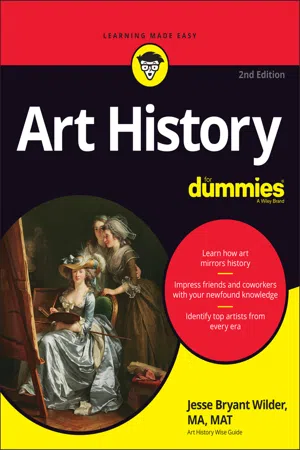
Art History For Dummies
eBook - ePub

Art History For Dummies

  1. English
  2. ePUB (mobile friendly)
  3. Available on iOS & Android
eBook - ePub

Art History For Dummies

About this book

Ready to discover the fascinating world of art history? Let's (Van) Gogh!

Fine art might seem intimidating at first. But with the right guide, anyone can learn to appreciate and understand the stimulating and beautiful work of history's greatest painters, sculptors, and architects. In Art History For Dummies, we'll take you on a journey through fine art from all eras, from Cave Art to the Colosseum, and from Michelangelo to Picasso and the modern masters. Along the way, you'll learn about how history has influenced art, and vice versa.

This updated edition includes:

  • Brand new material on a wider array of renowned female artists
  • Explorations of the Harlem Renaissance, American Impressionism, and the Precisionists
  • Discussions of art in the 20th and 21st centuries, including Dadaism, Constructivism, Surrealism, and today's eclectic art scene

Is there an exhibition in your town you want to see? Prep before going with Art History For Dummies and show your friends what an Art Smartie you are.

An unbeatable reference for anyone looking to build a foundational understanding of art in a historical context, Art History For Dummies is your personal companion that makes fine art even finer!

Information

Publisher
For Dummies
Year
2022
Print ISBN
9781119868668
eBook ISBN
9781119868675
Edition
2
Topic
Art
Subtopic
Art General
Part 1

Getting Started with Art History

IN THIS PART …
Distinguishing between art history and history
Recognizing the effects of culture and society on art
Knowing why artists make art
Checking out the design elements
Identifying art periods and movements
Chapter 1

Art Tour through the Ages

IN THIS CHAPTER
Bullet
Understanding the difference between art history and plain, old history
Bullet
Recognizing the importance of art from prehistoric times to the present
Bullet
Seeing how art periods are linked to environment and culture
Bullet
Identifying the various art historical periods
Bullet
Noting the effects of modern pressures on art development
Why study art history rather than music history, literary history, or the history of the postage stamp? Art history, which begins around 30,000 BC with the earliest known cave paintings (see Chapter 4), predates writing by about 26,500 years! That makes art history even older than history, which begins with the birth of script around 3500 BC. Along with archaeology, art history is one of our primary windows into prehistory (everything before 3500 BC). Cave paintings, prehistoric sculpture, and architecture together paint a vivid — although incomplete — picture of Stone Age and Bronze Age life. Without art history, we would know a lot less about our early ancestors.
Okay, but what do you need art history for after people learned to write during the historical period, which kicks in around 3500 BC? History is the diary of the past — ancient and relatively recent peoples writing about themselves combined with our interpretations of what they say. Art history is the mirror of the past. It shows us who we were, instead of telling us, as history does. Just as home movies document a family’s history (what you wore when you were five, how you laughed, and what you got for your birthday), art history is the “home movie” of the entire human family through the ages.
History is the study of wars and conquests, mass migrations, and political and social experiments. Art history is a portrait of humankind’s inner life: people’s aspirations and inspirations, hopes and fears, spirituality, and sense of self throughout the ages.

Connecting Art Divisions and Culture

Art history is divided into periods and movements, both of which represent the artwork of a group of artists over a specific time period. The difference between a period and a movement has to do with duration (periods are typically longer than movements) and intention (movements have specific intent). See Chapter 3 for more about art movements. An art period can last anywhere from 27,000 years to 50 years, depending on the rate of cultural change.
Here is a brief list, with examples of art periods and related cultural attributes:
  • Prehistoric art, the first leg of the longest art period, starts with the first known art around 30,000 BC, give or take a few thousand years, and lasts until the end of the Paleolithic period, or Old Stone Age, around 10,000 BC. The exact duration depended on where the artists lived with respect to the receding Ice Age. In those days, culture changed about as fast as a glacier melts — and this was long before global warming.
  • Prehistoric art, the next leg of the first period, the Neolithic or New Stone Age, lasted roughly another 6,500 years, from 10,000 to 3,500 BC, again depending upon where people lived. In the first period, people used stone tools, survived by hunting and gathering (in the Old Stone Age) or agriculture (in the New Stone Age), and didn’t know how to write — these are the period’s defining cultural characteristics.
    Painting hit rock bottom during the New Stone Age (the Neolithic Age), despite the fact that they had better stone tools, herds of domesticated animals, and permanent year-round settlements. But architecture really got off the ground with massive tombs like Stonehenge, temples, and the first towns.
    Cultural wisdom
    Although they couldn’t write, Old and New Stone Agers sure could express themselves with paint and sculpture. In the Old Stone Age, artists painted pictures of animals on cave walls and sculpted animal and human forms in stone. It seems their art was part of a magical or shamanistic ritual — an early form of visualization — to help them hunt.
  • The Neoclassical art period, by contrast, only lasted about 65 years, from 1765 to 1830. The pressures from the Industrial Revolution accelerated the rate of social and cultural change after the mid-18th century.

It’s Ancient History, So Why Dig It Up?

Ancient art teaches us about past religions (which still affect our modern religions) and the horrors of ancient warcraft. Rameses II’s monument celebrating his battle against the Hittites (see Chapter 6) and Trajan’s Column (see Chapter 8), which depicts the Emperor Trajan’s conquest of Dacia (modern-day Romania), are enduring eyewitness accounts of ancient battles that shaped nations and determined the languages we speak today.
Art isn’t just limited to paintings and sculptures. Architecture, another form of art, reveals the way men and women responded to and survived in their environment, as well as how they defined and defended themselves. Did they build impregnable walls around their cities? Did they raise monuments to their own egos like many Egyptian pharaohs (see Chapter 6)? Did they erect temples to honor their gods or celebrate the glory of their civilizations like the Greeks (see Chapter 7)? Or did they show off their power through awe-inspiring architecture to intimidate their enemies like the Romans (see Chapter 8)?

Mesopotamian period (3500 BC–500 BC) and Egyptian period (3100 BC–332 BC)

If we know who we were 3,000 years ago during the Mesopotamian period or the Egyptian period, we have a better sense of who we are today. Mesopotamian art is usually macho war art, propaganda art, or religious and tomb art. Egyptian art was nearly all tomb art — art to lead the dead into a cozy afterlife without snags. By learning to read Mesopotamian and Egyptian art, we also learn about how they influenced later cultures, especially the Ancient Greeks and Romans, and in turn, how the Greeks and Romans (and others) still influence, guide, and inspire us today.

Ancient Greek period (c. 850 BC–323 BC) and Hellenistic period (323 BC–32 BC)

Because of the conquests of Alexander the Great (356 BC–323 BC) and the later Roman love affair with Greek culture, the art produced in the city-states of Ancient Greece spread from the British Isles to India, changing the world forever. Even studying a few Ancient Greek vases can reveal a lot about our times — if you know how to read the vases. Many Greek vases show us what Ancient Greek theater looked like; modern theater and cinema are the direct descendants of Greek theater (see Chapter 7). Greek vases depict early musical instruments, dancers dancing, and athletes competing in the ancient Olympics, the forerunner of the modern Olympic Games. Some vases show us the role of women and men: Women carry vases called hydrias; men paint those vases. Modern gender roles are still affected, and in some cases driven, by ancient ones.
Cultural wisdom
The Greeks invented techniques like red-figure painting, the contrapposto pose (in which a human figure stands gracefully at ease with most of its weight on one foot), and perspective to enable artists to represent the world realistically (see Chapter 7). But as real looking as classical Greek art is, it is also idealized (made to look better than real life). Greek statues don’t have pot bellies or receding hairlines. Art of the classical period (when Greek art peaked) is...

Table of contents

  1. Cover
  2. Title Page
  3. Table of Contents
  4. Introduction
  5. Part 1: Getting Started with Art History
  6. Part 2: From Caves to Colosseum: Ancient Art
  7. Part 3: Art after the Fall of Rome: AD 500–AD 1760
  8. Part 4: The Industrial Revolution Revs Up Art’s Evolution: 1760–1900
  9. Part 5: Twentieth and Twenty-First Century Art
  10. Part 6: The Part of Tens
  11. Index
  12. About the Author
  13. Connect with Dummies
  14. End User License Agreement

Trusted by 375,005 students

Access to over 1.5 million titles for a fair monthly price.

Study more efficiently using our study tools.

Frequently asked questions

Yes, you can cancel anytime from the Subscription tab in your account settings on the Perlego website. Your subscription will stay active until the end of your current billing period. Learn how to cancel your subscription
No, books cannot be downloaded as external files, such as PDFs, for use outside of Perlego. However, you can download books within the Perlego app for offline reading on mobile or tablet. Learn how to download books offline
Perlego offers two plans: Essential and Complete
  • Essential is ideal for learners and professionals who enjoy exploring a wide range of subjects. Access the Essential Library with 800,000+ trusted titles and best-sellers across business, personal growth, and the humanities. Includes unlimited reading time and Standard Read Aloud voice.
  • Complete: Perfect for advanced learners and researchers needing full, unrestricted access. Unlock 1.5M+ books across hundreds of subjects, including academic and specialized titles. The Complete Plan also includes advanced features like Premium Read Aloud and Research Assistant.
Both plans are available with monthly, semester, or annual billing cycles.
We are an online textbook subscription service, where you can get access to an entire online library for less than the price of a single book per month. With over 1.5 million books across 990+ topics, we’ve got you covered! Learn about our mission
Look out for the read-aloud symbol on your next book to see if you can listen to it. The read-aloud tool reads text aloud for you, highlighting the text as it is being read. You can pause it, speed it up and slow it down. Learn more about Read Aloud
Yes! You can use the Perlego app on both iOS and Android devices to read anytime, anywhere — even offline. Perfect for commutes or when you’re on the go.
Please note we cannot support devices running on iOS 13 and Android 7 or earlier. Learn more about using the app
Yes, you can access Art History For Dummies by Jesse Bryant Wilder in PDF and/or ePUB format, as well as other popular books in Art & Art General. We have over 1.5 million books available in our catalogue for you to explore.