This book is a valuable resource for achieving and promoting a culture of risk awareness and integrating risk management principles and practices into the educational environment.
This integration is essential to ensure that students have the knowledge and skills to identify hazards, and assess and control risks in different contexts through the development and implementation of a risk management curriculum. Besides theoretical considerations and learning to ask the right questions at all times for the sake of critical thinking, effective risk management education also involves the use of case studies, simulations and other experiential learning tools to help students understand and apply risk management concepts in real-life situations. This approach helps students develop a questioning attitude and problem-solving skills, which are essential for effective risk management.
Overall, the interface between risk management and education is essential to develop a generation of professionals who can effectively deal with risks in a variety of contexts. By integrating risk management principles and practices into the educational process, educational institutions can help ensure that their students are well prepared to meet the challenges of the modern world.
1 Risk management is not only a matter of financial risk
Risk continues to perplex humankind. All societies worldwide, present and past, face and have faced decisions about how to adequately confront risks. Risk is indeed a key issue affecting everyone and everything. How to effectively and efficiently manage risks has been, is, and will always be, a central question for policy makers, industrialists, academics, and actually for everyone (depending on the specific risk). This is because the future cannot be predicted; it is uncertain, and no one has ever been successful in forecasting it. But we are very interested in the future, and especially in possible risky decisions and how they will turn out. We all face all kinds of risks in our everyday life and going about our day-to-day business. So, would it not make sense to learn how to adequately and swiftly manage risks, so that the future becomes less obscure?
Answering this question with an engineering perspective is the heart of this book. If you went to work this morning, you took a risk. If you rode your bicycle, used public transportation, walked, or drove a car, you took a risk. If you put your money in a bank, or in stocks, or under a mattress, you took other types of risk. If you bought a lottery ticket, you were involving an element of chance – something intimately connected with risk. If you decided to go ahead with one production process rather than another, you took a risk. If you decided to write a book, and not another book or some scientific papers, you took a risk. If you decided to publish one book, and not another one, you took a risk. All these examples reveal that “risk” may involve different meanings depending how we look at it.
The current highly competitive nature of economics might encourage firms to take on more or higher negative risks. But giving up managing such risks would be financially destructive or even suicidal, even possibly in the short term, because once disaster has struck it is too late to rewrite history. Some of you might argue that safety is expensive. We would answer that an accident is even more expensive: the costs of a major accident are very likely to be huge in comparison with what should have been invested as prevention.
Let us take, as an example, the human, ecological and financial disaster of the Deepwater Horizon drilling rig in April 2010. Are the induced costs of several billions of euros comparable to the investments that could or might have averted the catastrophe? Answering this question is difficult, a priori, because it would require assessing these uncertainties and therefore managing a myriad of risks, even the most improbable. Most decisions related to environment, health and safety are based on the concept that there exists a low level of residual risk that can be deemed as “acceptably low.” For this purpose, many companies have established their own risk acceptance or risk tolerance criteria. However, there exists many different types of risk and many methods of dealing with them, and at present, many organizations fail to do so. Taking the different types of risk into consideration, the answer to whether it would have been of benefit to the company to make all necessary risk management investments to prevent the Deepwater Horizon disaster would have been – without any doubt – “yes.”
In 2500 BC, the Chinese had already reduced risks associated with the boat transportation of grain by dividing and distributing their valuable load between six boats instead of one. The ancient Egyptians (1600 BC) had identified and recognized the risks involved by the fumes released during the fusion of gold and silver [1]. Hippocrates (460–377 BC), father of modern medicine, had already established links between respiratory problems of stonemasons and their activity. Since then, the management of risks has continued to evolve:
Pliny the Younger (first century AD) described illnesses among slaves.
In 1472, Dr. Ellenbog of Augsburg wrote an eight-page note on the hazards of silver, mercury and lead vapors [2].
Ailments of the lungs found in miners were described extensively in 1556 by Georg Bauer, writing under the name “Agricola” [3].
Dating from 1667 and resulting from the great fire that destroyed a part of London, the first Fire Insurance Act was published.
Despite today’s steep increase of risk and risk management knowledge and the never-ending acceleration of all kinds of risk management processes, what still remains to be discovered in risk management and risk engineering is rather systemic and more complex.
As Ale [4] indicates, the essence of risk was formulated by Arnaud as early as 1662: “Fear of harm ought to be proportional not merely to the gravity of the harm, but also to the probability of the event.” Hence, the essence of risk lies in the aspect of probability or uncertainty. Ale further notes that Arnaud treats probability more as a certainty than an uncertainty and as, in principle, measurable. Frank Knight even defines risk in 1921 as a “measurable uncertainty” [5]. Today, the word “risk” is used in everyday speech to describe the probability of loss, either economic or otherwise, or the likelihood of accidents of some type. It has become a common word, and is used whether the risk in question is quantifiable or not. In Chapter 2, we will further elaborate on the true definition and the description of the concept of “risk” and what constitutes it.
In response to threats to individuals, society and the environment, policy makers, regulators, industry and others involved in managing and controlling risks have taken a variety of approaches. Nowadays, the management of risk is a decision-making process aimed at achieving predetermined goals by reducing the number of losses of people, equipment and materials caused by accidents possibly happening while trying to achieve those goals. It is a proactive and reactive approach to accident and loss reduction. We will discuss risk management and its definition in a more general way in the next chapters, and we will define risk as having a positive and a negative side, but we will focus in the remainder of the book on managing risks with possibly negative consequences.
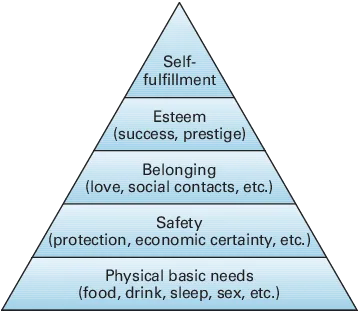
Human needs and wants for certainty can be divided into several classes. Abraham Maslow [6] discerned five fundamental types of human needs and ordered them hierarchically according to their importance in the form of a pyramid (Fig. 1.1).
Fig. 1.1: Maslow’s hierarchy of human needs.
As long as someone’s basic needs at the bottom of the hierarchy are not satisfied, these needs demand attention and the other (higher) needs are more or less disregarded. “Safety,” or in other words, the striving for a decrease of uncertainty about negative risks, is a very important human need, right above basic needs such as food, drink, sleep and sex. Consequently, if risks are not well managed in organizations, and people are not “safe,” the organizations will not be well managed at all. They may focus upon “production” (the organizational equivalent of the physical basic needs), but the organizations will never reach a level in which they excel. Thus, engineering risk management (ERM), as discussed in this book, is essential for any organization’s well-being and for its continuous improvement.
When reading this book it is necessary to wear “engineering glasses.” This means that we will look at risk management using an encompassing engineer’s approach – being systemic on top of analytic.
The analytic and the systemic approaches are more complementary than opposed, yet neither one is reducible to the other. In systemic thinking – the whole is primary and the parts are secondary; in analytic thinking – the parts are primary and the whole is secondary.
The analytic approach seeks to reduce a system to its elementary elements in order to study in detail and understand the types of interaction that exist between them. By modifying one variable at a time, it tries to infer general laws that will enable us to predict the properties of a system under very different conditions. To make this prediction possible, the laws of the additivity of elementary properties must be invoked. This is the case in homogeneous systems, those composed of similar elements and having weak interactions among them. Here the laws of statistics readily apply, enabling us to understand the behavior of the multitude of disorganized complexity.
The laws of the additivity of elementary properties do not apply in highly complex systems, like the risk management, composed of a large diversity of elements linked together by strong interactions. These systems must be approached by a systemic policy. The purpose of the systemic approach is to consider a system in its totality, its complexity, and its own dynamics [7].
This book is not written by financial experts, insurers, traders, bankers or psychologists. Although financial risk management is a crucial matter of daily business, it will not be covered here. As a consequence, we will not discuss the topic of money investments, when it is more convenient to invest in bank accounts, shares or other financial placements. Our concern and purpose is to apply engineering methodologies to (non-financial) risk management. On the other hand, we will discuss in one of the later chapters the micro-economic essentials related to decision-making with respect to engineering risks. We believe that ERM is all about making the right decisions and allocating the budget to deal with engineering risks, in the most optimal way. Such optimal decision-making requires being knowledgeable about financial aspects of risks and using micro-economics to aid the decision-making.
What is the essential idea of (engineering) risk management? We have all heard the saying, “Give a man a fish and you feed him for a day. Teach a man to fish, and you feed him for a lifetime.” We could adapt this expression taking into account a risk management standpoint: “Put out a manager’s fires, and you help him for a day. Teach a manager fire prevention, and you help him for a career.” If a manager understands good risk management, he can worry about things other than firefighting.
Negative risk (or the negative aspect related to engineering risks – the positive aspect is making profits by producing products or delivering a service) could be described as the probability and magnitude of a loss, disaster or other undesirable event. In other terms: something bad might happen. ERM focuses on the “avoiding losses” aspects of risks and can be described as the identification, assessment and prioritization of (safety, security, environment, quality, ethics) risks, followed by the coordinated and economical application of resources to minimize, monitor and control the probability (including the exposure) and/or impact of unfortunate events. In other terms: being smart about taking chances.
The first step is to identify the negative risks that a company faces: a risk management strategy moves forward to evaluate those risks. The simplest formula for evaluating specific risks is to multiply (after quantifying the risk in some form) the likelihood of the risky event by the damage of the event if it would occur. In other words, taking into consideration the possibility and consequences of an unwanted event.
The key word here is data. The best risk management specialists excel at determining predictive data.
The ultimate goal of risk management is to minimize risk in some area of the company relative to the opportunity being sought, given resource constraints. If the initial assessment of risk is not based on meaningful measures, the risk...
Table of contents
Title Page
Copyright
Contents
About the authors
1 Risk management is not only a matter of financial risk
2 Introduction to engineering and managing risks
3 Risk management principles
4 Risk diagnostic and analysis
5 Risk treatment/reduction
6 Event analysis
7 Major industrial accidents and learning from accidents
8 Crisis management
9 Economic issues of safety
10 Risk governance
11 Examples of practical implementation of risk management
12 Concluding remarks
Index
Trusted by 375,005 students
Access to over 1.5 million titles for a fair monthly price.
Study more efficiently using our study tools.
Frequently asked questions
Yes, you can cancel anytime from the Subscription tab in your account settings on the Perlego website. Your subscription will stay active until the end of your current billing period. Learn how to cancel your subscription
No, books cannot be downloaded as external files, such as PDFs, for use outside of Perlego. However, you can download books within the Perlego app for offline reading on mobile or tablet. Learn how to download books offline
Perlego offers two plans: Essential and Complete
Essential is ideal for learners and professionals who enjoy exploring a wide range of subjects. Access the Essential Library with 800,000+ trusted titles and best-sellers across business, personal growth, and the humanities. Includes unlimited reading time and Standard Read Aloud voice.
Complete: Perfect for advanced learners and researchers needing full, unrestricted access. Unlock 1.5M+ books across hundreds of subjects, including academic and specialized titles. The Complete Plan also includes advanced features like Premium Read Aloud and Research Assistant.
Both plans are available with monthly, semester, or annual billing cycles.
We are an online textbook subscription service, where you can get access to an entire online library for less than the price of a single book per month. With over 1.5 million books across 990+ topics, we’ve got you covered! Learn about our mission
Look out for the read-aloud symbol on your next book to see if you can listen to it. The read-aloud tool reads text aloud for you, highlighting the text as it is being read. You can pause it, speed it up and slow it down. Learn more about Read Aloud
Yes! You can use the Perlego app on both iOS and Android devices to read anytime, anywhere — even offline. Perfect for commutes or when you’re on the go. Please note we cannot support devices running on iOS 13 and Android 7 or earlier. Learn more about using the app
Yes, you can access Engineering Risk Management by Thierry Meyer,Genserik Reniers in PDF and/or ePUB format, as well as other popular books in Sciences physiques & Ingénierie de la chimie et de la biochimie. We have over 1.5 million books available in our catalogue for you to explore.