The Colorado River is in crisis. Persistent drought, climate change, and growing demands from ongoing urbanization threaten this life-source that provides water to more than forty million people in the U.S. and Mexico. Coupled with these challenges are our nation's deeply rooted beliefs about the region as a frontier, garden, and wilderness that have created competing agendas about the river as something to both exploit and preserve. Over the last century and a half, citizens and experts looked to law, public policy, and science to solve worsening water problems. Yet today's circumstances demand additional perspectives to foster a more sustainable relationship with the river.
Through literary, rhetorical, and historical analysis of some of the Colorado River's lesser-known stakeholders, Tributary Voices considers a more comprehensive approach to river management on the eve of the one-hundredth anniversary of the signing of the Colorado River Compact, which governs the allocation of water rights to the seven states in the region. Ranging from the early twentieth century to the present, Tributary Voices examines nature writing, women's narratives, critiques of dam development, the Latina/o communities' appeals for river restoration, American Indian authors' and tribal nations' claims of water sovereignty, and teachings about environmental stewardship and provident living. This innovative study models an interdisciplinary approach to water governance and reinvigorates our imagination in achieving a more sustainable water ethic.
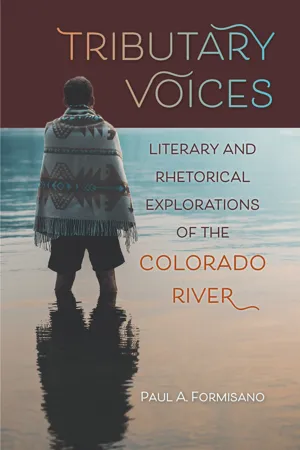
eBook - ePub
Tributary Voices
Literary and Rhetorical Exploration of the Colorado River
- English
- ePUB (mobile friendly)
- Available on iOS & Android
eBook - ePub
About this book
CHAPTER ONE
“Humanists at the Headgates”
Mapping a Discourse Ecology of Water Literacy
To know the spirit of a place is to realize that you are a part of a part and that the whole is made of parts, each of which is whole.
—GARY SNYDER, The Practice of the Wild
BEFORE LAUNCHING OUR PROVERBIAL BOAT into the turbulent waters of Colorado River discourse, I wish to outline in greater detail the frameworks and theoretical positions that illuminate the manifold ways the tributary voices considered herein employ narrative to establish their relationships with the Colorado River and surrounding landscapes both historically and in recent years. As Ingram suggests in the previous chapter, current water-resource challenges demand an “all hands on deck” approach—no one discipline or limited range of perspectives should dominate how the intellectual community and the greater public understand water issues. Thus, this chapter establishes the various ideas that constitute a “humanist at the headgates” vision for the Colorado River. Central to this discussion are the environmental humanities, a coalition of scholarly and activist approaches that are currently shaping numerous environmentally focused fields. Those especially relevant to establishing a discourse ecology of water literacy include perspectives from western American history and literature, environmental literary studies/ecocriticism, and rhetorical studies. Together, they illuminate useful heuristics such as “New Western Rhetoric,” the watershed model, and Walter Beale’s semiotic grammar of motives by which to challenge some of the most pervasive and dominant historical myths, discourses, and genres that have dictated how the river has been imagined over time. In so doing, this confluence of perspectives loosely tied together under the rubric of the environmental humanities helps us identify tributary voices and assess the value they and their respective narratives offer, and it invites us to critically listen to the potential solutions they provide. Through this process we can begin to reimagine and redefine the contours of our own relationships to the river and watershed both individually and collectively in a manner that makes us more aware of and invested in the future health of this remarkable water body and region.
THE ENVIRONMENTAL HUMANITIES
In light of the ongoing drought and many other challenges facing the Colorado River today, many believe that more science and better technology will lead us out of our current dilemmas rather than looking to disciplines within the humanities for possible answers. In their consideration of the environmental humanities, a panel of international scholars acknowledges this common assumption: “When policy makers and mainstream media outlets seek expertise on the environmental crisis today, they seldom turn to environmental historians and philosophers, much less to ecocritics” (Bergthaller et al. 262). Indeed, a 2019 article by Steven Allison and Tyrus Miller, an ecologist and dean of humanities, respectively, acknowledges this bias, noting how the recent Intergovernmental Panel on Climate Change report leaves little room for how ethics and social justice might play into the scientific and technological solutions outlined within the document (“Why Science Needs the Humanities”). These observations should be of little surprise, as western society emphasizes objectivity and rationality, the supposed terrain of the sciences, over the humanities’ attention to subjectivity and emotion to provide the necessary answers we need to address society’s environmental failings. Make no mistake. We need the best scientific thinking possible. However, while more science and better technology are essential to future efforts to more effectively govern the river, they are certainly not and cannot be the only solution.
One of the primary reasons for a more comprehensive approach is that while science, law, and policy excel at explaining what is happening to our world and establishing rules to govern action, they are less equipped to address human responses and the beliefs and values that influence such conclusions. Numerous scholars working on environmental solutions have noted this need for a more inclusive, interdisciplinary approach to address the challenges of the Anthropocene, our new human-dominated era. In a 2012 issue of BioScience, Sverker Sörlin explains that “in a world where cultural values, political and religious ideas, and deep-seated human behaviors still rule the way people lead their lives, produce, and consume, the idea of environmentally relevant knowledge must change. We cannot dream of sustainability unless we start to pay more attention to the human agents of the planetary pressure that environmental experts are masters at measuring but that they seem unable to prevent” (786).
Others have corroborated this view that humanity must be more at the forefront of our environmental deliberations. Hannes Bergthaller et al. observe that those working in science-dominated fields “have come to recognize that scientific know-how by itself is insufficient to successfully address climate instability, soil erosion, freshwater shortages, and a host of other chronic social-ecological afflictions. Clearly, the ecological crisis is not only a crisis of the physical environment but also a crisis of the cultural and social environment—of the systems of representation and of the institutional structures through which contemporary society understands and responds to environmental change (or fails to do so: hence the crisis)” (262). Erle Ellis, a professor of geography and environmental systems, corroborates this observation. In a recent New York Times op-ed, he bluntly states, “Putting expert scientific narratives at the center of decision making, like ‘nonnegotiable environmental limits,’ rather than focusing on opportunities for collective betterment, has led only to increasing divisions over which experts to trust. If we are to continue improving the human world, while retaining the nature we love, it will be necessary to get beyond polemics and expertise, scientific or otherwise. In the end, it is people, and their institutions—not science—that will decide the future” (“Science Alone”).
Despite our reliance on science and technology to assist us as we address complex environmental challenges, these areas cannot bear the sole responsibility, nor should they. And the fact is that while ample evidence exists for the extensive environmental challenges sweeping the globe today, the technical data communicating the reality of our precarious situation often fail to provoke meaningful action. All too often, such information is “delivered ‘downstream’ to a population of passive consumers” who are too overwhelmed by bad news, too indifferent as environmental collapse seems inevitable for them, or too ill-equipped to interpret the data in any meaningful way (Emmett and Nye 7). 1 The time has now come to make an important shift in our approach to solving environmental issues. Heeding Sörlin’s call to establish alternative forms of “environmentally relevant knowledge,” Tributary Voices examines a wide representation of texts for their values and beliefs that help us understand how we have arrived at our present situation and what potential solutions exist for establishing a more sustainable water ethic within the Colorado River Basin. Indeed, as Sörlin concludes, “It seems this time that our hopes are tied to the humanities” (788).
Citing both Bergthaller’s and Sörlin’s contributions to the emergence of the environmental humanities, ecocritic Ursula Heise clarifies the approach of this relatively nascent field, reaffirming the humanities’ unique position in addressing environmental concerns and noting specific tools the field employs to bring together a variety of environmentally centered disciplines both in and out of the hard sciences. 2 In her introduction to The Routledge Companion to the Environmental Humanities (2017), she explains that the environmental humanities “envision ecological crises fundamentally as questions of socioeconomic inequality, cultural difference, and divergent histories, values, and ethical frameworks” and notes that because “scientific understanding and technological problem-solving, essential though they are, themselves are shaped by such frameworks and stand to gain by situating themselves in this historical and social cultural landscape” (2). Failure to perform such self-reflexive, disciplinary soul-searching to reveal the ways in which the humanities inform the sciences—an influence not often considered outside the humanities and typically addressed in the reverse form, as the sciences inform and shape the humanities—further alienates these fields and masks the ways in which they indeed inform one another. This divide is particularly evident in the following chapters where desert writing negotiates scientific and aesthetic knowledge in order to communicate the power and agency of desert water, the basin’s tribes’ understanding of water that embraces Western science and their own respective epistemologies, and John A. Widtsoe’s mingling of science and his faith to address water stewardship. In sum, the environmental humanities—or more appropriately defined as the hydro humanities in regards to the current argument—are a necessary contribution to the broad and complex web of Colorado River representation and management. The hydro humanities’ reliance on many different frameworks and theoretical approaches can help clarify the beliefs, assumptions, and values that ultimately shape perception and action about water use. 3 With this belief at the forefront of Tributary Voices, I now turn to a set of theoretical orientations and metaphors that give shape to the hydro humanities and establish a discourse ecology of water literacy, revealing the value of marginalized hydromythologies.
NEW WESTERN RHETORIC, BIOREGIONS, AND THE WATERSHED
Skeptical of the prevailing myths that construct a very unified and reductive view of western progress evident in works like Turner’s frontier thesis and popular notions of the region, historians and literary scholars have, over a number of decades, recast the West as a much more complex and fraught space. The result of this ongoing renegotiation of place and culture has given birth to postwestern studies, New Western History, and, more recently, critical regionalism. The postwestern traces its roots to the 1970s, as Susan Kollin explains, wherein literary scholars began to examine works “that developed new interpretations of the West’s past,” which “provided viewers different viewpoints and loyalties from the usual fare” of heroic explorers, trappers, and cowboys (xii). A decade or so later, a dramatic shift within western American history further questioned traditional western values and ideals, leaving many frontier aficionados rankling at this “revisionist” history. Dubbed “New Western History” by individuals like Donald Worster and his fellow historians Patricia Limerick and William Cronon, among others, this approach positions the West in a new light, one typically far from the optimistic vision Turner’s thesis had suggested. In Worster’s words, New Western History “emerged out of the old clouds of myth and romance, and now seems for the first time honestly revealed” (Under Western Skies 5). While New Western History was quickly attacked by many in and out of the academy, it nonetheless began an important dialogue about our perceptions of the region and its human and nonhuman inhabitants.
Such critiques are particularly germane to the Colorado River Basin and the region’s water history. As Limerick explains in Legacy of Conquest (1987), one of the foundational texts to New Western History, “People moved to arid and semiarid regions, secure in the faith that water would somehow be made available, then found the prospect of water scarcity both surprising and unfair” (43). Ironically, however, the reality of the situation did not prevent the garden myth from flourishing. Marc Reisner suggests, “Even as the myth of the welcoming, bountiful West was shattered, the myth of the independent yeoman farmer remained intact” (51). With this hope still in play, the arid West has seen more than a century of efforts to reclaim the desert and transform it into a well-watered oasis. Yet in light of today’s increasing demands for a limited quantity of water, the perpetuation of this dream seems misguided, if not downright foolish.
A significant problem related to this inability to give up on the myth is the effect that propagating the myth has on those throughout the watershed. Since Turner’s thesis envisioned a place of renewed opportunity and progress, the supposed savage cultures and landscapes of the region did not stand a chance in the face of Anglo progress that moved steadily westward, armed with enlightenment and civilization. Ultimately, Turner’s thesis fails to account for the region’s realities and complexities by promoting instead his belief in the nation’s agrarian history. 4 Thus, for so many who have based their understanding of the West on Turner’s observations, they have accepted a very reductive view of what the region is generally about and whom it is for. As a result, the land, its resources, and its Indigenous cultures have suffered mightily, as the nation has often looked to the West as the land of endless possibilities. “Quite simply,” Worster explains, “the domination of nature in the water empire must lead to the domination of some people by others” (Under Western Skies 31). Such has often been the case with groups such as women, American Indians, Hispanos, Mexican Americans, and Mexicans throughout the Colorado’s development over the past century or so. Yet while these tributary voices seem absent from the broader discourse about the river, a closer look reveals their ongoing presence that informs our understanding of the river through the voices’ heterotopic nature to work within and against dominant narratives.
This need to acknowledge the value of lesser-known river perspectives draws strength from Limerick’s second major addition to New Western History, Something in the Soil (2000), which reflects on the contribution this field has made to the cultural landscape of the region. Recognizing the public’s poor reception of much of the early scholarship in this field because it supposedly “cast white men as wicked and demonic and envisioned the history of the American West as an unrelieved tragedy” (17), Limerick clarifies her position on western history through four key terms: “continuity,” “convergence,” “conquest,” and “complexity.” Limerick explains that the West is a place of continuity where the same practices at play before the closing in 1890 continue today, evident in such processes as ongoing boom-and-bust cycles in mining and other extractive industries (19). It is also a place of convergence, “one of the great meeting zones of the planet,” where peoples of countless races, ethnicities, and religions interacted—a reality that challenges the belief that the West was just a place for white Americans to occupy (19). Conquest and complexity round out Limerick’s description, suggesting that a simplistic, ahistorical notion of the frontier fails to acknowledge both the reality of widespread oppression of minority groups and the West’s highly intricate past that is far from the naive escape to innocence suggested in Turner’s work (20–21). Together these ideas aptly describe the Colorado River’s past and present evident in the continuity of frontier optimism that influences water use and the region’s development, the interaction of diverse cultures and beliefs about the river’s value, and the oppression of peoples and resources within the watershed.
This emphasis on conquest and complexity is equally significant and closely related to the advent of critical regionalism and its reenvisioning of the American West. Literary scholars Krista Comer and Neil Campbell have provided important commentary on the New West that they approach through the postmodern shift. Comer contends in Landscapes of the New West (1999) that “landscape is not an empty field of vision. . .but rather a brimming-full social topography that creates and enacts the various cultural assumptions and power struggles of the age.” Like Limerick, Comer is critical of past beliefs that landscape and the West in particular have been viewed as blank slates ready for the dominant culture’s sole imprint. Rather, she recognizes the multifaceted and competing histories, philosophies, and practices that have shaped the land and suggests that “we might approach western landscape studies, and all of the social relations that landscape represents and negotiates, from a more nuanced and proactive vantage point” (13). Tributary Voices responds to Comer’s invitation, as it encompasses a more comprehensive approach to the myriad discourses emerging from the watershed’s diverse time periods and cultural groups.
Echoing a call to establish more productive perspectives by which to examine the West’s landscapes as a site of critical discourse, Neil Campbell draws on Mikhail Bakhtin’s notions of dialogism and polyphony to better understand how the American West operates as a complex social and physical space. Such perspectives lead him to view the “lived space of the West as a complex web of interconnections, competing discourses, and different ‘voices’ that together constitute the region” (10). He continues to explain that viewing the West through polyphony, this continual mingling of viewpoints, removes “boundaries constructed by narrow historiographical studies, dime novel stereotypes, and romantic visualizations of landscape and human action, by introducing new discourses in dialogue with the old” (11). Campbell’s application of Bakhtin’s ideas to the West provides a solid grounding for the importance of my notion of the Colorado’s tributary voices that are continually in conversation with discourses of the past. Like rocks protruding from a stream that both shape the watercourse and are in turn shaped by the water, the tributary voices work within and against these past positions as they strive to leave their own imprint on the full body of river discourse.
Similar to the New Western historians and those promoting a critical regionalism of the West, I am equally interested in establishing new vantage points by which to examine the Colorado River Basin as a more complex discursive space. The history of the American Southwest is in many ways a tale of power struggles that have compromised the water rights and access to resources of Indigenous, Hispano, Mexican, and rural white communities, for example. At the same time, much of this dominance has come in the form of ideological and discursive power transmitted through narratives of individuality, progress, and science at the expense of those promoting community and faith. Thus, I posit that a New Western Rhetoric is necessary to address the very interdisciplinary and complex issues governing western water politics that often marginalize certain modes of communication and groups of people. I envision New Western Rhetoric as a special kind of discourse that acknowledges these disparate and conflicting regional perspectives from a wide range of backgrounds. However, while I am interested in the historical contributions a particular tributary voice makes to the river’s timeline, I am more concerned with analyzing these voices’ discursive strategies and appeals rooted in story, which forward their respective visions of the river and how such narratives engage, challenge, and even reject mainstream perspectives to posit alternative ways of living with the river. Therefore, while history plays an integral part in the delineation of this New Western Rhetoric, the primary contribution of this alternative approach is its emphasis on and critique of discursive activity rather than a celebration of a tributary voice’s mere presence. From New Western Rhetoric’s foregrounding of alternative narratives rooted within a quintessential western place, a discourse ecology of water literacy emerges that offers a more comprehensive and equitable representation of Colorado River use.
A discourse ecology of water literacy continues to take shape through ideas and metaphors integral to the development of place-based ecocritical studies that, in turn, are informed by ecology, geography, and other scientific fields. Among these is the bioregionalism movement and the related concept of the watershed. Bioregionalism emerged in the 1970s through the work of Peter Berg and Raymond Dasmann, who advocate for a reassessment of one’s con...
Table of contents
- Cover Page
- Title Page
- Copyright Page
- Contents
- Preface
- Introduction—A River of Words
- Chapter 1. “Humanists at the Headgates”—Mapping a Discourse Ecology of Water Literacy
- Chapter 2. Science, Poetry, and Paradox—Bridging Divergent Epistemologies in Colorado River Desert Writing
- Chapter 3. New Currents in Colorado River Boating Narratives—Westerns, Wilderness, and Women
- Chapter 4. Nuestro Río, the Goodlife, and Querencia—Hispano, Latina/o, and Mexican Perspectives on the Colorado River
- Chapter 5. Indigenizing Water Justice Along the Colorado—Rhetorical Sovereignty, Cosmovisions, and Systems of Responsibilities
- Chapter 6. Reclaiming Reclamation—Stewarding Water Resources in the Twenty-First Century
- Epilogue—Gathering Waters
- Notes
- Works Cited
- Index
- About the Author
Trusted by 375,005 students
Access to over 1.5 million titles for a fair monthly price.
Study more efficiently using our study tools.
Information
Publisher
University of Nevada PressYear
2022Print ISBN
9781647790424
Subtopic
Environmental ManagementeBook ISBN
9781647790431
Frequently asked questions
Yes, you can cancel anytime from the Subscription tab in your account settings on the Perlego website. Your subscription will stay active until the end of your current billing period. Learn how to cancel your subscription
No, books cannot be downloaded as external files, such as PDFs, for use outside of Perlego. However, you can download books within the Perlego app for offline reading on mobile or tablet. Learn how to download books offline
Perlego offers two plans: Essential and Complete
- Essential is ideal for learners and professionals who enjoy exploring a wide range of subjects. Access the Essential Library with 800,000+ trusted titles and best-sellers across business, personal growth, and the humanities. Includes unlimited reading time and Standard Read Aloud voice.
- Complete: Perfect for advanced learners and researchers needing full, unrestricted access. Unlock 1.5M+ books across hundreds of subjects, including academic and specialized titles. The Complete Plan also includes advanced features like Premium Read Aloud and Research Assistant.
We are an online textbook subscription service, where you can get access to an entire online library for less than the price of a single book per month. With over 1.5 million books across 990+ topics, we’ve got you covered! Learn about our mission
Look out for the read-aloud symbol on your next book to see if you can listen to it. The read-aloud tool reads text aloud for you, highlighting the text as it is being read. You can pause it, speed it up and slow it down. Learn more about Read Aloud
Yes! You can use the Perlego app on both iOS and Android devices to read anytime, anywhere — even offline. Perfect for commutes or when you’re on the go.
Please note we cannot support devices running on iOS 13 and Android 7 or earlier. Learn more about using the app
Yes, you can access Tributary Voices by Paul A. Formisano in PDF and/or ePUB format. We have over 1.5 million books available in our catalogue for you to explore.