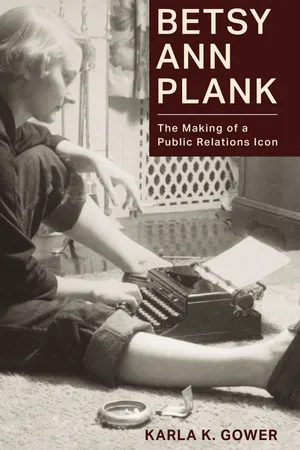
In 1973, Betsy Ann Plank became the first woman to chair the Public Relations Society of America in its twenty-five-year history. It was a tumultuous time to assume the national association's leadership. Civil society seemed to be fraying at the edges, and trust in political institutions and corporations had plummeted in the aftermath of Watergate. Nevertheless, Plank, in her fearless style, took up the challenge head-on. From the start and throughout the span of her sixty-three-year career in public relations, she managed to overcome the very real barriers she faced due to gender-based discrimination in what was a male-dominated industry. As a PR practitioner, Plank served as executive vice president of Daniel J. Edelman, Inc., director of PR planning at AT&T, and assistant vice president of external affairs at Illinois Bell. Beyond her service in the professional realm, Plank grew her legacy by taking the time to mentor countless PR professionals, educators, and students. She saw this dissemination of knowledge as her greatest gift to the field of public relations. In this highly readable biography, Karla Gower explores Plank's personal life and career, tracing her evolution from a low-level job in advertising through her contributions to the rise of the rapidly changing PR industry in the 1960s and the evolution of her personal devotion to the enhancement of public relations education.
- English
- ePUB (mobile friendly)
- Available on iOS & Android
eBook - ePub
About this book
CHAPTER 1
An Uncommon Heritage
The uncommon heritage of the University and the family whose panache and style it shaped and nurtured walks with me every day.
—Betsy Ann Plank
BETSY ANN PLANK was born on April 3, 1924, in the shadow of The University of Alabama. She would be the only child born to Richard (Dick) and Bettye Hood Plank.1 She would also be the only grandchild on either side of the family, solidifying her position as the center of everyone’s attention. Her family instilled in her a belief in the importance of education and the Protestant work ethic. She also benefited from a heritage of strong Southern women who were crucial to her development.
THE FAMILIES
Looking back on her childhood in Tuscaloosa and her connection with The University of Alabama, Plank described it as “an uncommon heritage.” UA’s presence was threaded throughout her young life. There was its physical proximity, of course—she lived most of her first six years just blocks from the campus—but there was more. Both her parents attended UA, as had her mother’s older sister, Adelyne, and her father’s younger brother, Stacey, although none of them graduated. In 1927, Stacey was killed in a car accident returning to Tuscaloosa after attending a UA football game at Georgia State.2 The others left school early for various reasons.
Prominent individuals from the university and town were regular visitors in Plank’s maternal grandmother’s home. Some of the notables included Hudson Strode, a UA creative writing professor and prolific author; “Uncle” Tom Garner, Tuscaloosa’s most successful choral director, choir leader, and music critic; Dr. Richard “Dick” Foster, who would later become university president; and Agnes Ellen Harris, dean of the school of home economics.3 But the “uncommon heritage” of which Plank spoke involved more than her family’s connection to the university. Plank’s family itself was uncommon for the time.
Her grandmother, Annie Hood, a classical pianist, insisted that all her children learn how to play a musical instrument because she believed being able to play music was akin to mastering the social graces. Her children, on the other hand, thought it was only so she would have someone to accompany her in concerts, and there may have been some truth to that. Regardless, she did instill a love of music in at least her two oldest children, Adelyne and Billy. Billy, whom Plank described years later as “impetuous,” moved to Chicago, joined a jazz band, and became a professional musician. But it was Adelyne, who bore the burden of Annie’s own musical dreams and desires, and whose musical talents along with her charisma led to the family’s greatest success.4
Adelyne was a talented musician, but more importantly, she was a performer, a trait Betsy inherited. In 1919, at the age of twenty-two, Adelyne accepted an offer from the Edison Phonograph Company to accompany a singer by the name of Vernon Dalhart on tour. Dalhart was already an established recording artist at thirty-five and married with two children at the time. Together Dalhart and Adelyne recorded several duets and performed around the country to packed venues. When her contract ended, she formed the Pantheon Singers. The group of three women, including Adelyne, and two men toured the Midwest and Canada in the early 1920s. Later, she would once again join Dalhart.
Adelyne was at her best when she took on the characters in her songs, such as Calamity Jane. “I’m Calamity Jane,” she would boast in song, “I’ve blazed the trail and rode the plain, I’m fast on the draw, don’t care for the law, I’m the famous Calamity Jane!” In the 1930s, strong resourceful female characters who matched wits with men and beat them at their own game dominated Adelyne’s recordings. Her looks and size belied the strength and range of her voice. Even as an adult, she had trouble reaching the piano pedals, and her small hands had to stretch for the keys.
Adelyne may have inherited Annie’s musical talent, but it was Plank’s mother, Bettye, who was most like Annie, at least according to Plank. Bettye had Annie’s “stature and steel, common sense and honest-to-God auburn hair,” a description that would apply equally to the adult Plank. Standing just four feet ten and never weighing more than ninety-five pounds, Bettye was a force to be reckoned with. Outgoing and lively, Bettye was seventeen—“looking twelve and going on thirty”—when she met Dick Plank.5
Dick was originally from Birmingham about fifty miles northeast of Tuscaloosa. His parents, Charles and Mary, had moved to the city from Georgia in 1911 for Charles’s work with the Tennessee Coal, Iron and Railroad Company. Charles was active in the community as a member of both the Elks and Masons. He was also a musician, playing saxophone and directing the Shriners’ Zamora Temple band. Mary was a bookkeeper and an aspiring artist. The couple worked hard and saved their money to ensure their children, Dick and Stacey, could attend The University of Alabama. Plank later wrote that the brothers were blond and attractive, with the charismatic Stacey being “our very own F. Scott Fitzgerald.”6
Dick majored in civil engineering at UA. But it was not always easy. He hustled to make ends meet, waiting tables at Alpha Tau Omega, the fraternity to which he belonged, and working weekends as a soda fountain jerk in downtown Tuscaloosa.7 Although Dick was certainly marriage material with his strong work ethic and “straight arrow” character when they met, Bettye was not quite ready to settle down. Not long after their courtship began, Bettye, whom Dick called “Little Girl,” left him and Tuscaloosa for a big-city experience in Chicago, where her sister Adelyne was performing with the Pantheon Singers.8 Dick begged her to come home, and after several months, she finally did. The two were married on December 10, 1922.9
The Tuscaloosa News described the bride as “one of the loveliest girls who was ever reared in this city.” Taking after her mother, Bettye was involved “cheerfully and willingly in every cause” in the community, “deeming it a privilege to lend a helping hand.” For his part, Dick was described as “esteemed and admired by a wide circle of friends.”10 Immediately following the ceremony, the newlyweds left for Birmingham where Dick was now working for Alabama Power. The couple planned to live for the time being with his parents.
PLANK’S EARLY CHILDHOOD
But two years later, a pregnant Bettye moved back to Tuscaloosa to be with her mother, Annie. She continued to live in the Hoods’ two-story, red-brick house on 8th St. after Betsy’s birth in April. Plank spent much of her first six years in that house with Bettye, her Uncle “Ish,” and Mama, as she called her grandmother.11 No mention is made of Dick living with them although doing so would not have been feasible at the time. Birmingham and his job were at least an hour away by train, and the couple could not afford their own car. Taking the train daily between the two cities would have been time-consuming and expensive for a young couple on a budget. More likely, he continued living with his parents in Birmingham during the week and traveled to Tuscaloosa to see his wife and daughter on weekends.

Fig. 1: Betsy Ann Plank at six months old, 1924, taken at her Grandmother Annie’s house in Tuscaloosa, Alabama. All photographs courtesy of the Betsy Ann Plank Papers, the Plank Center for Leadership in Public Relations at The University of Alabama
Dick’s stay in Birmingham ended up being a short one. The Depression came early to the South, and Dick was forced to go where he could find a job to support his family. By the time of the couple’s fifth wedding anniversary, he was working in Augusta, Georgia, and living in a hotel. With Dick working so far away and unable to make trips home often, it was a trying time for them. Whether it was living at home with her mother, the separation from her husband, or simply wanderlust, Bettye was not content sitting still. In May 1929, when Betsy was five, Bettye set sail for England with two other Tuscaloosa women to study sign language.12 Betsy appeared to deal well with her mother’s four-month absence, crying only occasionally. Annie and Plank’s nineteen-year-old uncle Ish, whom she adored, helped ease her pain.13
The following year, Bettye headed back to New York City for an extended visit with Adelyne, and Plank was once again left behind in Tuscaloosa. When her mother departed, the six-year-old Betsy lay on her bed and cried. As Annie described it in a letter to Bettye, Annie lay down beside her granddaughter while the two talked. Plank soon forgot she had said goodbye to her mother and shifted her focus to something she could control. “Well, Mama, let’s go downstairs and dress me and I’ll help you clean up the house.” Plank chatted with Adele and Sam Beale, Annie’s African American servants, as she worked. Annie overheard her say: “Sam, did you know my mother went to NY [sic] this morning and I cried when she told me good-bye. Sam said: What you do dat for? Betsy said: Well, I don’t know what made me do it. Wasn’t that a foolish thing to do?”14

Fig. 2: Betsy at four years old, 1928, taken at her Grandmother Annie’s house in Tuscaloosa, Alabama. Courtesy of the Plank Papers

Fig. 3: Annie Hood surrounded by three of her four children. Adelyne is standing on the left, Betsy’s mother, Bettye, is sitting on the arm of the chair, and Betsy’s Uncle “Ish” is standing behind Bettye. Ca. 1934. Courtesy of the Plank Papers
Shortly after, life for the Planks grew more traditional, and for the first time since Betsy’s birth, the three lived together on a full-time basis. Dick was now working in Roswell, Georgia, a small city in the northwest corner of the state. Betsy attended her first elementary school there, but it would not be her last. She went to eight schools in all before entering high school: two in Alabama and one each in Georgia, Kentucky, Louisiana, Mississippi, Pennsylvania, and Virginia.15
Although the Tuscaloosa News described a seven-year-old Betsy as “the personification of all that is winsome and fascinating” and a “universal favorite in the juvenile set because of her personal charm and ready wit,” Plank was lonely as a child. It is a sentiment shared by many only children, but the family’s constant moving made the loneliness worse. She was never in one place long enough to develop those close childhood friendships that last a lifetime. On the other hand, being thrust into so many new schools taught her how to be flexible and adapt to new environments. She was “always the ‘new kid on the block,’” which meant she learned early about coping on her own. She gained the skill to read people and size them up quickly to fit in. Plank credited this early training in relationship building to her later ability to handle meetings in which she was the only woman.16 While the chaos of constantly relocating was undoubtedly emotionally and socially taxing on young Betsy, her adaptability in new surroundings showed hints of the leader she would become.

Fig. 4: Betsy sits on her father’s lap, while Bettye looks on. Ca. 1934. Courtesy of the Plank Papers
Of all the towns, Winchester, Kentucky, nestled in the mountains and eighteen miles from Lexington, came to feel the most like home for her. Dick had found a position in the aerial photographic department of the U.S. Forest Service, making maps, charts, and blueprints from aerial photos of the forests near Winchester. The family stayed in the town with a population of 8,200 long enough to move into an apartment with a bedroom for Betsy. The prospect of having her own room was an exciting one for the nine-year-old. “MY OWN ROOM,” she wrote in a 1933 diary entry about the move. The other entries are typical of a pre-teenage girl, describing boy crushes and girlfriend squabbles. The writing style suggests, however, a maturity beyond her years. Only children, because of their early adult interaction, tend to be more mature than their peers in intelligence, achievement, motivation, and self-esteem while in elementary school. That certainly held true for Plank at this stage in her life.17
She was, no doubt, as active in Winchester as she appears to have been in Wellsboro, Pennsylvania, where the family moved next. The local newspaper described the ten-year-old Betsy as “a talented actress and pianist” who “is charming in appearance.” She appeared in several vaudeville programs and recitals, and her name was even used to promote future events. In encouraging people to attend an upcoming benefit for the Parent-Teachers Association, the Wellsboro Gazette noted that “Betsy Ann Plank, that little star who made such a hit in the Christmas pageant,” would be singing several numbers.18
Two years later, the family finally settled in Mt. Lebanon, Pennsylvania, after Dick took a position as a civil engineer with the Peoples Natural Gas Company in Pittsburgh. Plank entered Mt. Lebanon High at the age of twelve, having skipped two grades, and quickly became active in the school and the community. Her senior yearbook indicates she was chair of the Ways and Means Committee, and a member of the Banquet Committee, a National Honor Society, and the merit parade. Betsy had always loved to write, spending kindergarten recesses “crayon-writing ‘books’ on folded leaves of paper raided from the Girls’ Room.” So, it is no surprise that she wrote a column for the school newspaper and became editor-in-chief of the yearbook when the opportunity presented itself. The Mt. Lebanon newspaper described her as “a little package of energy and personality” who had been selected as “‘most likely to succeed’ among her classmates.”19 Her yearbook photo shows a pleasant-looking teenager with a shy smile and chin-length hair worn straight with tight curls at the ends in the style of the day.
HIGH SCHOOL DAYS
It was in high school that Plank first came across an adult who did not immediately adore her. Intelligent and a good communicator, Plank had been liked and treated as special by every grown-up she had met, probably because she pandered to them. But in her 1937 diary, she wrote about her science teacher, a man she described as a “mechanical robot” who “never looks at you other than to ask you or answer a question.” Because of his aloofness, she found him intriguing and sought to make him like her. “I’ll find out his type and he’ll like me. Oh yes, he will when I get through with him,” she wrote. After careful observation, she decided that the “robot” probably actually possessed a “dynamic” personality. She concluded that, “He’s kind and thoughtful. He acts humorless, insinuating, insulting, inhuman and mocking only to cover an inferior complex.”20
The teacher’s indifference to her charms bothered Plank to the extent that she even dreamed about him. Confident that she could win him over if she were to meet with him individually, she approached him after class and asked if he could go over an assignment with her. She was surprised when he said yes and thought she had made progress. But then, she later wrote in her diary, “he reprimanded me for talking in class when he was. Fool!” She may not have liked him for that, but their interaction taught her an important lesson. Sometimes charisma exists “only in the eyes of the beholder.” Not everyone was going to find her captivating and willing to do her bidding. Regardless of how the teacher really felt about Plank or what kind of personality he had, she earned an “A,” not only in his class, but in all five of her subjects that year.21 Her determination to be successful and earn high grades continued through her senior year.
It was not simply a matter of doing her best; Betsy wanted to be the best, and she was competitive about her grades. She complained in her diary when a girl beat her by one point in Latin, and when she figured another girl would get the lead in the school play, which would put her ahead of Plank in national honor and activity points. Betsy wrote, “God, for the first time in my life I voice a...
Table of contents
- Cover Page
- Half Title Page
- Title Page
- Copyright Page
- Dedication
- Contents
- List of Illustrations
- Preface
- Introduction
- Chapter 1 / An Uncommon Heritage
- Chapter 2 / Finding Her Passion
- Chapter 3 / The Emergence of a Public Relations Leader
- Chapter 4 / Leading by Example
- Chapter 5 / A Seasoned Leader
- Chapter 6 / Shaping the Future
- Chapter 7 / Leaving a Legacy
- Conclusion
- Notes
- Select Bibliography
- Index
Trusted by 375,005 students
Access to over 1.5 million titles for a fair monthly price.
Study more efficiently using our study tools.
Information
Publisher
University of MissouriYear
2022Print ISBN
9780826222596
Subtopic
Business BiographieseBook ISBN
9780826274731
Frequently asked questions
Yes, you can cancel anytime from the Subscription tab in your account settings on the Perlego website. Your subscription will stay active until the end of your current billing period. Learn how to cancel your subscription
No, books cannot be downloaded as external files, such as PDFs, for use outside of Perlego. However, you can download books within the Perlego app for offline reading on mobile or tablet. Learn how to download books offline
Perlego offers two plans: Essential and Complete
- Essential is ideal for learners and professionals who enjoy exploring a wide range of subjects. Access the Essential Library with 800,000+ trusted titles and best-sellers across business, personal growth, and the humanities. Includes unlimited reading time and Standard Read Aloud voice.
- Complete: Perfect for advanced learners and researchers needing full, unrestricted access. Unlock 1.5M+ books across hundreds of subjects, including academic and specialized titles. The Complete Plan also includes advanced features like Premium Read Aloud and Research Assistant.
We are an online textbook subscription service, where you can get access to an entire online library for less than the price of a single book per month. With over 1.5 million books across 990+ topics, we’ve got you covered! Learn about our mission
Look out for the read-aloud symbol on your next book to see if you can listen to it. The read-aloud tool reads text aloud for you, highlighting the text as it is being read. You can pause it, speed it up and slow it down. Learn more about Read Aloud
Yes! You can use the Perlego app on both iOS and Android devices to read anytime, anywhere — even offline. Perfect for commutes or when you’re on the go.
Please note we cannot support devices running on iOS 13 and Android 7 or earlier. Learn more about using the app
Yes, you can access Betsy Ann Plank by Karla K. Gower in PDF and/or ePUB format. We have over 1.5 million books available in our catalogue for you to explore.