The Olive Branch from Palestine provides a new narrative of the Palestinian effort to end the Israeli-Palestinian conflict and offers a bold plan for ending this conflict today, a proposal that focuses on Palestinian agency and the power of the Palestinians to bring about the two-state solution, even in the absence of a fully committed Israeli partner.
In part 1, Jerome Segal provides an analytical and historical study of the 1988 Palestinian Declaration of Independence, a remarkable act of unilateral peacemaking through which the PLO accepted the legitimacy of the 1947 Partition Resolution and thereby redefined Palestinian nationalism. In part 2, he proposes a new strategy in which, outside of negotiations, the Palestinians would advance, in full detail, the end-of-claims/end-of-conflict peace plan they are prepared to sign, one that powerfully addresses the Palestinian refugee question and is supported by the refugees themselves yet does not undermine Israel as a Jewish-majority state.
eBook - ePub
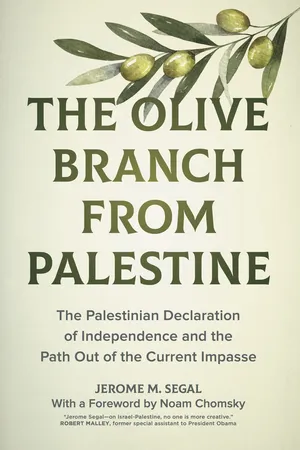
The Olive Branch from Palestine
The Palestinian Declaration of Independence and the Path Out of the Current Impasse
- 316 pages
- English
- ePUB (mobile friendly)
- Available on iOS & Android
eBook - ePub
The Olive Branch from Palestine
The Palestinian Declaration of Independence and the Path Out of the Current Impasse
About this book
Information
Publisher
University of California PressYear
2022Print ISBN
9780520381308
Edition
1eBook ISBN
9780520381315
ONE
The Unilateral Surprise
It was August of 1988. The West Bank and the Gaza Strip, under Israeli occupation since 1967, were in the midst of an unprecedented mass rebellion. It was called the Intifada, the “throwing off,” and it was now in its ninth month. The PLO leadership was based in Tunisia, over a thousand miles away, having been driven from Lebanon six years earlier by Israeli forces.
For the previous twenty years, Yasser Arafat had dominated the Palestinian national movement. Yet even now, his most basic objectives were unclear. To most Israelis, Arafat and the PLO were terrorists, committed to the destruction of Israel and unrestrained by moral norms. Their ideology was clearly stated in their Covenant—Israel had no right to exist. They even denied that there was a Jewish people, or that today’s Jews had a historical connection to the land between the Jordan River and the Mediterranean Sea.
Their aspirations notwithstanding, the Palestinians had long been on the losing end. For decades prior to the establishment of Israel, the Palestinians had feared, opposed, and then fought against the establishment of a Jewish state in Palestine. In 1947 they lost that struggle on the international diplomatic level when the United Nations General Assembly called for the division of Palestine into two states, one Arab and one Jewish. And in 1948, despite assistance from five Arab states following the Israeli Declaration of Independence, they lost their struggle in a full military conflict. Not only did they fail to prevent the Jewish state from coming into being, they failed to prevent it from expanding. When the fighting came to a halt in 1949, Israel controlled not only all of the land designated for the Jewish state in the UN Partition Resolution but also much of the land that the United Nations had intended for the Palestinian state. Further, most of the Palestinian population from the areas under Israeli control, having fled or been driven from their homes, were now living as refugees in neighboring Arab countries, prevented from returning by Israeli forces.
Following this failure in 1948 to prevent the establishment of the Jewish state, the Palestinians did not give up. Seamlessly, their goal shifted from preventing the Jewish state to destroying it. If only the full weight of the Arab states could be brought to bear, this did not seem an unrealistic objective. This appraisal of Israeli vulnerability was widespread until the 1967 war. It was shared by many Israelis as well, and in June of 1967, when Israel launched preemptive strikes against Egypt and Syria, among the Israeli public most felt they were fighting for their existence. In the Arab world such was the disbelief in Israeli military capabilities that the initial war reports in the Arab media maintained it was the United States, not Israel, that had destroyed the Egyptian and Syrian air forces in the opening hours of a sweeping conflict that lasted all of six days.
When the 1967 war began, Israel tried to convince the Jordanians, who controlled the West Bank and East Jerusalem, to stay neutral, but Jordan joined the Arab side. When the fighting ceased, Israeli forces had extended their control to all of mandatory Palestine, all of the area that was to have been divided into two states, one Arab and one Jewish. Further, it now occupied parts of Syria and vast swaths of Egypt, all the way to the Suez Canal.
Add to this history of Palestinian and Arab military and diplomatic defeats, the solidarity between the United States and Israel that emerged after 1967, the development of Israeli nuclear weapons, and Anwar Sadat’s diplomacy, which resulted in a stable peace treaty between Israel and Egypt, Israel’s most powerful neighbor, and it was clear to all who could see: The Palestinians had lost again and again and yet again. The question they faced was, what to do about it?
The Intifada of 1988, the political mobilization of the Palestinian population that had lived under Israeli occupation since 1967, gave the Palestinian people an unprecedented degree of agency. While none should pretend that they controlled their own fate, yet unlike at any previous point in their history, they had achieved the power to significantly shape the course of events. The Palestinian people became increasingly aware of this in the early months of 1988, as world attention focused on their revolt. Months went on; they had gained much support worldwide, but their leadership, the PLO in Tunis, which had not planned the Intifada, had yet to find a way to capitalize on the uprising.
Then in November of 1988, the PLO, acting in the name of the Palestinian people, and given credibility by the continued mass uprising, did what many other peoples had done before them. Affirming the right of the Palestinian people to self-determination and political independence, they proclaimed the establishment of their own state:
The Palestine National Council, in the name of God, and in the name of the Palestinian Arab people, hereby proclaims the establishment of the State of Palestine on our Palestinian territory with its capital Jerusalem (Al-Quds Ash-Sharif ).
This was something new in the hundred-year history of the conflict: a Palestinian state, proclaimed and run by the PLO; a state that would come into existence not through negotiations, and not through any peace agreement. This was a unilaterally proclaimed state, one emerging from a massive insurrection against Israeli forces. What could such a state mean for Israel and for the future of this hundred-year-old conflict?
In 1988 there were few Israelis who believed in a two-state solution to the Israeli-Palestinian conflict, few who believed that the conflict could be resolved if only a Palestinian state were to come into being. Shimon Peres did not believe it. Yitzhak Rabin did not believe it. Indeed, it was not even the aim of the Israeli peace movement. And certainly, almost no one believed that peace could be achieved through the establishment of a self-declared PLO state.
Rather, it was widely held that such an eventuality (a PLO-controlled state), if it ever came to pass, would represent a new and significant danger to Israel, most likely a terrorist base whose continued purpose would be the fulfillment of the PLO Covenant’s determination to destroy Israel. And unlike the hostile Arab states, such as Syria and Iraq, or the previously hostile Egyptian state, this new entity would be right at the gates, claiming sovereignty over Jerusalem and strategically poised in the hill country, only ten miles from Tel Aviv, overlooking Ben Gurion Airport and the coastline. This hostile state entity, it appeared to many, was what the PLO was seeking to create when the Declaration of Independence was proclaimed. It was seen the way the emergence of a Hamas-controlled Palestinian state in the West Bank is seen by many today.
THE FIRST SURPRISE: THE LEGITIMACY OF PARTITION
With declarations of independence, there is generally some identified entity that “hereby proclaims” the existence, or the establishment, of the new state. And this was the case with the Palestinian Declaration. After several paragraphs reciting the history of the Palestinian people and affirming their rights, the Declaration gets to its primary business:
Now by virtue of natural, historical and legal rights, and the sacrifices of successive generations who gave of themselves in defense of the freedom and independence of their homeland;
In pursuance of Resolutions adopted by Arab Summit Conferences and relying on the authority bestowed by international legitimacy as embodied in the Resolutions of the United Nations Organization since 1947;
And in exercise by the Palestinian Arab people of its rights to self-determination, political independence and sovereignty over its territory,
The Palestine National Council, in the name of God, and in the name of the Palestinian Arab people, hereby proclaims the establishment of the State of Palestine on our Palestinian territory with its capital Jerusalem (Al-Quds Ash-Sharif).
At first glance this statement contains no surprises. It cites history, sacrifices, institutions, and rights in support of the proclamation of statehood. This is the standard stuff of declarations. But if we look a bit more closely, we do find something remarkable. In citing the basis that gives legitimacy to this bold act of proclaiming and establishing a new state, the Declaration says:
and relying on the authority bestowed by international legitimacy as embodied in the Resolutions of the United Nations Organization since 1947.
For those who knew something of the history of the conflict, this reference to the resolutions of the United Nations since 1947 should have been startling. Does this not include the Partition Resolution of 1947, the very resolution that provided for the creation of Israel, a resolution that the Israelis themselves cited when in May 1948 they issued their own Declaration of Independence proclaiming the existence of a new state called Israel? Are the Palestinians citing as the basis for the legitimacy of their own state a United Nations resolution that provided equal legitimacy for the creation of Israel?
Were this to be the case, the PLO would be abandoning the very cause that had animated the Palestinian struggle for decades. They would be moving from trying to destroy Israel to acknowledging the legitimacy of its existence. Even if one believed that the Palestinians had no other choice if they wanted a state of their own, it would be astonishing that this acknowledgment of Israel’s legitimacy was not a final concession squeezed from the PLO after long and arduous negotiations, negotiations in which, in exchange for their recognition of Israel, the Palestinians attained Israeli recognition of their state, a withdrawal from the West Bank and Gaza, a capital in Jerusalem, and some redress for the Palestinian refugees.
But this was without any negotiations at all. Here the most fundamental reversal, on the most fundamental issue, seems to be occurring unilaterally. The PLO, the terrorist foe, seems to be conceding the legitimacy of Israel without any offsetting concessions from Israel.
Had anyone predicted this in advance, they would have been met by a chorus of dismissals. Impossible! Without precedent! Not the way the world works! Naive! Yet in November 1988 this is exactly what happened. The PLO did not merely and unilaterally proclaim their state, a state that could have been devoted to destroying Israel. They did something very different. They unilaterally proclaimed a state on the basis of the very United Nations resolution whose passage, forty-one years before, marked their most fundamental defeat in the world of nations.
Some may take issue with this interpretation; some may say the phrasing in question—“relying on the authority bestowed by international legitimacy as embodied in the Resolutions of the United Nations Organization since 1947”—is far too vague for such conclusions. After all, does “since 1947” include what was enacted by the United Nations in 1947 or just what was enacted after 1947? Furthermore, it might be said that the Palestinians were not acknowledging the legitimacy of Israel, as the text excerpted does not make any reference to the other state, the Jewish state.
And if all the Palestinians had to say on the matter was the paragraph cited, perhaps I would be guilty of reading too much into their words. But the Palestinian Declaration did say more, much more, making it quite explicit that the PLO, in their Declaration of Independence, unilaterally acknowledged the legitimacy in international law of the creation of Israel.
If we scroll back through the Declaration some five paragraphs, we are in a section where they detail their understanding of Palestinian history. The adoption by the United Nations of the Partition Resolution in 1947 was the pivotal defeat in that history, and it had to be addressed. Here is what they said:
Despite the historical injustice inflicted on the Palestinian Arab people resulting in their dispersion and depriving them of their right to self-determination, following upon UN General Assembly Resolution 181 (1947), which partitioned Palestine into two states, one Arab, one Jewish, yet it is this Resolution that still provides those conditions of international legitimacy that ensure the right of ...
Table of contents
- Title
- Copyright
- Dedication
- Epigraph
- Contents
- Foreword, by Noam Chomsky
- Preface
- Acknowledgments
- Introduction
- 1 • The Unilateral Surprise
- 2 • The Evolution of the Palestine Liberation Organization Prior to the Declaration
- 3 • 1988: Leading Up to the Declaration
- 4 • How the Declaration Was Drafted
- 5 • Darwish
- 6 • Two Declarations: Israeli and Palestinian Side by Side
- 7 • Reactions to the Declaration and Meeting the US Conditions
- 8 • The Struggle with the United States over Recognition of the New State
- 9 • PLO Strategy and the Declaration
- 10 • Early Statehood and Opportunities to Return to the Declaration
- 11 • The Path Out of the Current Impasse: Palestinian Peacemaking
- Conclusion: The Significance of the Declaration
- Appendix: State of Palestine Declaration of Independence
- Notes
- Index
Trusted by 375,005 students
Access to over 1.5 million titles for a fair monthly price.
Study more efficiently using our study tools.
Frequently asked questions
Yes, you can cancel anytime from the Subscription tab in your account settings on the Perlego website. Your subscription will stay active until the end of your current billing period. Learn how to cancel your subscription
No, books cannot be downloaded as external files, such as PDFs, for use outside of Perlego. However, you can download books within the Perlego app for offline reading on mobile or tablet. Learn how to download books offline
Perlego offers two plans: Essential and Complete
- Essential is ideal for learners and professionals who enjoy exploring a wide range of subjects. Access the Essential Library with 800,000+ trusted titles and best-sellers across business, personal growth, and the humanities. Includes unlimited reading time and Standard Read Aloud voice.
- Complete: Perfect for advanced learners and researchers needing full, unrestricted access. Unlock 1.5M+ books across hundreds of subjects, including academic and specialized titles. The Complete Plan also includes advanced features like Premium Read Aloud and Research Assistant.
We are an online textbook subscription service, where you can get access to an entire online library for less than the price of a single book per month. With over 1.5 million books across 990+ topics, we’ve got you covered! Learn about our mission
Look out for the read-aloud symbol on your next book to see if you can listen to it. The read-aloud tool reads text aloud for you, highlighting the text as it is being read. You can pause it, speed it up and slow it down. Learn more about Read Aloud
Yes! You can use the Perlego app on both iOS and Android devices to read anytime, anywhere — even offline. Perfect for commutes or when you’re on the go.
Please note we cannot support devices running on iOS 13 and Android 7 or earlier. Learn more about using the app
Please note we cannot support devices running on iOS 13 and Android 7 or earlier. Learn more about using the app
Yes, you can access The Olive Branch from Palestine by Jerome M. Segal in PDF and/or ePUB format, as well as other popular books in History & Middle Eastern History. We have over 1.5 million books available in our catalogue for you to explore.