- 216 pages
- English
- ePUB (mobile friendly)
- Available on iOS & Android
eBook - ePub
About this book
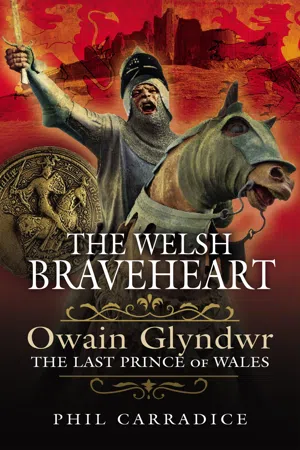
Like William Wallace in Scotland, Owain Glyndwr fought for his country and was only finally defeated by superior numbers and the military genius of Henry V. Yet Glyndwr was not just a freedom fighter. He was the last native-born Prince of Wales, a man who initiated the first Welsh parliament at Machynlleth and proposed an entirely independent Welsh church. Glyndwr also laid plans for two Welsh universities, proposed a return to the far sighted and revolutionary Laws of Hywel Dda and formed a Tripartite Agreement with Henry Percy and Edmund Mortimer. It led to an invasion of England and nearly brought the reign of Henry V to an end. And yet, despite his success and popularity, Glyndwr's rebellion seriously damaged the Welsh economy with towns destroyed and much agricultural land laid to waste. Even so, he was never betrayed by his people, despite a huge reward being offered for his capture. Glyndwr refused at least two offers of pardon from the English crown and remains the supreme champion of the underdog.
Information
Subtopic
Historical BiographiesIndex
HistoryChapter One
A Prelude to it All
Contrary to public opinion, Owain Glyndwr’s fifteenth-century rebellion against the English Crown was never as uniformly popular as some historians and lovers of Welsh culture would have us believe. In England, of course, he was feared both during and after his rebellion, held up as the epitome of everything that was evil and duplicitous. But even in his native Wales he was not always regarded as the saviour of the nation.
Undoubtedly he was idealised and lionised in many parts of his home country. Arguably he was even worshipped by those sections of Welsh society that he came to symbolise and represent – the uchelwyr or community leaders, particularly those from Mid and North Wales. But it was a sporadic and patchy approval which often changed from year to year and from region to region.
Despite this significant groundswell of support for the Glyndwr revolt, approval for his actions was far from universal and there was also a fair degree of active opposition to the man and his motives. Significant figures like Dafydd Gam of Brecon and Sir Gilbert Talbot from Goodrich opposed him to the end, more than happy to take up arms against the man who had set himself up as a Welsh saviour.
South Pembrokeshire, the ‘Little England beyond Wales’ of Edward Laws and Giraldus Cambrensis, even paid him money, a significant gratuity of £200 to stay away from the rolling and fertile pasture land below the Landsker boundary. Easy money for Glyndwr, a season’s peace for the ‘Why ayes’, as they were known, of the Norman lands around Pembroke town.
These two poles – the ayes and the nays – were, however, the preserves of the committed few. There were many more, perhaps the majority of the Welsh population, who simply stood and watched. For them it was case of waiting to see the outcome of the conflict before pledging allegiance to one side or the other.
In the months after September 1400, which saw an effective and startling beginning for Glyndwr, it really did seem as if he was about to achieve what the two dominant princes of Wales, Llewelyn the Great and Llewelyn the Last, had signally failed to do. That, of course, was the recreation, the rebirth if you like, of an independent Wales. The illusion – or was it delusion? – lasted for several years and brought the Welsh nation closer to independence than it had been for centuries.
Thousands flocked to Glyndwr’s banner, many coming from as far away as Oxford and Scotland. He actually had two flags, his own personal one and the more heavily symbolic banner of the Princes of Gwynedd. That particular flag, with its emblematic and iconic image of four lions rampant, seemed to draw out all that was noble in the Welsh people, with the result that warriors, labourers, even clergymen came willingly and without compunction to offer their support. How lasting that support was to be remains a moot point.
It was, of course, all something of a false dawn and from 1406 onwards Glyndwr’s star was fixed to a steady downhill trajectory. Defeat followed defeat and the gains he and his armies had made in the early years of the century were relentlessly recovered by the forces of the English Crown. The ‘fair weather’ friends and supporters who had so willingly joined him in the early days slipped quietly away as the rebellion’s feet of clay were relentlessly exposed.
Slowly but surely, after 1406 substantial inroads were made into Owain’s territories. Battles were lost and the great captured castles of Aberystwyth and Harlech, symbols of the Welsh resistance, were taken back. The upper hand had been clearly seized by King Henry IV and by his son and eventual successor, Prince Henry of Monmouth.
Without wishing to overly denigrate a Welsh national hero, it was definitely a case of ‘shades of grey’ where the popularity of Owain Glyndwr was concerned. He was loved, he was hated, he was feared and he was revered; he was never ignored.
There is no doubt that many kept on supporting him right to the end; large numbers of Welshmen continued to risk ruin and to die for him in the years between 1406 and 1412. But many more, perhaps the majority, once the outcome of the rebellion became more or less predictable, either sought a pardon from the King or simply buried their heads and got on with their daily lives. As with so much of Glyndwr’s story, the Biblical analogy is strong – in this case the people of Wales washing their hands like Pontius Pilate as Christ is convicted and condemned.
As ever with most popularist movements, the majority of the people of Wales were political and revolutionary lightweights. They liked the idea of independence but were not quite so happy to play their part in achieving it. Only in hindsight, when there was no chance of being called to arms, did many of the laggards suddenly discover that they, like Owain and his more devoted followers, were fervent nationalists at heart.
Of course, the early success of the rebellion awakened the long-dormant hopes of the more nationally conscious Welshmen. And yet in reality the revolt and the ensuing fight for independence never had much chance of coming to fruition. That was something the more pragmatic or realistic of the Welsh gentry quickly saw once the initial burst of enthusiasm had worn off.
In numbers alone, the Welsh armies were always in the minority when they took to the field. On most occasions Glyndwr’s soldiers were outnumbered by perhaps as many as ten or even twelve to one. Those were significant figures in the days of medieval warfare when it was as much bulk, brutality and brawn as tactics that usually won the day.
When it came to traditional pitched encounters the Welsh simply could not put enough troops into the combat, and when allies like France and Scotland failed him, Glyndwr was always fighting a losing battle. He knew it, of course, but it did not stop him trying.
The traditionally lightweight Welsh troops were ideal for guerrilla warfare and Glyndwr quickly realised that if he really was going to continue challenging the English Crown his best chances of success lay in the hit and run tactics for which his people were famous. Unfortunately, guerrilla campaigns rarely bring total and absolute victory; there usually has to be a major reckoning, a face to face confrontation between the main participants before victory is finally decided.
*****
Arguably – and it is a hugely debatable point – the Glyndwr rebellion had little to do with Welsh nationalism. It was much more a case of people showing their dislike of Henry Bolingbroke – Henry IV as he had become after the removal of Richard II – than any fervent desire to create an independent Welsh state.
Proclaiming the popularity of Owain Glyndwr was all well and good. It was connected with people’s beliefs and desires but it was not the sole motivating factor. It was almost a by-product of the moment. Such niceties were, at the time, barely noticed but Glyndwr was enough of a strategist to seize and use whatever support was liable to come his way.
Henry Bolingbroke, the son of John of Gaunt, was a usurper, a man who had seized the throne when the opportunity presented itself. He was certainly not a popular king but he was also beset with many problems in governing his domain. Chief among these was the issue of finance. Ruling the country was one thing, having the money to run it was something totally different.
The fact that his predecessor, Richard II, had been more unpopular and inefficient than him was immaterial. In the eyes of the rank and file bystanders Richard was the rightful king and Henry’s claims to the throne were at best marginal. Might rather than right, many felt, was an appropriate way of describing Henry’s position.
However, once Henry did finally manage to get the finances of his kingdom into shape – through heavy taxes, demands on barons, peace rather than war with France – things changed. When he was finally able to free himself from the fear of a French or Scottish invasion the economic power of England meant that the scales were always weighted in favour of Henry and his dynasty. Put simply, the longer the conflict went on the less chance there was of Welsh victory.
When looked at objectively it is clear that Glyndwr’s rebellion might have been a popular uprising – for some at least – but it also caused immense damage to the Welsh economy. Arguably, it irrevocably damaged the relationship between the English and the Welsh. And for that, many people never forgave him.
As far as Glyndwr was concerned anything that was of an English origin was tainted. It meant that everything, from the newly created towns and county boroughs to isolated farms and fisheries, was fair game for Glyndwr and his rebels. Consequently, they were attacked and destroyed. The English retaliated with similar wanton destruction by putting Welsh homesteads and villages to the torch.
As the armies marched, villagers fled, with the result that fields of crops were left untended and rotting, houses and whole villages falling into disrepair. It was like Dante’s Inferno, and though ninety-nine per cent of Welsh peasants did not have the faintest idea who Dante was, they would recognise the term from the stories and dire threats issued to them by their preachers and clergymen.
In particular, isolated manor houses, undefended villages, and corn mills – all vital components in medieval life – were easy targets for men with destruction in their hearts. That destruction was a monumental blow to the regimes and routines of the period and led to a severe setback in the growth of towns in Wales. Previously vibrant communities like the North Wales towns of Nefyn and Criccieth were sacked, and once decay set in, never fully recovered.
Inevitably, emotions ran high, with the result that the one factor which did grow, suddenly and hugely noticeable, was a wave of anti-Welsh feeling. It became endemic in the hearts and minds of English settlers and merchants who had good cause to be afraid of their neighbours. The sentiment was to be found both within the country and, in particular, along the borders or marches.
The feelings of hatred and distrust were replicated by the Welsh who, in their eyes at least, had more than enough reason to hate the English. Arguably, the friction has remained – sometimes hidden, sometimes openly on display – and if dredged deeply enough can be found even today.
The scorched-earth tactics of Glyndwr’s campaigning years also led to lasting feuds between the Welsh themselves, particularly at the uchelwyr or gentry level. For years after the end of the rebellion those who had fought for Glyndwr and those who had not were members of bitterly divided camps. The divide between the north and south of the country also owes much to the way Glyndwr’s war gave hope before finally stuttering and petering out altogether.
At the time, scorched earth tactics resulted in the imposition of draconian laws against the Welsh people. We shall look at these later; for the moment it is suffice to say that the anti-Welsh laws were something for which many blamed Glyndwr and never forgave him.
And yet, when it was all over, it was the memory and the promise of the rebel cause – both during and after the riotous years of Glyndwr’s glory – that the nation remembered. For some time, memory was all that the Welsh people would have. That national memory was possibly endemic of the whole enterprise. The inevitable failure of Glyndwr’s revolt was important to the Welsh persona. As someone once remarked, ‘nobody does maudlin like a defeated Welshman.’
Regardless of what had created the emotion, in the years after Glyndwr’s disappearance and death the memory of what had been, and, more importantly, what might have been was suddenly given shape and form in the breasts of many Welshmen. Hindsight is always the most effective science and in the years following his rebellion the Welsh were gifted with copious amounts of it.
If he had done nothing else, Owain Glyndwr had alerted and awakened the Welsh people to their heritage, albeit when it was too late to do much about it. That may not have been much consolation for Glyndwr and his more fervent supporters, but it was the reality of the situation after 1412.
It was as if the people of Wales had come alive after a long but far from dreamless sleep, and suddenly remembered that they were a proud race with a history and traditions of their own. Wales was, in heart and soul if not in actuality, an independent nation with its own language, its own culture and with hope for the future.
Perhaps, then, what Owain Glyndwr rekindled in the Welsh people was worth all of the scorched crops, the destroyed towns and the hundreds if not thousands of dead bodies scattered across the countryside. Glyndwr undoubtedly thought so, even though the conflict had seen his own residences destroyed, his lands forfeited, most of his family killed or rotting in prison, and which, in the final years of his life, left him a hunted outlaw.
It is interesting to note that throughout his period ‘on the run’, with a bounty on his head, no one ever attempted to turn him in, to betray their prince for the proverbial thirty pieces of silver. The people of Wales certainly had the opportunity, but they chose, whether deliberately or by default, not to exploit it.
Henry Bolingbroke, increasingly a broken and disheartened man, someone for whom the crown had become a wearisome weight upon his shoulders, feared that something like that might happen to him. He eventually died a solitary, unhappy and haunted shadow of the warrior he had once been. Owain Glyndwr, though we have no way of knowing, would probably have gone to his grave – his unmarked, unknown grave – a much happier and fulfilled individual.
*****
Even now, over 600 years since his death, there remains a huge temptation to first anoint and then, secondly, to revere Owain Glyndwr under the banner of the ‘Welsh Braveheart’. It is a form of acknowledgement of his deeds, using the inflated vocabulary of the cinema screen, but ultimately the appellation is used in imitation of Scotland’s William Wallace.
It is a temptation, yes, but that is where imagination should stop. It does not take a great deal of consideration to realise that while the cause of their two rebellions in Scotland and Wales, and the intentions of their leaders, were much the same, Owain Glyndwr was not an imitation of anyone. This was a man unlike any other. He was a unique figure, flawed in many respects, but perhaps more interesting because of those flaws. He was a hero, a villain, a warrior, a prince, a scholar and a farsighted diplomat, as noble in defeat as he was in victory.
Glyndwr was also a brutal warrior who would do what he had to do in order to achieve his aims, a man for whom killing became second nature. He was a man of many parts, but more than anything, he was a man who carved out a role and a reputation that were symbolic of the Welsh desire – sometimes hidden, often simply unacknowledged – for independence.
In many respects Glyndwr was the father of the Welsh nation. His fame, his charisma, his influence and, above everything else, the cause for which he stood have all remained intact. That is his legacy and that is what has made him a legend. He remains a symbol for Welsh independence, as powerful and memorable as King Arthur, Hector of Troy or Alexander the Great – and, yes, even as remarkable as William Wallace of Scotland.
He was well aware of the legends about a ‘Welsh saviour’ who would restore the nation’s standing and independence. He had been fed such prophesies all his life. He was equally as conscious of his own family connections with the royalty of Wales. And yet there still remains an element of doubt about his motives, at least to begin with. Did he, in the early days of his rebellion against the English Crown, really wish to eliminate the country’s overlords, to revenge Llewelyn the Last? Or, on a more prosaic level, did he see hims...
Table of contents
- Cover
- Title
- Copyright
- Content
- Acknowledgements
- Introduction
- A Personal Prologue
- Chapter One A Prelude to it All
- Chapter Two Wales Before Glyndwr
- Chapter Three Early Life
- Chapter Four Rebellion
- Chapter Five A Blazing Star
- Chapter Six The Glory Years
- Chapter Seven The Year of the French
- Chapter Eight The Pennal Letters
- Chapter Nine A Losing Battle
- Chapter Ten The King is Dead, Long Live the King
- Chapter Eleven The End of the Race
- Chapter Twelve A National Figure
- Epilogue
- Endnotes
- Bibliography
- Plate section
Trusted by 375,005 students
Access to over 1.5 million titles for a fair monthly price.
Study more efficiently using our study tools.
Frequently asked questions
Yes, you can cancel anytime from the Subscription tab in your account settings on the Perlego website. Your subscription will stay active until the end of your current billing period. Learn how to cancel your subscription
No, books cannot be downloaded as external files, such as PDFs, for use outside of Perlego. However, you can download books within the Perlego app for offline reading on mobile or tablet. Learn how to download books offline
Perlego offers two plans: Essential and Complete
- Essential is ideal for learners and professionals who enjoy exploring a wide range of subjects. Access the Essential Library with 800,000+ trusted titles and best-sellers across business, personal growth, and the humanities. Includes unlimited reading time and Standard Read Aloud voice.
- Complete: Perfect for advanced learners and researchers needing full, unrestricted access. Unlock 1.5M+ books across hundreds of subjects, including academic and specialized titles. The Complete Plan also includes advanced features like Premium Read Aloud and Research Assistant.
We are an online textbook subscription service, where you can get access to an entire online library for less than the price of a single book per month. With over 1.5 million books across 990+ topics, we’ve got you covered! Learn about our mission
Look out for the read-aloud symbol on your next book to see if you can listen to it. The read-aloud tool reads text aloud for you, highlighting the text as it is being read. You can pause it, speed it up and slow it down. Learn more about Read Aloud
Yes! You can use the Perlego app on both iOS and Android devices to read anytime, anywhere — even offline. Perfect for commutes or when you’re on the go.
Please note we cannot support devices running on iOS 13 and Android 7 or earlier. Learn more about using the app
Please note we cannot support devices running on iOS 13 and Android 7 or earlier. Learn more about using the app
Yes, you can access The Welsh Braveheart by Phil Carradice in PDF and/or ePUB format, as well as other popular books in History & Historical Biographies. We have over 1.5 million books available in our catalogue for you to explore.