New edition: The classic illustrated history of the special ops unit—"an unprecedented look into this little-known aspect of the Vietnam conflict" (
American Rifleman).
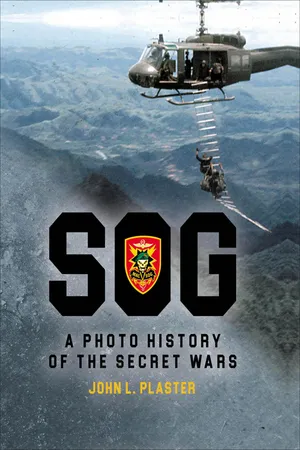
In 1972 the U.S. military destroyed all known photos of the top-secret Studies and Observations Group, with the intention that details could never be made public. But unknown to those in charge, SOG veterans had brought back with them hundreds of photographs of SOG in action and would keep them secret for more than three decades.
In this new edition of
SOG: A Photo History, more than 700 irreplaceable photos bring to life the stories of SOG legends Larry Thorne, Bob Howard, Dick Meadows, George Sisler, "Q" and others, and document what really happened deep inside enemy territory: Operation Tailwind, the Son Tay raid, SOG's defense of Khe Sanh, Hatchet Force operations, Bright Light rescues, HALO insertions, string extractions, SOG's darkest programs, and much more.
- 456 pages
- English
- ePUB (mobile friendly)
- Available on iOS & Android
eBook - ePub
About this book
Information
Subtopic
Military & Maritime HistoryIndex
HistoryPART ONE
THE SECRET WAR BEGINS
Chapter 1: COLBY’S COVERT WAR
Chapter 2: SWITCHING BACK—SOG IS BORN
Chapter 3: SHINING BRASS

Chapter One
COLBY’S COVERT WAR

WHEN CIA STATION CHIEF WILLIAM Colby arrived in Saigon in 1960, the French had been gone barely five years, the same number of years as had passed since a Geneva Convention had split Indochina into a communist north and noncommunist south. Although fighting officially had ended, Colby soon saw that the war was continuing.
Beginning in 1959, old communist Vietminh fighters who had emigrated to the North after the French-Indochina War started to reappear in South Vietnam’s most remote provinces to organize a guerrilla force, the Vietcong (VC), which falsely insisted that it had no connection to Hanoi. The new CIA station chief was neither naive nor inexperienced in the ways of secret wars. Sixteen years earlier, Office of Strategic Services (OSS) Lt. William Colby had parachuted into Nazi-occupied France to lead French resistance fighters against the Germans. A year later he’d parachuted into Norway to demolish Nazi rail lines. Colby could see through Hanoi’s subterfuge.
Troubled by reports of North Vietnamese infiltration, the new Kennedy administration immediately approved a CIA proposal to increase its Vietnam programs. National Security Adviser McGeorge Bundy signed National Security Action Memorandum 52 (NSAM-52), which expanded the CIA efforts to detect infiltration and to insinuate a network of CIA operatives in North Vietnam. NSAM-52 also authorized Colby to employ U.S. Army Special Forces and Navy SEALs to train and advise the operatives for the CIA’s covert missions.
THE CIA’S JUNK FLEET
Colby had inherited a small infiltration program begun by his predecessor that used cleverly disguised junks to deliver agents and supplies to the coast of North Vietnam. In February 1961, only weeks after the Kennedy inauguration, a CIA junk landed Colby’s first agent, Agent Ares, in North Vietnam, near Cam Pha, some 40 miles south of China. Over the next eight years, Agent Ares would prove the most prolific U.S. operative in the North. But Colby was looking for more than agents.
In Danang, Colby’s assistant, Tucker Gougleman, and a SEAL detachment were preparing Vietnamese Sea Commandos to raid North Vietnam’s coast. Despite his odd-sounding name, Gougleman was a man to be taken seriously. As a U.S. Marine Raider on Guadalcanal in 1942, Gougleman had been severely wounded, then fought in Korea, but had left the Corps on a medical discharge and established himself as one of the CIA’s top paramilitary officers. “He had that unappointed leadership quality,” said SEAL Barry Enoch. “It didn’t matter what he wore on his shoulder or arm; status-wise, he’d become a leader in any group. I thought he was a Marine, a hard-core Marine, and we loved him. We just absolutely loved him.”
Beginning in 1962, Gougleman’s SEAL-trained Sea Commandos ran harassment and sabotage raids on the coast of North Vietnam. For these quick across-the-beach attacks, SEAL Gunners Mate Enoch rigged a packboard with four cardboard tubes, each containing a 3.5-inch rocket and an electrical delay mechanism. Using Enoch’s rig, a Vietnamese raider could slip ashore, aim the packboard toward a target, and be long gone by the time the rockets fired.

When an 84-foot North Vietnamese Swatow patrol boat captured a CIA junk, Gunners Mate Enoch modified the rest of the boats so they could better defend themselves yet did not display any visible weapons. It wasn’t long before one of Enoch’s modified CIA junks found itself hailed by a Swatow and ordered to stand to. As the Swatow came alongside, the captain waved and the mate lifted his hand but instead of waving, his fingers found a toggle switch, whose wires ran to six canvas-covered troughs atop the wheelhouse, each holding a 3.5-inch rocket, with the whole of them arranged to hit a pattern the size of a Swatow. Lashed to each mast where a crewman stood was an innocent-looking 55-gallon drum containing a hidden .50-caliber machine gun on a custom, pop-up mount. And below the gunwhale lay the final two crewmen, cradling cocked Swedish K 9mm submachine guns and awaiting their captain’s signal.

CIA Saigon Station Chief William Colby in traditional Vietcong black pajamas. (Photo provided by the Colby family)

The top-secret CIA (and later SOG) base at Camp Long Thanh. Note the covered fences on the inner compound. (Photo provided by Dale Boswell)
Just as the Swatow cut its engines, six rockets crashed into her, two crewmen raised their Swedish Ks to riddle the boarding party, and both .50 calibers raked the Swatow’s deck. Before they’d finished firing, the captain started a powerful diesel engine, another feature Enoch had hidden in the junk. Then the junk was gone.
Inevitably the North Vietnamese got smart, and Swatows patrolled in pairs, with one covering while the other cautiously approached. Finally, two North Vietnamese Swatows cornered a CIA junk and ripped it in two with gunfire.
COVERT AGENTS AND AIRDROPS
With his junks now too vulnerable for agent landings, Bill Colby switched to airdrops from specially modified C-46s and C-47s and called upon the expertise of U.S. Air Force Col. Harry “Heinie” Aderholt to assist him. At this point, Aderholt, based at Takhli, Thailand, was wrapping up the CIA’s top-secret Tibet airlift, in which hundreds of pro-Dalai Lama guerrillas and thousands of tons of supplies had been parachuted into Chinese-occupied Tibet. During the 5-year Tibet airlift not one of Aderholt’s unmarked C-130s had been lost.
Colby asked Aderholt to provide instructor pilots to train Vietnamese in infiltration flying and to select routes for penetrating North Vietnam. U.S. Air Force Maj. Larry Ropka, who’d planned the Tibet flights, found that the smartest way into North Vietnam was its mountainous Laotian “backdoor” and laid out routes to exploit hundreds of mountains for terrain masking and electronic confusion.
Meanwhile in Saigon, Colby recruited a flamboyant Vietnamese air force pilot to head a special squadron of unmarked C-47s outfitted with long-range fuel tanks to fly the secret missions. The squadron commander, Nguyen Cao Ky, later would command his country’s air force and eventually serve as president of South Vietnam.
LONG-TERM AGENT TEAMS
The small teams Ky and his pilots would parachute into the North were mostly northerners who’d come south in 1954, such as Catholics and tribal minorities who’d fought alongside the French. But unlike the Vietminh infiltrating the South, U.S. policy forbade Colby’s long-term agents from building a resistance, or even having contact with civilians. The teams were neither short-term raiders, who could hit a target and be extracted, nor guerrillas, who blended with the populace from whom they might draw strength, support, and sustenance. The agent teams were operational orphans, totally dependent on airdropped supplies, hiding in the jungle to survive. It was a concept begging for disaster.

At Camp Long Thanh, agent trainees studied raid tactics on this model of an oil tank farm. (Photo provided by Bill Kendall)

Bridge demolition was instructed on this tabletop model. (Photo provided by Bill Kendall)

Agents who sabotaged light manufacturing facilities used this model for study. (Photo provided by Bill Kendall)
The long-term agent teams trained behind the tarp-covered cyclone fences at Camp Long Thanh, a secret CIA training center 25 miles northeast of Saigon where Green Berets and CIA officers taught them fieldcraft, weapons skills, small-unit tactics, demolitions, and survival. Team radio operators studied Morse code, encryption, and secret duress codes to let the CIA know that they’d been captured and were transmitting under enemy control.
Especially important was the team members’ specialized parachute training. Unlike conventional paratroops, the agents would jump in inky darkness into mountainous, triple-canopy jungle and then rappel to the ground. To survive such hazardous landings, they wore heavily padded U.S. Forest Service smokejumper suits and cra...
Table of contents
- Cover
- Dedication
- Title
- Copyright
- Contents
- Acknowledgements
- Introduction
- PART ONE: THE SECRET WAR BEGINS
- PART TWO: THE HO CHI MINH TRAIL
- PART THREE: SOG’S AIR ARM
- PART FOUR: RECON WEAPONS, MISSIONS, AND TACTICS
- PART FIVE: RECON OPERATIONS
- PART SIX: SOG’S HATCHET FORCES
- PART SEVEN: OTHER FRONTS IN THE SECRET WARS
- Afterword
- Glossary
Trusted by 375,005 students
Access to over 1.5 million titles for a fair monthly price.
Study more efficiently using our study tools.
Frequently asked questions
Yes, you can cancel anytime from the Subscription tab in your account settings on the Perlego website. Your subscription will stay active until the end of your current billing period. Learn how to cancel your subscription
No, books cannot be downloaded as external files, such as PDFs, for use outside of Perlego. However, you can download books within the Perlego app for offline reading on mobile or tablet. Learn how to download books offline
Perlego offers two plans: Essential and Complete
- Essential is ideal for learners and professionals who enjoy exploring a wide range of subjects. Access the Essential Library with 800,000+ trusted titles and best-sellers across business, personal growth, and the humanities. Includes unlimited reading time and Standard Read Aloud voice.
- Complete: Perfect for advanced learners and researchers needing full, unrestricted access. Unlock 1.5M+ books across hundreds of subjects, including academic and specialized titles. The Complete Plan also includes advanced features like Premium Read Aloud and Research Assistant.
We are an online textbook subscription service, where you can get access to an entire online library for less than the price of a single book per month. With over 1.5 million books across 990+ topics, we’ve got you covered! Learn about our mission
Look out for the read-aloud symbol on your next book to see if you can listen to it. The read-aloud tool reads text aloud for you, highlighting the text as it is being read. You can pause it, speed it up and slow it down. Learn more about Read Aloud
Yes! You can use the Perlego app on both iOS and Android devices to read anytime, anywhere — even offline. Perfect for commutes or when you’re on the go.
Please note we cannot support devices running on iOS 13 and Android 7 or earlier. Learn more about using the app
Please note we cannot support devices running on iOS 13 and Android 7 or earlier. Learn more about using the app
Yes, you can access SOG by John L Plaster,John L. Plaster in PDF and/or ePUB format, as well as other popular books in History & Military & Maritime History. We have over 1.5 million books available in our catalogue for you to explore.