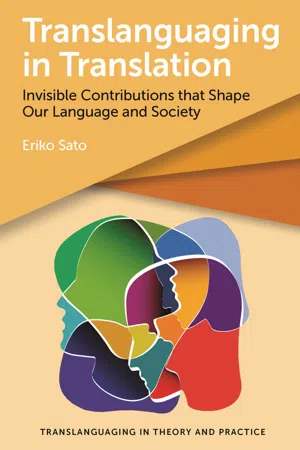
This book brings applied linguistics and translation studies together through an analysis of literary texts in Chinese, Hindi, Japanese and Korean and their translations. It examines the traces of translanguaging in translated texts with special focus on the strategic use of scripts, morphemes, words, names, onomatopoeias, metaphors, puns and other contextualized linguistic elements. As a result, the author draws attention to the long-term, often invisible contributions of translanguaging performed by translators to the development of languages and society. The analysis sheds light on the problems caused by monolingualizing forces in translation, teaching and communicative contexts in modern societies, as well as bringing a new dimension to the burgeoning field of translanguaging studies.
eBook - ePub
Translanguaging in Translation
Invisible Contributions that Shape Our Language and Society
- English
- ePUB (mobile friendly)
- Available on iOS & Android
eBook - ePub
Translanguaging in Translation
Invisible Contributions that Shape Our Language and Society
About this book
Information
1Introduction
The term ‘translanguaging’ is Colin Baker’s English translation of a Welsh term ‘trawsieithu’, which was originally coined by Cen Williams to refer to the pedagogical practice of deliberately using two languages (C. Baker, 2001: 281; Williams, 1994). The meaning of the term ‘translanguaging’ was significantly expanded across disciplines in the wake of the 21st century. Ofelia García uses the term translanguaging in her study of bilingualism and bilingual education, where translanguaging refers to bilinguals’ fluid use of their linguistic resources that disregards named language categories and enables them to ‘make sense of their bilingual worlds’ (García, 2009: 45). For Li Wei, translanguaging is a creative and critical multilingual practice as well as a continuous action that goes ‘between’ different linguistic structures and systems and goes ‘beyond’ them (Li, 2011). In their groundbreaking publication, Translanguaging: Language, Bilingualism and Education, García and Li (2014) conceptualize translanguaging as encompassing a wide range of linguistic phenomena in different contexts (e.g. classrooms and communities), in different modes (e.g. spoken and written), in different mental states (e.g. unconscious and fully conscious), with different perspectives (e.g. sociolinguistic, psycholinguistic, sociopolitical and pedagogical) and with different orientations (e.g. prescriptive, descriptive and theoretical).
Translation and translanguaging are both bilinguals’ language practices but sharply diverge in terms of how linguistic boundaries are dealt with: Linguistic boundaries are to be respected in translation practices but are disregarded or manipulated in translanguaging practices by definition. Translation is a monolingual practice, whereas translanguaging is a multilingual practice. Nonetheless, translation and translanguaging sometimes complement each other. Translanguaging in translation has been practiced since ancient times but is viewed as a problem only if the linguistic norms of the receiving culture of translation are societally monolingualized.
As claimed by Lawrence Venuti, highly praised and economically profitable translations in Anglophone societies are in fluent standard English without a trace of the source language (SL) to the extent that they do not look like translations (Venuti, 1995, 1998). However, SL linguistic elements in translated texts can be essential to the readers of translation to directly sense the context of the source text (ST). Similarly, the use of SL elements in translation can be the only way to avoid distorting the culture of the ST. Strikingly, the way texts are translated mirrors the ideology toward multilingualism in the receiving culture of translation.
This monograph brings applied linguistics and translation studies together and qualitatively examines the traces of translanguaging in translated texts to show their benefits, challenges, mechanisms and roles. At the same time, it debunks the problems of ‘monolingualizing’ forces prevailing in Anglophone societies and explores the nature of language.
Translanguaging perspectives in applied linguistics contributes to translation studies to enable us to gain a uniform account of a variety of heterolingual translation practices, ranging from Venutian resistant foreignization to creative integration of SL elements in translation for enhanced rhetorical effects or for enhanced intercultural communication.
On the other hand, the methodology of descriptive translation studies and cultural perspectives in translation studies contribute to applied linguistics to enable us to see the nature of our languages as societal constructs. A trace of translanguaging found in translated texts serves as a snapshot evidence of bilinguals’ strategic language use.
In this monograph, translations of Chinese, Hindi, Japanese and Korean from and into English are examined, with special focus on linguistic elements such as culture/society-specific words/morphemes, proper names, pronouns, terms of addressing, metaphors, units of measurement, onomatopoeias, scripts, puns, heterolingual discourse and etymology-based vocabulary classes. The results show that languages change mostly, if not always, due to our translanguaging practices in a broad sense. Translanguaging in translation in particular triggers both the formation of neo-borrowings and the changes of grammatical structures.
Unlike code-switching, translanguaging is not based on the static view of language or the notion of native speakers and does not view one’s use of multilingual resources as a sign of inadequate language proficiency. In addition, translanguaging can explain why languages change as our societies change, but code-switching cannot. These are the very reasons why heterolingual phenomena in translated texts should be analyzed through a translanguaging perspective, and not as code-switching phenomena.
The current study empirically supports translanguaging as a theory of language and language use, and thus translanguaging has a transformative implication especially on pedagogical practices in language classrooms. It liberates language learners, language teachers and textbook authors from monolingual constraints and makes our classrooms more inclusive.
This chapter provides an overview of the concept of translanguaging and central issues in translation studies with focus on heterolingual translation, presents the main assumption on the relationship between translanguaging and translation held in this book and outlines the organization of the book.
1.1 Translanguaging
This section overviews the theoretical assumptions of translanguaging that are relevant to the research presented in this book.
1.1.1 Nature of language
Translanguaging takes a Bakhtinian interactionalist’s position and is based on the idea that language is not a static set of rules and codes, but is an ongoing and dynamic action, ‘languaging’, that emerges in communicative interactions (García & Li, 2014). We use languages not only to convey information but also to elicit responses, request an action, persuade someone, evoke emotions and cause some change during communicative interaction (Austin, 1962).
Interactionists’ view of language cannot be separated from the context of language use. Our language use is systematically related to its function in a given situation, in a given discourse and in a given sociocultural environment (Halliday, 1985/2014), and thus words cannot mean anything without their contexts. We cannot understand someone else’s utterance without relating it to the context. As we make utterances, we automatically adjust them so we can bring about the highest contextual effect with minimum interpretive cost (Sperber & Wilson, 1986). Our language practices are constantly shaped and reshaped as the surrounding sociocultural environment changes. People move from one place to another. Our sociopolitical ideologies, our understanding of the history, our socioeconomic status and our popular culture also change from time to time. As our surroundings change, new meanings naturally arise or we create them to introduce a new concept, to fine-tune our expressions, to voice our critical views and to advance our societies. Thus, languages self-evolve in the context of its use.
The interactionist’s view of language suggests that languages, including language varieties, vary depending on the users as well as the context. Otheguy et al. (2015: 290) argue that ‘everyone speaks his unique idiolect, which is a mental grammar that is acquired primarily through, and deployed mostly in his surrounding environment’. The factors of language variation include not only the speaker’s geographic origin but also his age, gender, education, occupation, economic status, lifestyle, personality, interest, attitude, migration history, family heritage, value, belief, interest and more. Linguistic variations are not limited to lexical words but are also found in the choice of pronouns, morphosyntactic elements, contractions, sentence structures, sentence-endings and so forth. No two persons grow up in exactly the same environment even if they belong to the same family: The second child in a family has a very different linguistic and social environment than the first child of the same family even though they have exactly the same parents and live in exactly the same house. Furthermore, even the same person speaks differently depending on the situation and the mode. As Otheguy et al. (2015) argue, we are constantly adjusting our idiolect, keenly reflecting on our communicative context at each and every moment in our communicative activities. Children in a multilingual family continuously adjust their language use depending on who is nearby at the dining table at each given moment. Some adjustments may be temporary, but others may be long term. Languages are not a set of finite linguistic features. No one person grows up having exactly the same set of linguistic features throughout his life. Languages are living and constantly changing through communicative interaction.
If we all speak idiolects as Otheguy et al. (2015) argue, named languages are only sociopolitical constructs. This point is made by Max Weinreich: ‘A language is a dialect with an army and navy (A shprakh iz a dialekt mit an armey un flot)’ (Weinreich, 1945). The invention of nation-states triggered the invention of monolingualism (Makoni & Pennycook, 2007). Naming languages is a relatively new practice in human history, and named languages are sociopolitically charged ideological illusions. A pair of two named languages such as Danish and Norwegian can be just two dialects. A pair of two dialects such as Cantonese and Mandarin can be two separate languages. A pair of two named languages such as Hindi and Urdu can be the same language if their scripts are disregarded. Similarly, English has many community-based varieties, and so we actually have ‘Englishes’ (plural) (Kachru, 1985). Whether we call some language ‘a language’ or ‘a language variety’ and whether we call multiple languages ‘a language’, ‘languages’ or ‘varieties of the same language’ are sociopolitically determined.
1.1.2 Language learning
The Chomskyan view of language as a single static set of rules and codes is partially supported by the notion of native speakers. Its assumption is that the native speakers of a language share the same grammatical judgment over sentences. However, it is not always the case especially when a sentence is syntactically complex and semantically ambiguous or when the speakers are in different age groups or from different geographic areas. Interestingly, their subtle grammaticality judgments change after being extensively exposed to a different language or language variety for many years. This leads us to think that what seems to be the native speakers’ intuition is environmentally constructed through experiences and conditioned by the frequency of language use.
Lieven and Tomasello (2008) argue that children learn language from experience and by using their general cognitive ability to make connections and learn, rather than through imitation and without requiring a separate module in a child’s mind. This usage-based cognitive approach is realistic because there is an interdependency between children’s general cognitive development and their linguistic development (Piaget, 1951; Vygotsky, 1978).
More and more research findings suggest that first language acquisition requires human interaction. Kuhl et al. (2003) shows that American infants (10–12 months) learned Chinese phonemes through interacting with a Chinese caregiver in person with picture books and props, but not through watching the pre-recorded video of the same Chinese caregiver re-enacting the situation of being with a child using the same props and making similar utterances. This is surprising because infants are seeing the same person, who is using the same props and making similar utterances. What is the difference between seeing and hearing her in person, versus on a pre-recorded video? The only difference is the presence or absence of two-way interaction. In person, they can react to her utterances and sh...
Table of contents
- Cover-Page
- Half-Title
- Series
- Title
- Copyright
- Contents
- Figures and Tables
- Preface and Acknowledgments
- 1 Introduction
- 2 Scripts
- 3 Names
- 4 Words
- 5 Contexts
- 6 Roles of Translanguaging and Translation
- 7 Conclusion
- References
- Primary Sources
- Appendices
- Appendix 2: Examples of SL Words in Anurag Yadav’s English Translation of Godaan Published in 2009 in India
- Index
Trusted by 375,005 students
Access to over 1.5 million titles for a fair monthly price.
Study more efficiently using our study tools.
Frequently asked questions
Yes, you can cancel anytime from the Subscription tab in your account settings on the Perlego website. Your subscription will stay active until the end of your current billing period. Learn how to cancel your subscription
No, books cannot be downloaded as external files, such as PDFs, for use outside of Perlego. However, you can download books within the Perlego app for offline reading on mobile or tablet. Learn how to download books offline
Perlego offers two plans: Essential and Complete
- Essential is ideal for learners and professionals who enjoy exploring a wide range of subjects. Access the Essential Library with 800,000+ trusted titles and best-sellers across business, personal growth, and the humanities. Includes unlimited reading time and Standard Read Aloud voice.
- Complete: Perfect for advanced learners and researchers needing full, unrestricted access. Unlock 1.5M+ books across hundreds of subjects, including academic and specialized titles. The Complete Plan also includes advanced features like Premium Read Aloud and Research Assistant.
We are an online textbook subscription service, where you can get access to an entire online library for less than the price of a single book per month. With over 1.5 million books across 990+ topics, we’ve got you covered! Learn about our mission
Look out for the read-aloud symbol on your next book to see if you can listen to it. The read-aloud tool reads text aloud for you, highlighting the text as it is being read. You can pause it, speed it up and slow it down. Learn more about Read Aloud
Yes! You can use the Perlego app on both iOS and Android devices to read anytime, anywhere — even offline. Perfect for commutes or when you’re on the go.
Please note we cannot support devices running on iOS 13 and Android 7 or earlier. Learn more about using the app
Please note we cannot support devices running on iOS 13 and Android 7 or earlier. Learn more about using the app
Yes, you can access Translanguaging in Translation by Eriko Sato in PDF and/or ePUB format, as well as other popular books in Languages & Linguistics & Linguistics. We have over 1.5 million books available in our catalogue for you to explore.