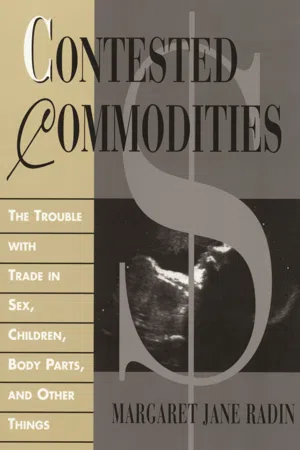
Not only are there willing buyers for body parts or babies, Radin observes, but some desperately poor people would be willing sellers, while better-off people find such trades abhorrent. Radin observes that many such areas of contested commodification reflect a persistent dilemma in liberal society: we value freedom of choice and simultaneously believe that choices ought to be restricted to protect the integrity of what it means to be a person. She views this tension as primarily the result of underlying social and economic inequality, which need not reflect an irreconcilable conflict in the premises of liberal democracy.
As a philosophical pragmatist, the author therefore argues for a conception of incomplete commodification, in which some contested things can be bought and sold, but only under carefully regulated circumstances. Such a regulatory regime both symbolizes the importance of nonmarket value to personhood and aspires to ameliorate the underlying conditions of inequality.
eBook - PDF
Contested Commodities
About this book
Information
Publisher
Harvard University PressYear
2001Print ISBN
9780674007161
9780674166974
eBook ISBN
9780674290105
Table of contents
- Cover
- Title Page
- Copyright
- Dedication
- Acknowledgments
- Contents
- Preface
- Chapter 1. Commodification as a Worldview
- Chapter 2. Market-Inalienability
- Chapter 3. Problems for the Idea of a Market Domain
- Chapter 4. Compartmentalization: Attempting to Delineate a Market Domain
- Chapter 5. Personhood and the Dialectic of Contextuality
- Chapter 6. Human Flourishing and Market Rhetoric
- Chapter 7. Incomplete Commodification
- Chapter 8. Conceptual Recapitulation
- Chapter 9. The Double Bind
- Chapter 10. Prostitution and Baby-Selling: Contested Commodification and Women’s Capacities
- Chapter 11. Commodification, Objectification, and Subordination
- Chapter 12. Free Expression
- Chapter 13. Compensation
- Chapter 14. Democracy
- Notes
- Index
Trusted by 375,005 students
Access to over 1.5 million titles for a fair monthly price.
Study more efficiently using our study tools.
Frequently asked questions
Yes, you can cancel anytime from the Subscription tab in your account settings on the Perlego website. Your subscription will stay active until the end of your current billing period. Learn how to cancel your subscription
No, books cannot be downloaded as external files, such as PDFs, for use outside of Perlego. However, you can download books within the Perlego app for offline reading on mobile or tablet. Learn how to download books offline
Perlego offers two plans: Essential and Complete
- Essential is ideal for learners and professionals who enjoy exploring a wide range of subjects. Access the Essential Library with 800,000+ trusted titles and best-sellers across business, personal growth, and the humanities. Includes unlimited reading time and Standard Read Aloud voice.
- Complete: Perfect for advanced learners and researchers needing full, unrestricted access. Unlock 1.5M+ books across hundreds of subjects, including academic and specialized titles. The Complete Plan also includes advanced features like Premium Read Aloud and Research Assistant.
We are an online textbook subscription service, where you can get access to an entire online library for less than the price of a single book per month. With over 1.5 million books across 990+ topics, we’ve got you covered! Learn about our mission
Look out for the read-aloud symbol on your next book to see if you can listen to it. The read-aloud tool reads text aloud for you, highlighting the text as it is being read. You can pause it, speed it up and slow it down. Learn more about Read Aloud
Yes! You can use the Perlego app on both iOS and Android devices to read anytime, anywhere — even offline. Perfect for commutes or when you’re on the go.
Please note we cannot support devices running on iOS 13 and Android 7 or earlier. Learn more about using the app
Please note we cannot support devices running on iOS 13 and Android 7 or earlier. Learn more about using the app
Yes, you can access Contested Commodities by Margaret Jane Radin in PDF and/or ePUB format, as well as other popular books in Economics & Economic Theory. We have over 1.5 million books available in our catalogue for you to explore.