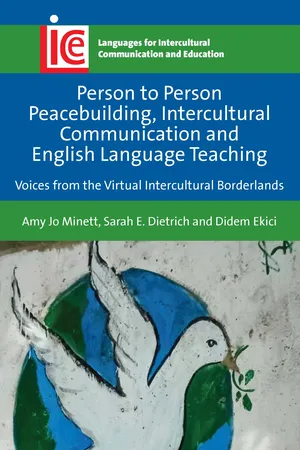
This book maps the discursive terrain and potential of person to person peacebuilding as it intersects with, and is embedded in, intercultural communication. It foregrounds the voices and discourses of participants who came together in the virtual intercultural borderlands of online exchange through a service-learning project with a non-profit organization which focused on peace through education in Afghanistan, primarily through English language tutoring. By analyzing the voices and perspectives of US-based tutors who are pre-service teachers of English as an Additional Language, in equal measure with the voices and perspectives of adult English learners in Afghanistan, the authors examine how intercultural interactants begin to work as peacebuilders. The participants describe the profound transformations they undergo throughout their intercultural tutoring journeys, transformations which evidence three dimensions of person to person peacebuilding: the personal, relational and structural. Inspired by these voices, the book further explores ways teachers and teacher educators of language and intercultural communication can more deliberately leverage the affordance of peacebuilding, whether face to face or in the virtual intercultural borderlands of online exchange.
eBook - ePub
Person to Person Peacebuilding, Intercultural Communication and English Language Teaching
Voices from the Virtual Intercultural Borderlands
- English
- ePUB (mobile friendly)
- Available on iOS & Android
eBook - ePub
Person to Person Peacebuilding, Intercultural Communication and English Language Teaching
Voices from the Virtual Intercultural Borderlands
About this book
Information
1Introduction
The Chaos that Surrounds
‘Rose,’ Tutor of English as an additional language:
In light of the horrific events this weekend, I would like to touch on the impact this tutoring experience has and will have on me moving forward. As I was listening to the news and reading posts on the internet about the Orlando shootings connected to Islamic extremism, I could not help but reflect upon my brief but growing relationship with my tutee in Afghanistan. With so much hate and misunderstanding … it is not only refreshing but overwhelmingly encouraging to know that it is still possible for two people from completely different walks of life to make a genuine connection despite the political/ideological chaos that surrounds. I am hopeful that someday we may focus our attention on building such positive relationships rather than condemning each other for our differences. (Rose, Summer 2016)
‘Najibullah,’ Afghan student:
[M]any of these [Afghan] students haven’t had the experience to talk or communicate with a foreigner, like with an American or European, and in some areas, they are so religious … they say bad things about you guys, honestly, but when students … [are tutored] online with an American, then their idea changes, about you, they know that you are not bad, first, second, you’re good [we laugh], they can share their happiness with you … their mindset, ok, become positive, because when these students go home, he or she can share this experience to his family, to his mother, which is religious, to his father, which is religious, to his sister, and brothers, so it is not an effect on only one student, and the student, and his or her family, and his or her classmates. You have to add those too.
In these quotes we first meet Rose, a future teacher of English as an additional language (EAL),1 who writes here of her experiences tutoring an adult learner of English who lives in Afghanistan. Their interactions took place online through videoconferencing, in a space we call the virtual intercultural borderlands. In this journal entry, as she responds to news of a shooting at a gay nightclub in the US state of Florida – in which 49 people died and 53 were injured – she refers directly to the ‘political/ideological chaos that surrounds.’ In her words, we see Rose place her growing personal connection with someone she describes as very different from herself within a broader context of conflict at a national and global level. In doing so, she evokes the power and potential future impacts of their intercultural interactions, suggesting that one on one relationships can not only lead to individual change but lay the groundwork for change at a ‘political’ or ‘ideological’ level. Put more simply, in Rose’s words, we begin to see intersections between intercultural communication and person to person peacebuilding.
The second quote comes from an Afghan learner of English tutored online by a future teacher of EAL who was probably not unlike Rose. In Najibullah’s words, too, we see the power and potential impact of intercultural interaction as he shares his perspectives on the value of Afghan English learners meeting online, one on one, with US-based tutors. Specifically, he remarks on the potency of direct contact between persons of different nationalities and ‘mindsets’: by such contact, we may come to realize that our intercultural counterpart is first ‘not bad,’ and second, perhaps, ‘even good.’ And what we learn from one another through such interactions we may share with our family and friends, who may share with their families and friends, and so on, in the process starting a counternarrative and new discourse chain (Bakhtin, 1984; Blackledge, 2005) which may push back against ideologies promoted by religious and political leaders alike.
The collaboration that brought Rose, Najibullah – and more than 70 other future EAL teachers – together with Afghan learners of English started with a conversation between the authors of this book. Our initial goal was relatively simple: to create opportunities for graduate students in teaching English to speakers of other languages (TESOL) to gain practical experience as part of their coursework. Inspired by the service-learning model (and, more recently, intercultural and international service learning; see Bamber, 2016; Rauschert & Byram, 2018), in which experiential education is linked to academic course goals, we designed a project in collaboration with an international community partner, a US-based non-profit organization that focuses on peace in Afghanistan through education. Among other initiatives, this organization works with volunteer coordinators from across Afghanistan to pair students who want to practice English with volunteer tutors from across the globe.
For the project we explore in this book, the TESOL course instructor, the US-based director of coordination for the tutoring initiative, and local volunteers in Afghanistan worked together to pair each graduate student tutor with an adult Afghan learner of English. The pairs met over the course of a semester for weekly 90-minute tutoring sessions using videoconferencing; tutors and students were separated physically by a distance of over 7000 miles or 9000 kilometers. Many of the Afghan students did not have internet access in their homes and logged into their sessions from computers in educational centers and/or internet cafes. Tutors generally – although not all – participated from their homes. Given the time difference between Afghanistan and the US, most sessions for tutors were held before 8:30 in the morning or after 10:00 at night. As part of their coursework, the graduate students submitted six written journal entries in which they reflected on their tutoring experiences.
At the end of the first semester of this collaboration, we read the graduate students’ reflections. Initially, we focused on what the tutors shared about teaching grammar, using technology and interacting online. Some reported feeling limited by only being able to see their students’ faces; some expressed frustration at being unable to explain grammatical forms that to them just ‘sounded right.’ And then there were reflections like Rose’s, which begins this chapter. Over and over, tutors described transformations they experienced, including their own shifting perceptions and prejudices, their evolving relationships with their Afghan counterparts and their growing insights into war, peace and the world around them. Compelled by their words and voices, we realized that we wanted to learn more. While the project continued with other groups of future EAL teachers and Afghan learners, we put out a call inviting former tutors and Afghan participants alike to share their thoughts on and experiences with the project in interviews. As our data grew, so did the references to peace and conflict in participant voices. Thus the research for this book began.
The Purposes, Aims and Focus of This Book
In this book, we map the discursive terrain and potential of person to person peacebuilding as it intersects with and is embedded in intercultural communication. Using deductive content and critical discourse analysis, we show how participants, both EAL tutors and Afghan learners of English, avail themselves of the unexpected affordance of building peace, person to person, as they meet and interact in what we call the virtual intercultural borderlands of online exchange. Ultimately, it is our aim in this book to provide teachers and teacher educators of language and intercultural communication with evidence of the power and potential of online exchange, particularly between students in conflict-affected countries, as well as with conceptual frameworks (Broome & Collier, 2012; Lederach, 2003) which can help teachers more deliberately leverage the communicative affordances of person to person peacebuilding, whether in the virtual intercultural borderlands of online exchange or in in-person classrooms.
As we explore the words and experiences of project participants, the following questions guide our research and analysis:
•In what ways do the discourses of intercultural interactants – US-based tutors and adult Afghan English learners – evidence change, actions and action possibilities that contribute to peacebuilding personally, relationally and structurally?
•How do participants’ discourses evidence intersections between person to person peacebuilding and intercultural communication?
•How can teachers and teacher educators of language and intercultural communication help language learners and intercultural interactants more deliberately leverage the affordance of peacebuilding?
To answer these questions, we draw on analytical frameworks for peacebuilding developed by Lederach (2003) and Broome and Collier (2012) in conjunction with critical discourse analysis (Blackledge, 2005; Cruikshank, 2012; Fairclough, 1989, 2001, 2013; van Leeuwen, 2008; Wodak et al., 2009). As we explore the voices of US-based tutors of EAL and adult Afghan English learners as they write and talk about the tutoring project, themselves, each other, their interactions and their worlds, we examine three distinct but interconnected levels related to peacebuilding: the personal, the relational and the structural (Broome & Collier, 2012; Lederach, 2003). Lederach et al. (2007: 18) describe these levels or dimensions – in addition to a cultural dimension2 – as sites of inexorable change as a result of social conflict. Accordingly, through analysis of participants’ voices as gathered from interview transcripts and reflective writing, we seek discursive evidence of positive or ‘preferred’ change related to the personal, relational and structural levels of peacebuilding: change that points toward what Lederach (2003: 35) calls ‘the horizon of the preferred future’; change that bodes the promise of less conflict, more peace. At the same time, we acknowledge the interdependence of these dimensions. To look at any one level solely is to sorely curtail understandings of the work of intercultural communication in peacebuilding – and peacebuilding in the work of intercultural communication.
It is our hope, finally, that the analyses we present and the implications thereof will add importantly to the limited but growing research into the peacebuilding prospects of intercultural communication and language teaching, particularly as they occur online through videoconferencing, in the virtual intercultural borderlands of online exchange. From these borderlands, we discovered in our participants’ voices and discourses the unexpected affordance of peacebuilding, an affordance comprised of the accumulation and constellation of discursive indicators of peacebuilding which we find in and gather from the voices of tutoring project participants. These discursive indicators, in turn, provide us with ways to reimagine our work as language and intercultural communication educators, where person to person peacebuilding becomes an affordance we deliberately leverage in order to maximize opportunities for peace work at personal, relational and structural levels.
Chapter Overview
In this first chapter, we begin with a quick overview of the current landscapes of conflict, global and geopolitical – both the backdrop to our work and the motivation that propels us forward. We next provide the definitions of peacebuilding we use before examining how the three pivotal constructs we take up – peacebuilding, language teaching and intercultural communication – have been explored and operationalized in various combinations in previous research which both inform our work and make plain how our study is distinct. We conclude with details about the peacebuilding frameworks we use along with methods and participants before outlining the remaining chapters that make up the book.
The Backdrop: Landscapes of Conflict
We live in an age in which we hear devastating news on a daily basis: we are contending with catastrophic numbers of pandemic deaths, the dramas of a climate (environmental and political) undergoing dangerous change, ongoing war and acts of terrorism. We worry, therefore, that it may be too easy to become numb to or ‘normalize’ such devastation and violence. In terms of conflict specifically, we worry that the abi...
Table of contents
- Cover-Page
- Half-Title
- Series
- Title
- Copyright
- Contents
- Preface and Dedication: With and Without
- 1. Introduction
- 2. Understandings of Peacebuilding and Intercultural Communication
- 3. Context(s)
- 4. Person to Person Peacebuilding at the Personal Level
- 5. The Relational Dimension of Person to Person Peacebuilding
- 6. Person to Person Peacebuilding at the Structural Level
- 7. Fostering Person to Person Peacebuilding While Teaching Language and Intercultural Communication
- Afterword: August 2021
- References
- Index
Trusted by 375,005 students
Access to over 1.5 million titles for a fair monthly price.
Study more efficiently using our study tools.
Frequently asked questions
Yes, you can cancel anytime from the Subscription tab in your account settings on the Perlego website. Your subscription will stay active until the end of your current billing period. Learn how to cancel your subscription
No, books cannot be downloaded as external files, such as PDFs, for use outside of Perlego. However, you can download books within the Perlego app for offline reading on mobile or tablet. Learn how to download books offline
Perlego offers two plans: Essential and Complete
- Essential is ideal for learners and professionals who enjoy exploring a wide range of subjects. Access the Essential Library with 800,000+ trusted titles and best-sellers across business, personal growth, and the humanities. Includes unlimited reading time and Standard Read Aloud voice.
- Complete: Perfect for advanced learners and researchers needing full, unrestricted access. Unlock 1.5M+ books across hundreds of subjects, including academic and specialized titles. The Complete Plan also includes advanced features like Premium Read Aloud and Research Assistant.
We are an online textbook subscription service, where you can get access to an entire online library for less than the price of a single book per month. With over 1.5 million books across 990+ topics, we’ve got you covered! Learn about our mission
Look out for the read-aloud symbol on your next book to see if you can listen to it. The read-aloud tool reads text aloud for you, highlighting the text as it is being read. You can pause it, speed it up and slow it down. Learn more about Read Aloud
Yes! You can use the Perlego app on both iOS and Android devices to read anytime, anywhere — even offline. Perfect for commutes or when you’re on the go.
Please note we cannot support devices running on iOS 13 and Android 7 or earlier. Learn more about using the app
Please note we cannot support devices running on iOS 13 and Android 7 or earlier. Learn more about using the app
Yes, you can access Person to Person Peacebuilding, Intercultural Communication and English Language Teaching by Amy Jo Minett,Sarah E. Dietrich,Didem Ekici in PDF and/or ePUB format, as well as other popular books in Languages & Linguistics & Teaching Language Arts. We have over 1.5 million books available in our catalogue for you to explore.