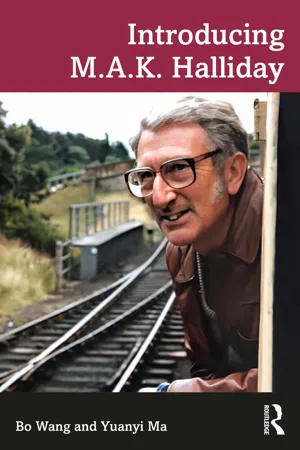
In this section, we first present a short biography of M.A.K. Halliday by describing his life as a linguist, introducing his family background, how he began to study linguistics, and his motivation for doing research. Then we introduce two of Halliday’s teachers, i.e. Wang Li and J.R. Firth, who significantly influenced and shaped his career in important ways. Further, we discuss Marxism’s influence on Halliday. In terms of Halliday’s influence on various Systemic Functional Linguists, we find the topic too vast to be pursued here; thus, we choose to narrow down the topic and focus on Halliday’s influence on Christian M.I.M.Matthiessen – one of Halliday’s closest friends and a long-time collaborator since the 1980s. Finally, we briefly discuss the relationship between Halliday’s Systemic Functional Linguistics (SFL) and some other approaches to language, especially some of the functional approaches, highlighting the influence of Halliday on a family of unification grammars. In this section, we first present a short biography of M.A.K. Halliday by describing his life as a linguist, introducing his family background, how he began to study linguistics, and his motivation for doing research. Then we introduce two of Halliday’s teachers, i.e. Wang Li and J.R. Firth, who had significant influence on Halliday and shaped his career in important ways. Further, we discuss Marxism’s influence on Halliday. In terms of Halliday’s influence on various systemic functional linguists, we find the topic too vast to be pursued here; thus, we choose to narrow down the topic and focus on Halliday’s influence on Christian M.I.M. Matthiessen – one of Halliday’s closest friends and a long-time collaborator since the 1980s. Finally, we briefly discuss the relationship between Halliday’s Systemic Functional Linguistics (SFL) and some other approaches to language, especially some of the functional approaches, highlighting the influence of Halliday on a family of unification grammars.
Who is M.A.K. Halliday?
Michael Alexander Kirkwood Halliday was born in Leeds, Yorkshire, England on Easter Monday 13 April, 1925. He was the only child of two teachers (see Williams & Lukin 2001; O’Donnell n.d.). His father – Wilfrid Joseph Halliday taught English and Latin at the secondary level at Pudsey Grammar School. In addition to being a teacher, Michael Halliday’s father had an “equal love for grammar and for Elizabethan drama, and [was] also a dialectologist and dialect poet” (Halliday 2002a: 117).1 Michael Halliday’s mother – Winifred – taught French at Pudsey Grammar School. After she left her job upon getting married, she was also involved in language teaching in various ways, such as teaching French at the University of Leeds during World War II.
The young Michael Halliday was called “Mick” early in his life and he changed it to “Michael” later. From his boyhood, he grew up with two passions: (i) China and (ii) language (Webster 2005, 2015). For the first passion, while he was at the age of 4, he even wrote a story about how a little boy went to China. And for the second passion, he pursued it throughout his life as a linguist and a grammarian.
At the age of 4, Halliday went to West Leeds Elementary School. When he was 13, he was enrolled in Rugby School – one of the leading boarding schools in the UK. In a local newspaper, Halliday was honored as the “youngest boy to win the scholarship to Rugby” (O’Donnell n.d.: 5). However, Rugby School paid special attention to classical languages, and Halliday felt on the one hand that he was trapped in a system that was so over-specialized in nothing but classics (Kress, Hasan & Martin 1992). On the other hand, Halliday enjoyed studying modern languages, but he did not like the way languages were taught, as he discussed in an interview (Kress, Hasan & Martin 1992: 176–177 original emphasis):
The English part was literature, and I enjoyed it very much – except when the teachers started telling me something about the language in literature. What they said made no contact with what was actually there. And this worried me…
… I felt that literature was made of language so it ought to be possible to talk about that language. After all, my father was an English teacher and a grammarian, so I knew from him that there were ways of talking about language.
Halliday thought what his teachers said about the language of literature made no sense, so he searched in the library and discovered a subject called “linguistics” as well as a book about language, i.e. Leonard Bloomfield’s (1933) Language. But the book seemed difficult for him at that time, so he did not understand Bloomfield (Halliday 2002a).
In early 1942, Halliday volunteered for studying the foreign language course for the armed services. The course was initiated by J.R. Firth, with a purpose of training more servicemen to speak Asian languages. Halliday passed a test that included two parts: (i) a language aptitude test that involved the decoding of made-up languages and (ii) a memory test focused on the four languages offered (i.e. Chinese, Japanese, Turkish, and Persian), e.g. to repeat an increasingly long list of monosyllables with various tones. Then, shortly after his seventeenth birthday, Halliday had his first lesson in Chinese given by Dr. Walter Simon. As a learner, Halliday was often puzzled by the grammar of Chinese. He wanted some explanations on what could be said and what could not be said.
After the training, Halliday joined the services and did counterintelligence work for the Chinese Intelligence Unit in Calcutta. In 1945, the war against the Japanese continued and more servicemen were needed, so Michael Halliday was pulled back to London to teach Chinese to the new recruits (see e.g. Halliday [2014a] for his reflections on teaching Chinese to foreign learners). According to his recollection, he began his teaching on May 13, 1945 and then he began to gradually discover something about linguistics.
In 1947, Michael Halliday finished his military service. He decided to go to China to study Chinese. When he arrived at Peking and met Hu Shih (胡适) – the president of Peking University, Hu Shih said to him: “Good. You start teaching next week in our English Department.” Through teaching at Peking University, Michael Halliday earned his living and gained more experience as a language teacher. He reflected on this in an interview (Kress, Hasan & Martin 1992: 181):
I’d never taught any English before; but they were very desperate for speakers of English because, of course, English had been totally banned under the Japanese occupation and most of their students were pretty well beginners. So, in 1947, at the beginning of classes, I enrolled as a student in Peking University, in the Chinese Department, and began teaching English in the English Department. And in the Chinese Department I went to everything that I could find – literature, classical Chinese and all – still not knowing what I wanted to do afterwards …
For his studies in China, Halliday planned to further extend his external BA degree, having already completed the first-year exam in London. Yet he still needed to pass an additional exam. Halliday then went to read everything he could find – literature and classical Chinese, but he still did not know what he wanted to study afterwards (Kress, Hasan & Martin 1992). After staying for one year at Peking University, Halliday flew to Nanking to take part in the exam organized for him by the British Council in June 1948. The exam was “a combination of language of literature – including History of Chinese Literature from the year 500 BC to the present day” (Kress, Hasan & Martin 1992: 182). In the exam paper, there was a question that required him to write about an author of his choice. Halliday had already prepared for that question very well after spending a whole day with Cao Yu (曹禺) (1910–1996) in Shanghai, who was an important Chinese playwright famous for his plays titled Thunderstorm, Sunrise, The Wilderness, and Peking Man.
After completing his undergraduate studies, Halliday stayed on in China, working as a volunteer for the Chinese Industrial Cooperatives (CIC) – a Western-supported movement aimed to help the Chinese fight against Japanese imperialism. After several months, Halliday successfully obtained a Scarborough Scholarship for Advanced Study and Research, which could support him to continue his postgraduate study in China. He was then once again enrolled at Peking University and was assigned to study Chinese phonology, lexicography, and comparative historical linguistics with Professor Luo Changpei (罗常培) (see also Hasan & Martin 1989). However, Luo’s research area was the diachronic studies of language, and Halliday was more interested in synchronic studies; thus Luo recommended Halliday to Professor Wang Li (王力) who was working at Lingnan University in Canton at the time. With Wang Li, Halliday conducted research on dialects spoken in the Pearl River Delta. Halliday benefited from the research method that Wang Li taught him and was heavily influenced by Wang Li (see entry on influence from Wang Li).
Two years later, Halliday obtained his MA degree from Lingnan University.2 It was also in this period that Halliday had read extensively, pursuing his interest in sociolinguistics and grammar and becoming familiar with the Prague School and the Marr School of Linguistics in Soviet Russia. He was meanwhile acquainted with Firth’s (e.g., 1950) ideas on language in society. He was looking forward to going back to the UK and to studying further with Firth (see entry on influence from J.R. Firth).
When Halliday was back to England in 1950, he originally planned to study under Firth’s supervision and to teach at the School of Oriental and African Studies (SOAS). However, due to the prevailing McCarthyism at the time, he was asked to make the commitment that he would not become a member of the Communist party in the future. He refused and did not get the offer. Eventually, he was admitted to Cambridge University as a PhD student to be supervised by Professor Gustav Haloun. Halliday tried to conduct a study on the grammar of the dialects based on the data he collected in ...