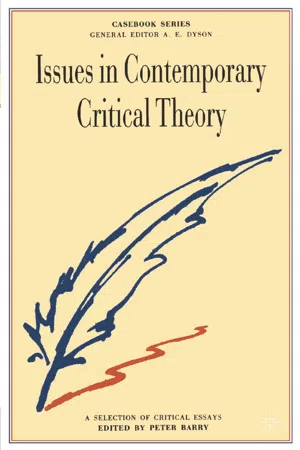
General Editor's Preface.- Introduction.- PART 1 EARLY MODERN VIEWPOINTS: CRITICAL BACKGROUND TO CONTEMPORARY DEBATES.- PART 2 THE MAJOR ISSUES IN CONTEMPORARY DEBATES.- Is Theory Necessary ? (Empiricism vs Theoreticism).- What Does the Literary Work Represent'.- Is Literature Language? (The Claims of Stylistics).- What is Deconstruction'.- What is the Reader's Place'.- PART 3 THE NEW THEORIES IN PRACTICE.- Fiction Poetry Drama.- Select Bibliography.- Notes on Contributors.- Acknowledgements.- Index.
- 193 pages
- English
- ePUB (mobile friendly)
- Available on iOS & Android
eBook - ePub
About this book
Information
PART ONE
Early Modern Viewpoints: The Critical Background to Contemporary Debates
T. S. Eliot (1919)
‘The Impersonality of Poetry’
… What happens [to the poet in the act of poetic composition] is a continual surrender of himself as he is at the moment to something which is more valuable. The progress of an artist is a continual self-sacrifice, a continual extinction of personality. … the mind of the mature poet differs from that of the immature one … by being a more finely perfectly medium in which special, or very varied, feelings are at liberty to enter into new combinations. … The mind of the poet … may partly or exclusively operate upon the experience of the man himself; but, the more perfect the artist, the more completely separate in him will be the man who suffers, and the mind which creates; the more perfectly will the mind digest and transmute the passions which are its material. … My meaning is, that the poet has, not a ‘personality’ to express, but a particular medium, which is only a medium and not a personality, in which impressions and experiences combine in peculiar and unexpected ways. Impressions and experiences which are important for the man may take no place in the poetry, and those which become important in the poetry may play quite a negligible part in the man, the personality. … It is not in his personal emotions, the emotions provoked by particular events in his life, that the poet is in any way remarkable or interesting. His particular emotions may be simple, or crude, or flat. The emotion in his poetry will be a very complex thing, but not with the complexity of the emotions of people who have very complex or unusual emotions in life. … The business of the poet is not to find new emotions, but to use the ordinary ones and, in working them up into poetry, to express feelings which are not in actual emotions at all. … There are many people who appreciate the expression of sincere emotion in verse, and there is a smaller number of people who can appreciate technical excellence. But very few know when there is an expression of significant emotion, emotion which has its life in the poem and not in the history of the poet. The emotion of art is impersonal. And the poet cannot reach this impersonality without surrendering himself wholly to the work to be done ….
SOURCE: extracts from ‘Tradition and the Individual Talent’ (1919); reprinted in Selected Essays (London, 1932; 3rd edition 1951), excerpted from pp. 17–22.
L. C. Knights (1933)
‘Literature as Complex Language rather than Plot, Character and Theme’
… In the mass of Shakespeare criticism there is not a hint that ‘character’ – like ‘plot’, ‘rhythm’, ‘construction’ and all our other critical counters – is merely an abstraction from the total response in the mind of the reader or spectator, brought into being by written or spoken words; that the critic therefore – however far he may ultimately range – begins with the words of which a play is composed. This applies equally to the novel or any other form of art that uses language as its medium. ‘A Note on Fiction’ by Mr C. H. Rickword in The Calendar of Modern Letters expresses the point admirably with regard to the novel: ‘The form of a novel only exists as a balance of response on the part of the reader. Hence schematic plot is a construction of the reader’s that corresponds to an aspect of the response and stands in merely diagrammatic relation to the source. Only as precipitates from the memory are plot or character tangible; yet only in solution have either any emotive valency.’1
A Shakespeare play is a dramatic poem. It uses action, gesture, formal grouping and symbols, and it relies upon the general conventions governing Elizabethan plays. But, we cannot too often remind ourselves, its end is to communicate a rich and controlled experience by means of words – words used in a way to which, without some training, we are no longer accustomed to respond. To stress in the conventional way character or plot or any of the other abstractions that can be made, is to impoverish the total response. ‘It is in the total situation rather than in the wrigglings of individual emotion that the tragedy lies.’2 ‘We should not look for perfect verisimilitude to life’, says Mr Wilson Knight, ‘but rather see each play as an expanded metaphor, by means of which the original vision has been projected into forms roughly correspondent with actuality, conforming thereto with greater or less exactitude according to the demands of its nature. … The persons, ultimately, are not human at all, but purely symbols of a poetic vision.’3…
Since everyone who has written about Shakespeare probably imagines that he has ‘treated him primarily as a poet’, some explanation is called for. How should we read Shakespeare?
We start with so many lines of verse on a printed page which we read as we should read any other poem. We have to elucidate the meaning (using Dr Richards’s fourfold definition4) and to unravel ambiguities; we have to estimate the kind and quality of the imagery and determine the precise degree of evocation of particular figures; we have to allow full weight to each word, exploring its ‘tentacular roots’, and to determine how it controls and is controlled by the rhythmic movement of the passage in which it occurs. In short, we have to decide exactly why the lines ‘are so and not otherwise’.
As we read other factors come into play. The lines have a cumulative effect. ‘Plot’, aspects of ‘character’ and recurrent ‘themes’ – all ‘precipitates from the memory’ – help to determine our reaction at a given point. There is a constant reference backwards and forwards. But the work of detailed analysis continues to the last line of the last act. If the razor-edge of sensibility is blunted at any point we cannot claim to have read what Shakespeare wrote, however often our eyes may have travelled over the page. A play of Shakespeare’s is a precise particular experience, a poem – and precision and particularity are exactly what is lacking in the greater part of Shakespeare criticism, criticism that deals with Hamlet or Othello in terms of abstractions that have nothing to do with the unique arrangement of words that constitutes these plays ….
SOURCE: extracts from How Many Children Had Lady Macbeth?: An Essay in the Theory and Practice of Shakespeare Criticism (Cambridge, 1933); reprinted in ‘Hamlet’ and Other Essays (Cambridge, 1979), pp. 273–4 & 285–6.
NOTES
[Reorganised and renumbered from the original – Ed.]
1. [Ed.] Rickword edited the Calendar, a forerunner of Leavis’s Scrutiny, in the 1920s. His point is that plot and character are retrospective constructs in the reader’s mind, rather than part of the text itself: or, in the terms of a later critic, Wolfgang Iser, they are part of the ‘configurative meaning’ which is produced when ‘we reduce the polysemantic possibilities [of a text] to a single interpretation’. See section 5 of Part Two, below.
2. M. C. Bradbrook, Elizabethan Stage Conditions (1932), p. 102.
3. G. Wilson Knight, The Wheel of Fire (1930), p. 16.
4. [Ed.] The critic I. A. Richards defined meaning as comprising Sense, Feeling, Tone and Intention, these being, respectively, the thing to be communicated, the writer’s attitude towards it, the writer’s attitude towards the audience, and the effect the writer wishes to communicate.
F. R. Leavis (1937)
‘The Distinction between Literary Criticism and Philosophy’
[Leavis is here replying to an essay by the Czech-American critic René Wellek, who had argued the need for literary critics to spell out their principles of interpretation in a way which would meet philosophical criteria – Ed.] … Literary criticism and philosophy seem to me to be quite distinct and different kinds of discipline – at least, I think they ought to be. … I should not find it easy to define the difference satisfactorily, but Dr Wellek knows what it is and could give at least as good an account of it as I could. Philosophy, we say, is ‘abstract’ (thus Dr Wellek asks me to defend my position ‘more abstractly’), and poety ‘concrete’. Words in poetry invite us, not to ‘think about’ and judge but to ‘feel into’ or ‘become’ – to realise a complex experience that is given in the words. They demand, not merely a fuller-bodied response, but a completer responsiveness – a kind of responsiveness that is incompatible with the judicial, one-eye-on-the-standard approach suggested by Dr Wellek’s phrase: ‘your “norm” with which you measure every poet.’ The critic – the reader of poetry – is indeed concerned with evaluation, but to figure him as measuring with a norm which he brings up to the object and applies from the outside is to misrepresent the process. The critic’s aim is, first, to realise as sensitively and completely as possible this or that which claims his attention; and a certain valuing is implicit in the realising. … It would be reasonable to fear – to fear blunting of edge, blurring of focus and muddled misdirection of attention: consequences of queering one discipline with the habits of another. The business of the literary critic is to attain a peculiar completeness of response and to observe a peculiarly strict relevance in developing his response into commentary; he must be on his guard against abstracting improperly from what is in front of him and against any premature or irrelevant generalising – of it or from it. His first concern is to enter into possession of the given poem (let us say) in its concrete fulness, and his constant concern is never to lose his completeness of possession, but rather to increase it.…
From this consistency and this coherence (in so far as I have achieved them) it should, of course, be possible to elicit principles and abstractly formulable norms. … I think I have gone as far in explicitness as I could profitably attempt to go, and that I do not see what would be gained by the kind of explicitness [Wellek] demands. … If, as I did, I avoided such generalities, it was not out of timidity; it was because they seemed too clumsy to be of any use. I thought I had provided something better. My whole effort was to work in terms of concrete judgements and particular analyses: ‘This – doesn’t it? – bears such a relation to that; this kind of thing – don’t you find it so? – wears better than that,’ etc ….
SOURCE: extracts from ‘Literary Criticism and Philosophy: A Reply’, Scrutiny (June 1937), vol. 6, excerpted from pp. 60–3.
W. K. Wimsatt & Monroe C. Beardsley (1946)
‘Authorial Intention and the Distinction between Internal (textual) and External (biographical) Evidence’
… The meaning of a poem may certainly be a personal one, in the sense that a poem expresses a personality or state of soul rather than a physical object like an apple. But even a short lyric poem is dramatic, the response of a speaker (no matter how abstractly conceived) to a situation (no matter how universalised). We ought to impute the thoughts and attitudes of the poem immediately to the dramatic speaker, and if to the author at all, only by an act of biographical inference ….
There is a difference between internal and external evidence for the meaning of a poem. And the paradox is only verbal and superficial that what is (1) internal is also public: it is discovered through the semantics and syntax of a poem, through our habitual knowledge of the language, through grammars, dictionaries and all the literature which is the source of dictionaries, in general through all that makes a language and culture; while what is (2) external is private or idiosyncratic; not a part of the work as a linguistic fact: it consists of revelations (in journals, for example, or letters or reported conversations) about how or why the poet wrote the poem – to what lady, while sitting on what lawn, or at the death of what friend or brother. There is (3) an intermediate kind of evidence about the character of the author or about private or semi-private meanings attached to words or topics by an author or by a coterie of which he is a member. The meaning of words is the history of words, and the biography of an author, his use of a word and the associations which the word had for him, are part of the word’s history and meaning. But the three types of evidence, especially (2) and (3), shade into one another so subtly that it is not always easy to draw a line between examples, and hence arises the difficulty for criticism. The use of biographical evidence need not involve intentionalism, because while it may be evidence of what the author intended, it may also be evidence of the meaning of his words and the dramatic character of his utterance. On the other hand, it may not be all this. And a critic who is concerned with evidence of type (1) and moderately with that of type (3) will in the long run produce a different sort of comment from that of the critic who is concerned (2) and with (3) where it shades into (2).…
SOURCE: extract from ‘The Intentional Fallacy’ (1946); reproduced in Wimsatt’s The Verbal Icon: Studies in the Meaning of Poetry (Lexington and London, 1954, 1967), pp. 5 & 10–11.
F. R. Leavis (1953)
‘The Separation between a Poem and its Social Context’
[Leavis is here replying to an essay by the critic F. W. Bateson, who had argued the relevance of ‘social context’ to the interpretation of poetry – Ed.] … He starts from the commonplace observation that a poem is in some way related to the world in which it was written. He arrives by a jump (at least, his arrival there is not by any steps of sober reasoning) at the assumption that the way to achieve the correct reading of a poem – of, say, Marvell’s or Pope’s – is to put it back in its ‘total context’ in that world. No idea of such an undertaking troubles the reader whose attention is really and intelligently focussed upon the poem, and if the undertaking were proposed to him he would see its absurdity at once. He would see that it was gratuitous, and worse; and at the same time he would see that any achievement corresponding to it is impossible – that the aim, in fact, is illusory. What is this ‘complex of religious, political and economic factors that can be called the social context’, and the reconstruction of which enables us (according to Mr Bateson) to achieve the ‘correct reading’, ‘the object as in itself it really is, since it is the product of progressive corrections at each stage of the contextual series’. How does one set to work to arrive at this final inclusive context, the establishment of which puts the poem back in ‘its original historical setting’, so that ‘the human experience in it begins to be realised and re-enacted by the reader’? Mr Bateson doesn’t tell us, and doesn’t begin to consider the problem. He merely follows up those plainly false assertions about the passage of Marvell and Pope with some random notes from his historical reading.
That is all he could do. And all he could do more would be to go on doing that more voluminously and industriously. For the total ‘social context’ that he postulates is an illusion. And so it would have been, even if he had started by reading the poem. But he would then – at least, if he had really read the poem, and kept himself focussed upon that – have seen that in the poem, whatever minor difficulties of convention and language it might present, he had something determinate – something indubitably there. But ‘context’, as something determinate, is, and can be, nothing but his postulate; the wider he goes in his ambition to construct it from his readings in the period, the more is it his construction (...
Table of contents
- Cover
- Title Page
- Copyright
- Contents
- General Editor’s Preface
- Introduction
- Part One: Early Modern Viewpoints – The Critical Background to Contemporary Debates
- Part Two: Major Issues in Contemporary Debates
- Part Three: New Theories in Practice
- Select Bibliography
- Notes on Contributors
- Acknowledgements
- Index
Trusted by 375,005 students
Access to over 1.5 million titles for a fair monthly price.
Study more efficiently using our study tools.
Frequently asked questions
Yes, you can cancel anytime from the Subscription tab in your account settings on the Perlego website. Your subscription will stay active until the end of your current billing period. Learn how to cancel your subscription
No, books cannot be downloaded as external files, such as PDFs, for use outside of Perlego. However, you can download books within the Perlego app for offline reading on mobile or tablet. Learn how to download books offline
Perlego offers two plans: Essential and Complete
- Essential is ideal for learners and professionals who enjoy exploring a wide range of subjects. Access the Essential Library with 800,000+ trusted titles and best-sellers across business, personal growth, and the humanities. Includes unlimited reading time and Standard Read Aloud voice.
- Complete: Perfect for advanced learners and researchers needing full, unrestricted access. Unlock 1.5M+ books across hundreds of subjects, including academic and specialized titles. The Complete Plan also includes advanced features like Premium Read Aloud and Research Assistant.
We are an online textbook subscription service, where you can get access to an entire online library for less than the price of a single book per month. With over 1.5 million books across 990+ topics, we’ve got you covered! Learn about our mission
Look out for the read-aloud symbol on your next book to see if you can listen to it. The read-aloud tool reads text aloud for you, highlighting the text as it is being read. You can pause it, speed it up and slow it down. Learn more about Read Aloud
Yes! You can use the Perlego app on both iOS and Android devices to read anytime, anywhere — even offline. Perfect for commutes or when you’re on the go.
Please note we cannot support devices running on iOS 13 and Android 7 or earlier. Learn more about using the app
Please note we cannot support devices running on iOS 13 and Android 7 or earlier. Learn more about using the app
Yes, you can access Issues in Contemporary Critical Theory by Peter Barry in PDF and/or ePUB format, as well as other popular books in Literature & Literary Criticism Theory. We have over 1.5 million books available in our catalogue for you to explore.