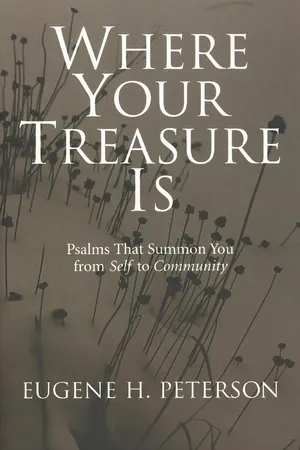
This is a bold book. It has to do with changing the life of American society, from the inside out, through "source action" of prayer. "I have written a book for Christians, " says Eugene Peterson, "who want to do something about what is wrong with America and want to plunge into the center, not tinker at the edge. I have chosen eleven psalms that shaped the politics of Israel and can shape the politics of America, and I have taken them seriously...I have written to encourage Christians to pray them both as children of God with eternal destinies and as American citizens with daily responsibilities in caring for our nation." Peterson is concerned with the "unselfing" of our self-preoccupied, self-bound society through the action of praying together with other believers. He offers insightful, thought-provoking reflections on eleven select psalm-prayers that can help us overcome such things as self-centeredness, self-assertiveness, self-righteousness, self-sufficiency, self-pity, self-service, and self-love. Originally published under the title Earth and Altar and now being reprinted for wider distribution, Where Your Treasure Is provides solid fare for any thoughtful, concerned Christian. But the book is especially suitable for group study and discussion: what Peterson writes here will serve to stir small groups of Christians to pointed reflection and prayer-action.
- 190 pages
- English
- ePUB (mobile friendly)
- Available on iOS & Android
eBook - ePub
About this book
Information
Topic
Theology & ReligionSubtopic
Religion1. The Unselfing of America
PSALM 2
Why do the nations conspire,
and the peoples plot in vain?
The kings of the earth set themselves,
and the rulers take counsel together,
against the LORD and his anointed, saying,
“Let us burst their bonds asunder,
and cast their cords from us.”
He who sits in the heavens laughs;
the LORD has them in derision.
Then he will speak to them in his wrath,
and terrify them in his fury, saying,
“I have set my king
on Zion, my holy hill.”
I will tell of the decree of the LORD:
He said to me, “You are my son,
today I have begotten you.
Ask of me, and I will make the nations your heritage,
and the ends of the earth your possession.
You shall break them with a rod of iron,
and dash them in pieces like a potter’s vessel.”
Now therefore, O kings, be wise;
be warned, O rulers of the earth.
Serve the LORD with fear,
with trembling kiss his feet,
lest he be angry, and you perish in the way;
for his wrath is quickly kindled.
Blessed are all who take refuge in him.
My experience and observations have taught me to recognize in this degeneration into the All-Self the opponent of mankind, steadily increasing in might during the epochs of history, but especially in our time. It is none other than the spirit itself, cut off, that commits the sin against the holy spirit.
On the “ribbon of highway” that stretches “from California to the New York island” — the great American Main Street — the mass of people seem completely self-absorbed. One hundred and fifty years ago Alexis de Tocqueville visited America from France and wrote: “Each citizen is habitually engaged in the contemplation of a very puny object, namely himself.”2 In a century and a half things have not improved. For all the diverse and attractive, buzzing and mysterious reality that is everywhere evident, no one and no thing interrupt people more than momentarily from obsessive preoccupation with themselves.
America is in conspicuous need of unselfing. Concerned observers using the diagnostic disciplines of psychology, sociology, economics, and theology lay the blame for the deterioration of our public life and the disintegration of our personal lives at the door of the self: we have a self problem and that problem is responsible for everything else that is going wrong.
A few people carry Ban-the-Bomb placards to try to wake up the masses to the danger in which a century of mindless selfishness has delivered us. Desperately they try to avert the destruction of the earth by protesting the insanities of militarism, greedy and reckless practices that ravage our streams and forests and air, and bloated consumerism that leaves much of the world hungry and poor. Others hand out Repent-or-Perish tracts in an attempt to startle the shuffling crowds into dealing with their souls, not just their selves. They urgently call attention to the eternal value of the soul, present the authoritative words of Scripture that tell us who we are and what we were made for, and ask the big question, “Are you saved?” Both groups attract occasional flurries of attention, but not for long. The two groups, while they both care, don’t seem to care much for each other. If they talk to each other at all, it is in contempt. One group wants to save society, the other to save souls, but they recognize no common ground. From time to time other solutions are offered: psychologists propose a therapy, educators install a new curriculum, economists plan legislation, sociologists imagine new models for community. Think tanks hum. Ideas proliferate. Some of them get tried. Nothing seems to work for very long.
In Alexander Solzhenitsyn’s extensively reported and now famous sermon to America, delivered in 1978 at Harvard University, he said, “We have placed too much hope in politics and social reforms, only to find out that we were being deprived of our most precious possession: our spiritual life. It is trampled by the party mob in the East, by the commercial one in the West.” We are, he thundered, at a “harsh spiritual crisis and a political impasse. All the celebrated technological achievements of progress, including the conquest of outer space, do not redeem the 20th century’s moral poverty.” We need a “spiritual blaze.”3
What the journalists did not report — not a single pundit so much as mentioned it — is that a significant number of people are actually doing something about Solzhenitsyn’s concern. I work with some of these people, encouraging and sometimes providing guidance. Thousands of pastor, priest, and lay colleagues are similarly engaged. They are doing far more for both society and the soul, tending and fueling the “spiritual blaze,” than anything that is being reported in the newspapers. The work is prayer.
Prayer, of course, has to do with God. God is both initiator and recipient of this underreported but extensively pursued activity. But prayer also has to do with much else: war and government, poverty and sentimentality, politics and economics, work and marriage. Everything, in fact. The striking diagnostic consensus of modern experts that we have a self problem is matched by an equally striking consensus among our wise ancestors on a strategy for action: the only way to get out of the cramped world of the ego and into the large world of God without denying or suppressing or mutilating the ego is through prayer. The only way to escape from self-annihilating and society-destroying egotism and into self-enhancing community is through prayer. Only in prayer can we escape the distortions and constrictions of the self and enter the truth and expansiveness of God. We find there, to our surprise, both self and society whole and blessed. It is the old business of losing your life to save it; and the life that is saved is not only your own, but everyone else’s as well.
The Source Action
Prayer is political action. Prayer is social energy. Prayer is public good. Far more of our nation’s life is shaped by prayer than is formed by legislation. That we have not collapsed into anarchy is due more to prayer than to the police. Prayer is a sustained and intricate act of patriotism in the largest sense of that word — far more precise and loving and preserving than any patriotism served up in slogans. That society continues to be livable and that hope continues to be resurgent are attributable to prayer far more than to business prosperity or a flourishing of the arts. The single most important action contributing to whatever health and strength there is in our land is prayer. Not the only thing, of course, for God uses all things to effect his sovereign will, and the “all things” most certainly includes police and artists, senators and professors, therapists and steelworkers. But prayer is, all the same, the source action.
The single most widespread American misunderstanding of prayer is that it is private. Strictly and biblically speaking, there is no private prayer. Private in its root meaning refers to theft. It is stealing. When we privatize prayer we embezzle the common currency that belongs to all. When we engage in prayer without any desire for or awareness of the comprehensive, inclusive life of the kingdom that is “at hand” in both space and time, we impoverish the social reality that God is bringing to completion.
Solitude in prayer is not privacy. The differences between privacy and solitude are profound. Privacy is our attempt to insulate the self from interference; solitude leaves the company of others for a time in order to listen to them more deeply, be aware of them, serve them. Privacy is getting away from others so that I don’t have to be bothered with them; solitude is getting away from the crowd so that I can be instructed by the still, small voice of God, who is enthroned on the praises of the multitudes. Private prayers are selfish and thin; prayer in solitude enrolls in a multivoiced, century-layered community: with angels and archangels in all the company of heaven we sing, “Holy, Holy, Holy, Lord God Almighty.”
We can no more have a private prayer than we can have a private language. A private language is impossible. Every word spoken carries with it a long history of development in complex communities of experience. All speech is relational, making a community of speakers and listeners. So too is prayer. Prayer is language used in the vast contextual awareness that God speaks and listens. We are involved, whether we will it or not, in a community of the Word — spoken and read, understood and obeyed (or misunderstood and disobeyed). We can do this in solitude, but we cannot do it in private. It involves an Other and others.
The self is only itself, healthy and whole, when it is in relationship, and that relationship is always dual, with God and with other human beings. Relationship implies mutuality, give and take, listening and responding. “I wonder,” wrote Baron Friedrich von Hügel to his niece when she was learning to pray, “whether you realize a deep, great fact? That souls — all human souls — are deeply interconnected. That we can not only pray for each other, but suffer for each other? Nothing is more real than this interconnection — this gracious power put by God into the very heart of our infirmities.”4 If the self exploits other selves, whether God or neighbor, subordinating them to its compulsions, it becomes pinched and twisted. If the self abdicates creativity and interaction with other selves, whether God or neighbor, it becomes flaccid and bloated. So neither by taking charge nor by letting others take charge is the self itself, but by being in relationship. How do we develop that? How do we overcome our piratical rapaciousness on the one hand and our parasitic sloth on the other? How do we develop not only as Christians but as citizens? How else but in prayer? Many things — ideas, persons, projects, plans, books, committees — help and assist, but the “one thing needful” is prayer.
The School of Prayer
The best school for prayer continues to be the Psalms. It also turns out to be an immersion in politics. The people in the Psalms who teach us to pray were remarkably well integrated in these matters. No people have valued and cultivated the sense of the person so well. At the same time no people have had a richer understanding of themselves as a “nation under God.” Prayer was their characteristic society-shaping and soul-nurturing act. They prayed when they were together and they prayed when they were alone, and it was the same prayer in either setting. These prayers, the psalms, are terrifically personal; they are at the same time ardently political.
The word politics, in common usage, means “what politicians do” in matters of government and public affairs. The word often carries undertones of displeasure and disapproval because the field offers wide scope for the use of power over others, which power is often abused. Politics is smudged with greasy adjectives: ruthless, corrupt, ambitious, power-hungry, unscrupulous. But the word cannot be abandoned just because it is dirtied. It derives from the Greek word polis (“city”). It represents everything that people do as they live with some intention in community, as they work toward some common purpose, as they carry out responsibilities for the way society develops. Biblically, it is the setting in which God’s work with everything and everyone comes to completion (Rev. 21). He began his work with a couple in a garden; he completes it with vast multitudes in a city.
For Christians, “political” acquires extensive biblical associations and dimensions. So rather than look for another word untainted by corruption and evil, it is important to use it just as it is so that by it we are trained to see God in the places that seem intransigent to grace. The people who warn that “religion and politics don’t mix” certainly know what they are talking about. The mix has resulted in no end of ills — crusades, inquisitions, witch hunts, exploitation. All the same, God says, “Mix them.” But be very careful how you mix them. The only safe way is in prayer. It is both unbiblical and unreal to divide life into the activities of religion and politics, or into the realms of sacred and profane. But how do we get them together without putting one into the unscrupulous hands of the other, politics using religion or religion using politics, when what we want is a true mixture, politics becoming religious and religion becoming political? Prayer is the only means that is adequate for the great end of getting these polarities in dynamic relation. The psalms are our most extensive source documents showing prayer in action.
The Psalms are an edited book. One hundred and fifty prayers are collected and arranged to guide and shape our responses to God accurately, deeply, and comprehensively. Everything that it is possible to feel and experience in relation to God’s creative and redeeming word in us — John Calvin called the psalms “an anatomy of all the parts of the soul”5 — is voiced in these prayers. Two psalms are carefully set as an introduction: Psalm 1 is a laser concentration on the person; Psalm 2 is a wide-angle lens on politics. God deals with us personally, but at the same time he has public ways that intersect the lives of nations, rulers, kings, and governments. The two psalms are together by design, a binocular introduction to the life of prayer, an initiation into the responses that we make to the word of God personally (“blessed is the man,” 1:1) ...
Table of contents
- Cover
- Title Page
- Copyright
- Dedication
- Contents
- Preface
- 1. The Unselfing of America—Psalm 2
- 2. Unself-Made—Psalm 87
- 3. Unself-Centered—Psalm 110
- 4. Unself-Government—Psalm 93
- 5. Unself-Help—Psalm 46
- 6. Unself-Assertion—Psalm 62
- 7. Unself-Pity—Psalm 77
- 8. Unself-Righteous—Psalm 14
- 9. Unself-Serving—Psalm 82
- 10. Unself-Sufficient—Psalm 114
- 11. Unself-Love—Psalm 45
Trusted by 375,005 students
Access to over 1.5 million titles for a fair monthly price.
Study more efficiently using our study tools.
Frequently asked questions
Yes, you can cancel anytime from the Subscription tab in your account settings on the Perlego website. Your subscription will stay active until the end of your current billing period. Learn how to cancel your subscription
No, books cannot be downloaded as external files, such as PDFs, for use outside of Perlego. However, you can download books within the Perlego app for offline reading on mobile or tablet. Learn how to download books offline
Perlego offers two plans: Essential and Complete
- Essential is ideal for learners and professionals who enjoy exploring a wide range of subjects. Access the Essential Library with 800,000+ trusted titles and best-sellers across business, personal growth, and the humanities. Includes unlimited reading time and Standard Read Aloud voice.
- Complete: Perfect for advanced learners and researchers needing full, unrestricted access. Unlock 1.5M+ books across hundreds of subjects, including academic and specialized titles. The Complete Plan also includes advanced features like Premium Read Aloud and Research Assistant.
We are an online textbook subscription service, where you can get access to an entire online library for less than the price of a single book per month. With over 1.5 million books across 990+ topics, we’ve got you covered! Learn about our mission
Look out for the read-aloud symbol on your next book to see if you can listen to it. The read-aloud tool reads text aloud for you, highlighting the text as it is being read. You can pause it, speed it up and slow it down. Learn more about Read Aloud
Yes! You can use the Perlego app on both iOS and Android devices to read anytime, anywhere — even offline. Perfect for commutes or when you’re on the go.
Please note we cannot support devices running on iOS 13 and Android 7 or earlier. Learn more about using the app
Please note we cannot support devices running on iOS 13 and Android 7 or earlier. Learn more about using the app
Yes, you can access Where Your Treasure Is by Eugene H. Peterson in PDF and/or ePUB format, as well as other popular books in Theology & Religion & Religion. We have over 1.5 million books available in our catalogue for you to explore.