Spiritual reading has fallen on bad times. Today, reading is largely a consumer activity, done for information that may fuel ambitions or careers -- and the faster the better.
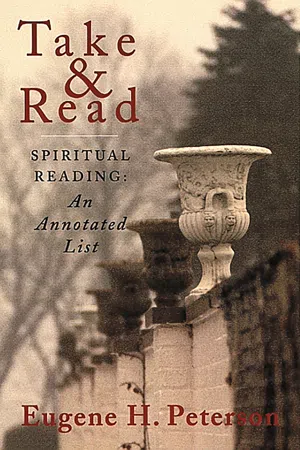
Take and Read represents Eugene H. Peterson's attempt to rekindle the activity of spiritual reading, reading that considers any book that comes to hand in a spiritual way, tuned to the Spirit, alert to intimations of God.
Take and Read provides an annotated list of the books that have stood the test of time and that, for Peterson, are spiritually formative in the Christian life. The books on this list range from standard spiritual classics to novels, poems, and mysteries, and include an equally broad spectrum of authors -- from Augustine and C. S. Lewis to William Faulkner and Fyodor Dostoyevsky. Annotations following each entry offer Peterson's own significant insights into the power of each work.
- 136 pages
- English
- ePUB (mobile friendly)
- Available on iOS & Android
eBook - ePub
About this book
Information
Topic
Theologie & ReligionSubtopic
ReligionXV
Commentaries
The first Bible that I chose for myself was a Scofield Reference Bible, purchased with my own money when I was thirteen years old. It was bound in Morocco leather and printed on fine India paper. It cost $10.95, a healthy sum in 1946. I had determined to get it when I heard an adult whom I respected say that this particular Bible was indispensable for understanding Scripture. My first chosen Bible was also my first commentary on the Bible.
Ten years later I rejected, with more vehemence than was probably necessary, nearly everything that Scofield had written in his notes on the scriptural text. I resented the intrusion of his headings and outlines. But however thoroughly I came to quarrel with the man, I do not quarrel with his gift to me of a lifelong love of commentaries.
I read commentaries the way some people read novels, from beginning to end, skipping nothing. I admit that they are weak in plot and character development, but their devout attention to words and syntax keeps me turning the pages. Plot and character — the plot of salvation, the character of Messiah — are everywhere implicit in a commentary and persistently assert their presence even when unmentioned through scores, even hundreds, of pages. The power of these ancient nouns and verbs century after century to call forth intelligent discourse from learned men and women continues to be a staggering wonder to me.
Among those for whom Scripture is a passion, reading commentaries has always seemed to me analogous to the gathering of football fans in the local bar, replaying in endless detail the game they have just watched, arguing (maybe even fighting) over observations and opinion, and lacing the discourse with gossip about the players. The level of knowledge evident in these boozy colloquies is impressive. These fans have watched the game for years; the players are household names to them; they know the fine print in the rulebook and pick up every nuance on the field. And they care immensely about what happens in the game. Their seemingly endless commentary is evidence of how much they care. Like them, I relish in a commentary not bare information but conversation with knowledgeable and experienced friends, probing, observing, questioning the biblical text. Absorbed by this plot that stretches grandly from Genesis to Revelation, captured by the messianic presence that in death and resurrection saves us one and all, there is much to notice, much to talk over.
1. George Adam Smith, ISAIAH, 2 volumes (1889). George Adam Smith was pastor of Queen’s Cross Free Church in Aberdeen (Scotland) when he wrote his Isaiah. While there, he integrated a powerful preaching ministry with pastoral work and academic pioneering. These were the days of the new criticism in biblical studies that regularly polarized the church into an obscurantist pietism on the one hand, and an arrogant intellectualism on the other. But Smith demonstrated that polarization was not inevitable. In that context, this commentary is a brilliant achievement, fiercely honest intellectually, and passionately evangelical spiritually.
2. William Temple, READINGS IN ST. JOHN’S GOSPEL (1959). As a bishop in the Church of England, William Temple took his diocesan clergy on retreat once a year and nurtured them with readings and commentary from John’s Gospel. Temple was a fine theologian and a true pastor; this book exhibits the accurate integration of learning and praying that took place in his life. Informality, simplicity, and profundity all come together here.
3. Gerhard von Rad, GENESIS, translated by John Marks (1961). I met Gerhard von Rad only once, and that briefly. I was a guest at “The Symposium,” a book club in Princeton that conducted a monthly dinner meeting at the old Princeton Inn. That evening, von Rad, on a visit from Germany, was also a guest, invited by his longtime friend, Professor Otto Piper. Piper introduced von Rad and asked him to say a few words. The room was dimly lit, and I was about thirty feet away. He stood and spoke. I remember him as tall and craggy, an alpine figure. He talked for probably no more than two or three minutes, but the impression on me was powerful. There was no small talk, none of the pleasantries one comes to expect on such occasions. Without preamble, he started talking about Abraham. I don’t recall the content of his remarks but remember the repetition of “mystery,” “darkness,” “faith,” and “prayer.” As von Rad spoke from a shadowed part of that room, for a few moments Abraham was present for me in his person, a real presence out of the centuries, out of the shadows, the vibrations of faith, and the energies of prayer. Years earlier in seminary, my Hebrew professor had told me that German was the most important Semitic language, so I set out to learn it. Von Rad’s Der Heilige Krieg im alten Israel was the first book that I read all the way through in German. In the process, Hebrew and German became fused for me in the person of von Rad. Now, looking at him and listening to him, all the complexities and difficulties of the two languages distilled into something distinctly spiritual, something Abrahamic, something mystic. When I arrived home after the Princeton meeting, the first thing I did was purchase von Rad’s commentary on Genesis. On page after page I found confirmation of my first impressions of the commentator: strong, spare, ascetic, mystic. In and behind the sinewy scholarship, I was conscious of urgency and faith. Lives were at stake here. Every sentence counted. Theology was wedded to philology. I learned later that the commentary had gotten its start many years earlier in 1944 when he expounded the book of Genesis daily to his fellow inmates at a prisoner of war camp in Bad Kreusnach. This was a book authenticated in adversity and pastoral care.
4. Austin Farrer, THE REVELATION (1964). I grew up in a church that read and interpreted Scripture with imagination. Learning was not greatly prized but imagination was given free rein. Education was, in fact, suspect, a compensation, I was told, for failure to believe in the power of God to be “his own interpreter” through the immediate outpouring of the Holy Spirit. But the telling of stories, the invention of allegories, the uncovering of the “deeper meanings” — these were held in high repute. When I, not heeding the warnings of my pious friends, went far away to be schooled in theology and the Scriptures, these valuations were reversed. Imagination was treated condescendingly; the rational and critical intelligence was honored. Unthinkingly, I accepted the thinking of my teachers. By the time I learned of the hermeneutic polarization in the early church between Antioch and Alexandria, I was firmly in the Antiochene camp, heaping abuse on the Alexandrines. The Antioch interpreters were sober, historically grounded, as meticulous with the text as a watchmaker. The Alexandria interpreters were wildly extravagant, bounding off the text like a gymnast off a trampoline. I was being carefully trained in criticism and grammar, learning to be responsible and rational before the biblical text. My position was confirmed by what I learned in church history as I discovered the havoc wrought among the faithful through the centuries by preachers and teachers whose feverish zeal used the Bible, as Ellen Goodman once said, as if it were a Rorschach test rather than a religious test, reading more into the ink than they read out of it. And then I came across the work of Austin Farrer and realized that there was still a case to be made for Alexandria. Imagination cannot be banished from the hermeneutical task. Poetry is a biblical mode. Story is a gospel genre. Farrer, Warden of Keble College, Oxford, and a scholar in New Testament and philosophy, was a disciplined thinker and knowledgeable exegete who was at the same time extravagantly imaginative. As I read Farrer on the Gospels and the Apocalypse, I found myself at home again in the colorful world of my childhood and youth, playful in the analogical, delighting in the anagogical, but with one large difference — this was an imagination informed by and submissively disciplined to every grammatical insight and historical datum available. In his commentary on the Revelation (1964), Farrer is at his best, wonderfully showing the “right brain” and “left brain” together in courteous discourse, the fierce Antiochene wolf and the playful Alexandrine lamb lying down in peace on the holy mountain.
5. Gordon Fee, 1 CORINTHIANS (1987). Textual criticism, the scrupulous study and exacting judgments that go into establishing the most accurate text possible for our Greek and Hebrew Scriptures, is sometimes supposed to be least “spiritual” of all scholarly pursuits, grimly stereotyped in Robert Browning’s Grammarian, “… in love with hoti, dead from the waist down.” The work is, after all, mostly a matter of collecting and arranging thousands of small bits of data — counting words and variants of words. But the stereotypical supposition shatters on the pages of this commentary. Whenever Professor Fee, eminent among the church’s textual critics, touches on a text-critical or exegetical matter, it characteristically springs to life — we see that words matter immensely, and why; it is impossible to give too much care to the minute and precise details of this biblical text. But there is far more here than an accumulation of precise notations; there is a passionate and wise entering into the life of the Spirit that created the Corinthian church and occasioned this letter. And this combination — exegetical precision and passionate spirituality — is rare indeed. The Corinthian letter, when read carelessly or ideologically, has caused much mischief in the church, splitting Christians into factions, exacerbating controversy. But under Professor Fee’s disciplined intelligence and exuberant spirit, the text comes into its own as God’s Word shaping a Christian life of wise and robust maturity.
6. F. Dale Bruner, THE CHRISTBOOK (1987) and THE CHURCHBOOK (1990). This is the kind of commentary I most want: a theological wrestling with Scripture. Bruner grapples with the text, not only as a technical exegete (although he also does that very well) but as a church theologian, caring passionately about what these words tell us about God and ourselves. Here he places his considerable teaching gifts at the service of the Christian community, caring as much about us as he cares about the text. His Matthew commentary is in the grand traditions of Augustine, Calvin, and Luther — expansive and leisurely, loving the text, the people in it, and the Christians who read it.
7. Gregory of Nyssa, THE SONG OF SONGS, translated and edited by Herbert Musurillo, S.J., in From Glory to Glory (1961). The Song of Songs may be the most commented upon book in our Scriptures, despite the omission of the name of God in its pages. The subject is love. Both Jews and Christians have found this text endlessly fascinating, inviting, and nurturing. The rationalist critics of our day tend to be condescending and dismissive of the Song, reducing it to “nothing but” a collection of erotic verse. But devout readers find that these love poems still reflect and refract the insights and truths, the beauties and pains of love in all its many forms, variations, and combinations: love between the sexes, God’s love for us and our love for God, Christ’s love for the Church and the Church’s love for Christ. Of all the excellent commentators on this text, Gregory of Nyssa holds my allegiance. Gregory, a fourth-century scholar and pastor, seems to be present to the entire canon of Holy Scripture at once; he constantly surprises and delights me as he shows me correspondences, resonances, and relationships. He doesn’t dissect Scripture into bits and pieces; by reverently attending to the organic aliveness of each Spirit-connected word and sentence, he makes explicit what is everywhere implicit: these Scriptures are one Book with one Author. He is at his best in the Song of Songs.
8. Brevard Childs, EXODUS (1974). The scholarship invested in the Christian Scriptures in this twentieth century is quite without precedent. No other century has had so many men and women, equipped with so much learning and assisted with so much technology, spend their lives studying and writing about the Bible. We welcome this initially as a great boon; but very soon we find ourselves buried under an avalanche of periodicals and books, numbed by knowledge. We need someone to dig us out and show us how to find our way through the knowledge without being crushed by it. Brevard Childs of Yale Divinity School has rescued many of us. He seems to be acquainted with everything that is in the libraries in addition to keeping up with his significant contemporaries. But Childs does more — he has formulated a method (canonical criticism) for holding it all together coherently so that the biblical story is kept intact. In the deluge of scholarly studies, he keeps our heads above water so that we can maintain our bearings and see where the gospel is leading us. His Exodus commentary is typical of his clarifying methodology and wise exegetical/theological judgments.
9. Charles Gore, EPISTLE TO THE EPHESIANS (1897). This letter is a primary text for the formation of mature Christian character and requires a mature Christian to comment on it. Lacking sanctity, a writer is in danger of trivializing or obscuring this extravagant exercise in Christian thinking and praying. Gore, a bishop in the Church of England a hundred years ago, qualifies in both intellect and spirit. The way he comments on Paul’s theological poetry shows him to be of the same mind as the Spirit who inspired its writing in the first place.
10. F. Godet, A COMMENTARY ON THE GOSPEL OF ST. LUKE, translated by E. W. Shalders, 2 volumes (1870). There is a leisurely quality to this work that invites contemplative reflection, just as the Gospel itself does. Godet, a French professor, wrote this at a time when many scholars were intent on weeding everything out of the Scriptures that they couldn’t explain or account for by a rigorous historical-critical methodology. They thought we modern men and women needed a Bible without mystery or miracle — indeed, without God. The atmosphere became tense and polemical. Voices became shrill. But not Godet; he never raised his voice; he never wrote a discourteous sentence. He consistently dealt gently and firmly with matters of controversy, but he did not write primarily to contest rationalist critics; his purpose was to affirm believing Christians. He wrote in the service of Luke and his Lord the Spirit.
11. Karl Barth, THE EPISTLE TO THE PHILIPPIANS, translated by James W. Leitch from the 1947 German edition (1962). Barth, best known as a theologian, was also a master of biblical exegesis; but most of his exegetical work is in the fine print of his multivolumed Church Dogmatics. But here, in his commentary on Philippians, the theological exegesis stands on its own — terse, accurate, targeted.
12. Brooke Foss Westcott, THE EPISTLE TO THE HEBREWS (1903). Westcott was one of the magisterial commentators of the nineteenth century. Besides collaborating (with Hort) on a landmark critical Greek text, he commented on several New Testament books. In The Epistle to the Hebrews he is at his characteristic best, weaving sharply observed philology with a deeply lived spirituality.
13. Martin Luther, LECTURES ON ROMANS, translated and edited by Wilhelm Pauck (1961). The great attraction of this commentary for me is that in addition to being a commentary on a pivotal piece of Scripture, it exhibits the working of a great mind and spirit as the Spirit is preparing him for the reformation of Christ’s Church. Luther wrote this while he was still a monk, but most of the hermeneutical, theological, and ecclesiastical details that proved to be formative in the Reformation are on display in these pages. This is quintessential Luther: bombastic, personal, devout, and insightful.
XVI
Place
The work of salvation is always local. We regularly pray, “… on earth as it is in heaven.” Geography is as essential to spirituality as theology. The creation of land and water, star and planet, tree and mountain, grass and flower provides ground and environment for the blessings of providence and the mysteries of salvation. But in a world that is obsessively converting all landscape into real estate, it is easy to miss this.
The covenant always has the creation for its context. Nothing spiritual in our Scriptures is served apart from the material. Creation, Incarnation, Sacraments, all these are integral to the gospel. When God fashioned a universal gospel for “all the world,” he became incarnate on a few square miles of Palestinian hills and valleys. An accurate street address is far more important in the proclamation of the gospel than a world map. Words like Nazareth, Shiloh, and Hebron appear on the same page as forgiveness, grace, and love.
But world conditions are not congenial to this honoring of locale. Ordinary place, the place of residence and work, is dismissed with terms such as “backwater,” “hick town,” “out-of-theway,” “regional,” “provincial,” “the sticks.” Places that are honored are places to visit such as Bermuda or places to be entertained such as Disney World. Exotic scenery and exciting diversion give value to place, but place as such is limitation and confinement, a place to be stuck. So successful is the devil in convincing us that God’s creation is a millstone on the neck of our spirituality that we resort to the most unlikely expedients to confer value on our place: a house containing the bed George Washington slept in; a battle fought two hundred years ago, the victorious reign of a football team. When world conditions so debase our imaginations into a devaluation of place, we no longer have a context for faith in Jesus Christ. Fa...
Table of contents
- Cover
- Title Page
- Copyright
- Dedication
- Contents
- Introduction
- I. Basics
- II. Classics
- III. The Psalms
- IV. Prayer
- V. Prayerbook and Hymnbooks
- VI. Worship/Liturgy
- VII. Spiritual Formation
- VIII. Spiritual Direction
- IX. North American Spirituality
- X. Novelists
- XI. Poets
- XII. Pastors
- XIII. Jesus
- XIV. Mysteries
- XV. Commentaries
- XVI. Place
- XVII. Saints
- XVIII. Sin and the Devil
- XIX. History
- XX. E. H. Peterson
Trusted by 375,005 students
Access to over 1.5 million titles for a fair monthly price.
Study more efficiently using our study tools.
Frequently asked questions
Yes, you can cancel anytime from the Subscription tab in your account settings on the Perlego website. Your subscription will stay active until the end of your current billing period. Learn how to cancel your subscription
No, books cannot be downloaded as external files, such as PDFs, for use outside of Perlego. However, you can download books within the Perlego app for offline reading on mobile or tablet. Learn how to download books offline
We are an online textbook subscription service, where you can get access to an entire online library for less than the price of a single book per month. With over 1.5 million books across 990+ topics, we’ve got you covered! Learn about our mission
Look out for the read-aloud symbol on your next book to see if you can listen to it. The read-aloud tool reads text aloud for you, highlighting the text as it is being read. You can pause it, speed it up and slow it down. Learn more about Read Aloud
Yes! You can use the Perlego app on both iOS and Android devices to read anytime, anywhere — even offline. Perfect for commutes or when you’re on the go.
Please note we cannot support devices running on iOS 13 and Android 7 or earlier. Learn more about using the app
Please note we cannot support devices running on iOS 13 and Android 7 or earlier. Learn more about using the app
Yes, you can access Take and Read by Eugene H. Peterson in PDF and/or ePUB format, as well as other popular books in Theologie & Religion & Religion. We have over 1.5 million books available in our catalogue for you to explore.