- 160 pages
- English
- ePUB (mobile friendly)
- Available on iOS & Android
eBook - ePub
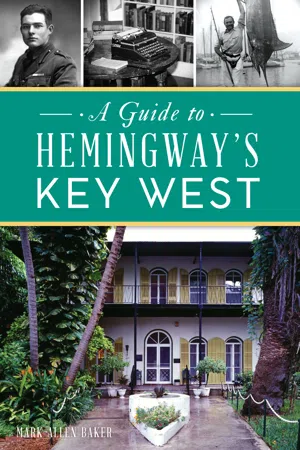
Guide to Hemingway's Key West, A
About this book
See the Conch Republic through Hemingway's eyes.
Trusted by 375,005 students
Access to over 1 million titles for a fair monthly price.
Study more efficiently using our study tools.
Information
Subtopic
Literary BiographiesIndex
History1
ERNEST HEMINGWAY’S KEY WEST (1928–1940)
I’m sitting on top of the world,” Al Jolson crooned, and why not? People were happy: Calvin Coolidge, a Republican lawyer from New England, was carrying us down the road to prosperity, and land on Broadway and Wall Street in New York City was selling at a record price. Life was grand. Described on his passport as “6 feet tall, pointed chin, medium forehead, dark brown hair, brown eyes, fair complexion, straight nose and oval face,” Ernest Miller Hemingway, age twenty-six, appeared to be on the cusp of literary success. He need only make a couple decisive decisions to ensure his destiny.
ERNEST HEMINGWAY WAS BORN on July 21, 1889, in the affluent Chicago suburb of Oak Park, Illinois. His father, Clarence Edmonds Hemingway, was a physician, and his mother, Grace Hall Hemingway, a musician. As the dominant figure in the family, Grace ruled the roost, as they say. Named after his grandfather, Ernest Miller Hall, young Ernest was the first son and the second of the Hemingways’ six children. Talented both in and out of the classroom, Ernest appeared destined to become a good writer or athlete or perhaps even an outdoorsman, as he loved to hunt and fish. After leaving high school—he did not attend college—Hemingway became a cub reporter for the Kansas City Star. And it was there that he skillfully utilized “The Star Copy Style,” a guide that would form the foundation for his prose.14

In December 1917, after being rejected by the U.S. Army for poor eyesight, Ernest Hemingway responded to a Red Cross recruitment effort and signed on to be an ambulance driver in Italy. His uniform was on display at the Key West Art and Historical Society.
The changing landscape in Europe brought about World War I. And when his country called, Ernest Hemingway answered. Although he was rejected by the U.S. Army for poor eyesight, he signed on with the Red Cross as an ambulance driver in Italy. Wounded by mortar fire, he spent his recuperation in a Red Cross hospital in Milan. It was while convalescing that he fell in love with a tall, bright-eyed Red Cross nurse named Agnes von Kurowsky. Seven years older than her teenage admirer, she was flattered by his affections. When Hemingway returned to the United States in January 1919, he believed he was destined to marry Agnes. He was wrong.
Upon receiving a “Dear Ernest” letter from Agnes in March 1919, the myth of living happily ever after died with the relationship. Complicating matters, the adjustment to civilian life presented a challenge. After a Michigan fishing and camping trip with his high school buddies, Hemingway was offered a job in Toronto—courtesy of a family friend. He accepted, and it led to a position as a freelancer and staff writer for the Toronto Star Weekly. Returning to Michigan briefly, he moved next to Chicago in September 1920. While living there with friends, he took a job as an associate editor of the monthly journal Cooperative Commonwealth.
Even if he wasn’t looking for love, especially after his relationship with Agnes, Hemingway wasn’t blind to the idea. When the beautiful red-haired sister of his Chicago roommate paid a visit, the thought took on a face. Eight years older than Hemingway, Hadley Richardson had briefly attended college before returning home to St. Louis to care for her mother.15 Her devotion to family and sense of responsibility impressed many, including the young journal editor. After corresponding for months, the pair married on September 3, 1921, in Bay Township, Michigan.
Upon the advice of novelist Sherwood Anderson, whom Hemingway met in Chicago, the pair headed for Paris. And it would be through Anderson that Hemingway was given introductions to the Parisian literary set: John Dos Passos, F. Scott Fitzgerald, Ford Madox Ford, James Joyce, Ezra Pound, Gertrude Stein and Alice B. Toklas. Having accepted a job as a foreign correspondent for the Toronto Star, Ernest, accompanied by his bride, soon fell into a comfortable yet economical lifestyle in Europe.

Ernest Hemingway’s wallet, calling card and photograph. These items were on display at The Key West Art & Historical Society.
The only child of Ernest and Hadley Hemingway, John Hadley Nicanor Hemingway, was born on October 10, 1923, in Toronto, Ontario, Canada. “Bumby,” as he was nicknamed—he had Gertrude Stein and Alice B. Toklas as his godparents—appeared destined for a literary life.

Ernest Hemingway, Elizabeth Hadley Richardson and Jack “Bumby” Hemingway, Schruns, Austria, spring 1926. Ernest Hemingway Collection. John F. Kennedy Presidential Library and Museum, Boston.
Writing short stories to subsidize his income, Ernest Hemingway wasn’t living a life of luxury, but he did manage to do a bit of traveling. Spain, and even Austria, provided new vistas for the family. Fascinated by bullfighting, Ernest was profoundly moved by the Fiesta de San Fermín in Pamplona, Spain. It even became the setting for his novel The Sun Also Rises.
Enter Pauline Marie Pfeiffer, born on July 22, 1895, in Parkersburg, Iowa. Her affluent parents, Paul and Mary Pfeiffer, were attentive to their daughter’s needs and committed to her education. Having moved to St. Louis in 1901, Pauline attended school at Visitation Academy of St. Louis. When her family moved to Piggott, Arkansas, she opted to stay in Missouri and study at the University of Missouri School of Journalism. Upon Pauline’s graduation in 1918, she honed her skills at newspapers in Cleveland and New York before turning to magazine work. And it was in Paris, in 1926, while working for Vogue, that she met Ernest and Hadley Hemingway.
BACK TO THE TWO decisions facing Hemingway early in 1926. The aspiring author had to choose between two publishers, Boni & Liveright, which published his first book, In Our Time, as part of a three-book contract, or Scribner’s, a publishing firm with greater potential offering a long-term contract. The latter was the choice—the decision made easier when Boni & Liveright terminated Hemingway’s contract.16 Having begun an affair with Pauline Pfeiffer in February 1926, Hemingway’s next decision was far more difficult: Ernest divorced Hadley in January 1927 and married Pauline in May.
Pauline and Ernest spent their honeymoon in Le Grau-du-Roi in southern France. As part of their marriage agreement, Hemingway converted to Catholicism. When Pauline found out she was pregnant, she wanted to have the baby in America. Where, they weren’t sure. On the recommendation of John Dos Passos, Ernest and Pauline left Paris for Key West in March 1928. Sailing from La Rochelle aboard the Orita, they headed first to Havana, then on to their Florida island destination.
KEY WEST IN 1928
Billing itself as “Nature’s Ideal Spot” in the late 1920s, Key West—all 4.2 square miles of it—considered the weather its greatest asset. Granted, the tropical savanna climate was tough to ignore, as was the abundant sunshine, but it didn’t take long before visitors discovered other benefits. As a two-season wet and dry climate—the period from November through April was normally sunny and dry, with only 25 percent of the annual rainfall occurring, while May through October brought the precipitation—it took time for visitors to get used to the heavy tropical downpours, followed by intense sunshine, but few seemed to mind. For mainland Floridians, where showers and thunderstorms occur in the afternoon, the switch to morning showers was their first adjustment. Folks liked the consistency in temperature, refreshing easterly trade wind and that the Florida Keys and Miami Beach are the only places within the contiguous United States to have never recorded a frost or freeze. Because the humidity was often over 70 percent, it was hard for natives to believe that the record high temperature was only 97°F (36°C) on July 19, 1880.17
During the late 1920s, Key West was selling itself as disease-free by virtue of the purifying effect of the sea breeze. The island was quick to note that during the flu epidemic of 1918, deaths there were proportionately smaller than those of any other city in the United States. Visitors could rest assured: Key West’s climate was disease resistant.
The location of the island made it the gateway to Cuba, the West Indies and Central America. And it was the nearest United States port to the Panama Canal. Thanks to the Florida East Coast Railway—the Key West extension, linking together the chain of Florida Keys—traveling had never been easier.18 With its natural deep harbor, Key West was capable of berthing the largest vessels either in the deeper outer harbor or the inner harbor.19 It was a resource the United States military found difficult to ignore.
As for ferries and steamships: the former arrived daily, while the latter offered a convenient schedule. The P.&O. Steamship Company offered daily service between Key West and Havana with biweekly trips made between Tampa and the Island City. The 105-mile trip between Key West and Havana took about six hours. The company operated four passenger steamers (largest capacity 425 passengers): Cuba, Governor Cobb, Miami and Northland. Simplifying matters, the steamships and the Florida East Coast Railway used the same terminals.
The Mallory Steam Line, formed in 1860 by Charles Henry Mallory, offered freight and passenger service from New York, Key West and Galveston.20 And the luxurious steamships offered four-day trips from New York to Key West. There is no better way to convey the luxury than a quick view of the dinner menu; for cocktails they had fresh shrimp, Bengal chutney, diced celery and assorted olives; French onion and hot or jellied consommé for soups; for entrées fresh mackerel, curried lobster with rice and prime ribs of beef au jus; vegetable choices were broccoli, mashed turnips, boiled or snow potatoes and creamed spinach; and for dessert you could have charlotte russe, vanilla ice cream, wine jelly with whipped cream, Nabisco wafers or even cheddar or camembert cheese and crackers.

A view of the Bahia Honda Rail Bridge in the lower Florida Keys. It once connected Bahia Honda Key with the Spanish Harbor Key.
Speaking of transportation, negotiations were underway between the United States and Cuba for the possible establishment of air service between Key West and Havana—the trip was estimated to take seventy-five minutes.
The U.S. military viewed Key West as the “Gibraltar of America,” and it was called on as needed. Planes and ships of all types frequented the military base. From an army barracks and naval base hospital to a marine hospital and submarine base, the versatility of the military was always on display.
The best cigars in the world, using Havana tobacco, were made in Key West. The similarity of the climates, not to mention ingredients, made it impossible to tell where the cigars were produced. As one of the main industries on the island, cigar making employed thousands of local workers. If you didn’t know where an individual worked, it was a good bet that it had something to do with a cylinder of tobacco rolled in tobacco leaves for smoking.
Thousands of pounds of fish and shellfish were shipped all over the world from Key West. And the island had the only green turtle canning factory in the country. And if it wasn’t seafood being shipped, it was likely sponges. When grass, wool and yellow sponges were discovered in these waters, customers finally found a buying alternative to the Mediterranean countries.

Construction on the original Overseas Highway lasted through most of the mid-1920s. It officially opened for traffic on January 25, 1928, and many souvenirs, such as those pictured, commemorated the event. These items were on display at the Key West Art and Historical Society.

Transforming the economic infrastructure of the town in the first half of the twentieth century, Norberg Thompson significantly influenced the development of Key West. As Thompson’s businesses were located in the Historic Seaport District, this is where you will find this statue.
If visitors needed a place to bed down, there was a situation to fit their budget. From the Casa Marina, Hotel La Concha, Jefferson Hotel and the Overseas Hotel to the Island City Hotel and Panama Hotel, visitors had plenty of choices when it came to quality accommodations. Boardinghouses, such as the Watrous House and the O’Brien House, were also available.
For those planning on staying a bit longer: Monroe County, of which Key West was the county seat, offered outstanding public education. And residents had options. Private schools were also available on the island. They included Convent of Mary Immaculate and St. Joseph’s College. The Methodists also had a strong presence in educating the Cuban poor.
Picking up a copy of the Key West Citizen, the island’s daily newspaper, a visitor could read about the progress being made on the island. From public services to utilities, the tropical paradise was pav...
Table of contents
- Front Cover
- Half Page
- Title Page
- Copyright
- Contents
- Preface
- Acknowledgements
- Introduction. Hemingway On Boxing
- 1. Ernest Hemingway’s Key West (1928–1940)
- 2. Hemingway’s Mob, Associates and Assorted Guests
- 3. In the Author’s Footsteps, Route One: From Whitehead Street West
- 4. In the Author’s Footsteps, Route Two: Duval Street—Between Whitehead Street and White Street
- 5. In the Author’s Footsteps, Route Three: Assorted Locations—From White Street East
- 6. The Key West Written Work of Ernest Hemingway, 1928–1940
- 7. From Souvenirs to Treasures
- 8. The Hemingway Mythos
- Appendix. Street Reference and Distances
- Notes
- Bibliography
- About the Author
Frequently asked questions
Yes, you can cancel anytime from the Subscription tab in your account settings on the Perlego website. Your subscription will stay active until the end of your current billing period. Learn how to cancel your subscription
No, books cannot be downloaded as external files, such as PDFs, for use outside of Perlego. However, you can download books within the Perlego app for offline reading on mobile or tablet. Learn how to download books offline
Perlego offers two plans: Essential and Complete
- Essential is ideal for learners and professionals who enjoy exploring a wide range of subjects. Access the Essential Library with 800,000+ trusted titles and best-sellers across business, personal growth, and the humanities. Includes unlimited reading time and Standard Read Aloud voice.
- Complete: Perfect for advanced learners and researchers needing full, unrestricted access. Unlock 1.4M+ books across hundreds of subjects, including academic and specialized titles. The Complete Plan also includes advanced features like Premium Read Aloud and Research Assistant.
We are an online textbook subscription service, where you can get access to an entire online library for less than the price of a single book per month. With over 1 million books across 990+ topics, we’ve got you covered! Learn about our mission
Look out for the read-aloud symbol on your next book to see if you can listen to it. The read-aloud tool reads text aloud for you, highlighting the text as it is being read. You can pause it, speed it up and slow it down. Learn more about Read Aloud
Yes! You can use the Perlego app on both iOS and Android devices to read anytime, anywhere — even offline. Perfect for commutes or when you’re on the go.
Please note we cannot support devices running on iOS 13 and Android 7 or earlier. Learn more about using the app
Please note we cannot support devices running on iOS 13 and Android 7 or earlier. Learn more about using the app
Yes, you can access Guide to Hemingway's Key West, A by Mark Allen Baker in PDF and/or ePUB format, as well as other popular books in History & Literary Biographies. We have over one million books available in our catalogue for you to explore.