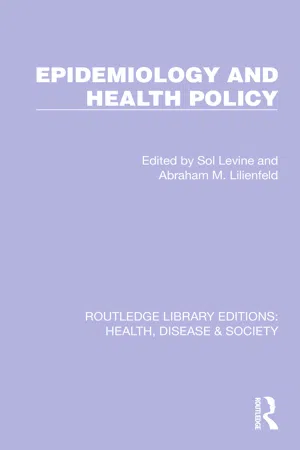
Originally published in 1987, this book examines the priorities of health policy in the late 20th Century and the varied approaches or strategies to foster the prevention or control of disease. Several chapters focus on specific diseases and conditions, but other areas of concern such as injuries, alcoholism, drug-abuse, occupational health and nutrition are also dealt with. The book illuminates how epidemiology can serve as a more effective basis for health policy and practice and will be of great value to students and lecturers of medical sociology, epidemiological medicine and health policy.
- 316 pages
- English
- ePUB (mobile friendly)
- Available on iOS & Android
eBook - ePub
Epidemiology and Health Policy
About this book
Information
One Child health
C. Arden Miller
During the war on poverty in the 1960s, Dr Jack Geiger worked in rural Mississippi to establish a neighborhood comprehensive health center. The work was difficult, leading Dr Geiger to observe in later years that anyone who believes this country does not have a health policy ought to try changing it. He might have added that part of our unwritten health policy holds that there shall be no separately identifiable policy on behalf of children.
A concept of policy
For purposes of this presentation health policy is regarded as the aggregate of principles, stated or unstated, that more or less consistently characterize the distribution of resources, services, and political influence that impact on the health of the population of concern, in this instance the nation’s children. This view of health policy emphasizes analysis of what we collectively do on behalf of improved health, rather than what we say we do. The phrasing of legislative acts, court decisions, and political speeches may all embrace pronouncements that carry the ring of policy declarations. For example, the Comprehensive Health Planning and Public Health Service Amendments of 1966 was introduced by the statement, “The Congress declares that fulfillment of our national purpose depends on promoting and assuring the highest level of health attainable for every person, in an environment which contributes positively to healthful individual and family living.” That statement reads like policy that disallows social inequities, medical neglects, and preventable hazards of the work-place, highway, school or home. Abundant evidence that the aspiration was not fulfilled may mean that the policy statement continues to be relevant and should more vigorously guide regulatory authority and distributions of relevant goods and services. On the other hand conspicuous gaps between the declared intent and the achievement may in fact suggest that the statement is hollow, not influential, and not an appropriate expression of actual practice or priorities, and hence not a valid expression of operational policy.
The statement in question begins a paragraph that ends with the caveat that the stated purposes are to be served “without interference with existing patterns of private professional practice of medicine, dentistry, and related healing arts.” The idealistic purpose is constrained by protection of a special interest. What is the operative policy? It can be determined only by inferences drawn from careful analysis of how our society distributes relevant power (licensure, accreditation entitlements) and resources (grants, reimbursements, eligibilities, benefits, etc.) that are provided by the programs in question. When such careful analysis, covering a span of years and a variety of programs, yields more or less consistent characterizations, they are legitimately designated as operational policy. The careful analysis that yields generalizations that characterize operational health policy requires the use of epidemiologic skills in ways that will be further amplified.
A clear statement of nominal, as opposed to operational, policy appears in the preamble to the School Lunch Program: “It is declared to be the intention of Congress, as a measure of national security, to safeguard the health and well being of the nation’s children” (School Lunch Program, US Code 1751, 1946). Analysis of that program’s record has led some critics to suggest that the nutritional interests of children were best served when they coincided with the interests of agribusiness, which welcomed an assured outlet for surplus commodities. By the early 1980s national security was no longer defined in ways that emphasized protection of children’s health by means of nutritional supplementation. Large sums were allocated for military preparedness; domestic expenditures for children’s health services, including school lunch programs, were drastically reduced. Did the policy undergo a change; did the preamble not accurately reflect operational policy at the time it was written; did higher priorities take precedence over a policy that persists but with a reduced claim to resources? Answers to these questions are not self-evident, and enlightenment may only come by study of many programs that entail some of the same concerns.
These few examples illustrate some assumptions about health policy. Among them is the view that some operational patterns are sufficiently durable to serve as characterizations of health policy, admitting that policy is not immutable and can change over time. Prevailing health policy is seen to emerge as a result of negotiations among competing values promoted by competing interest groups. In those negotiations infants, children, and their parents, who are largely young and poor, lack a competitive advantage either in political or economic terms. The interests of maternal and child health require sponsorship by advocates who attempt to act as surrogates in the arenas of negotiation. These dynamics suggest that epidemiologic data are only one of the considerations that influence health policy. Dominant social values and political influence are also critical determinants. Their influence, at least in the short run, may run counter to the available data. For example, the data on reproductive health might suggest a certain direction for policies about abortion and contraception but the prevailing policy may be pushed in quite another way by certain religious and social values. Control of handguns is another issue where data and policy run counter to each other. Among black males between fifteen and twenty-four years of age homicide and suicide are now the leading causes of death. Handguns are a leading instrument of this mortality, yet policy that would control access to them is effectively resisted.
Formulations of policy
Defensible characterizations of operational health policy might include the following:
1 As a nation we allocate resources as if medical care were the major determinant of health, contrary to the weight of epidemiologic evidence (McKeown 1976). Analysis of children’s health suggests that greatest benefits would derive from emphasis on family planning, nutrition, sanitation, environmental protection, accident prevention, and income supplementation for poor families (Keniston 1977; Select Panel 1981). Such interventions require public supports and regulations that run counter to some social values that are even more powerful than concern for children’s health. The operative health policy appears to seek good health by means of medical care, even at great expense, rather than to engage in painful social reforms that would probably be more effective in terms of improved population-based health outcomes.
Two important programs stand out as exceptions to the policy formulation that emphasizes achieving favorable health status by means of medical care. Both programs have medical components and both have been implemented only by the greatest perseverance of child health advocates. The first program is Headstart. For preschool poverty level children the program provides enriched day care including health check-ups and supervision, nutritional supplementation, and parent education. Early evaluations of the program found no durable benefits, but recent studies of early Headstart enrollees, now graduated from high school, demonstrated for the enrolled group reduced school dropouts and reduced need for enrollment in special education programs for handicapped children (Lazar 1980). The findings were used decisively to preserve public funding for Headstart at a time when it was earmarked for drastic reductions.
The other exceptional program is WIC (Special Supplemental Food Program for Women, Infants and Children). The program is administered through health agencies, usually the clinics of local health departments, and provides nutritional supplements for poverty level pregnant women, infants, and children through five years of age. It is one of the few food supplementation programs that unambiguously serves the nutritional needs of a high risk population rather than the economic interests of agribusiness. When Congress authorized and made appropriations for WIC the funds were impounded by the Nixon administration and were released only after prolonged delays, terminated by litigation brought by child advocacy groups. The amount of appropriations has never been sufficient to serve more than about a quarter of eligible women and children. The program has been a special target for further funding reductions by the Reagan administration.
Evaluations of benefits from WIC have been encouraging, but they are not yet decisive enough to persuade all skeptics. Better birth weights and weight gains for infants and children, increased head circumference for infants, and reduced rates of iron deficiency anemia are all encouraging findings (Kennedy and Gershoff 1982; Kennedy et al. 1982). Participation in WIC provides another benefit by increasing participation in prenatal and well child care (Kotch and Whiteman 1982). Poor pregnant women appear to attend clinics to obtain food and stay to receive appropriate health services.
A strong case can be made for including the nation’s family planning program as a third endeavor (significantly, outside the usual medical care system) that impacts favorably on infant and child health (Morris and Vory 1975).
2 The political power that is associated with delivery of medical care is largely entrusted to physician practitioners. At one time a number of states provided that their Boards of Healing Arts, which grant licensure for practicing the healing arts, should be constituted by the state medical society or some component of it. Other states empowered the governor to make appointments to such boards, but constrained his choice by providing that he must appoint from a panel proposed by the medical society, or from physicians already licensed to practice in the state. These state laws have tended to become less restrictive and to increase the participation of other health professionals and the public at large. Even with these changes the influence of the practicing medical profession in authorizing licensure, accreditation, and certification of health service providers is predominant.
This circumstance has prompted some analysts to suggest that medical practice in this country functions with the economic characteristics of a monopoly that restricts entry of other providers into the market. Those restrictions serve the public interest by restraining quacks and charlatans, but restrictions also pertain to providers who might be advantageous, especially for children’s health. In many parts of the country trained nurse midwives and pediatric nurse practitioners are constrained from rendering services, even to demonstrably underserved populations, in spite of abundant evidence on the effectiveness and economy of care rendered by such mid-level practitioners (Select Panel 1981).
3 Health services are predominantly distributed in a private economic market, on a fee for service basis, an emphasis that is both subsidized and protected by government. About 90 per cent of all children have a regular source of medical care, and that source is a privately practicing physician for about 80 per cent of those served. The distribution is different for poverty level children. About 80 per cent have a regular source of care, and that source is a privately practicing physician for only about half of them. Public clinics and emergency departments of hospitals serve the remainder (Kovar 1982; Miller et al. 1981). For selected services, such as immunization and family planning, public providers play a much larger role, rendering about two-thirds of the respective services to minors.
Since enactment of Medicaid and Medicare in 1965 the proportion of the total health outlay that is paid by government has progressively increased. Nearly half of the nation’s health bill is paid by government, but only about 3 per cent of the expenditures are made for services by the public health agencies (Comprehensive NPHPRS Report 1980). Predictions in 1970 that 90 per cent of the population would be served by 1980 in systems featuring prepayment for services fell far short of the mark. Fee for service payments characterize care for more than 90 per cent of the population (Saward and Fleming 1980).
Children are less well covered by insurance and public payment systems than any other age group, even though a higher proportion of children than any other age group live in poverty level households (Budetti, Butler, and McManus 1982). As a consequence, out of pocket payments for ...
Table of contents
- Cover
- Half Title
- Title Page
- Copyright Page
- Original Title Page
- Original Copyright Page
- Table of Contents
- List of contributors
- Acknowledgments
- Preface
- Introduction
- 1 Child health
- 2 Nutrition and health policy
- 3 Epidemiology and health policy: coronary heart disease
- 4 Cancer epidemiology and health policy
- 5 Epidemiology in occupational health policy
- 6 Injuries
- 7 Infectious diseases
- 8 Psychiatric epidemiology and mental health policy
- 9 Epidemiology and alcohol policy
- Name index
- Subject index
Trusted by 375,005 students
Access to over 1.5 million titles for a fair monthly price.
Study more efficiently using our study tools.
Frequently asked questions
Yes, you can cancel anytime from the Subscription tab in your account settings on the Perlego website. Your subscription will stay active until the end of your current billing period. Learn how to cancel your subscription
No, books cannot be downloaded as external files, such as PDFs, for use outside of Perlego. However, you can download books within the Perlego app for offline reading on mobile or tablet. Learn how to download books offline
Perlego offers two plans: Essential and Complete
- Essential is ideal for learners and professionals who enjoy exploring a wide range of subjects. Access the Essential Library with 800,000+ trusted titles and best-sellers across business, personal growth, and the humanities. Includes unlimited reading time and Standard Read Aloud voice.
- Complete: Perfect for advanced learners and researchers needing full, unrestricted access. Unlock 1.5M+ books across hundreds of subjects, including academic and specialized titles. The Complete Plan also includes advanced features like Premium Read Aloud and Research Assistant.
We are an online textbook subscription service, where you can get access to an entire online library for less than the price of a single book per month. With over 1.5 million books across 990+ topics, we’ve got you covered! Learn about our mission
Look out for the read-aloud symbol on your next book to see if you can listen to it. The read-aloud tool reads text aloud for you, highlighting the text as it is being read. You can pause it, speed it up and slow it down. Learn more about Read Aloud
Yes! You can use the Perlego app on both iOS and Android devices to read anytime, anywhere — even offline. Perfect for commutes or when you’re on the go.
Please note we cannot support devices running on iOS 13 and Android 7 or earlier. Learn more about using the app
Please note we cannot support devices running on iOS 13 and Android 7 or earlier. Learn more about using the app
Yes, you can access Epidemiology and Health Policy by Sol Levine,Abraham Lilienfeld in PDF and/or ePUB format, as well as other popular books in Medicine & Health Care Delivery. We have over 1.5 million books available in our catalogue for you to explore.