This book investigates the relationship between the International Criminal Court and Africa (the ICC or the Court), asking why and how the international criminal justice system has so far largely failed the victims of atrocities in Africa.
The book explores how the Court degenerated from a very promising multilateral institution to being an instrumentalised, politicised, weaponised institution that ended up with the victims being the greatest losers. Instead of looking at the International Criminal Court as a recent alternative to a prevailing international criminal justice paradigm, this book argues that the Court is a manifestation of the same world order that was established by the Reconquista in 1492. Written from a decolonial perspective, the book particularly draws on evidence from Zimbabwe in order to demonstrate how the International Criminal Court is failing the victims of the four crimes that fall under its jurisdiction. Drawing on the perspectives of victims in particular, this book highlights the damage caused within Africa by the international criminal justice system and argues for a decolonial conception of justice.
The book will be of interest to researchers from across African politics, international relations, law and criminal justice.
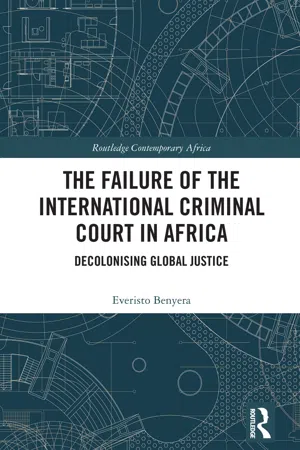
eBook - ePub
The Failure of the International Criminal Court in Africa
Decolonising Global Justice
- 216 pages
- English
- ePUB (mobile friendly)
- Available on iOS & Android
eBook - ePub
The Failure of the International Criminal Court in Africa
Decolonising Global Justice
About this book
1 Self-writing as restitutive justice in Africa An introduction
DOI: 10.4324/9781003267416-1
What an old man sees sitting down, a young man cannot see standing up.(Igbo proverb)
The aforementioned Igbo proverb alludes to the importance of perspective, especially in the formulation of narratives. One’s epistemological location hugely determines their perspective. The word perspective is derived from the Latin word perpect, meaning to look closely. One narrative possesses many perspectives depending on the positionality of the narrator. For example, the letter M, when looked at from four different sides gives four different readings (perspectives): (1) M, (2) 3, (3) W and (4) E. Four people, standing closely together, looking at a paper written the letter M, see four different perspectives (M, W, E and 3). What this illustrates is the power of positionality in framing narratives. Having looked at the same paper, with the same letter, one person will frame a numerical narrative having seen the number 3 and the other three will formulate different narratives having seen letters of the alphabet (M, W and E).
Commenting in a pre-soccer match interview in which his team, Kaizer Chiefs was to play rivals Mamelodi Sundowns on 21 November 2016, renowned South African soccer coach Steven Komphela has this to say about perspectives:
You know, there are times where before you say something you gotta (sic) think hard and deep. Because there is a greater possibility it’s a reflection of either the psyche, the mentality, the character in the person or it reflects a bit of background and for fear of exposing where you come from, you think twice and consider perspectives.(SuperSport, 2016)
What Steve Komphela was alluding to in the aforementioned quotation are five important things in the framing of a narrative. These are one’s: (1) epistemology, (2) background, (3) bias, (4) introspection and finally (5) positionality. Epistemology frames what one considers to be knowledge and by extension not knowledge. The background indicates one’s comprehension of the problem being responded to in the narrative. Bias alludes to ‘the unconscious attitudes that give rise to discriminatory behaviours, without the awareness or control of the individual who harbours such attitudes’ (Johnson, 2020, p. 2). Introspection refers to the examination of one’s thought processes and these result in one’s positionality in framing the narrative about the efficacy of the ICC in Africa and the concomitant need to decolonise international criminal justice. One’s epistemology, background, bias, introspection and positionality determines their resultant narrative, in other words, their locus of enunciation, to borrow from Ramon Grosfoguel. The locus of enunciation, by definition, ‘is the geo-political and body-political location of the subject that speaks’ (Grosfoguel, 2009, p. 14). While epistemic location is different from social location, this book was conceptualised and written from a Global South episteme and social location. Its framing of international criminal justice and the ICC as the main vehicle for delivering international criminal justice was framed from the perspective of the victims in the Global South.
The ICC, just like any other court of law, is a place for seeking, attaining and upholding justice. This is undebatable. What is debatable is whose perspective should be considered when seeking, attaining and upholding justice at the ICC. In this book, the overarching argument that the ICC failed its major intended beneficiaries, i.e. the victims in Africa and the Global South, is informed by the existence of a fundamental misalignment of the ICC as the perspective used to seek, attain and uphold justice is different from that of those who are intended to get justice from the Court. Stated differently, the ICC’s form of justice is framed from a Euro-North American perspective yet the majority of the victims of the four crimes which fall under its jurisdiction, are from a Global South epistemic positionality. This misalignment is not by mistake but a construction to perpetuate coloniality because to do otherwise would have implied not only recognising but also instituting justice mechanisms that are from the Global South. These forms of justice include the many restorative and restitutive forms of justice used across Africa. Besides, for those in the Global North, subjecting themselves to the justice mechanisms of the Global South would be too ghastly to contemplate. Imagine a convicted war criminal from the United States, partaking mato oput1 in Northern Uganda’s Acholiland for the crime of being a commander in one of Joseph Kony’s brigades.
This leads to a cardinal question: what is justice from an African perspective? According to Magobe Ramose, most African communities believe in the equality of human beings, and from this equality of all is drawn the idea that justice means giving to the other what is due to them, ‘meaning equal and non-discriminatory treatment to equal cases’ (Ramose, 2001). Equality, non-discrimination and giving what is due form the pillars of justice. This framing of justice casts slavery, colonialism, racism, apartheid and other vices as unjust and therefore punishable. Most importantly, it classifies the treatment of Africa as the Court’s geographical area of almost exclusive concerns where the Court concerns itself with the crimes committed by Africans (not crimes committed in Africa) as unjust and therefore deserving of justice. Not all international criminal crimes committed are being addressed as some suspects both local and international enjoy the protection of the strongest nations, entities and individuals in the international arena (Gegout, 2013). Politics is used to determine who gets prosecuted for international crimes and who does not. For example, the United States actively supported the establishment of the international tribunal to prosecute the Khmer Rouge leaders for war crimes, but no such tribunal was set up to prosecute the US leaders for the roles in the international crimes committed in Vietnam or Laos (Mamdani, 2010, p. 62). How do I tell such a story?
The world systems from an African storytelling perspective
Storytelling allows humanity to reach those areas of our history and existence where no theory can reach. Storytelling is to the Global South what theory is to western-centric epistemology. In the Global South, our stories are our theories; they reach the innermost parts of our being, individually and collectively. They evoke soul searching and introspection, thereby rendering both self-forgiving and other-forgiving possible and efficacious.
Facts alone without the truths are insufficient to bring justice to Africa. Facts state what happened without allowing other perspectives to paint a background to what happened, how it happened and why it happened. Facts are not concerned with what happened before and after. Truths, not the truth, help in framing narratives of injustice and deliver restitutive, restorative and survivors’ justice way beyond the abilities of facts which are the hallmark of prosecutorial justice that the ICC pursues. Facts are brutal. They don’t have any morals, and they feel no empathy or compassion. Storytelling is an antidote to forgetfulness and amnesia. As tools of analyses, theories have a major shortcoming in that at times they limit options and lead to simplistic views of otherwise complicated phenomena.
From a western-centric perspective, it is easy and possible to abuse a being that you don’t know the different ‘other’. On the other hand and from an Ubuntu based perspective, the solution to human rights abuses is therefore to know and relate to the ‘other’. This allows one to see themselves in the ‘other’, thereby making the abuse of one by the ‘other’ difficult as Ubuntu prescribes that humanity and being are exercises of reciprocal authentication. Racism, genocides, slave trade and many other heinous atrocities thrive on the fact that they will be perpetrated on the different ‘other’. Atrocities are made possible by a paradigm of differences: that Whites are different from Blacks, men from women, Africans from Euro-North Americans, Igbos from Hausas, Shiite from Sunnis, Zulu from Vendas and Shonas from Ndebeles, and the list is endless. The different ‘other’ becomes the dispensable ‘other’.
Storytelling is a viable archive for the African story, good or bad. This is how some of the atrocities such as the Euro-North American slave trade and colonial genocides survived. Storytelling gives the Global South the ammunition with which to make sense of their predicaments especially when used in conjunction with theories such as the world-systems. It works well in a world organised by and through the world-systems (Wallerstein, 2004). Developed by Immanuel Wallerstein, the world-system analysis advocates for the analyses of the problem of injustice in the Global South as one whole, as opposed to various parts and episodes such as slavery, colonialism and so on. According to the world-system analysis, the unit of analysis is not the nation-state but the world itself. Analysing the problem of the Global South using the nation-state as the unit of analysis forms part of the problem because what happens at the nation-state level has global system-wide origins, purposes and repercussions. When reduced to its simplest form, the world system is about the management and governance of the world and the concomitant efforts to conceptualise, identify and address those global problems that go beyond the capabilities of individual nation-states. Most importantly nation-states are not homogenies and are structured into three broad categories: the centre, periphery and semi-periphery. Countries in the same categories such as those in the centre or the periphery tend to face similar problems, view the world from the same perspective and hence they tend to agree on their positionalities on issues such as international criminal justice.
These system-wide phenomena such as racism are like an odourless, colourless killing gas that diffuses itself silently, reaching all parts of the Global South, in the process of killing its victims silently. For Wallerstein, the problems of human rights abuses in the Global South are:
Closely intermeshed that each presumes the other, each affects the other, each is incomprehensible without taking into account the other boxes. And part of the problem is that we tend to leave out of our analyses of what is and is not “new” the three important turning points of our modern world-system: (1) the long sixteenth century during which our modern world-system came into existence as a capitalist world-economy; (2) the French Revolution of 1789 as a world event which accounts for the subsequent dominance for two centuries of a geoculture for this world-system, one that was dominated by centrist liberalism; and (3) the world revolution of 1968, which presaged the long terminal phase of the modern world- system in which we find ourselves and which undermined the centrist liberal geoculture that was holding the world-system together.(Wallerstein, 2004, p. x)
Analysing the problem of the Global South as various episodes, affecting different parts of the world is part of the problem that is compounded by the division of knowledge into disciplines at the university. These separate boxes of analyses, as Wallerstein calls them, ‘are an obs...
Table of contents
- Cover
- Half Title
- Series
- Title
- Copyright
- Dedication
- Contents
- Foreword
- Preface
- Acknowledgements
- Acronyms
- 1 Self-writing as restitutive justice in Africa: an introduction
- 2 The international criminal justice system as a problem for Africa
- 3 The ICC and prosecutorial obsession
- 4 Is the ICC unfairly targeting Africa?
- 5 Can (post)colonial states deliver international criminal justice? the case of Zimbabwe
- 6 The ICC and international criminal justice in Zimbabwe
- 7 Rethinking and reconstituting the international criminal justice system: towards a cure that heals the patient
- Index
Trusted by 375,005 students
Access to over 1.5 million titles for a fair monthly price.
Study more efficiently using our study tools.
Frequently asked questions
Yes, you can cancel anytime from the Subscription tab in your account settings on the Perlego website. Your subscription will stay active until the end of your current billing period. Learn how to cancel your subscription
No, books cannot be downloaded as external files, such as PDFs, for use outside of Perlego. However, you can download books within the Perlego app for offline reading on mobile or tablet. Learn how to download books offline
Perlego offers two plans: Essential and Complete
- Essential is ideal for learners and professionals who enjoy exploring a wide range of subjects. Access the Essential Library with 800,000+ trusted titles and best-sellers across business, personal growth, and the humanities. Includes unlimited reading time and Standard Read Aloud voice.
- Complete: Perfect for advanced learners and researchers needing full, unrestricted access. Unlock 1.5M+ books across hundreds of subjects, including academic and specialized titles. The Complete Plan also includes advanced features like Premium Read Aloud and Research Assistant.
We are an online textbook subscription service, where you can get access to an entire online library for less than the price of a single book per month. With over 1.5 million books across 990+ topics, we’ve got you covered! Learn about our mission
Look out for the read-aloud symbol on your next book to see if you can listen to it. The read-aloud tool reads text aloud for you, highlighting the text as it is being read. You can pause it, speed it up and slow it down. Learn more about Read Aloud
Yes! You can use the Perlego app on both iOS and Android devices to read anytime, anywhere — even offline. Perfect for commutes or when you’re on the go.
Please note we cannot support devices running on iOS 13 and Android 7 or earlier. Learn more about using the app
Please note we cannot support devices running on iOS 13 and Android 7 or earlier. Learn more about using the app
Yes, you can access The Failure of the International Criminal Court in Africa by Everisto Benyera in PDF and/or ePUB format, as well as other popular books in Law & International Law. We have over 1.5 million books available in our catalogue for you to explore.