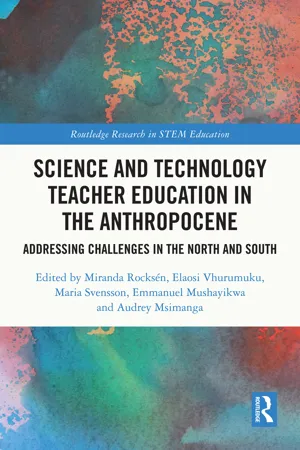
This unique book compares anthropogenic challenges in science and technology teacher education between the northern and southern contexts of Sweden and South Africa, respectively.
Presenting the results of a three-year research collaboration between science and technology teacher education researchers from South Africa and Sweden, the book explores theoretical perspectives and pedagogical experiences in response to challenges in the Anthropocene. It discusses research-informed practice in teacher education to address sustainable development. Chapters in the book collectively investigate the influence of current environmental and societal changes on the education of teachers, answering the question of how science and technology teacher education can adjust to current changes in the world and prepare new teachers for work in their future profession. Touching on issues such as climate change, global warming and pandemic diseases, the book uses a comparative approach and explores opportunities and possibilities for fulfilling the goals of science and technology education for sustainable development.
The book offers recommendations and opportunities to implement sustainability issues and develop sustainable teaching strategies. It will be a key reading for researchers, academics and post-graduate students in the fields of teacher education, science and technology education, sustainability education and comparative education.
Part ITheoretical Perspectives, Policies and Curricula in Science and Technology Teacher Education
1Sustainability and science and technology teacher educationA review of the literature
Miranda Rocksén, Elaosi Vhurumuku and Maria Svensson
DOI: 10.4324/9781003190158-3
Introduction
In the contemporary era of the Anthropocene, globally, there is increasing consensus that the use of energy and natural resources is no longer sustainable. There is a frightening and alarming realisation that humanity is recklessly pushing the earth beyond the limit necessary for preserving planetary ecological systems, galloping the earth towards cataclysm (Hamilton, 2017; Sepkoski, 2020). While this is so, there is some measure of universal agreement that research-based science and technology teacher education can make important contributions to sustainability or sustainable development (Eilks, 2015). Nevertheless, it appears that there is no single answer to the question of what a research-based science and technology teacher education means.
In many countries, politicians have generally agreed that the challenges of the Anthropocene require that teacher education programmes integrate science and technology education for sustainable development (ESD) into their curricula (Fuertes-Camacho, Graell-Martín, Fuentes-Loss, & Balaguer-Fàbregas, 2019). There is an underlying assumption that this will contribute towards achievement of the United Nations’ Sustainable Development Goals (UN SDGs) through developing teachers’ scientific and technological literacy, emphasising the importance of fighting for global sustainable development. It is contended that developing teachers’ scientific and technological literacy is not only related to, but a necessity, for a more sustainable future. Nonetheless, in order to prepare student teachers properly, it is not only necessary to include science and technology ESD in curricula, but also essential to glean insights from critical literature perspectives and research results.
It suffices to mention that the research literature on sustainable development in teacher education is not one articulate field. Many of the visions in the UN SDGs have been expressed in such research fields as ESD and environmental education (EE). These efforts aboard, disparate and convoluted views on what necessary skills student teachers need in order to contribute meaningfully to sustainable development efforts. Moreover, debates around these issues are based on varying theoretical perspectives and ideological orientations (Knutsson, 2013). A common feature threading these discussions is the acceptance that, through ESD, student teachers are expected to develop many complex competencies (Wiek, Withycombe, & Redman, 2011) necessary for participation in sustainable development. In school practice, ESD requires the teacher to embrace and cognise a different understanding of both teaching and learning (Dahl Madsen, 2013). The research field is also permeated by the policy statements, stakeholder expectations as well as views expressed by various interest groups, both at the national and international arenas. In 1972 the United Nations’ Conference on Human Environment was held in Stockholm, Sweden. In 1982 sustainable development was established and defined as a concept by the report, Our Common Future (World Commission on Environment and Development, 1987) and in 2002 the World Summit on Sustainable Development was held in Johannesburg, South Africa. By the year 2021 the Cop26 conference on climate change was held in Glasgow. These events coexist with research on the global arena and can be expected to have strong influence on the direction of research. As alluded to, in many parts of the world the achievement of UN SDGs is an important goal for education in general and science and technology teacher education in particular.
In line with the theme of this book, in this chapter, we delve into the issue of how sustainable development has been approached focusing on the research literature in science and technology teacher education. Starting in the year 1980, just before the Brundtland report (World Commission on Environment and Development, 1987) and ending in 2020, we look at 40 years of publications in the two countries, South Africa and Sweden. Focusing on these two countries, our aim is to explore how environmental issues and sustainability have been conceptualised in relation to teacher education and the fields of science and technology, covering the period from 1980 to 2020. We start with a presentation of some conceptualisations of the ESD and EE research fields. This is followed by an examination of a sample of pertinent research literature from South Africa and Sweden. Within this effort, we provide some useful insights for the practice of science and teacher education, for both the global North and the South.
Figuring the field
Eilks' four models of integrating ESD into science education practices
From the perspective of science education, Eilks (2015) reviews central frameworks of ESD and presents four models for connecting ESD and science education. Model 1 means adopting principles from sustainable practices in science and technology for hands-on science education laboratory work. This entails minimising the use of harmful chemicals and performing small-scale experiments. Students’ learning can be expanded by their critical reflection and comparison of these strategies. In model 1, this idea of an ESD school laboratory mirrors the shift towards industrial “green” production. Model 2 means adding sustainable science as content, in science and technology curricula. Here, sustainable science and technology are topics addressed in the teaching. For instance, energy efficient processes, innovative products and new methods for products based on renewable resources. By focusing only on the technological applications, Eilks argues that there is a risk that this model does not allow students to get a thorough understanding of the interplay between science, technology or society, which means the interplay of economic, ecological and societal sustainability. Model 3 means to use controversial sustainability questions for the socioscientific issues driven science education. When using model 3 science education most often does not focus on neither the learning of science nor the learning about sustainability issues. For students the topics that are presented and interrogated imply that they need to include “both scientific knowledge and reflection upon societal debates on the practical, technical applications of such knowledge as factors to be learned” (Eilks, 2015, p. 155). In model 4, science and technology education is integrated into a development of a whole institution, like a school, along the main lines of ESD. Eilks describes this fourth model as an open classroom in which pupils and teachers engage in non-formal school projects, with visits to university, industry or research centres. All involved are required to explore future challenges and reflect on ESD-learning and their active participation in society. The four models presented by Eilks (2015) represent a synthesis of 15 years of integrating ESD into science teaching and science education. Other syntheses provide ideas about the historical development of research in ESD, in which the number of publications today is growing exponentially (e.g. Pavlova, 2013; Zhang & Wang, 2021).
Fifteen currents in environmental education
As research turfs, the ESD and EE fields are broad and not easily digested. In the 1960s the book Silent Spring (Carson, 2002) had a big influence and EE was introduced in many Western countries, including Sweden. The book worked as an eye-opener concerning the effects of pesticides on wildlife and environment. Today, environmental problems have grown so big that it is globally accepted that the earth has entered a new epoch (Zalasiewicz et al., 2017) called the Anthropocene. Over the years, for both EE and ESD, theoretical perspectives and the foci of research have fluctuated. For example, Sauvé (2005) recognises the lack of consensus and describes 15 currents in EE (see Figure 1.1). These 15 currents are separated into those with a historically longer tradition and those that more recently emerged.
Figure1.1Fifteen currents in environmental education, from Sauvé (2005)
Currents with a longer tradition in EE are calling for action. This has entailed calling for changes in individual behaviour or collective action. These currents approach EE from a cognitive perspective. For example, one of the currents with a longer tradition is Problem-solving, where the goal is to inform or help people to inform themselves and learn about environmental issues, as well as to develop attitudes and skills for solving them. Another example is the Systemic current that allows for identification of the various components of an environmental situation or issue. Currents that more recently emerged in EE are connected to such theoretical perspectives as critical theory and socio-ecological theory in combination with globality. One example is the Holistic current in which the global perspective is as central as the to the importance of embodiment in our relations with the environment, allowing beings (plants, animals, rocks, etc.) to speak by themselves about their own nature and in that way enable us to better care for them. The kind of analysis proposed by Sauvé (2005) allows for the construction of a “bigger picture” view, which enables a synthesis of the reality under study. In the line-up of currents in EE presented by Sauvé, the 15th current is called “Sustainable Development/Sustainability Current”. Sauvé (2005, p. 30) writes:
According to the supporters of this current, environmental education has limited itself to a naturalist approach and has neglected to encompass social preoccupations, and especially economic considerations, ...
Table of contents
Cover Page
Half-Title Page
Series Page
Title Page
Copyright Page
Dedication Page
Contents
List of figures
List of tables
Contributors
Preface
Foreword
Acknowledgements
A list of key terms
Introduction to the book
PART I Theoretical Perspectives, Policies and Curricula in Science and Technology Teacher Education
PART II Experiences and Pedagogical Practices in Science and Technology Teacher Education
Index
Trusted by 375,005 students
Access to over 1.5 million titles for a fair monthly price.
Study more efficiently using our study tools.
Frequently asked questions
Yes, you can cancel anytime from the Subscription tab in your account settings on the Perlego website. Your subscription will stay active until the end of your current billing period. Learn how to cancel your subscription
No, books cannot be downloaded as external files, such as PDFs, for use outside of Perlego. However, you can download books within the Perlego app for offline reading on mobile or tablet. Learn how to download books offline
Perlego offers two plans: Essential and Complete
Essential is ideal for learners and professionals who enjoy exploring a wide range of subjects. Access the Essential Library with 800,000+ trusted titles and best-sellers across business, personal growth, and the humanities. Includes unlimited reading time and Standard Read Aloud voice.
Complete: Perfect for advanced learners and researchers needing full, unrestricted access. Unlock 1.5M+ books across hundreds of subjects, including academic and specialized titles. The Complete Plan also includes advanced features like Premium Read Aloud and Research Assistant.
Both plans are available with monthly, semester, or annual billing cycles.
We are an online textbook subscription service, where you can get access to an entire online library for less than the price of a single book per month. With over 1.5 million books across 990+ topics, we’ve got you covered! Learn about our mission
Look out for the read-aloud symbol on your next book to see if you can listen to it. The read-aloud tool reads text aloud for you, highlighting the text as it is being read. You can pause it, speed it up and slow it down. Learn more about Read Aloud
Yes! You can use the Perlego app on both iOS and Android devices to read anytime, anywhere — even offline. Perfect for commutes or when you’re on the go. Please note we cannot support devices running on iOS 13 and Android 7 or earlier. Learn more about using the app
Yes, you can access Science and Technology Teacher Education in the Anthropocene by Miranda Rocksén, Elaosi Vhurumuku, Maria Svensson, Emmanuel Mushayikwa, Audrey Msimanga, Miranda Rocksén,Elaosi Vhurumuku,Maria Svensson,Emmanuel Mushayikwa,Audrey Msimanga in PDF and/or ePUB format, as well as other popular books in Education & Education General. We have over 1.5 million books available in our catalogue for you to explore.