Two economists take readers on a tour of the economics of legal and illegal weed, showing where cannabis regulation has gone wrong and how it could do better.
Cannabis "legalization" hasn't lived up to the hype. Across North America, investors are reeling, tax collections are below projections, and people are pointing fingers. On the business side, companies have shut down, farms have failed, workers have lost their jobs, and consumers face high prices. Why has legal weed failed to deliver on many of its promises? Can Legal Weed Win? takes on the euphoric claims with straight dope and a full dose of economic reality.
This book delivers the unadulterated facts about the new legal segment of one of the world's oldest industries. In witty, accessible prose, economists Robin Goldstein and Daniel Sumner take readers on a whirlwind tour of the economic past, present, and future of legal and illegal weed. Drawing upon reams of data and their own experience working with California cannabis regulators since 2016, Goldstein and Sumner explain why many cannabis businesses and some aspects of legalization fail to measure up, while others occasionally get it right. Their stories stretch from before America's first medical weed dispensaries opened in 1996 through the short-term boom in legal consumption that happened during COVID-19 lockdowns. Can Legal Weed Win? is packed with unexpected insights about how cannabis markets can thrive, how regulators get the laws right or wrong, and what might happen to legal and illegal markets going forward.
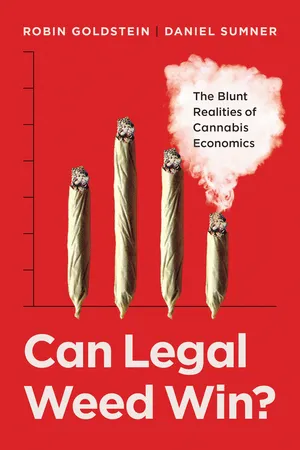
eBook - ePub
Can Legal Weed Win?
The Blunt Realities of Cannabis Economics
- 232 pages
- English
- ePUB (mobile friendly)
- Available on iOS & Android
eBook - ePub
Can Legal Weed Win?
The Blunt Realities of Cannabis Economics
About this book
Information
Publisher
University of California PressYear
2022Print ISBN
9780520397378
Edition
1eBook ISBN
9780520383272
1
We Call It Weed
Weed (Figure 2) is a product of the Cannabis sativa or Cannabis indica plant that gets you high. The most common form of weed is smokable flower buds, shown in Figure 2, which you can roll into a joint or smoke from a pipe. You can also consume weed by inhaling weed vapor from an electric device, eating a weed edible, or drinking a weed tincture or beverage.

FIGURE 2. Weed, in smokable flower form.
In this book, we choose to call the product “weed” rather than “cannabis” or “marijuana.” In making this choice, we diverge from most of the academic literature. We prefer a term used by buyers and sellers in real markets to a term used by government regulators. “Weed” is, first of all, what most consumers call it when talking among themselves. For instance: “Does anyone have some weed?” When weed consumers say this, they mean, precisely, a product of the Cannabis sativa or Cannabis indica plant that gets you high.
Figure 3 shows the relative numbers of Google searches (in proportion to all Google searches) for the terms cannabis, marijuana, and weed in each calendar year between 2004 and 2020. The Y axis of the graph is a relative search volume index where 100 is set to be the maximum value. We find no evidence that the effect illustrated by Figure 3 can be attributed to hipsters’ newfound interest in gardening.

FIGURE 3. Worldwide Google search interest in “cannabis,” “marijuana,” and “weed.”
Speaking of gardening, there’s also the term pot, which was popular in the late 1960s through early 2000s but has been waning in popular usage in recent years; and grass, whose contemporary usage is largely limited to boomers.
From a market perspective, cannabis and marijuana are less precise words. Cannabis, although often used in regulatory language to refer to weed, technically covers a broader category of products of the Cannabis sativa or Cannabis indica plant that includes industrial hemp and smokable products that don’t get you high.
Marijuana, meanwhile, is a term that was originally appropriated by the U.S. government as a slur against Mexican immigrants and was later defined under U.S. federal law as any product of the Cannabis sativa or Cannabis indica plant containing more than 0.3 percent THC (tetrahydrocannabinol, thought to be the main psychoactive ingredient in weed). Thus “marijuana” technically includes forms of cannabis like hemp cloth with 1 percent THC, which you would have to be pretty desperate to try to get high on.
To confuse things further, some governments call legal weed “cannabis” and illegal weed “marijuana” or switch back and forth between terms for the legal industry. For instance, the agency that regulates weed in California was first named the “Bureau of Medical Marijuana Regulation,” then renamed the “Bureau of Medical Cannabis Regulation,” then renamed the “Bureau of Marijuana Control,” then renamed the “Bureau of Cannabis Control,” then renamed the “Department of Cannabis Control.”
With due respect to the good people at these various agencies, which have been among the foremost supporters of weed economics research in the country, we just call the product “weed,” whether it is legal or illegal, recreational or medical. We also encourage you to do the same when weed is what you mean.
Weed Has a Long History
Human beings have been using weed for quite a while. According to Martin Booth’s Cannabis: A History, it was probably consumed in prehistoric civilizations for more than 5,000 years, for nutritional and perhaps also medical or spiritual reasons. Weed was “one of the first plants to be cultivated by mankind” and is now “more widely taken than any other drug save tobacco, alcohol, and aspirin.”
Weed was used in Neolithic China, in Hebrew temples, by Taoist priests, and possibly by Jesus Christ. The ancient Greek historian Herodotus, in the fifth century BC, wrote of weed being part of a funeral ritual: “Transported by the fumes, they shouted in their joy.” Fun funeral.
Sometime around 1155, according to Booth, in present-day northeastern Iran, a Persian monk named Haydar left his monastery near Neyshaur, went out for a walk, and discovered an unusual plant “standing unwithered by the blazing sun.” Haydar “grew curious . . . so he cut a few leaves and chewed them as he went on his way. Usually a taciturn man, he returned . . . with a smile on his face” and “remained in a capricious mood until his death sixty-six years later.”
As cannabis spread through the ancient world, it kept its linguistic roots in the Sanskrit cana, the ancient Greek kannabis, the Hebrew qanneb, Arabic qannob, Slavic konopla, Celtic quannab, and Spanish cañamo. The plant was named Cannabis sativa by Swedish botanist and Tree-of-Life inventor Carl Linnaeus in 1753. Cannabis indica was added in 1785 by Jean-Baptiste Lamarck, who identified a closely related species that was growing in India.
Although sativa and indica are thought by many in the cannabis market to have different effects on the brain, the two were long known to be hard to distinguish by their sensory or psychoactive properties. According to Booth: “It has been discovered that seeds taken from, say, a European Cannabis sativa plant and cultivated in India come to display some of the characteristics of the Cannabis indica plant in just a few generations—and vice versa.”
Nowadays, there is an urban legend, supported by many budtenders across North America, that indica relaxes your body and puts you to sleep, whereas sativa makes you creative, alert, and occasionally paranoid. The sativa-indica divide may be an effective tool for marketing or pricing. However, we haven’t seen any peer-reviewed studies showing that sativa could be differentiated from indica in a blind taste test or cognitive test, so we think that for now the issue remains unresolved scientifically.
Hemp Is Not Weed
Cannabis plants also have many industrial and standard food uses. In the United States and the rest of the world, it has long been an important agricultural crop, also known (generally when marketed in noningestible forms) as “hemp.”
It is hard to infer from ancient traces of cannabis whether the plant was being ingested for its psychoactive properties, used for its fiber, or both. Hemp seed is now widely used as a food ingredient among those willing to pay high prices compared to other oil seeds. Certainly, consumers know that weed is special, whereas much cannabis (hemp) is simply practical.
Today, the distinction between “hemp” and “marijuana” is a specific legal distinction created and curated with great force by the U.S. government, which labels any ingestible Cannabis sativa or Cannabis indica products with 0.3 percent THC or less (in a lab test) as “hemp,” and any products with more than 0.3 percent THC as “marijuana.”
In this book, we do not include hemp when we refer to weed.
What Is Recreational Weed?
You hear a lot about recreational weed legalization. We will talk about it a lot in this book. First we ask: What does it actually mean for weed to be “recreational”?
Research and reflection suggest that the word recreational is a strange and vague term that people now use mostly when talking about drugs (or maybe four-wheel-drive vehicles). For drugs, recreational is largely used in the context of, and in opposition to, the word medical. The most precise way one can define the modern usage of “recreational weed” is as any legal weed that’s not medical weed.
The word recreational has recently come into style mostly or entirely with respect to drugs, specifically as a way of referring to drugs that are not medical in the sense of having government-approved pharmaceutical uses. That is, the distinction is more a matter of law than of science or psychology.
In a former life, the Middle English word recreation (mental or spiritual consolation) came from the Latin recreare (to create again or renew), which sounds a bit like health, or at least wellness. Oxford’s more modern Lexico, on the other hand, defines “recreational (adj.)” first as “relating to or denoting activity done for enjoyment when one is not working: ‘recreational facilities,’ ” and second as “relating to or denoting drugs taken on an occasional basis for enjoyment: ‘recreational drug use.’ ” Merriam-Webster, the U.S. standard for dictionaries, goes as far as to call out Colorado weed in an example for recreational: “Colorado’s burgeoning marijuana industry had struggled under its own astonishing success since legal recreational sales began Jan. 1.”
It’s a historical turn of events that “enjoyment” is now a key part of “recreational.” Enjoyment, per Lexico, is “the state or process of taking pleasure in something (‘the enjoyment of a good wine’).” So recreation is now about pleasure, not about creation or renewal.
The Medicalization of Weed
Looking back through history, the distinctions between “food” and “drug,” and between “medical” and “recreational,” probably did not exist for the first few thousand years that human beings were using weed. Nonetheless, the use of weed in ways that we would now call “medical” has a long history. We can’t vouch for the specific claims, but according to Booth, by the late 1800s, 50 percent of all commercial medicine was made from cannabis plants. The idea that cannabis can be medicine is nothing new, even if some (including us sometimes) roll their eyes at the labeling of stoner-paradise shops as “medical dispensaries.”
Other drugs now thought of as mostly “recreational” also have histories of medical uses. Heroin was commercialized by Bayer, the pharmaceutical company, as a cure for coughs, colds, and opium addiction. Cocaine, methamphetamine (meth), and MDMA (ecstasy) also had many “medical” uses and at some points in time were administered more by doctors than by private citizens. Lately, there has also been some discussion of medical uses of psychedelics such as psylocibin (mushrooms).
Under the prevailing framework in the broad market for ingestible products (including foods, beverages, tobacco, legal and illegal drugs, etc.), all consumption is classified as either medical or recreational, and never as both—even if the medical and recreational versions of a product are identical in ...
Table of contents
- Subvention
- Title
- Copyright
- Contents
- Preface: Fear and Stoning in Las Vegas
- Acknowledgments
- 1 We Call It Weed
- 2 Legal versus Illegal: A Market Battle
- 3 Prices Get High
- 4 We Ask Our Data: Where’s the Cheapest Legal Weed?
- 5 California Dreamin’
- 6 Sabrina’s Story
- 7 Legal Weed in 2050
- 8 How to Survive Legalization
- Conclusion: Five Pipe Dreams about Legal Weed
- Bibliography
- Index
Trusted by 375,005 students
Access to over 1.5 million titles for a fair monthly price.
Study more efficiently using our study tools.
Frequently asked questions
Yes, you can cancel anytime from the Subscription tab in your account settings on the Perlego website. Your subscription will stay active until the end of your current billing period. Learn how to cancel your subscription
No, books cannot be downloaded as external files, such as PDFs, for use outside of Perlego. However, you can download books within the Perlego app for offline reading on mobile or tablet. Learn how to download books offline
Perlego offers two plans: Essential and Complete
- Essential is ideal for learners and professionals who enjoy exploring a wide range of subjects. Access the Essential Library with 800,000+ trusted titles and best-sellers across business, personal growth, and the humanities. Includes unlimited reading time and Standard Read Aloud voice.
- Complete: Perfect for advanced learners and researchers needing full, unrestricted access. Unlock 1.5M+ books across hundreds of subjects, including academic and specialized titles. The Complete Plan also includes advanced features like Premium Read Aloud and Research Assistant.
We are an online textbook subscription service, where you can get access to an entire online library for less than the price of a single book per month. With over 1.5 million books across 990+ topics, we’ve got you covered! Learn about our mission
Look out for the read-aloud symbol on your next book to see if you can listen to it. The read-aloud tool reads text aloud for you, highlighting the text as it is being read. You can pause it, speed it up and slow it down. Learn more about Read Aloud
Yes! You can use the Perlego app on both iOS and Android devices to read anytime, anywhere — even offline. Perfect for commutes or when you’re on the go.
Please note we cannot support devices running on iOS 13 and Android 7 or earlier. Learn more about using the app
Please note we cannot support devices running on iOS 13 and Android 7 or earlier. Learn more about using the app
Yes, you can access Can Legal Weed Win? by Dr. Robin Goldstein,Prof. Daniel Sumner in PDF and/or ePUB format, as well as other popular books in Economics & Economic History. We have over 1.5 million books available in our catalogue for you to explore.