- 280 pages
- English
- ePUB (mobile friendly)
- Available on iOS & Android
eBook - ePub
About this book
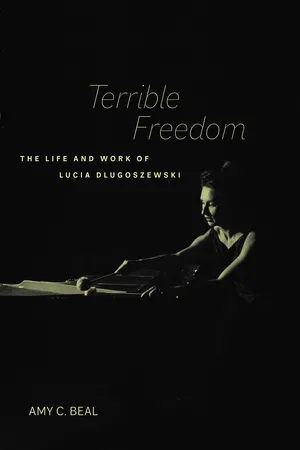
From her childhood in Detroit to her professional career in New York City, American composer Lucia Dlugoszewski (1925–2000) lived a life of relentless creativity as a poet and writer, composer for dance, theater, and film, and, eventually, choreographer. Forging her own path after briefly studying with John Cage and Edgard Varèse, Dlugoszewski tackled the musical issues of her time. She expanded sonic resources, invented instruments, brought new focus to timbre and texture, collaborated with artists across disciplines, and incorporated spiritual, psychological, and philosophical influences into her work. Remembered today almost solely as the musical director for the Erick Hawkins Dance Company, Dlugoszewski's compositional output, writings on aesthetics, creative relationships, and graphic poetry deserve careful examination on their own terms within the history of American experimental music.
Trusted by 375,005 students
Access to over 1.5 million titles for a fair monthly price.
Study more efficiently using our study tools.
Information
ONE

Lucille in Detroit (1925–48)
I think I wanted to be a composer even as a little girl because there are so many things that music can do, almost more than any other art. It can be faster and subtler, more sensual, more elusive. It can be larger and darker than we imagine, more mysterious, more violent. The dimension of its freedom is dizzying. Its sensitivity is unspeakable.1
FAMILY LIFE AND EARLY CHILDHOOD
Lucille Ruth Dlugoszewski was born in Detroit, Michigan, on 16 June 1925.2 During the year of her birth, Calvin Coolidge was inaugurated to his first elected term, F. Scott Fitzgerald’s “Roaring Twenties” era-defining novella The Great Gatsby was published, Igor Stravinsky conducted the New York Philharmonic during his first United States tour, and Louis Armstrong began fronting his own band. Less than a year after her birth, Detroit installed its first residential telephones.3
Lucille’s father Chester (Czeslaw; nicknamed “Czesio”) Dlugoszewski (1887–1975) arrived in the United States with an eighth-grade education in 1909. Before settling in Detroit he was employed as a sheet metal worker in Cleveland; in Depression-era Detroit Chester worked in the tool and die trade, eventually coming to work for Fisher Body, a branch of General Motors. Lucille’s mother Jennie (nicknamed “Jolas”) Goralewski (1903–1988) immigrated in 1913, having completed the equivalent of high school. Both parents were born and raised in the Polish town of Plock, on the Vistula River, some seventy miles northwest of Warsaw. Chester and Jennie married in Michigan on 1 March 1924; Jennie was naturalized in Detroit on 17 April 1931, and by 1940 Chester had been naturalized as well.
Lucille grew up fluent in Polish, and the Dlugoszewski household, which moved around frequently in Detroit during her young years, was one filled with Polish pride. A set of undated notes about her family background written down much later in Dlugoszewski’s life include some details about family music making and her parents’ courtship:
[Jennie’s sister] Helen played the violin and Jennie played the piano
They played duets together for their parents + Jennie’s husband, Chester fell in love with her when they played these duets
Chester and Jennie used to go dancing every week at the Polish National Home in Detroit on Chene St. before they were married + danced to 3 o’clock in the morning
when they were first married + Lucia was born they lived on MacDougall in Detroit4
In 1930, the Dlugoszewskis lived at 14637 Glenwood Avenue, in the northeastern part of the city near the well-to-do suburb of Grosse Pointe. Between approximately 1935 and 1940, they lived in a rented house at 5210 Moran Street, not far from the General Motors Hamtramck Assembly Plant. (The MacDougall Street mentioned [above] in Dlugoszewski’s autobiographical notes also stood in the shadow of the GM Hamtramck Assembly Plant, just a few blocks from Moran Street.) In 1942, the year of Lucille’s graduation from high school, Chester registered for the draft, and listed his address as 5327 Baldwin Avenue, about a mile away from their previous house on Moran Street, and this is the address Lucille used throughout her college years. By August 1948 the family had moved to 9894 Chenlot Avenue. Later in life she claimed to have grown up in Detroit’s “slums.”5
In an interview conducted around 1960, Dlugoszewski characterized her childhood in Detroit in unambiguous ways. She described the cultural background of her Polish-born parents, and described Poland—a place she never visited—as “a country vivid for rebellion, courage, exile.” (She also referred to what she called the family’s musical “chauvinism” with regard to their preference for Polish composer Frédéric Chopin.6) She described her father as being agnostic but raised culturally Catholic, with interests in mathematics, science, and dialectics. She described her mother as an amateur painter and as a person drawn to nature. Furthermore, she said, her mother displayed “simplicity, sensibility, respect for danger, lack of sentimental romanticism and idealism, [and a] delight in clear, radiant physicality.” This trope remained consistent throughout her life: a feature article in the Detroit News published in 1972 explained that “Lucia credits her father, who was a toolmaker, with filling her head with liberal politics and intellectual pursuits; her mother, a painter and naturalist, nurtured her interest in the arts.”7 (In a separate, undated, typewritten “biography” Lucille described her father as an “ardent amateur in mathematics and political science” and her mother as a “painter.”) She identified her hometown as “a factory city, therefore haunted, ugly, surreal, [and] slightly Charles Dickens.” She recalled growing up surrounded by Midwestern dialects, French and Native American place names, and the unique terrain of the Great Lakes region: the “delicate blue uniqueness of [the] Northern sky and fresh water, exquisite bareness of deciduous trees . . . , much smell of snow.”8 The Michigan of Dlugoszewski’s youth would remain a powerful source of metaphor and nostalgia throughout her life.
Her ambiguous reference to Dickens notwithstanding, Lucille’s poetic depiction of her hometown neglected to mention the grim and gritty realities of the Detroit in which she grew up. Her “haunted, ugly, surreal” factory city was perhaps made so in part through the corruption of the Prohibition-era bootleg industry, strangled by organized crime’s violent domination over liquor trafficking across the Detroit River between Windsor, Ontario, and Michigan speakeasies and “blind pigs”—illegal drinking locales, perhaps as many as twenty-five thousand of them in Detroit alone during Prohibition. As much as 85 percent of all the liquor smuggled into the United States from Canada is likely to have entered the United States in this way.9
The auto industry flourished alongside the organized distribution of hundreds of millions of dollars’ worth of bootleg Canadian liquor.10 As a result, Lucille and her family—especially her father, who worked in the auto industry—were eyewitnesses to the unprecedented and also violent union activities in Detroit, Pontiac, and elsewhere in the region, including the first “sit-down” strike at the General Motors Fisher Body Plant No. 1 in Flint on 30 December 1936, during the fight to establish the United Auto Workers. Racial tensions resulting from attempts to desegregate public housing were also on the rise during Lucille’s childhood and teenage years. And as the United States entered the Second World War, Detroit’s auto industry, suddenly known as “The Arsenal of Democracy,” exclusively manufactured war materials like armored tanks, bomber planes, and other vehicles for use in the battles overseas.11 In the immediate postwar era, while Lucille was in college at Detroit’s Wayne State University, the metropolis saw large populations moving away from the inner city and out toward the automobile-friendly suburbs. Lucille’s family, too, eventually moved to a wooded lakeside suburb outside the city.
The Detroit of Lucille’s childhood was also one populated by Polish immigrants and second-generation Polish Americans, some three hundred fifty thousand of them by 1930, many of whom were drawn to the area because of the booming automobile industry. In particular, the Polish neighborhood of Hamtramck increased from just under four thousand in 1910 to a peak population of sixty thousand in 1928, and was by some accounts the most densely populated city in the United States at that time.12 “Hamtramck was a very comfortable place for Poles,” wrote local historian Dennis Badaczewski: “For immigrants especially it was a place where one could remain Polish—speaking the same language, following the same religion, living by the same customs, as in Poland.”13 Most Poles in Detroit during the Depression were Catholic churchgoers, many of whom belonged to the Polish National Catholic Church.14 This hegemonic culture clashed with a new wave of immigrants from the South in the early 1940s, namely some estimated fifty thousand African Americans and two hundred thousand whites from West Virginia, Kentucky, and Tennessee, who came to work in Detroit’s factories, bringing with them a new dynamic in racial conflict that caused the city to face “a rapid deterioration of race relations.”15
In the shadow of these conflicts, Lucille’s family seems to have adhered to certain Polish customs, including the typical Christmas Eve Wigilia (“vigil,” in Polish) dinner, a traditional meal with holiday-specific foods, and festivities that began with the first appearance of the evening star.16 Dlugoszewski invoked the spirit of Wigilia throughout her life, perhaps because it symbolized her Polish heritage and upbringing. The word itself would become obsessively recycled in Dlugoszewski’s later writings, as did references to the appearance of the evening star. In several of those writings, she also analyzed the divergent influences her parents had on her psychological makeup, blaming her mother, on at least one occasion, for her own competitive nature:
Jolas
seduced me
ravished me through aesthetics
then lived through me
so nothing I did was good enough
and she made me think
that she would stop loving me
if I didn’t get every prize
every award
and my one escape route
where I was true
was my creativity and the open door to that adventure
also
intellectual adventure
which was
always
Czesio
Another writing made a similar comparison of her parents, with a more favorable depiction of her mother:
Czesio courage
courage thru intellect
Face anything
but this way you know
you understand
+ that is worth
the world + a whole life
Jolas courage
the gift of courage
not through intellect
but through love
go sweet adventurer
try the most dangerous challenge
Have that ultimate fun of life
of trying the limit of adventure
don’t fear, you have nothing to lose
because I will always love you
In the late 1980s, for the benefit of a New York Times writer, Dlugoszewski described herself as “the only child and hope of a Polish immigrant family.” “So I had to be a prodigy,” she added.17
Lucille attended Detroit public schools and completed first grade at the Ferry School in Grosse Pointe Woods the day after her sixth birthday. Her elementary school report cards show that she was repeatedly given excellent marks in the subjects of literature, geography, and music. Lucille also wrote prolifically from an early age, and since her father worked away from home in Flint, Michigan, for an extended period while she was young, she had ample opportunities to practice her letter-writing skills. Her earliest extant letters, written to her father when she was just eight years old, revealed her enthusiasm for school, her love of learning, and her pride in her own academic successes.18
In other letters from this period she told her father about poems she was writing, and would relay conversations she had with people during the course of her days. She described receiving mail from the White House after she sent a letter to President Roosevelt (an executive branch spokesperson explained that the commander in chief did...
Table of contents
- Imprint
- Subvention
- Title Page
- Copyright
- Dedication
- Epigraph
- Contents
- List of Illustrations
- Acknowledgments
- Margins, Shadows, and Footnotes: An Introduction
- 1 • Lucille in Detroit (1925–48)
- 2 • Letters from New York (1949–51)
- 3 • New York Beginnings: A Broader View (1950–53)
- 4 • Expanding Creativity and Collaboration (1953–60)
- 5 • The Disparate Element (1960–70)
- 6 • Aesthetic Immediacy (1970–80)
- 7 • Rage (1980–87)
- 8 • Losses (1988–2000)
- Out from the Shadows: A Conclusion
- Appendix 1: Selected Works List
- Appendix 2: Lucia Dlugoszewski–Erick Hawkins Collaborations
- Appendix 3: Discography
- Notes
- Sources and Bibliography
- Index
Frequently asked questions
Yes, you can cancel anytime from the Subscription tab in your account settings on the Perlego website. Your subscription will stay active until the end of your current billing period. Learn how to cancel your subscription
No, books cannot be downloaded as external files, such as PDFs, for use outside of Perlego. However, you can download books within the Perlego app for offline reading on mobile or tablet. Learn how to download books offline
Perlego offers two plans: Essential and Complete
- Essential is ideal for learners and professionals who enjoy exploring a wide range of subjects. Access the Essential Library with 800,000+ trusted titles and best-sellers across business, personal growth, and the humanities. Includes unlimited reading time and Standard Read Aloud voice.
- Complete: Perfect for advanced learners and researchers needing full, unrestricted access. Unlock 1.5M+ books across hundreds of subjects, including academic and specialized titles. The Complete Plan also includes advanced features like Premium Read Aloud and Research Assistant.
We are an online textbook subscription service, where you can get access to an entire online library for less than the price of a single book per month. With over 1.5 million books across 990+ topics, we’ve got you covered! Learn about our mission
Look out for the read-aloud symbol on your next book to see if you can listen to it. The read-aloud tool reads text aloud for you, highlighting the text as it is being read. You can pause it, speed it up and slow it down. Learn more about Read Aloud
Yes! You can use the Perlego app on both iOS and Android devices to read anytime, anywhere — even offline. Perfect for commutes or when you’re on the go.
Please note we cannot support devices running on iOS 13 and Android 7 or earlier. Learn more about using the app
Please note we cannot support devices running on iOS 13 and Android 7 or earlier. Learn more about using the app
Yes, you can access Terrible Freedom by Amy C. Beal in PDF and/or ePUB format, as well as other popular books in Media & Performing Arts & Music. We have over 1.5 million books available in our catalogue for you to explore.