- 208 pages
- English
- ePUB (mobile friendly)
- Available on iOS & Android
eBook - ePub
The 50 Greatest Explorers in History
About this book
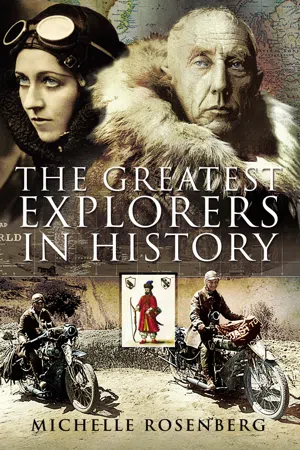
This is a book about one of the first recorded pilgrims who climbed Mount Sinai; it's about Amelia Earhart, the famous American aviator whose story and disappearance continues to capture the world's imagination. It's the story of a doomed expedition to discover the North West Passage, and the tale of Marco Polo, who remained at the court of the Kublai Khan for an incredible 17 years. The 50 Greatest Explorers in History brings to life the pioneers in aviation flying thousands of miles with the most basic of maps in open cockpits, exposed to the elements and the unrelenting smell of petrol fumes. They travel by steamboat, on horseback, by rickshaw, motorbike, train, swim with piranhas, embark into black nothingness in new spacecraft, explore by Jeep, yachts, tea boats and elephants, disguise themselves as men, take canoes and use innovative, advanced technological scuba equipment. Going where in many cases, no man or woman had ever gone before, some women featured in this books were often denied respect, acknowledgment, or recognition and they determined to break the 'men's club' mentality of global exploration from which they were excluded.
Information
Subtopic
Historical BiographiesIndex
HistoryChapter 1
Amelia Earhart
(24 July 1897–1937)
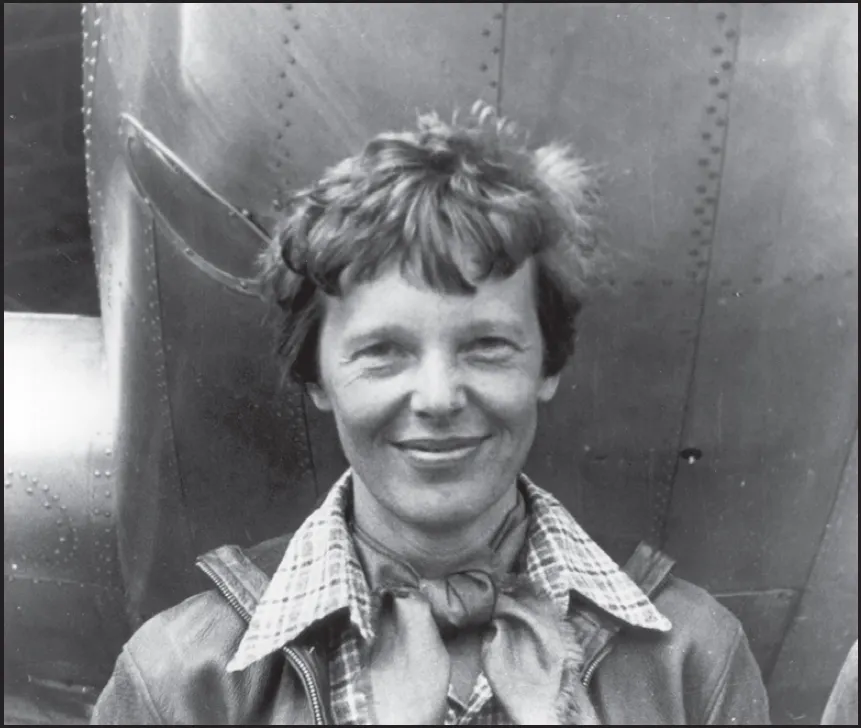
[Women] do get more glory than men for comparable feats. But, also, women get more notoriety when they crash.
Amelia Earhart: the famous American aviator whose story and disappearance has captured the imagination of the world. Until relatively recently, her fate and death remained a fiercely debated mystery.
Born in Atchison, Kansas, she was captivated by the pilots training at a local airfield. During the First World War, she served as a Red Cross nurse’s aide in Toronto in Canada. On her eventual return to the US, she enrolled at New York’s Columbia University as a pre-medical student. She took her first plane ride in 1920 and the rest is history. In 1923, she became the sixteenth woman to receive a pilot’s licence.
She was the first president of the organization of licensed pilots, the Ninety-Nines, and in 1928 she was the ‘aviation’ editor of Cosmopolitan magazine.
Preferring smelling salts instead of tea or coffee to keep her awake during long flight hours, on 17 June 1928, she embarked from Newfoundland on an epic flight across the Atlantic with pilots Wilmer ‘Bull’ Stulz and Louis E. ‘Slim’ Gordon. Twenty-one hours later, she had become the first woman to cross the Atlantic.
She would later become the first woman to fly solo across the Atlantic (where she had a cup of hot chocolate for sustenance) and the first person to fly, solo, from Hawaii to the US.
On 1 June 1937, she set off in an attempt to become the first woman to circumnavigate the globe. She disappeared over the Pacific in July 1937 in her Lockheed Electra 10E.
In a letter to her husband, George Putnam (they married on 7 February 1931), she had written: ‘Please know I am quite aware of the hazards. I want to do it because I want to do it. Women must try to do things as men have tried. When they fail, their failure must be but a challenge to others.’
New evidence and theories suggest that rather than the widely held belief that they crashed into the Pacific, Earhart and her companion and navigator Fred Noonan, low on fuel, were forced to land on the reef of Gardner Island, 2,000 miles from Hawaii.
The theory says that they sent a series of emergency radio signals to Itasca, the Coast Guard vessel in charge of monitoring this particular leg of Earhart’s journey. Those radio signals were sent at low tides, the only times when the water level was low enough for the plane’s engine to safely run without risk of flooding.
Two days after their forced landing, a message from Earhart was received via radio frequency by a listener in San Francisco: ‘Still alive. Better hurry. Tell husband all right.’
On 7 July, another message, intercepted by a listener in New Brunswick, Canada: ‘Can you read me? Can you read me? This is Amelia Earhart … Please come in.’
And then the last message: ‘We have taken in water, my navigator is badly hurt … we are in need of medical care and must have help. We can’t hold on much longer.’
And that was it. Nothing further was intercepted or heard from Earhart.
Most recently, in January 2019, debris of a plane that might have been Earhart’s, has been discovered off Papua New Guinea. At last writing, National Geographic Explorer at Large, Dr Robert Ballard, is leading a team to discover what happened to Amelia.
National Amelia Earhart Day is celebrated on 24 July.
Sources
https://www.history.com/topics/exploration/amelia-earhart
https://eu.usatoday.com/story/news/2018/07/24/amelia-earhart-birthday-distress-call/782617002/
https://www.rd.com/culture/amelia-earhart-facts/
Chapter 2
Amy Johnson
(1 July 1903–5 January 1941)
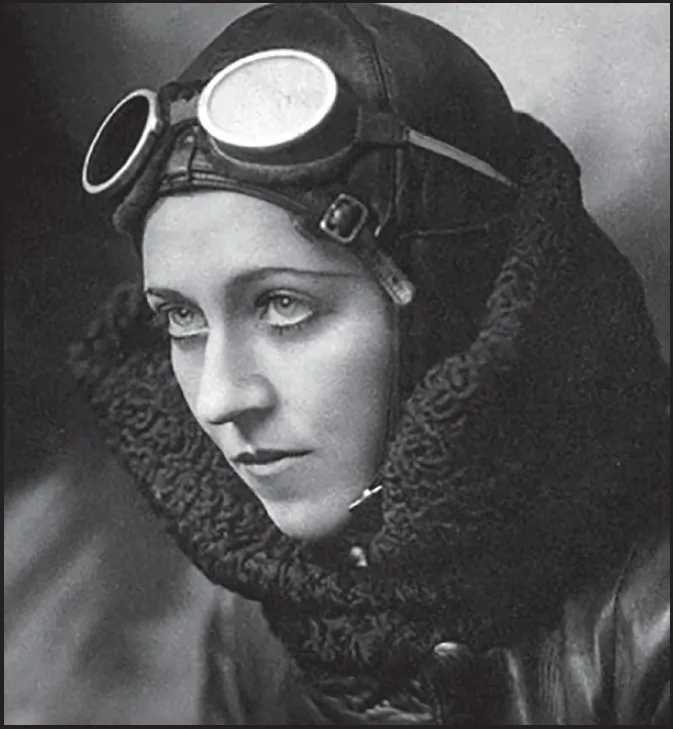
Setting off unknown to face the unknown, against parental opposition, with no money, friends, or influence, ran it a close second. Clichés like ‘blazing trails,’ flying over ‘shark-infected seas,’ ‘battling with monsoons,’ and ‘forced landings amongst savage tribes’ became familiar diet for breakfast. Unknown names became household words, whilst others, those of the failures, were forgotten utterly except by kith and kin.
Born in Hull, the eldest of four sisters, Amy Johnson completed a Bachelor of Arts in Economics at Sheffield University. After a love affair with Swiss businessman Hans Arregger went awry, she moved to London to work as a typist for a firm of solicitors. A chance visit to the Stag Lane Aerodrome in Edgware, north London, led her to start flying in 1929 as a hobby; she received her pilot’s ‘A’ licence in July 1929.
Her father was one of her biggest champions, supporting her financially when she bought her first plane, a second-hand Gipsy Moth that she named Jason, in honour of his fish export and import business.
A true pioneer in aviation and determined to demonstrate that women could compete in what was a male-dominated arena, just a year later, on 5 May 1930, she set off in Jason from Croydon – travelling solo the 11,000 miles it took to arrive in Darwin, Australia, nineteen days later on 24 May.
There was no radio contact with the ground. No weather satellite information systems. Only basic maps and an open cockpit exposing her to the elements and the unrelenting smell of petrol fumes. She would fly up to eight hours at a time before refuelling stops. Up until that point, her longest solo flight was between London and Hull.
The previous record set by Australian Bert Hinkler was sixteen days; although she didn’t break that, she became the first female pilot to fly solo from Britain to Australia, was awarded a CBE for her efforts, and the time she took to fly from Croydon to India did establish a new record flight time for aviation.
That same year, in December, she became the first woman in England to be given an Air Ministry’s ground-engineer licence.
She married pilot Jim Mollison in 1932 (rumour has it that he proposed in the cockpit after flying for eight hours together) but they divorced in 1938. Together they flew a DH Dragon non-stop from South Wales all the way to the USA in 1933. They also took part in the England to Australia air race, flying non-stop to India in 1934 in a DH Comet.
Amy set other records, including becoming the first pilot to fly from London to Russia in one day; she set a record time for Britain to Japan with her co-pilot, Jack Humphreys, and a solo record for the flight between London and Cape Town.
As the Second World War started, she joined the Air Transport Auxiliary as a pilot, tasked with transporting men and aircraft from factory airstrips to Royal Air Force bases. During that time she was made a first officer. She also modelled clothes for fashion designer Elsa Schiaparelli, designed her own travel bag and was president of the Women’s Engineering Society (1935–1937).
Amy died mysteriously on 5 January 1941, when her Airspeed Oxford crashed into the Thames Estuary. Her body was never found. She had been delivering the plane to Kidlington airbase – the flight time was only an hour and a half – easy for someone who’d conquered the Britain to Australia flight eleven years earlier. There was freezing fog that day; four and a half hours after take-off, and 100 miles off-course, she crashed into the Thames Estuary. There is great suspicion and intrigue over her death, with some convinced she was working as a spy and that there was a great cover-up over her death.
Parts of the plane washed up nearby, as did her travelling bag, her log book and cheque book. She was just 37 years old.
Sources
http://amyjohnsonartstrust.co.uk/her-life/
https://amyjohnsonproject.org/aboutamy/
https://www.questia.com/library/journal/1G1-217244391/fashion-takes-flight-amy-johnson-schiaparelli-and
https://www.hullwebs.co.uk/content/l-20c/people/amy-johnson/amy-johnson.pdf
Chapter 3
Annie Smith Peck
(19 October 1850–18 July 1935)
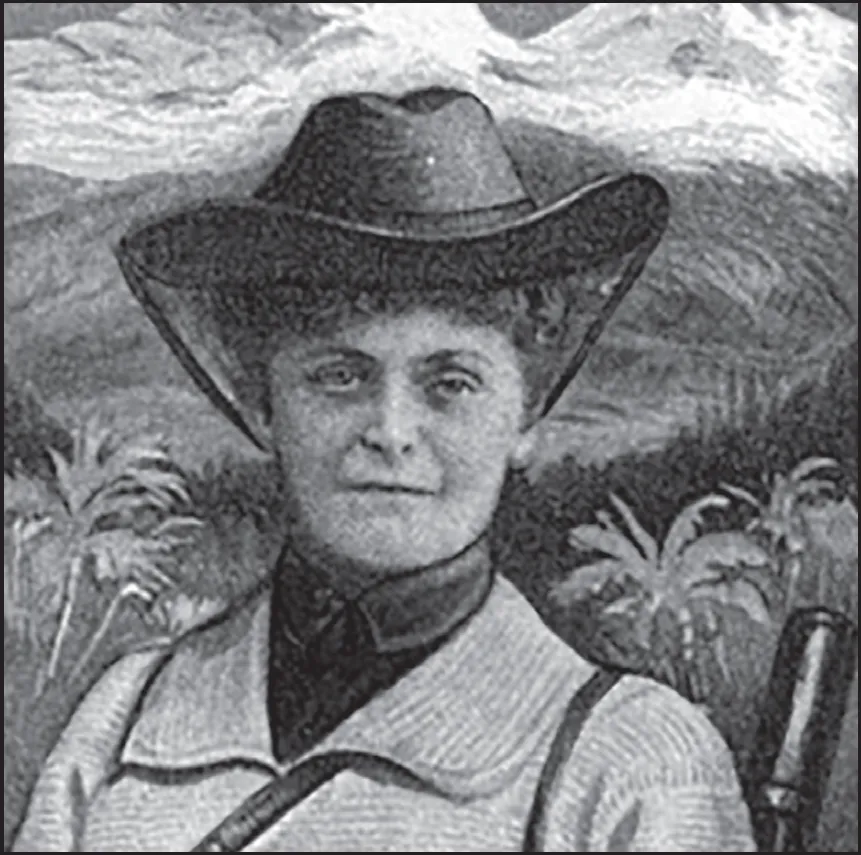
Climbing is unadulterated hard labour. The only real pleasure is the satisfaction of going where no man has been before and where few can follow.
Nineteenth-century suffragette and mountaineer Annie Peck hung a ‘Votes for Women’ banner on Mount Coropuna in Peru. She was 61 years old, it had taken her five attempts over four years and she was the first person to do it. That right there tells you what you need to know. She later referred to the experience as a ‘horrible nightmare’.
Annie was the youngest of five children, and the only daughter. Born on 19 October 1850, in Providence, Rhode Island, into a traditional New England family, her father George, was a lawyer and her mother, Anna Smith Peck, a descendant of Roger Williams, the Puritan minister who founded the Rhode Island colony and was firmly against the confiscation of land from Native Americans and firmly for religious toleration and the separation of church and state.
Annie never married and never had children. Having received a good education, she did one of the few things open to women at the time: she became a teacher, graduating from Rhode Island Normal School (a teaching establishment) in 1872. Keen to continue, she wanted to apply to Brown University, like her brothers and father before her. She was refused admission because she was a woman. She moved to Michigan t...
Table of contents
- Cover
- Dedication
- Title
- Copyright
- Contents
- Foreword: Reflecting on a Life of Travel
- Chapter 1 Amelia Earhart (24 July 1897–1937)
- Chapter 2 Amy Johnson (1 July 1903–5 January 1941)
- Chapter 3 Annie Smith Peck (19 October 1850–18 July 1935)
- Chapter 4 Beryl Markham (26 October 1902–3 August 1986)
- Chapter 5 Egeria (dates unknown)
- Chapter 6 Emma Rowena Gatewood aka Grandma Gatewood (25 October 1887–4 June 1973)
- Chapter 7 Fanny Bullock Workman (8 January 1859–22 January 1925)
- Chapter 8 Freya Stark (31 January 1893–9 May 1993)
- Chapter 9 Gertrude Bell (14 July 1868–12 July 1926)
- Chapter 10 Harriet Chalmers Adams (22 October 1875–July 17 1937)
- THE EXPLORERS CLUB
- THE MEN
- THE RACE TO THE SOUTH POLE
- SPACE
Trusted by 375,005 students
Access to over 1.5 million titles for a fair monthly price.
Study more efficiently using our study tools.
Frequently asked questions
Yes, you can cancel anytime from the Subscription tab in your account settings on the Perlego website. Your subscription will stay active until the end of your current billing period. Learn how to cancel your subscription
No, books cannot be downloaded as external files, such as PDFs, for use outside of Perlego. However, you can download books within the Perlego app for offline reading on mobile or tablet. Learn how to download books offline
Perlego offers two plans: Essential and Complete
- Essential is ideal for learners and professionals who enjoy exploring a wide range of subjects. Access the Essential Library with 800,000+ trusted titles and best-sellers across business, personal growth, and the humanities. Includes unlimited reading time and Standard Read Aloud voice.
- Complete: Perfect for advanced learners and researchers needing full, unrestricted access. Unlock 1.5M+ books across hundreds of subjects, including academic and specialized titles. The Complete Plan also includes advanced features like Premium Read Aloud and Research Assistant.
We are an online textbook subscription service, where you can get access to an entire online library for less than the price of a single book per month. With over 1.5 million books across 990+ topics, we’ve got you covered! Learn about our mission
Look out for the read-aloud symbol on your next book to see if you can listen to it. The read-aloud tool reads text aloud for you, highlighting the text as it is being read. You can pause it, speed it up and slow it down. Learn more about Read Aloud
Yes! You can use the Perlego app on both iOS and Android devices to read anytime, anywhere — even offline. Perfect for commutes or when you’re on the go.
Please note we cannot support devices running on iOS 13 and Android 7 or earlier. Learn more about using the app
Please note we cannot support devices running on iOS 13 and Android 7 or earlier. Learn more about using the app
Yes, you can access The 50 Greatest Explorers in History by Michelle Rosenberg in PDF and/or ePUB format, as well as other popular books in History & Historical Biographies. We have over 1.5 million books available in our catalogue for you to explore.