- 224 pages
- English
- ePUB (mobile friendly)
- Available on iOS & Android
eBook - ePub
About this book
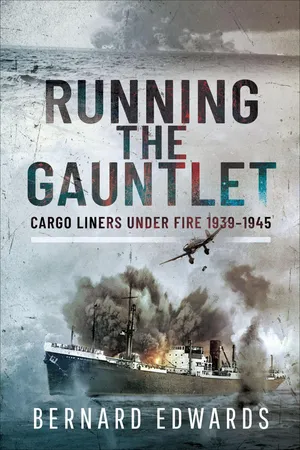
The British Merchant Navy dominated the world trade routes in the years leading up to the Second World War. The star players of the fleet were the cargo liners, faster and larger than the tramps and offering limited passenger accommodation. On the outbreak of war these cargo liners became crucial to the nation's survival using their speed and expertise to evade Nazi warships, raiders and U-boats. Initially operating alone, but increasingly relying on Royal Navy protected convoys, these key elements of the Merchant Navy plied the oceans and seas despite mounting losses, throughout the war years. This superbly researched book describes numerous dramatic incidents. Some ended in disaster such as the New Zealand Shipping Company's Turakina which was sunk after a running battle with the German raider Orion. Others were triumphs for example Operation Substance when six fast cargo liners succeeded against all the odds in reaching besieged Malta with vital supplies. The common denominations in all these historic voyages were the courage and skilled seamanship of the Merchant Navy crews. As Running The Gauntlet vividly illustrates, their contribution to victory, too long overlooked, cannot be overstated.
Trusted by 375,005 students
Access to over 1.5 million titles for a fair monthly price.
Study more efficiently using our study tools.
Information
Subtopic
Military & Maritime HistoryIndex
HistoryCHAPTER ONE
The Gentleman Raider
The rattle of crockery from the Officers’ Pantry below warned the Norseman’s wireless operator that lunch was on the way and it was almost time to go off watch. He reached for his pen and began to write up the log.
There was little to report. It was Sunday, 30 September 1939, and the Cable & Wireless ship was on station off the north-east coast of Brazil, a lonely spot where even the cry of the seagull was subdued. Furthermore, the war was only four weeks old, and any other ships in the area were keeping strict radio silence. Radio watchkeeping in these troubled times had been reduced to sheer boredom. No longer was the Norseman’s operator able to while away the watch chatting to passing ships or distant shore stations; he was condemned to re-reading the same old well-thumbed paperback, with one ear tuned to nothing but the irritating crackle of atmospherics. It seemed to him that although radio silence might be necessary in the Western Appproaches, where Hitler’s U-boats were busy laying waste to Allied shipping, out here, 3,000 miles removed from the conflict, such a precaution was hardly called for. He glanced out of the window. Overhead, the sky was an untroubled blue, a gentle breeze was hard pressed to raise even a ripple on an even bluer sea, and only the occasional wisp of smoke marred a horizon that was as sharp as a whetted knife. The cold, wet Western Approaches were truly a world away.
The operator was about to throw the off switch on his receiver when a faint burst of morse broke the silence of the ether. He snatched up his headphones and listened. When it came again, the message was still faint, but unmistakable in its meaning: RRR RRR 09 08S 3404W CLEMENT GUNNED. The prefix RRR was code for ‘I am being attacked by an enemy surface raider’. Somewhere, 2,500 miles south of the Norseman, a British ship was in trouble.
The cable ship’s operator passed the distress message to the Norseman’s Captain, who despite the danger of giving away his own ship’s position to the enemy, decided to break radio silence to warn the Admiralty of the presence of a German surface raider off Brazil.
All efforts to contact shore stations in the West Indies were in vain, and in desperation the Norseman’s operator went over to short wave and called Portishead Radio, some 3,000 miles away in the Bristol Channel. Here, he also drew a blank, for although Portishead was an extremely powerful station, normally able to keep in touch with ships worldwide, the atmospheric conditions were adverse.
Fortunately, later in the day the Norseman did suceed in contacting the American steamer Mormacrio, then in the vicinity of Pernambuco. She repeated the Clement’s RRR signal to a nearby shore station, which in turn passed it to the British Consul in Pernambuco. By this devious route the signal finally reached the Admiralty in London.
The 5,051-ton Clement, owned by the Booth Steamship Company of Liverpool, was one of a 30-strong fleet of medium-sized cargo/passenger carriers whose stock-in-trade had for many years been an advertised service from Liverpool to North Brazil via Oporto, Lisbon and Madeira. On this occasion, having left Liverpool some weeks earlier, the Clement was engaged on an intermediate run from New York to Bahia carrying 20,000 cases of kerosene. Packed two 5-gallon drums to a case, this amounted to a total of 200,000 gallons of potential fire hazard, a cargo Captain Harris and those who sailed with him would be heartily glad to see the back of. The Clement then being only 200 miles north of Bahia, journey’s end was almost in sight.
Captain Frederick Charles Pearce Harris, RNR, immaculate as ever in crisp white tropical uniform, had enjoyed a full English breakfast, and was ready for the day’s work. Being Sunday, it was Captain’s inspection of the accommodation and galleys at eleven o’clock, but first he must write a letter to Head Office advising them of the progress of the voyage so far, which he was happy to report had been without incident.
Contributing to Captain Harris’s good spirits was the knowledge that having put 4,000 miles of the Atlantic behind her, the Clement was well out of the war now raging in Europe. Although hostilities were yet to break out on land, in the Western Approaches there were reports of mayhem. Ships were sinking, men were dying. Meanwhile, the Clement continued to sail unchallenged and was unlikely to come within shooting range of the enemy. There were rumours that a German commerce raider was somewhere in the area, but the threat was so vague as to be ignored.
Harris put down his pen when the whistle of the bridge voicepipe shrilled urgently. It was Third Officer Gill, who had the watch on the bridge, reporting an unidentified warship sighted on the port bow, and bearing down on the Clement at speed.
Hurrying to the bridge, Captain Harris examined the approaching ship through his binoculars. She was end-on, and difficult to identify, but she certainly had the distinctive silhouette of a man-of-war – and a large one at that. Her high bowwave indicated she was closing at something like 30 knots. Under normal circumstances, this would have been alarming. But no alarm bells rang for Captain Harris. Prior to sailing from New York he had been informed that the British light cruiser Ajax was in the area, and at some time the Clement was quite likely to be challenged and boarded. He ordered the ensign to be hoisted and warned the engine room to stand by for orders.
That the Clement was about to be challenged was true enough, but not by HMS Ajax or any other British ship. Her challenger was the German pocket battleship Admiral Graf Spee, whose namesake’s origins lay deep in the history of Anglo-German relations. The link went back a quarter of a century to November 1914, when the German East Asia Squadron, under Vizeadmiral Maximilian Johannes Maria Hubert Graf von Spee, inflicted a humiliating defeat on the Royal Navy at the Battle of Coronel.
The German East Asia Squadron was made up of the two heavy cruisers Scharnhorst and Gneisenau, the light cruisers Dresden, Leipzig and Nürnberg, and a number of supply colliers. On 1 November 1914, this force met up with with a British squadron at Coronel, off the coast of Chile. The British squadron consisted of the armoured cruisers Good Hope and Monmouth, the light cruiser Glasgow, and the armed merchant cruiser Otranto, all under the command of Rear Admiral Christopher Cradock.
Gun for gun, the two opposing forces were evenly matched, but there the similarity ended. Whilst the German ships were all comparatively new, Good Hope and Monmouth were built at the turn of the century and Glasgow was five years old and in need of modernization. Furthermore, the men manning these British ships were largely reservists, sadly lacking in gunnery training. The armed merchant cruiser Otranto, on the other hand, was an 18-knot ex-passenger liner mounting a handful of ancient 4.7s firing over open sights, and likely to prove more of a liability than an asset in a fight. This Cradock was quick to realize and he detached Otranto out of harm’s way before the action began.
The battle was joined as the sun was going down on 1 November, with von Spee craftily positioning his ships in the shadow of the coast. The British ships were silhouetted by the light of the setting sun, and hopelessly outclassed from the start. The combined gunfire of Scharnhorst and Gneisenau quickly overwhelmed Good Hope and Monmouth, and both the British heavy cruisers were sunk with all hands, some 1,600 men being lost. HMS Glasgow was forced to run and escaped only by virtue of her superior speed.
The Battle of Coronel was the Royal Navy’s first significant defeat since the days of Nelson and Napoleon, and it caused consternation at home and abroad. Anticipating a swift response from the vastly superior British forces he knew to be in the area, Vizeadmiral Graf von Spee lost no time in quitting the Pacific. He is quoted as saying, ‘You must not forget that I am homeless. I cannot reach Germany… I must fight my way through the seas of the world doing as much mischief as I can, until my ammunition is exhausted, or a foe far superior in power succeeds in catching me. But it will cost the wretches dearly before they take me down.’
As von Spee had anticipated, the Royal Navy was quick to seek retribution for the loss of the Good Hope and Monmouth, and the victorious East Asia Squadron now became the hunted. The German ships fled east, rounding Cape Horn undetected. They might well have got clean away, had von Spee not been tempted to strike one last blow against his enemies. Moving into the South Atlantic, the squadron closed the Falkland Islands intent on bombarding the Royal Navy’s coaling station at Port Stanley. Von Spee had assumed the base would be unguarded, but unfortunately for him, the pre-dreadnought battleship HMS Canopus, mounting four 12-inch guns, had been beached just inside the breakwaters. As the German ships approached, Canopus opened fire with her big guns, some of her shells falling uncomfortably close to Scharnhorst and Gneisenau. Caught unawares, and fearful that his heavy cruisers might receive serious damage, von Spee abandoned the attack and made off at full speed.
And that would have been that, had not HMS Inflexible and HMS Invincible been patrolling waters nearby. Alerted by Canopus, the two 20,000-ton battlecruisers set off in pursuit of the enemy squadron.
The British ships had a top speed of 26½ knots, and the chase was short-lived. In just over an hour, the German vessels were being pounded by the guns of Inflexible and Invincible, each of which mounted four twin 12-inch turrets. Scharnhorst and Gneisenau replied but their 8-inch guns were no match for the combined firepower of the British battlecruisers. Of the East Asia Squadron, only the light cruiser Dresden survived. Scharnhorst, Gneisenau, Leipzig and Nürnberg all went to the bottom, taking with them some 2,200 men, including their leader Vizeadmiral Maximilian Graf von Spee and his two sons Ferdinand and Heinrich, who were serving as lieutenants in the squadron.
Although the East Asia Squadron was roundly defeated at the Falklands, Maximilian von Spee was hailed as a hero in Germany. When the dust of 1918 had settled and the German Navy was again becoming a force to be reckoned with, his name would be remembered and honoured.
On the outbreak of war in July 1914, Germany was ranked as one of the world’s great naval powers. Her Imperial Navy then consisted of 14 dreadnought battleships, 22 pre-dreadnoughts, 4 battlecruisers, 9 armoured cruisers, 41 cruisers, 144 destroyers, 28 submarines, and various small craft. The Treaty of Versailles, signed in June 1919, had been designed to put an end to Germany’s warlike ambitions, and one of the restrictions imposed on her was the reduction of her fleet to 6 pre-dreadnought battleships, each of not more than 10,000 tons displacement, 6 light cruisers, 12 destroyers, and 12 torpedo boats. In the light of the damage they had done to Allied merchant shipping during the war, no submarines were to be allowed.
As might be expected, these savage cuts were not well received in Germany, and when Adolf Hitler came to power in 1933 a veil of secrecy was drawn around German naval shipbuilding activity. Little control was exercised by the Treaty Powers, leaving the design engineers of Hitler’s new Reichsmarine free to work their magic. One of the end results was the building of three battlecruisers of the Deutschland class, one of which was named Admiral Graf Spee in memory of the hero of Coronel.
The Graf Spee, classified as a pocket battleship by the Admiralty, was ready for sea in January 1936. In order to conform with the restrictions of the Treaty of Versailles, she was declared as having a load displacement of 10,000 tons, whereas she actually displaced 16,280 tons fully loaded. Powered by eight MAN 9-cylinder diesels geared to two propellers, she had a top speed of 28½ knots, and a cruising range of 16,300 miles at 18½ knots. Her armament consisted of six 11-inch guns in two triple turrets, eight 5.9-inch in single turrets and three 3.5-inch. Eight 21-inch torpedo tubes completed this very impressive array of weaponry. She also carried two catapult-launched Arado Ar 196 floatplanes and, for the first time in any German warship, was equipped with the new 50cm Seetakt radar. The panzerschiffe Admiral Graf Spee was a far cry from the modest home-defence cruiser envisaged by the Treaty of Versailles.
After three months working up in the Baltic and North Sea, the Graf Spee joined the German fleet, and over the following two years was involved in the Spanish Civil War carrying out non-intervention patrols for the Nationalists. In February 1938, with Kapitän zur See Hans Langsdorff in command, she embarked on a world tour to show the flag, which included an appearance at Spithead for the Coronation Review of King George VI in May 1937.
Born within the sound of the sea on Rügen Island in 1894, Hans Wilhelm Langsdorff was predestined to serve in Germany’s navy. When he was four years old, the Langsdorffs moved to Dusseldorf, taking a house near the estate of Count Rudolf von Spee, whose son Maximilian would later become the hero of Coronel and the Falklands. Young Langsdorff fell under the spell of this naval family and was enrolled at the Naval Academy in Kiel on leaving school. By the time the First World War broke out, he had attained the rank of Leutnant zur See, and subsequently saw action at Jutland. After the war, he took up a series of shore-based appointments.
When Hitler became Reichschancellor, Langsdorff requested a return to sea, but it was not until late 1936, with the rank of Kapitänleutnant, that he was appointed to the newly-commissioned panzerschiffe Admiral Graf Spee on the staff of Admiral Boehm. His career then took off and in January 1937 Langsdorff was promoted to Kapitän zur See. In October 1938, he was given command of the Graf Spee. Less than a year later, on 21 August 1939, he sailed out of Wilhelmshaven, bound for the South Atlantic.
Before crossing the Equator, the Graf Spee made a rendezvous with her supply ship Altmark in a remote spot south of the Canary Islands. The 11,000-ton Altmark was one of five tankers built to supply German surface raiders. Commissioned in Kiel in 1939 under the command of Kapitän Heinrich Dau, she was a tw...
Table of contents
- Cover
- Title
- Copyright
- Dedication
- Preface
- 1. The Gentleman Raider
- 2. The Miracle of Dunkirk
- 3. Kretschmer Strikes
- 4. Under the Southern Cross
- 5. Slaughter in the Indian Ocean
- 6. Retribution
- 7. The Merchant Gunner
- 8. A Challenge to the Big Guns
- 9. Operation SUBSTANCE
- 10. No Surrender
- 11. Union Castle at War
- 12. Last Battle for Malta
- 13. Dangerous Waters, Dangerous Times
- 14. A Sense of Duty
- 15. Voyage Not Completed
- Conclusions
- Bibliography
- Plates
Frequently asked questions
Yes, you can cancel anytime from the Subscription tab in your account settings on the Perlego website. Your subscription will stay active until the end of your current billing period. Learn how to cancel your subscription
No, books cannot be downloaded as external files, such as PDFs, for use outside of Perlego. However, you can download books within the Perlego app for offline reading on mobile or tablet. Learn how to download books offline
We are an online textbook subscription service, where you can get access to an entire online library for less than the price of a single book per month. With over 1.5 million books across 990+ topics, we’ve got you covered! Learn about our mission
Look out for the read-aloud symbol on your next book to see if you can listen to it. The read-aloud tool reads text aloud for you, highlighting the text as it is being read. You can pause it, speed it up and slow it down. Learn more about Read Aloud
Yes! You can use the Perlego app on both iOS and Android devices to read anytime, anywhere — even offline. Perfect for commutes or when you’re on the go.
Please note we cannot support devices running on iOS 13 and Android 7 or earlier. Learn more about using the app
Please note we cannot support devices running on iOS 13 and Android 7 or earlier. Learn more about using the app
Yes, you can access Running the Gauntlet by Bernard Edwards in PDF and/or ePUB format, as well as other popular books in History & Military & Maritime History. We have over 1.5 million books available in our catalogue for you to explore.