In April 1945, German troops withdrawing from the Seelow Heights were encircled by the Soviet Army near the small town of Halbe, south-east of Berlin. Rather than surrender, their orders were to attempt to break out, westward, and join up with the German 12th Army. A brutal battle ensued, with an estimated 30, 000 German and 20, 000 Russian soldiers killed, along with thousands of civilians. This collection of first-hand accounts tells the story of the battle and its aftermath from the German perspective. It is an eclectic mix, containing the recollections of ordinary soldiers, SS-men and men of the Panzer Divisions, as well as civilians caught up in the battle as they attempted to flee ahead of the advancing armies. It brings to life the grim realities of this one-sided engagement, revealing the brutal vengeance of the Soviets and the desperation to escape the slaughter. Translated into English for the first time, this is an important insight into this devastating and little-known aspect of World War II history.
eBook - ePub
The Battle of Halbe, 1945
Eyewitness Accounts from Hell's Cauldron
- 208 pages
- English
- ePUB (mobile friendly)
- Available on iOS & Android
eBook - ePub
About this book
Trusted by 375,005 students
Access to over 1.5 million titles for a fair monthly price.
Study more efficiently using our study tools.
Information
Subtopic
German HistoryIndex
HistoryTHE EYEWITNESS ACCOUNTS
Dear visitor,
When you come to Halbe, consider this:
You are at the site of the largest burial ground in all of modern Germany’s history!
Remember the fallen. Consider that they were not only soldiers, but women and children too, who died during their so-called ‘liberation’ by the Soviets!

Lakes and dense forests dominate the landscape of Mark Brandenburg south-east of Berlin, creating bottlenecks on the German retreat routes in 1945.
‘Geography is a Law which Governs History’
Attributed to Cervantes
This quote came true with the tragic and bloody destruction of the Ninth Army, an army which retreated to the south-west over the Berlin–Frankfurt/Oder highway with its left flank completely destroyed but whose general, Theodor Busse, showed himself utterly inflexible when it came to strategy. Intent on refusing either to be pushed or ordered back into an encircled Berlin under any circumstances, he also had no wish to capitulate and offer up his army to the Soviets. His only other option then was to pass round Berlin to the south-west and, by reaching the safety of the Elbe river, link up with Walther Wenck’s Twelfth Army.
Slipping through tight gaps in a neck of land bounded by a chain of lakes south of the highway, the units that were forced back would find themselves in a large heavily forested region, a cauldron with its southern edge bordering on the impenetrable Spreewald and traversed by the Dahme river. The only break-out route led through a bottleneck-shaped piece of countryside with no lakes.
The Route through Halbe
Those managing to traverse this corridor ended up in a dense forest, enclosed on all sides, with its southern border made up by the Baruth glacial valley which points west and only west. Two Reichsautobahnen, four Reichsstrassen and the same number of rail lines cut through this crescent-shaped woodland from north to south offering those surrounding the pocket ideal lines of advance. The Soviet chief of staff had done his homework and, having studied the geography of this area in depth, was in full control and able to exercise command on both a strategic and tactical level. Soviet resources extended, of course, to the German communist scouts operating undercover who were well equipped to put themselves to ‘good use’.
It so happened that when it came to cartography the encircled German troops were groping in the dark, often quite literally. Not a single officer in the lower ranks of the army reported having had any maps to hand. Even the commander of the ‘30th January’ SS Division, charged with providing cover to the Ninth Army retreating from the Halbe cauldron, was completely out of his depth and unaware of what was going on. Only one small unit reports that it had been fortunate enough to acquire a ramblers’ map of the area which outlined an escape route along a trail penetrating the forest and then to the safety of the opposite bank of the Elbe.
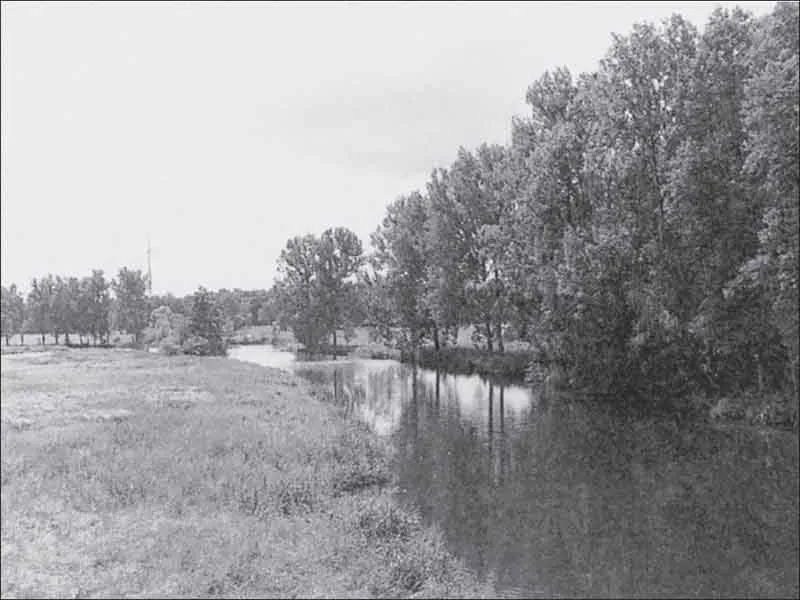
The course of the Dahme not far from Märkisch Buchholz, another obstacle in the face of the Ninth Army’s retreat.
The Halbe bottleneck became a fateful pit swallowing up tens of thousands of men …
Opposing Forces in the Battle of Halbe
Red Army
45 rifle divisions, 13 tank/armoured brigades 1 artillery division
Wehrmacht
11 infantry divisions, 2 motorised divisions, 1 tank division
At the beginning of the Battle of Berlin (16 April 1945) German divisions were reduced to an average combat force of 5,000 soldiers and the above matchup shows the vast, indeed four-fold, Russian superiority in available units: a ratio of 45 to 11 infantry divisions. Additionally, the German forces would lose much of their heavy armour in the course of their retreat and were running dangerously low on fuel and lubricants. The troops’ morale had dropped precipitously and wounded and sick German bodies heaped on the ground could barely be attended to (a 50 per cent casualty rate was registered). Also, fuelled by Nazi propaganda, the Germans were terrified of what would happen if Berlin fell into Soviet hands.
Contrasting the dismal picture on the German side, the Soviet situation was impressive. With Soviet troops highly motivated, tightly organized and well equipped with heavy weapons of all sizes, their thrusts were keenly coordinated; in addition, they had a highly efficient system in place for recovering their wounded. If this were not enough, the 1st Ukrainian Front was well informed about the local geography and its men were able to construct elaborate ambush positions along the German line of retreat that would enable them to inflict heavy casualties. Wenck’s Twelfth Army was thinly strung out to the west with sometimes only a handful of soldiers holding a kilometre of the front line.
Red Army Psychological Warfare
Willi Haenecke, ex-mayor of Halbe
The following steps were taken to encourage troops of the Ninth Army to capitulate:
•1st Ukrainian Front dropped some 4 million propaganda flyers.
•Hundreds of loudspeakers positioned just behind the front line blared out invitations to surrender.
•Turncoat prisoners of war working for the Red Army against their former comrades were often sent back (to the German side) to incite and agitate.
•Specially trained civilians from the battle zone, men and women, were sent to infiltrate German positions. (A total of 861 prisoners were sent to the German side. Some 477 of these went back to the Russians – taking with them 8,816 defectors.)
•So-called Seydlitz units (supposedly operating on behalf of the National Committee for a Free Germany*) were present, camouflaged in Wehrmacht uniforms.
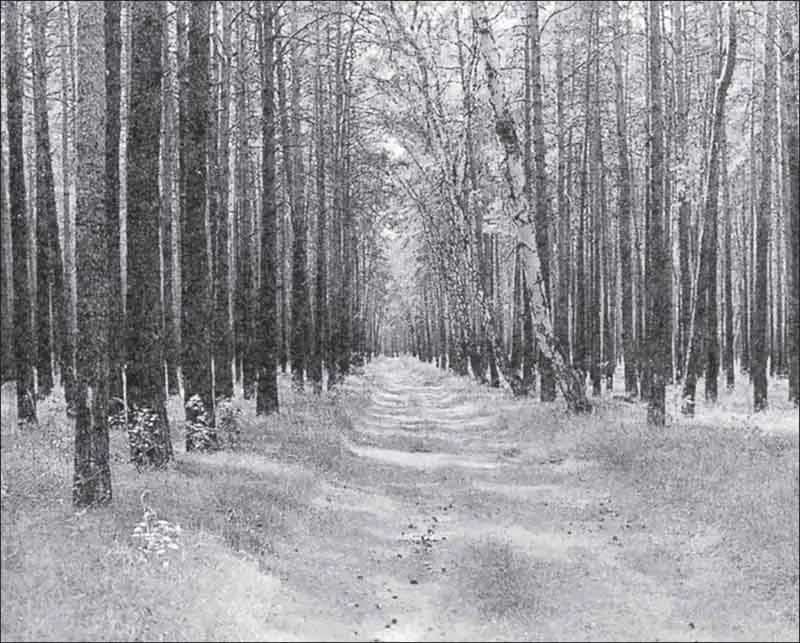
A typical forest track. The Mark Brandenburg woods seemed to offer safety and shelter for the fugitives but for many it became their last resting place.
After some initial break-outs the situation of the Ninth Army turned catastrophic. Effectively deprived of any leeway to act, it possessed only the barest minimum of ammunition for its heavy weapons and had severe shortages of fuel for its tanks and trucks. Troops were reduced to close-quarter fighting with little more than small arms. A thinly spread line of tanks and assault guns with a pathetic number of shells provided the backbone of the German operations and were thus far more exposed to the ferocious enemy fire. Nearly all of them were destroyed.
The Soviet troops – so close to victory – were highly motivated. The other side of the coin was, however, the fact that not a single one of them wished to die a hero’s death. Later German eyewitness accounts comment on how carefully Soviet infantry behaved on the raging battlefield as they knew full well that whichever way this attack ended, ‘Fritz’ wasn’t going to slip through their fingers.
Deafening Noises reach Halbe
Willi Haenecke, ex-mayor of Halbe
In the summer of 1944, the Allies embarked on their invasion of the Atlantic coast. While the war was already lost, many people refused to believe this to be true or put on a show of confidence to calm each other down.
In Halbe, as in the Reich as a whole, a provisional militia, the Volkssturm, was formed from October 1944 with all men between the ages of sixteen and sixty called up to register at the local town hall. I was one of those waiting in line.
An Allied propaganda newspaper reports the Anglo-American crossing of the Rhine and Soviet successes in the East. The Rhine crossing caused Stalin to speed up his assault on Berlin

The Red Army reached the banks of the Oder early in 1945. The Volkssturm was sworn in. We were trained in how to operate a Panzerfaust and once I even got the chance to fire one. This, I asked myself incredulously holding the launch tube in my hand, is supposed to do the trick and hold off the Soviets? One of our units was charged to construct defensive positions in Halbe: we dug foxholes and laid anti-tank defences all around the city.
Halbe itself had to face its own challenge: housing a stream of refugees with some 1,000 passing through every night. Many of them arrived with carts brimming over with whatever possessions these people had managed to gather before fleeing their homes; others just pulled along a sparsely filled hand-wagon. Each morning they were ordered to move on and make way for the next batch. Few of them had a destination in mind. ‘West’ was the single word etched in their consciousness.
Understandably, ever since January 1945 the population had been feeling increasingly worried. With the daily din of shelling and explosions near the Oder growing to a crescendo, the question on everyone’s lips was: ‘What’ll happen to us? Where should we flee to?’
Then one day, our two French workers said to me in broken German: ‘Boss, you getting two large crates. You putting in all valuables – you then bury it.’ They were, truth be told, better informed than we had realised. It is thanks to them that we managed to salvage enough to keep us going for a while after the war. Some horse dealers, including myself, had considered setting off westwards.
Otto Buchwald, a bar owner and also a trader in horses like me, planned to go along with the retreating troops by using the forest path leading to Baruth. At the time, none of us knew that the Red Army had occupied Baruth, Wünsdorf and Zossen and that in actual fact we were surrounded. I had covered two carts with a tarpaulin and was intending to harness a horse to one of them for my parents. For one reason or another we kept delaying our departure and, fortunately for us, this turned out to be the right decision.
It transpired that our friends the Paulitz family would pay dearly for their flight. While they managed to travel without any hassle from the Buchwalds’ place to the Autobahn, they then realised too late that it had already fallen into the hands of the Red Army. (The loss of civilian life this entailed was horrendous.) Frau Buchwald was able to escape to Baruth and then return several weeks later, but Herr Buchwald and the Paulitz family fled to Halbe with Frau Paulitz being shot dead en route. Herr Buchwald, heavily wounded, sought refuge in his cellar, but his wagon and his animals were gone.
Like my predecessor Schiebe I tried to ensure that the Volkssturm stored their weapons in a stable on the lower level of the town hall. In truth, I had no authority to give any such commands, but by then everyone had realised that it was sheer folly to put up any resistance.
I kept turning over and over in my mind what I was meant to do. Should I attempt to break away, at some point, somehow? Surely, I would be able to return once all had calmed down. Before too long I had packed my rucksack, stuffed it with food and set off. As I passed Löptner Strasse near Mastrangelos a woman stopped to ask me where I was headed. When I admitted that indeed I had no idea, she offered to help. ‘Why don’t you stay the night … perhaps it won’t be as bad as you fear.’ I decided to do just that, never dreaming that this particular night would determine my fate. I decided to stay put and not flee …
Seydlitz Troops
Hauptsturmführer Hohengassner, SS Anti-Aircraft Division 550
On 25 April 1945 our squad was redistributed to the area of Hermsdorf–Forstamt Hammer. It was at the time when the enemy put the lid on the Halbe cauldron – we were completely encircled … The enemy hammered us with an irresistible ferocity, deploying supporters of the National Committee for a Free Germany who were charged to cause confusion amongst German troops.
This is when we first came across Seydlitz troops and realised what their intentions were. Men in fake officers’ uniforms began to appear more and more frequently, mingling amongst our troops and issuing what struck us as the most impossible orders, which they presented to us as commands from higher up. These fabricated instructions had a devastating impact. They varied in content and complemented each other: units were not permitted to retreat; they were to gather and convene at assembly points; it was their duty to blow up guns, tanks and other vehicles. Non-compliance with the orders would result in unit leaders being shot immediately, on the spot. One thing these turncoats had in common was that none seemed to cover their heads; they all wore a white armband and sported new uniforms on which were pinned numerous decorations.
Chaos erupted close to the Dahme river. Units thrust forwards from all directions towards its only bridge. Some intended to escape to Wendisch-Buchhold, others to Halbe. Amid the turmoil members of the National Committee for a Free Germany issued conflicting orders as described above … What followed was total mayhem. Officers took their own lives and men became hysterical, running through the open space like hounded prey. Wounded bodies piled up high on the roadside. Indiscriminate Russian fire caused heavy casualties on our side and there was no resistance to speak of. Each one of ...
Table of contents
- Cover
- Title
- Copyright
- Contents
- Introduction by Roger Moorhouse
- Translator’s Note
- The Eyewitness Accounts
- Epilogue
- Table of Ranks
Frequently asked questions
Yes, you can cancel anytime from the Subscription tab in your account settings on the Perlego website. Your subscription will stay active until the end of your current billing period. Learn how to cancel your subscription
No, books cannot be downloaded as external files, such as PDFs, for use outside of Perlego. However, you can download books within the Perlego app for offline reading on mobile or tablet. Learn how to download books offline
Perlego offers two plans: Essential and Complete
- Essential is ideal for learners and professionals who enjoy exploring a wide range of subjects. Access the Essential Library with 800,000+ trusted titles and best-sellers across business, personal growth, and the humanities. Includes unlimited reading time and Standard Read Aloud voice.
- Complete: Perfect for advanced learners and researchers needing full, unrestricted access. Unlock 1.5M+ books across hundreds of subjects, including academic and specialized titles. The Complete Plan also includes advanced features like Premium Read Aloud and Research Assistant.
We are an online textbook subscription service, where you can get access to an entire online library for less than the price of a single book per month. With over 1.5 million books across 990+ topics, we’ve got you covered! Learn about our mission
Look out for the read-aloud symbol on your next book to see if you can listen to it. The read-aloud tool reads text aloud for you, highlighting the text as it is being read. You can pause it, speed it up and slow it down. Learn more about Read Aloud
Yes! You can use the Perlego app on both iOS and Android devices to read anytime, anywhere — even offline. Perfect for commutes or when you’re on the go.
Please note we cannot support devices running on iOS 13 and Android 7 or earlier. Learn more about using the app
Please note we cannot support devices running on iOS 13 and Android 7 or earlier. Learn more about using the app
Yes, you can access The Battle of Halbe, 1945 by Eberhard Baumgart, Eva Burke in PDF and/or ePUB format, as well as other popular books in History & German History. We have over 1.5 million books available in our catalogue for you to explore.